




Dani’el’s Friends Punished
3: 19-23
Dani’el’s friends are punished DIG: Why was Nebuchadnezzar so overwhelmed with rage? Why were Shadrach, Meshach and Abednego thrown into the fiery furnace wearing their robes, trousers, turbans and other clothes? What happened to the soldiers who threw them into the furnace? Why was that ironic?
REFLECT: When have you been so angry that you couldn’t think straight? Haste makes waste. What did Yeshua mean when He said, “whoever wants to save his life will lose it, but whoever loses his life for me will find it?” Why would ADONAI be with Shadrach, Meshach, and Abednego, but not with His own Son?
Like Shadrach, Meshach, and Abednego,
Yeshua’s obedience was tested and found faithful until death.
The three Jews confession of faith in the God of Abraham, Isaac, and Jacob (to see link click Bo – The Jews Confess Their Faith), courageous to us, exasperated Nebuchadnezzar. He was furious with Shadrach, Meshach and Abednego for refusing to serve his gods or worship the statue of gold that he had set up. He was so overwhelmed with rage that he couldn’t think straight anymore and his facial expression changed toward them. The king’s pride was severely wounded, so he ordered a furnace, evidently burning in the background of the scene, heated seven times hotter than usual (3:19). This picture is not to be understood literally, perhaps reflecting the heat of his own anger. The writer is using a proverbial expression meaning as hot as possible (Proverbs 24:16 and 26:16).138 This decision showed a lack of thinking because if this was supposed to be torture, the hotter the fire, the shorter the period of suffering during the execution.
And the king also commanded some of the strongest soldiers in his army to tie up Shadrach, Meshach and Abednego and throw them into the blazing furnace. But this didn’t make any sense either. It was not as though the three Jews could have escaped those powerful soldiers. The king was so anxious to carry out the death sentence that the executioners were not even permitted time to strip the prisoners of their clothes. Again, it seems that Nebuchadnezzar just wasn’t thinking logically. So these men, wearing their robes, trousers, turbans and other clothes, were bound and thrown into the blazing furnace (3:20-21). This detailed reference to their clothing serves to heighten the extraordinary nature of their eventual deliverance, since even their clothes would not even smell like smoke (3:28). As government officials, Shadrach, Meshach and Abednego were clothed in upper-class garments that were befitting the occasion. Yet, Nebuchadnezzar didn’t bother to have them removed. The whole scene gives us a sense of haste; a hurry to carry out the king’s decree. Having bound the three Jews, the soldiers carried them to the furnace and threw them in.139
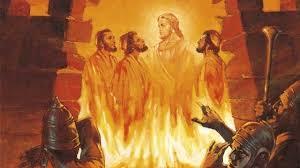
The king’s command was so urgent and the furnace so hot that the flames of the fire killed the soldiers who took up Shadrach, Meshach and Abednego, and these three men, firmly tied, fell into the blazing furnace (3:22-23). The furnace was used for smelting ore. It had a large opening at the top through which fuel and vessels full of ore could be placed into the fire and there was a door at the bottom through which the metal was taken out. An opening in the wall enabled the smelters to check on the progress of their work, and through the holes in the wall they could use bellows to make the fire blaze even more. It was large enough for at least four people to walk around in. It was into this furnace that Nebuchadnezzar cast the three faithful Jews, fully clothed and bound.140
When the soldiers approached the furnace from the edge of the cliff or ascending slope, they were able to get close enough to its opening to throw their prisoners inside. Evidently, because of the extreme heat or a shift in the wind, the soldiers were consumed by the flames.141 There is a great irony here, to be sure. The ones who obeyed Nebuchadnezzar’s commands died, while those whom he condemned to death emerged alive! What a vivid demonstration of Yeshua’s statement that whoever wants to save his life will lose it, but whoever loses his life for me will find it (Matthew 16:25). The issue was not whether Isra’el’s God could keep His servants alive, but whether Nebuchadnezzar could! In a similar way, our own idols often turn out to be liars, unable to deliver either the rewards that they promise or the judgments they threaten.142 But what about those who refuse obedience when it comes to a choice between faithless Nebuchadnezzar and to ADONAI Himself? Was there a God who could rescue them from the hands of such a powerful ruler?143 Nebuchadnezzar himself gives us the answer (see Bq – The Vindication of the Jews).
Like Shadrach, Meshach, and Abednego, Yeshua’s obedience was tested and found faithful until death. He went through His own personal furnace experience completely alone. ADONAI was with the three Jewish men in the fire, and we have the promise of the Lord’s sustaining presence with us in our trials, but on the cross Yeshua felt the utter loneliness of total abandonment by YHVH. When the fire of God’s wrath burned Him to the core and blazed unchecked over Him, He was entirely alone. There was no companion to share His burden, no angel was sent to relieve His agony, no saving hand from God stretched down to preserve His faithful Servant in His moment of greatest need. For Yeshua, there was no deliverance from experiencing the power of the final enemy, death itself.
Now why would ADONAI be with Shadrach, Meshach, and Abednego, but not with His own Son? Why would He be faithful to His promise to be with Isra’el, sinners as they were (Isaiah 64:5), and then abandon Yeshua, His perfect chosen One? You would expect it to be the other way around.
The answer to that question is that on the cross, Yeshua was taking into Himself the fiery pains that we deserve for our compromise to idolatry. Unlike Dani’el’s three friends, we are no heroes of the faith. Every time we bow down to the idols of our own hearts, we deserve the judgment curse of Ha’Shem. We choose to escape the fiery threat of our idols, but only at the cost of earning the fiery judgment of God for our unfaithfulness. Nebuchadnezzar is not the only one who condemns to the fire those who will not bow the knee to Him (Revelation 20:14). ADONAI rightfully demands the wholehearted worship of those whom He has created. Yet, in the case of His people, the LORD took all of our fiery judgment curse and laid it on His own Son. Yeshua personally paid the price of our hell during those six hours on the cross so that we might pass through the threatening fire unburned and emerge safely out on the other side. What is more, all of Messiah’s perfect righteousness was transferred to our spiritual bank accounts at the moment of faith. Therefore, a faithfulness that far exceeds that of Shadrach, Meshach, and Abednego is now ours as a free gift. And we are welcomed into the presence of God for Messiah’s sake.144
Dear heavenly Father, praise You that nothing is impossible for You (Luke 1:37)! Your Steadfast Love, Infinite Wisdom and Almighty Power work together so you are totally able to rescue me from any spiritual problem or trial. Thank You that You were willing to put on human flesh and come down from Your heavenly home and be there with Dani’el’s three friends. But King Nebuchadnezzar answered saying: Look! I see four men walking about unbound and unharmed in the middle of the fire, and the fourth has the appearance like the Son of God (Dani’el 3:25)!
You appeared to Abraham at Mamre when he saw “three men”. Then ADONAI appeared to him at Mamre’s large trees while he was sitting in the entrance of his tent during the heat of the day. When he lifted up his eyes to see, suddenly, three men were standing right by him. When he saw them, he ran from the entrance of his tent to meet them and bowed down to the ground (Genesis 18:1-2) . . .Then He said, “I will most surely return to you in about a year’s time, surprisingly, Sarah your wife will have a son.” (Genesis 18:10 also 16-22). Your children worship and exalt Your holy Name and we love to live our lives trusting You with a heart full of love and joy to put You first at all times- even in circumstances when death is possible. In Messiah Yeshua’s holy Name and power of His resurrection. Amen
Leave A Comment