




The Vindication of the Jews
3: 24-27
The vindication of the Jews DIG: What is ironic about the Babylonian soldiers dying and the three Hebrew men living? Who was the fourth figure in the furnace? Where is the Angel of ADONAI found in the TaNaKh? What was Nebuchadnezzar’s response to the miracle? How did it fulfill the prophecy by Isaiah?
REFLECT: Has there ever been a period in your life when you knew there was someone with you in the furnace? If you were to write about your adventures in faith, what would the title be? What is the most difficult place for you to maintain your identity as a believer? Who can you pray for this week?
Every time the Angel of ADONAI is mentioned in the TaNaKh,
it is always a preincarnate appearance of the Messiah.
Nebuchadnezzar was prepared to watch Shadrach, Meshach and Abednego disintegrate into flames, but he was not prepared for what he saw. When the king saw that the three men were unharmed by the raging flames, his rage quickly turned to bewilderment. Then King Nebuchadnezzar leaped to his feet in amazement and asked his advisers, “Weren’t there three men that we tied up and threw into the fire?” They replied, “Certainly, Your Majesty” (3:24).
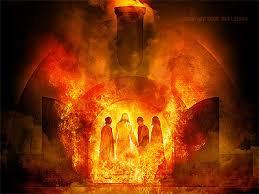
Was there a God who could rescue Shadrach, Meshach and Abednego from the hands of such a powerful ruler? Nebuchadnezzar himself gives us the answer. He said, “Look! I see four men walking around in the fire, unbound and unharmed, with their ropes evidently burned away. The description reveals that the three men were in no hurry to escape from the flames, but were walking around unharmed (3:25a). The majority of Jewish scholars have identified this fourth person as an angel. For example, Slotki remarks, “The Talmud asserts that it was the archangel Gabriel (Pes. 118a-b). The majority of rabbis believe that Nebuchadnezzar was permitted to see the angel even though he did not deserve it on his own merit. Seeing “the fourth man” in the fiery furnace did not mean that Nebuchadnezzar attained any insight into prophecy as Dani’el did. He was simply permitted to see “the fourth man” because it served God’s purposes.
But this was no ordinary angel because “the fourth man” looked like the Son of God (3:25b). Only Yeshua can save. Even a powerful angel like Gabriel, who makes announcements (Dani’el 8:16, 9:21, and Luke 1:19), or like Michael, the great prince who fights with the Adversary (Dani’el 10:13, 12:1, Jude 1:9 and Revelation 12:7) never saved anyone. From a Messianic perspective, every time the Angel of ADONAI is mentioned in the TaNaKh, it is always a preincarnate appearance of Yeshua Messiah. Therefore, “the fourth man” in the fiery furnace was the Second Person of the Trinity. It is certainly true that when believers go through fiery trials, Messiah is with us. God did not simply rescue His servants from the fire, He sent His Son to pass through the fire with them, a Presence that takes richer dimensions in the B’rit Chadashah when YHVH comes to dwell physically with us as Immanuel (Matthew 1:23).
The Angel of ADONAI is seen in many places in the TaNaKh, and each time points to the preincarnate Messiah. Here are seven examples. The first example of the Angel of ADONAI in the TaNaKh was with Hagar near a spring in the Negev desert. The Angel of ADONAI told her to go back to Sarah: You are now with child and you will have a son. You shall name him Ishmael (see the commentary on Genesis Ej – Hagar and the Angel of the LORD).
The second example of the Angel of ADONAI was with Abraham, and was told by God, “Take your son, your only son, Isaac, whom you love and sacrifice him there as a burnt offering on one of the mountains I will tell you about. Abraham was obedient, and just as he raised the knife to sacrifice his son, the Angel of ADONAI called out to him from heaven, saying: Abraham, Abraham! Do not lay a hand on your son. Now I know that you fear God, because you have not withheld your son, your only son from Me (see Genesis Fo – Abraham Called that place The LORD Will Provide).
Thirdly, when Moses was tending the flock of Jethro, his father-in-law, the priest of Midian, he suddenly found himself confronted by a burning acacia bush. But there was something different about it; Moshe saw that though the bush was on fire it did not burn up. There, within the burning bush, the Angel of ADONAI appeared to him and said: Do not come any closer. Take off your sandals, for the place where you are standing is holy ground (see the commentary on Exodus Aq – Flames of Fire from within a Burning Bush).
The fourth example of the Angel of ADONAI was with Balaam. Going to meet the rulers of Mo’ab, Balaam saddled his donkey. But God was very angry with him because the LORD knew full well that despite his superficial piety, Balaam fully intended to curse Isra’el. Therefore, the Angel of ADONAI blocked Balaam’s path three times. Finally, on the third attempt, God opened Balaam’s eyes, so that he could see the Angel of ADONAI standing in the way with His drawn sword in His hand. Then Balaam bowed his head and fell on his face (see the commentary on Numbers Dr – Balaam and the Donkey).
Fifthly, God raised up Deborah to be the fourth judge in Isra’el’s cycle of judgment and deliverance. The Canaanite kings came into Isra’el looking for the spoils of battle, but they left empty handed, trusting in their chariots, which proved inadequate to save them. While retreating, the Israelite city of Meroz failed to do its duty. They sided with the Canaanites and let those fleeing through Meroz escape when they should have blocked their path and put them to death. “Curse Meroz!” said the Angel of ADONAI, “Curse the people living there with a bitter punishment for not coming to help ADONAI, to help ADONAI against the mighty warriors.” Their sin wasn’t simply failing to assist Isra’el; they failed to help ADONAI (see Judges Bb – The Defeat of the Canaanites).
The sixth example of the Angel of ADONAI came after the Israelite victory over the Canaanites. But the passing years blurred the memory of the great deliverance and the next generation reverted to an easy-going syncretistic religion that once again threatened to obliterate Isra’el’s distinctive worship of YHVH. After being enslaved by the Midianites, the people cried out to God, and He raised up Gideon as a new judge. The Angel of ADONAI came and sat down under the oak in Ophrah that belonged to Joash the Abiezrite, where his son Gideon was threshing wheat in a winepress to keep it from the Midianites. When the Angel of the ADONAI appeared to Gideon, He said, “You courageous hero! ADONAI is with you (see Judges Bf – The Call of Gideon).
The seventh example of the Angel of ADONAI came on the heels of the Assyrian invasion in the fourteenth year of Hezekiah’s reign, when Sennacherib king of Assyria attacked all the fortified cities of Judah and captured them (Isaiah 36:1). But then he went one step beyond where God permitted by sending a letter to Hezekiah saying that ADONAI could not help the Jews. When Hezekiah received the letter from Sennacherib he went up to the Temple of LORD, and spread it out before ADONAI as a symbolic act, displaying the Assyrian’s blasphemies in the presence of God. And Hezekiah prayed: ADONAI-Tzva’ot, God of Isra’el . . . listen to all the words Sennacherib has sent to insult the living God (37:14b-15). Then, that night the Angel of ADONAI went out and put to death a hundred and eighty-five thousand men in the Assyrian camp. When the people in Jerusalem got up the next morning, there were all the dead bodies in front of them (see the commentary on Isaiah Gw – Then the Angel of the LORD Put to Death a Hundred and Eighty-Five Thousand Men in the Assyrian Camp).
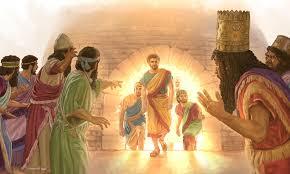
Continuing with the story, then Nebuchadnezzar approached the opening of the blazing furnace and shouted, “Shadrach, Meshach and Abednego, servants of the Most High God, come out! Come here!” So Shadrach, Meshach and Abednego came out of the fire, and the satraps, prefects, governors and royal advisers crowded around them. The young men were not merely unharmed, their clothing did not even smell of smoke. They saw that the fire had not harmed their bodies, nor was a hair of their heads singed; their robes were not scorched, and there was no smell of fire on them (3:26-27). A powerful testimony to the extent of their salvation by the Angel of ADONAI.
This was the fulfillment of the words the LORD had spoken to His people through Isaiah the prophet two centuries later: When you pass by the waters, I will be with you; when you pass through the rivers, they will not overwhelm you; when you walk through the fire, you will not be scorched . . . the flames will not burn you” (Isaiah 43:2). Notice that God didn’t promise to take his people around the rivers or to keep the fire from them. On the contrary, trials and hardships are the anticipated path for the people of God, then and now. After preaching the Good News, Paul and Barnabas returned to Pisidian Antioch strengthening the disciples and encouraging them to remain true to the faith, saying: We must go through many hardships to enter the Kingdom of God (Acts 14:21-22).
Trials provide the context in which our faith shines with unmatched clarity before the eyes of a world. Rejoice in this, even though for a little while you may have to experience grief of various trials. Even as gold is tested for genuineness by fire. The purpose of these trials is so that the genuineness of your trust, which is far more valuable than perishable gold, will be judged worthy of praise, glory and honor at the revealing of Yeshua Messiah (First Peter 1:6-7). It is precisely in the furnace that the reality of our faith is displayed most clearly. Yet, in the midst of those trials and difficulties, our Lord promises that we can count on His Presence to be with us, ensuring that our trials would not utterly overwhelm us. ADONAI doesn’t stand far off from us when we need His help; He has promised to be God with us, Immanuel. As a result, nothing in all of creation can separate us from God’ love (see the commentary on Romans Cm – The Certainty of Redemption).145
Leave A Comment