




Agitation: The King’s Dream
4: 4-18
Agitation: the king’s dream DIG: How does the king’s handling of this dream differ from his handling of the earlier one? Who is Belteshazzar? How does the tree seem to represent the king? What did the iron and the bronze stand for? What hope is conveyed by letting the stump of the tree remain? Who is the messenger, and how does he fit into the dream of the tree?
REFLECT: Describe a lesson that you or someone you know learned the hard way. In what ways have you seen pride function as a destructive force? How can you appreciate your accomplishments without bragging or putting yourself or others down? How is discomfort and disaster, or at least profound personal discomfort, often the necessary precursors of spiritual growth and change.
ADONAI saw the pride in Nebuchadnezzar’s heart and was prepared to deal with it.
Some students believe that twenty or thirty years may have elapsed between the episode of the fiery furnace described in Chapter 3 and the events described in this chapter. Nebuchadnezzar was now enjoying a time of peace and security. After defeating all his enemies and completing several impressive building projects, he was able at last to rest at home and delight in what had been accomplished. Nebuchadnezzar thought that he was the builder of “Babylon the great” and the architect of its peace and prosperity, but he would soon learn that all these things had been permitted by the will of the Most High God. Once again ADONAI, in His grace, used a dream to communicate an important message to Nebuchadnezzar. In his first dream (to see link click Aw – The King’ Dream), the king saw a great metallic statue of which he was the head of gold, but in this dream he saw a huge flourishing tree that fed and sheltered a multitude of animals and birds. After the first dream, the king was troubled (2:3), but after the second dream, he was terrified (4:5).153
I, Nebuchadnezzar, was at home in my palace, contented and prosperous. This reminds us of David walking around on the roof of his place in Jerusalem (see the commentary on the Life of David Dc – David and Bathsheba). The king was quite literally, the lord of all that his eyes could see. Yet that situation of contentedness and prosperity was an obstacle to the very work of God in his life that had to be addressed before his heart was changed.
As Iain Duguid relates in his commentary on Daniel, this is an important point for us to recognize in our own experience. Discomfort and disaster, or at least profound personal discomfort, are very often the necessary precursors of spiritual growth and change. As long as we are comfortable and at ease in the world, we are not normally ready to examine our hearts and make deep changes. On the other hand, when ADONAI disturbs the calm waters of our lives, we begin to be ready to seek different paths to pursue. It is often when our career hopes are dashed, or our marriage relationship is in shreds, or the doctor announces the we have cancer that we are finally persuaded to become serious about spiritual things. Since that is true, however, it suggests that we should approach these troubled times of our lives with a far more positive outlook than we normally do. These shattering experiences should prompt within us the expectation and hope that God is going to do something important in our lives. It is precisely through the storms of life that the Lord will show us who we really are, and even more importantly, who He really is.154
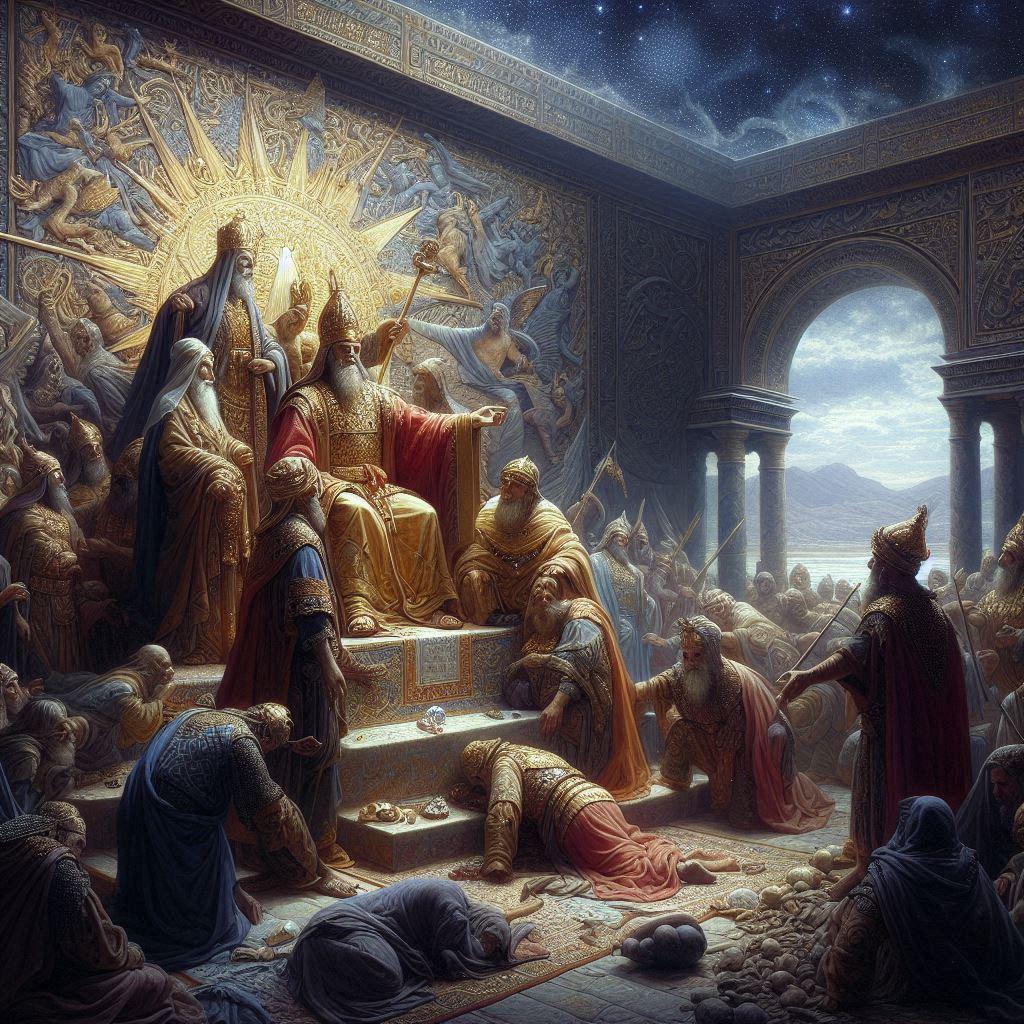
Suddenly the king’s carefree life was suddenly shattered by a strange dream. I had another dream that made me afraid. As I was lying in bed, the images and visions that passed through my mind terrified me. So I commanded that all the wise men of Babylon be brought before me to interpret the dream for me (4:4-6). The summons was more than just a friendly invitation. It was a command, which emphasized the seriousness of the situation. The king issued a command for the wise men to gather. Unlike the first time, Nebuchadnezzar only wanted the interpretation of his dream. He did not bother demanding that the wise men reveal the content as well.155 However, when the magi (Hebrew: chartom, refers to a magician or wise man, often associated with the practice of interpreting dreams, or performing magic), enchanters (Hebrew: ashshaph, refers to a class or wise men who were often consulted for their ability to interpret dreams, signs, and omens, and as such, were key figures in the king’s advisory team), sorcerers (Hebrew: kashaph, refers to the use of drugs, potions, or spells and is associated with “sorcery” or “witchcraft”) and diviners (Hebrew: gezar, primarily means to cut or divide. The term conveys a sense of separation or determination, often implying authority or finality in a decision being made. They were important in a religious society that was shaped by divine and royal decrees) came to see the king, he told them about the dream, but he was frustrated because they could not interpret it for him (4:7).
As he did in Chapter 2 (see Ax – Dani’el Interprets the King’s Dream), Dani’el came to the rescue. Finally, Dani’el came into my presence and I told him the dream. After the experience of the first dream, when the wise men failed so miserably (see As – The Challenge to the Magi), you would think Nebuchadnezzar would have bypassed his advisers and called Dani’el immediately. But it seems in the record of both dreams, Dani’el was kept apart from the wise men, even though he was chief of the magi. This title was not meant to be a compliment. It was appropriate because that had been Dani’el’s position since 2:48, when he became the head of the Babylonian school of astrology. In practice, however, Dani’el never performed astrology or any other form of sorcery.
He is called Belteshazzar (meaning Bel protect life), after the name of my god (Bel). When Nebuchadnezzar acknowledged that the spirit of the gods was with Dani’el, he was simply addressing him as a master astrologer. At this point, Nebuchadnezzar was obviously polytheistic although he had acknowledged YHVH’s sovereignty years before (2:27 and 3:28-29).156 I said, “Belteshazzar, chief of the magi, I know that the spirit of the gods [or God] is in you, and no mystery is too difficult for you. Here is my dream; interpret it for me (4:8-9). These are the visions I saw while lying in bed: I looked, and there before me stood a tree in the middle of the land.
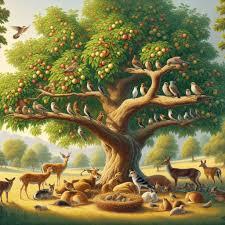
The first part of the dream (4:10-12): Nebuchadnezzar remembered the dream vividly. This time, it was not an image of an enormous statue, but of an enormous tree. The height of the tree was enormous. The tree grew large and strong and its top reached the heavens; it was visible to the ends of the earth. Its leaves were beautiful, its fruit abundant, and on it was food for all. Under it the wild animals found shelter, and the birds lived in its branches; from it every creature was fed. It was truly unique. Previously, Nebuchadnezzar had traveled to Lebanon to watch the felling of the great cedars to provide timber for his construction projects in Babylon. The tree he saw in his dream was significant because of its size and beauty. The tree bore so much fruit that there was enough for all living creatures. The animals of the earth rested in its shadows and the birds nested in its branches. It was an ideal setting.
The second part of the dream (4:13-15a): The first part of the king’s dream probably would have caused Nebuchadnezzar no concern. In fact, it may have produced pride as he recognized himself as the tree who provided bountifully for the subjects of his reign. But the second part of the dream, that the tree was to be cut down, turned into a troublesome nightmare.157 After the description of the tree, the king narrated the plot. It begins with the appearance of a “messenger.” In the visions I saw while lying in bed, I looked, and there before me was a holy one, an angelic messenger, coming down from heaven. He made sure that the commands of Ha’Shem were carried out. With a shout, the angel gave the order that the great tree was to be cut down and its branches trimmed. Not only that, but its leaves were to be stripped off and its fruit scattered. The animals were to flee from under it and the birds from its branches. But he commanded that the stump and its roots, bound with iron and bronze, remain in the ground, in the grass of the field. The stump indicates that even though the tree is to be devastated, the tree’s stump was to be preserved, yet bound with iron and bronze. As we will see later, 4:23 and 26 demonstrate that this metal band is symbolic of the preservation of Nebuchadnezzar’s life and kingdom.158
The third part of the dream (4:15b-16): In the third part of Nebuchadnezzar’s dream, the tree had abruptly morphed into a person. This must have been even more terrifying as the king realized that he would live like an animal for seven years. Let him be drenched with the dew of heaven, and let him live with the animals among the plants of the earth. Let his mind be changed from that of a man and let him be given the mind of an animal, till seven years pass by for him (see Bx – Humiliation: The King’s Discipline).
The purpose (4:17-18): This dream was designed to be a part of God’s revelation of Himself and His authority over Nebuchadnezzar who in pride had exalted himself above YHVH. The decision is announced by messengers, the holy ones declare the verdict, so that the living may know that the Most High is sovereign over all kingdoms on earth and gives them to anyone he wishes and sets over them the lowliest of people (4:17). ADONAI saw the pride in Nebuchadnezzar’s heart and was prepared to deal with it. The king could issue his decrees, but it was the decrees from the throne in heaven that rules the events on earth (4:17 and 24, 9:24-27). ADONAI has made the heavens His throne; from there He rules over everything (Psalm 103:19 NLT).159 This is the dream that I, King Nebuchadnezzar, had. Now, Belteshazzar, tell me what it means, for none of the wise men in my kingdom can interpret it for me. But you can, because the spirit of the gods is with you (4:18). With his account of the dream concluded, Nebuchadnezzar turns with confidence to Dani’el in order to hear his interpretation (see Bv – Interpretation: The King’s Danger).
Dear heavenly Father, praise You that as the Almighty Sovereign Ruler of the universe You have amazing love that seeks to bless by guiding and warning so they bend the knee before You worshiping and acknowledging you as the King of heaven, so You can pour Your love on them. You can see into the heart and You desire a heart that loves You back and repents/turns from wrong to following You. The Lord is not slow in keeping His promise, as some consider slowness. Rather, He is being patient toward you – not wanting anyone to perish, but for all to come to repentance (Second Peter 3:9). You are sovereign over the realms of men and women. The same sun that hardens clay, melts wax. Lord, let my heart melt like wax in love and obedience to You. To the One who sits at Your right hand. Amen.
Leave A Comment