




Redemption: The King’s Deliverance
4: 34-37 and 1-3
Redemption: The King’s Deliverance DIG: What position regarding “all the world” and “the Most High God” is Nebuchadnezzar assuming? If people do “prosper greatly,” who would like to take the credit? What does that say about this king? Was king Nebuchadnezzar part of the Righteous of the TaNaKh of his day? Why? Why not?
REFLECT: Think of a time when you were given a second chance at something. How do you suppose Nebuchadnezzar approached his kingship and kingdom differently after receiving his second chance? How does sanity begin with a realistic self-appraisal before God? Why should God exalt the humble? How can you raise your eyes to Yeshua?
ADONAI is the God of second chances.
The king’s restoration (4:34-35): At the end of the king’s humiliation (to see link click Bx – Humiliation: The King’s Disciple), restored to his right mind, Nebuchadnezzar took over the narrative again, reverting to the first person, with the simple explanation: I, Nebuchadnezzar, raised my eyes toward heaven. For all that time he behaved like an ox. His eyes were focused on the ground, where he could look for grass. However, the day came when Nebuchadnezzar lifted his eyes skyward, and that was the turning point in his madness. The ability to recognize ADONAI is a fundamental difference between man and beast. As Nebuchadnezzar raised his eyes toward heaven, his sanity returned. Then I praised the Most High; I honored and glorified Him who lives forever (4:34a).
Just as Dani’el 4:3 contained noteworthy biblical terminology (see below), Nebuchadnezzar’s words in this verse also include scriptures that are well known from other parts of the TaNaKh. His dominion is an eternal dominion; His kingdom endures from generation to generation (4:34b). David said: Your Kingdom is an everlasting Kingdom, and Your dominion endures throughout all generations (Psalm 145:13a). Thus, he acknowledged God’s sovereign authority, and because He is sovereign, He can do as He pleases, and nobody can hinder Him or call Him to account (Romans 9:14-23). The heart of sinful mankind rebels at the very idea of a sovereign God, for the human heart wants to be “free” of all outside control. Sinners think they are “free” and don’t realize how much they are in bondage to their fallen nature and to the forces of Satan and the world. We are free because ADONAI is sovereign.
All the peoples of the earth are regarded as nothing (4:35a). Isaiah said: All the nations who do not know Him are as nothing; they are regarded by Him as worthless and less than nothing (formless or confusion) (Isaiah 40:17a). There are three Hebrew words that are used beautifully here. The first word means nothing, the second word means nothingness, and the third word means confusion. This word confusion is the same word that is used in Genesis 1:2, where we read that the earth was formless and empty, or the earth was formless and confused. The nations are nothing, nothingness, and mere confusion. Therefore, there is no comparison between the greatness of God and the triviality, insufficiency and confusion of the nations. This bold appraisal does not mean the LORD doesn’t value the Gentile nations. He doesn’t think they are worthless and the many statements in the TaNaKh make this clear. It is merely that by comparison with ADONAI (in the sense of His presence), Assyria and its gods, Babylonia and its gods, Persia and its gods, fade into insignificance.
He does as he pleases with the powers of heaven and the peoples of the earth. No one can hold back His hand or say to Him: “What have you done” (4:35b)? Isaiah also said: Woe to those who argue with their Creator. Does the clay pot argue with its maker? Does the clay say to the potter, “What are you making?” Does your work say, “How clumsy can you be” (Isaiah 45:9)? Also the king confessed that mankind is answerable to YHVH and no one has the right to question Him (Job 33:12b-13; Isaiah 29:16; Romans 9:19-20).
The king’s return (4:36): Submitting to God’s sovereign will didn’t make Nebuchadnezzar any less of a man; in fact, his commitment transformed him from living like a beast to living like a man.175 At the very moment that Nebuchadnezzar acknowledged the Most High as God, the king was returned to his throne. At the same time that my sanity was restored, my honor and splendor were returned to me for the glory of my kingdom. My advisers and nobles sought me out, and I was restored to my throne. Remarkably, he regained his position as king with even greater honor than before when he walked in pride. Where sin increased, grace increased even more (Romans 5:20b). This return was the fulfillment of the band of iron and bronze mentioned in 4:15. Just as the band kept the stump and the roots of the tree in the ground, so did it symbolically secure the king’s power.176 ADONAI is the God of second chances (see the commentary on Jonah Ax – The Ninevites Believed God).
This is an important point for us to recognize in our own lives. On the one hand, discontent and disaster, or at least profound physical discomfort, are very often necessary for spiritual growth and change. As long as we are comfortable and at ease in this world, we are not normally ready to examine our hearts and undertake deep changes. On the other hand, when our Lord disturbs the calm waters of our lives we begin to be ready to seek different paths to pursue. It is often when our career hopes are dashed, or our marriage relationship is in shreds, or the doctor announces that we have only a few more months to live that we are finally persuaded to become serious about spiritual things. If that is true, however, it suggests that we should approach these troubled times of our lives with a far more positive outlook than we normally do. These shattering experiences should prompt within us the expectation and hope that ADONAI is going to do something important in our lives. It is precisely through the storms of life that God will show us who we really are, and, even more importantly, who He really is.177
The king’s testimony (4:1-3): King Nebuchadnezzar, To the nations and peoples of every language, who live in all the earth: May you prosper greatly (4:1)! It is my pleasure to tell you about the miraculous signs and wonders that the Most High God has performed for me. How great are His signs, how mighty His wonders, namely, the interpretation of his dream by Dani’el and the deliverance of the three Hebrews in the fiery furnace!178 His Kingdom is an eternal Kingdom; His dominion endures from generation to generation. In his testimony, the king declared a number of things about the nature of God: (1) He lives forever, (2) He has an eternal Kingdom, (3) all the peoples of the earth are regarded as nothing before Him, (4) He is ADONAI-Tzva’ot, the LORD of heaven’s angelic armies (see Joshua 5:13-15; Second Kings 19:31; Psalm 24:10; Second Corinthians 6:18), (5) He does as He pleases with the peoples of the earth, (6) No one can resist His will, and (7) No one can object to His will.179 What an expression of worship.
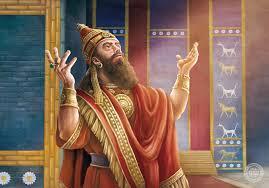
The king’s redemption (4:37): Now I, Nebuchadnezzar, praise and exalt and glorify the King of heaven, because everything He does is right and all His ways are just (4:37a). These verbs indicate continued action, suggesting that Nebuchadnezzar did these things consistently. These verbs embody the ideas of reverence, respect, honor, admiration, and worship. Since Nebuchadnezzar said that these attributes characterized his life, we may conclude that he joined the righteous of the TaNaKh of his time, and was united with Abraham in sh’ol (see the commentary on Hebrews Cp – The Faith of Abraham). Nebuchadnezzar confessed that what Ha’Shem had done to him was right and just. This is certainly not acknowledged by someone who continues in rebellion against God. The king also admitted that he had walked in pride (5:20), but had been humbled by his experience. This too would testify to a transformation in his character through a newfound trust in the God of Abraham, Isaac, and Jacob.180
Peter tells us that between Yeshua’s death on the cross and His resurrection, our Lord was put to death in the body but made alive by the Spirit. He was spiritually alive but physically dead. Sometime during those three days He went and preached to the spirits in prison (First Peter 3:18-19). With Messiah dead on the cross the demons must have been celebrating their seeming victory only to have the living Messiah show up and make a triumphant announcement that He had conquered death. Rabbi Sha’ul mentions the same thing when Messiah descended into the low, earthly regions of sh’ol (Ephesians 4:9). The TaNaKh refers to the place of the dead as sh’ol (see the commentary on Proverbs Af – Sh’ol).
One part of sh’ol was a place of torment and agony, occupied by the unrighteous dead and by the demons who disobeyed long ago when God waited patiently in the days of Noah while the ark was being built (First Peter 3:20a). However, another part of sh’ol was a place of contentment and rest, inhabited by the righteous dead who had put their faith in ADONAI. Abraham’s side (Luke 16:22) was a common name for that side of sh’ol at the time of the Messiah. They resided there until Yeshua had paid for their sins on the cross. Then, after declaring victory over those very demons, the Lord of Life liberated the godly captives and led them to heaven when He ascended on high (Ephesians 4:8). Among those who went with Him were Adam, Eve, Abel, Seth, Enoch, Methuselah, Lamech, Noah, Nebuchadnezzar and all the righteous of the TaNaKh before the cross, including those mentioned in the hall of faith in the book of Hebrews (see my commentary on Hebrews Cl – The Hall of Faith).
And those who walk in pride, He is able to humble (4:37b). There seems to be a prophetic application in this incident, as well as in the one in Chapter 3 (see Bs – The Significance of Dani’el Chapter 3 to Times of the Gentiles). Even though ADONAI has appointed Gentiles to a place of prominence during the Times of the Gentiles, most nations and people continue to rebel against Him. The Psalter asks: Why are the nations so angry? Why do they waste their time with futile plans? The kings of the earth prepare for battle; the rulers plot together against ADONAI and against His Messiah. “Let us break their chains,” they cry, “and free ourselves from slavery to God” (Psalm 2:1-3 NLT). Therefore, one purpose of the Great Tribulation, which will precede Messiah’s Second Coming (see the commentary on Isaiah Kg – The Second Coming of Jesus Christ to Bozrah), will be to humble the nations and have them submit themselves to Messiah’s authority (Philippians 2:10-11).
At the conclusion of God’s judgment, described in Revelation Chapters 6-18, Yeshua Messiah, the victorious Rider on the white horse, will descend from heaven and annihilate the nations (see the commentary on Revelation Ex – The Eight Stage Campaign of Armageddon). Then an angel will announce that the kingdom of the world has become the Kingdom of God and of His Messiah, and He will reign forever and ever (Revelation 11:15). Ha’Shem’s judgment on Nebuchadnezzar, designed to humble him to God’s authority, seems to prefigure Ha’Shem’s judgment on the nations and subject them to the authority of the One who has given them the right to rule (see Bz – Dani’el’s Vision of Four Beasts).181 As always, our Lord has the last word: For those who exalt themselves will be humbled, and those who humble themselves will be exalted (Matthew 23:12).
Suffering and redemption: As Iain Duguid relates in his commentary on Daniel, how is it possible for the humble to be restored through trials? Is there something inherently redemptive about Nebuchadnezzar’s suffering and ours that earns God’s favor? Is restoration achieved through a kind of penance, a work suffered that we must learn how to atone for our pride and thus get to heaven? If we think that, we haven’t understood humanity at all. Remember, Nebuchadnezzar’s restoration did not come when he looked at himself, but rather when he raised his eyes toward heaven. He simply looked to ADONAI’s grace to restore him, not based on anything he had done – not even his newfound humbleness. His hope was simply in God’s mercy.
Yet, that still begs the question, “Why should ADONAI exalt the humble?” We may certainly see why God should humble the proud and show them that they are not as great and important as they think they are. The arrogant of this world need to be taken down a peg or ten. Wicked kings like Nebuchadnezzar deserve their punishment. But why should the LORD exalt the humble? Why do they receive His favor?
The answer to that question takes us to the consideration of another King who was brought down from the heights to the depths. This King could truly have looked out over all creation and said, “Is this not the world I have created for My royal residence, by My mighty power and for the glory of My majesty?” He didn’t simply create one of the wonders of the ancient world; He created the whole world out of nothing! Yet, instead of exalting Himself, this King voluntarily humbled Himself. Even though He was in very nature God, this King humbled Himself and became a man. He left the comforts and glories of heaven and came to dwell on the earth among sinful humanity (John 1:14), a step downwards at least as significant as when Nebuchadnezzar went to dwell among the beasts of the field and the birds of the air. Yet, He took His humbling even further than that. This King took upon Himself the form of a servant (Mark 10:45): He healed the sick and preached to the poor, and even washed the feet of His disciples. He carried His servanthood all the way to a criminal’s death on the cross, even though He had done nothing wrong (Philippians 2:6-8). What greater humbling experience could there possibly be than for the living God to die? Yet, this King’s humbling was not forced upon Him because of His pride. On the contrary, it was a voluntary choice on His part so that He might redeem our pride.
This humble King is named Yeshua. However, His time of humiliation is over and now He is once again exalted in glory. Now that He has accomplished our salvation, He is seated at the right hand of the Father (Hebrews 10:12-13). Now this Yeshua is the one who our worship is directed, the One in heaven to whom our eyes are raised. This is why the humble are exalted: not because our humility has been earned, but because of our faith/trust/belief in the Lord, who was once humbled and is now glorified, instead of looking at ourselves. We are united with Him (John 6:56, 17:20-23; Romans 7:4, 12:5; Ephesians 4:25, 5:30), so that His glorification is our glorification also, minus His deity.
So we need to take our eyes off of ourselves and our accomplishments. We even need to take our eyes off of our failures and disasters. We need to stop comparing ourselves with others. Instead, we need to raise our eyes heavenward and look to Messiah, the humbled, exalted King. His death and resurrection are the means by which we are restored to our senses and made welcome in the most exalted company, heaven itself. We need to put away the pride of our successes, be humbled by all of our sins and failures, and rejoice in the extraordinary riches of God’s mercy and grace. We need to raise our eyes to heaven and praise ADONAI that though He humbles the proud, He also redeems and exalts the humble. Through His grace, He makes us fit to stand in His presence forever.182
Dear heavenly Father, praise You for Your great steadfast love that both protects me and seeks to humble the proud, bringing them into Your sheepfold. Yeshua declared: I am the Good Shepherd. The Good Shepherd lays down His life for the sheep . . . I have other sheep that are not from this fold; those also I must lead, and they will listen to My voice. So there shall be one flock, one Shepherd (John 10:11, 16). How gracious You are to desire a relationship with those who have turned from selfish pride to faith in You as their Lord and Savior. Your sacrificial death and resurrection paid the way for those who trust in You to become part of your family. But whoever did receive Him, those trusting in His name, to these He gave the right to become children of God (John 1:12). Thank You for using trials to both humble my pride and to refine me to grow closer to You. Truly you are worthy of all love, praise and worship! In Mesiah Yeshua’s holy Name and power of His resurrection. Amen
Leave A Comment