




Living in the Valley of Darkness
8: 15-26
Living in the valley of darkness DIG: How was Antiochus a type of the antichrist? In what ways is Gabri’el an important angel? Who was the two-horned ram? Who was the male goat? What does the ram and the goat have to do with each other? Why will the Tribulation be like living in the valley of darkness for unbelievers?
REFLECT: If Dani’el’s response to the threats at the end of the world was grim, what do you think our response should be? All of us have at one time or another suffered under the attack of the evil one. How do you handle living in the valley of darkness? Where do you find comfort? How do you get the devil to flee from you (James 4:7)?
Even though I walk through the valley of darkness, I will fear no evil (Psalm 23:4a adapted).
Since Dani’el did not understand the vision of the ram, the male goat, and the small horn (to see link click Ck – The Ram and the Male Goat), he received the interpretation from the angel Gabri’el. Dani’el now reports his second vision, and once more animals are employed to symbolize empires. In Chapter 7 ADONAI had given a preview of world history with an emphasis on the end times, especially the evil deeds of the antichrist. But God’s people needed to be warned of another crisis that would come in less than four hundred years after Dani’el’s death, the persecutions of a madman named Antiochus IV Epiphanes (175-165 BC). His reign would be one of the most horrible periods in history for the Jews. It would only last for a few years, but God knew that for those extremely dark days, His people would need a supernatural revelation to encourage them as they encountered the face of evil.237
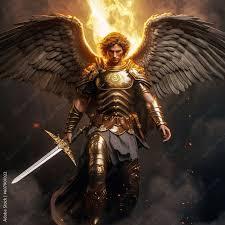
The Appearance of Gabriel (8:15-18): If Dani’el returned to a state of consciousness at all, he was soon sent back in a visionary state, and saw before him a man-like figure who spoke with a human voice. While Dani’el was watching the vision and trying to understand it, there before him stood one who appeared to be a man (8:15). There are several good reasons to believe that this unknown creature standing over the Ulai Canal was actually the Archangel Micha’el. First, Angels in the Bible always appear as young men. Second, Micha’el and Gabri’el are associated together later in the book (10:13, 21, and 12:1). Third, as the archangel, Micha’el has authority to give orders to other angels. And I heard Micha’el say to Gabri’el, tell this man the meaning of the vision (8:16). Gabri’el is an important angel. In the B’rit Chadashah he was chosen to announce to Zacharias that he would be the father of John the Baptist (see The Life of Christ Ak – The Birth of John the Baptist Foretold) and to Mary that she would bear the Messiah (see The Life of Christ Al – The Birth of Jesus Foretold to Mary). As Gabri’el approached Dani’el, the aged prophet was so overwhelmed by the spiritual power that stood before him, he fell on his face as Ezeki’el had done in his visions (Ezeki’el 1:28, 3:23, and 44:4). As Gabri’el came near the place where Dani’el was standing, he was terrified and fell down prostrate, stunned with awe and dread (8:17a).238
Then Gabri’el spoke to him, saying: Son of man, understand that the vision concerns the time of the end. Yet, if this vision describes Antiochus IV Epiphanes, how can it speak of “the end?” This is a general prophetic expression that means “the end of a specific prophecy.” In the present case, the end means the end of Antiochus.239 While he was speaking to me, I fainted and fell on my face. Abraham experienced something similar in Genesis 15:12. When Dani’el was laying on the ground, knocked out by fear, Gabri’el touched him and helped him stand up straight. Then Gabri’el touched Dani’el and raised him to his feet (8:17b-19).
The interpretation of the ram (8:20): The two-horned ram that you saw represents the kings of Media and Persia. The two horns represent the Medes and the Persians. Yet they belonged to the same animal. This fact emphasizes the unity of the Medo-Persian Empire: one bear, two sides (see Cc – The Kingdoms of This World: The second beast), one ram, two horns, one empire composed of two kingdoms.
The interpretation of the male goat (8:21-22): The shaggy goat is the king of Greece, and the large horn between its eyes is the first king. The four horns that replaced the one that was broken off represent four kingdoms that will emerge from his nation but will not have the same power. Dani’el describes a king who would conquer the Medo-Persian Empire. This was an historical event that took place several centuries after Dani’el lived. The small horn of Chapter 8 springs from the division of the Greek Empire of Alexander the Great. We know him as Antiochus Epiphanes. He was the ruler who sought to show his contempt for the Jews by going to the Temple and slaughtering a pig, putting its blood on the altar.
The interpretation of time (8:19): Gabri’el said: I am going to tell you what will happen later in the time of wrath, because the vision concerns the end of the appointed time of wrath. His oppression of the Jews was directly predicted in 8:9-14. An angel had asked: How long will it take for the vision to be fulfilled – the vision concerning the daily sacrifice, the rebellion that causes desolation, the surrender of the Sanctuary and the trampling underfoot of ADONAI’s people?” And the answer was: It will take 2,300 evenings and mornings; then the Sanctuary will be properly restored (8:13-14). Therefore, the duration of that time of wrath was prophetically allotted to Antiochus Epiphanes it was 2,300 whole days.
Antiochus Epiphanes (8:23-25): These verses are the heart of the vision and the reason for the revelation to Dani’el. ADONAI disclosed this historical summary to the prophet to prepare the Jewish people for the coming crisis – Antiochus’ persecution. Jewish worship and lifestyle stood in the way of his policy of Hellenization. It was in the latter part of their reign when Antiochus would rise to power. This refers to the period near the end of Greek rule when the four kings who succeeded Alexander the Great carved up his empire into four kingdoms. Additionally, his rise to power was because of rebellion (8:12), when rebels had become completely wicked (8:23a). This may allude to the sins of the Jewish people themselves, when reaching its climax, brought about divine judgment in the form of Antiochus’ persecutions. The books of 1 and 2 Maccabees record many in Isra’el who were not faithful to ADONAI and even adopted the idolatrous Greek religion (1 Maccabees 1:11-15 and 43). Those sins would have brought about the discipline of Ha’Shem in order to purify the nation.240
Antiochus is described as a fierce-looking king and a master of intrigue, who would deal harshly with those who oppose him (8:23b). One of his first acts was to drive out the high priest Onias and replace him with Jason, a supporter of the Greeks. Jason was replaced by Menelaus, who bought the high priesthood. Believing a rumor that Antiochus had died, Jason attacked the holy City only to learn that Antiochus was very much alive. The angry king attacked Jerusalem.241 Raging like a wild animal, he sent an army of twenty thousand men under Apollonius to level Tziyon. He ordered his soldiers to cut down without mercy those whom they met, and to slay those who took refuge in their houses. They entered the City on the Sabbath and there was a massacre of young and old, a killing of women and children, a slaughter of virgins and infants. In the space of three days, eighty-thousand were lost, forty thousand meeting a violent death, and the same number being sold into slavery (2 Maccabees 5:11-14). For the Jews, it was like living in the valley of darkness.
Antiochus began to rule a rather weak kingdom in 175 BC, but attained great power through military conquests. He will become very strong; but not by his own power, but only by the power of Satan, the prince of darkness. Through his numerous wars with Egypt and other nations, and his persecution of the Jews, Antiochus will cause astounding devastation and will succeed in whatever he does. He will destroy the mighty men, military and political of other countries who were killed by Antiochus, and the righteous of the TaNaKh who would not follow the command to accept his Greek gods (8:24). Consequently, for 2,300 days Antiochus appeared to be invincible.242
Through his shrewdness he will cause deceit to succeed and will consider himself superior. He will rise to power by promising false security and will destroy many, and take his stand against the Prince of princes, that is against God Himself. But such arrogance can only lead to one end, he will be destroyed, but not by human power (8:25). The ultimate power behind the Maccabean freedom fighters was Ha’Shem Himself, who allowed them to restore the Temple to its former function as the center for worship of the true and living God. His House was more than a building; it was a symbol of His presence with His people, hence a source of life and hope. Its desecration at the hands of Antiochus was an assault against ADONAI and a cause for despair among the righteous of the TaNaKh. But the restoration of the Temple meant new life, the offering of the sacrifices, and the possibility of fellowship with God once again.243 But it did not end well for Antiochus Epiphanes, for in the same year that he desecrated the Temple, he died from a divinely-inflicted disease!
In the final analysis, it may be concluded that there is a dual reference in this striking prophecy. It is not only speaking of Antiochus in his desolation and desecration of the Temple; it is also looking forward to the great desolator who would come, the one who is called the little horn (7:23-25). What Antiochus did in history, the antichrist will do in the far eschatological future; in addition, God’s destruction of Antiochus will be a foretaste of His final destruction of the antichrist. But they both had one thing in common. The hatred of the Jews by Antiochus in the past, foreshadowed the hatred of the Jews by the antichrist in the future.
The affirmation (8:26): The vision of the evenings and mornings that has been given you is true, but seal up the vision, in the sense of concluding it, not in the sense of keeping it secret, for it concerns the distant future. He kept the vision in his mind and later preserved it in writing when he wrote it down under the inspiration of the Ruach Ha’Kodesh.
Hope in the blackest night: As Ian Duguid explains in his commentary on Daniel, we need to see clearly how Dani’el Chapter 8 gives us hope in the blackest of nights, in the face of the worst of our own failures and the worst assaults of the devil against us. Like the apostle Paul, we often find ourselves under stress to the point that we may be tempted to despair of the future (Second Corinthians 1:8-9). We have our own personal failures in the ongoing struggle against sin. We may be tempted to ask how can God’s purposes to save and sanctify stand in the face of mankind’s continual rebellion and the Tempter’s constant assaults?
The answer to that question comes as we see how Dani’el 8 affirms ADONAI’s victory, even in the face of the coming darkness of the days of Antiochus Epiphanes. If God’s purpose were not thwarted by that period of rebellion and defilement, then they will certainly never be thwarted by our personal experience of unfaithfulness or persecution.
Even though Antiochus desecrated the Temple, he couldn’t lay a hand on YHVH Himself. But nearly two hundred years later, in the person of Yeshua Messiah, the dwelling place of God was once again desecrated because of our sin and rebellion. The LORD’s own people rejected the Messiah that He had sent. As John’s Gospel declares: He came to His own people, and even they rejected Him (John 1:11 NLT). Instead, the leaders of God’s chosen people actually allied themselves with the forces of evil against the Son of God and handed him over to the Romans, and to death, crying out: Crucify him (Matthew 27:22)! What worse abomination or act of betrayal could there ever be than crucifying YHVH? No wonder it was dark on that day (see The Life of Christ Lv – Jesus’ Second Three Hours on the Cross: The Wrath of God: Darkness That Covers the Entire World). It seemed that darkness had completely triumphed and God’s, “Let there be light,” had been swallowed up by night.
The cross is surely the ultimate expression of the rebellion of God’s people and the hatred of the kingdoms of this world against Him. Nor should we think that, as believers, we are any better than those first-century Jews. We too were once the enemies of Ha’Shem because of our fallen nature (Romans 3:23), all of us are rebels against God. We too loved darkness rather than light because our deeds were evil (John 3:19). Our own hearts testify to the profound truth of that judgment. By our comfortable coexistence with our cherished sins, we bear witness daily to the darkness that still remains in our hearts.
Yet, even such abominable rebellion and hatred could not thwart God’s purposes. At the cross, the Adversary did his worst to Yeshua, and as a result, simply brought about what ADONAI had planned from the beginning of time. The light shines in the darkness, and the darkness has not overcome it (John 1:5). The cross is therefore the guarantee that God’s plan will always prevail in the face of our weakness, rebellion, and sin, and in spite of the relentless attacks of the Serpent and all of his demons. Because of the victory won on the cross, the gates of hell can never prevail against Messiah’s flock (see The Life of Christ Ms – The Eternal Security of the Believer). To be sure, evil remains awful and powerful in this world. Sin still has devastating effects, whether it comes from inside or outside the Church, and it will not simply pass away as our world matures. Our path to heaven often takes us through the valley of darkness. The horrible realities in the here and now may be the fruits of our own sin, or of the sin of others, or the hate of powerful spiritual forces.
But God remains in control. Despite the best efforts of the enemy, He will bring all things to their proper end at the proper time (see Ao – The Times of the Gentiles). In the meantime, we are called to be faithful and obedient, trusting in Messiah alone and giving thanks daily for the cross, the place of triumph over our sin. How long will it take for the vision to be fulfilled (8:13)? How long will it be until the darkness will finally be over and the daylight will come? How long until the Son of righteousness will rise, and His children will shine with Him forever? How long until we are sanctified and cleansed of all our remaining sin? How long, O Lord? Come quickly, Lord Yeshua, and bring Your great work to its completion in us.244
Dear heavenly Father, praise You that when I am living in dark trials, You are always there with me. You never leave me alone. For God Himself has said, “I will never leave you or forsake you . . . the Lord is my helper; I will not fear (Hebrews 13:5b and 6b). When I keep my focus on You and not my circumstances, it gives me strength and courage. Thank You that no time is so dark that Your light cannot penetrate it. Yeshua spoke to them again, saying, “I am the light of the world. The one who follows Me will no longer walk in darkness, but will have the light of life” (John 8:12). Thank You for walking with me (John 14:23), lighting up dark times with Your steadfast love (Psalms 63:3) and your almighty power (Rev 19-20). In Messiah holy Name and power of His resurrection. Amen
Leave A Comment