




Belshazzar’s Great Banquet
5: 1-4
Belshazzar’s great banquet DIG: Who was Belshazzar the king? Why did he have such a great banquet? Why was he so unconcerned with the enemy camped outside the city gates? What was so wrong about using the sacred vessels from the Temple? How was Belshazzar similar to the rich fool in Yeshua’s parable?
REFLECT: What contemporary examples come to mind of people mocking God? Then and now, does it seem that ADONAI is quick, or slow, to judge such sacrilegious behavior? How could understanding the past (his grandfather’s encounters with God) have helped Belshazzar understand the present more clearly?
Belshazzar’s heart was a factory of rebellion against God (October 12, 539 BC).
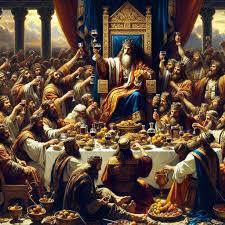
King Belshazzar (to see link click Co – The Great Banquet of Belshazzar and the Fall of Babylon) gave a great banquet for a thousand of his nobles (5:1a). The extravagance of the banquet described here is not without parallels. The description of this boisterous party reminds us of the opening of the book of Esther (see the commentary on Esther Ak – The King Gave a Grand Banquet in Susa, and Displayed the Vast Wealth). Greek historians like Herodotus recorded many such lavish feasts on the part of the Babylonians, and this was one of the best. Everyone was dressed in their finest clothes and the tables were set with the most ornate silverware. Yet, by focusing our attention on this elaborate feast as the sole event worth mentioning in his account, the writer subtly underlines for us the emptiness at the end of Belshazzar’s life. Unlike his famous grandfather, King Nebuchadnezzar, who destroyed cities and carried off plunder (1:2), made statues (3:1-7), and built the wonders of royal Babylon (4:30), the only thing that Belshazzar could make was a banquet. The former built an empire, the latter planned a party.252
The timing of the banquet seemed to be sheer chutzpah. According to the Nabonidus Chronicle (preserved on a single clay tablet now kept at the British Museum in London), the Babylonians had suffered a crushing defeat just days before at the hands of the Medes and Persians. Belshazzar knew that the enemy was camped outside the city walls. Only the great city of Babylon itself remained unconquered, and the situation looked pretty bleak. Perhaps the celebration was meant to build morale and encourage his citizens. But the king was so confident of the city’s massive walls, being 320 feet tall and 80 feet thick, that he literally let down his guard. In an attempt to quiet any fears that his subjects may have had, Belshazzar made the fatal decision to remove the guards from the walls of the city. As a result, no one was watching what was happening outside the city on that fateful night.253
As a result, Belshazzar’s wives, concubines, and a thousand nobles were feasting and drinking, Darius, king of the Medes and Persians advanced outside the city gates, ready to invade. The Euphrates River ran through Babylon so there was an ample supply of water, and within the city were supplies that would sustain it for twenty years! Therefore, the king felt he had little cause for concern. And Belshazzar drank wine before them (5:1b). Normally, the king was hidden from the sight of his guests, but here he deliberately sat in full view of his subjects and took the lead in drinking himself under the table as a demonstration of his bravado. Drank is a rendering of an Aramaic participle (see Ac – Dani’el from a Messianic Jewish Perspective: languages) that, in this context, probably carries the idea of continuous drinking. The king’s actions encouraged those attending the party to drink, and drink, and drink. And probably within a short amount of time, the king and his guests were well on their way to a drunken orgy.254 This feast was a microcosm of the world focused on the lust of the flesh, the lust of the eyes, and the pride of life (First John 2:16). Why worry about the enemy when you have security and plenty to eat?
Belshazzar was doubtless ignorant of Isaiah’s words concerning Babylon’s ultimate humiliation. But even had he known, there is little doubt that he would have acted any differently: You have trusted in your wickedness and have said, ‘No one sees me.’ Your wisdom and knowledge mislead you when you say to yourself, “I am, and there is none besides me.” Disaster will come upon you, and you will not know how to conjure it away. A calamity will fall upon you that you cannot ward off with a ransom; a catastrophe you cannot foresee will suddenly come upon you (see Isaiah Ih – Go Down, in the Dust, Virgin Daughter of Babylon). Belshazzar is perhaps the supreme parallel in the TaNaKh to the rich fool in Yeshua’s parable (see Hd – The Parable of the Rich Fool). Having already given expression to their lust for more (in the case of the rich fools his lust for more money), they would never be satisfied without more. Blinded by the pursuit of that lust, they were oblivious to the possibility that this very night your life will be demanded from you (Luke 12:20).255
While Belshazzar was drinking his wine, he gave orders to bring in the gold and silver vessels that Nebuchadnezzar, his “father”, had taken from the Temple in Jerusalem. The Aramaic term for “father,” av, literally means just that, “father.” However it can also refer to one’s ancestors (Dani’el 2:23; Ezra 4:14 and 5:12).256 Nebuchadnezzar had decreed that all peoples were to give respect to the God of the Jews (3:29), and he himself praised ADONAI for His sovereignty and greatness (see By – Redemption: The King’s Deliverance). Evidently, he considered the vessels too precious to actually use. But as the years passed, the great king’s words were forgotten, and his drunken grandson Belshazzar had no problem treating the God of Isra’el disrespectfully. So they brought in the gold vessels that had been taken from the Temple of God in Jerusalem, and the king and his nobles, his wives and his concubines drank from them (5:2-3). Both the men and women at the drunken orgy brazenly used those holy vessels like common drinking cups. But Belshazzar went even further in his sacrilege. He not only committed blasphemy; he combined it with idolatry. Here is where his profanity surpassed even that of Nebuchadnezzar. Belshazzar used God’s holy vessels to toast the lifeless idols of his own religion. As they drank the wine, they praised the false gods of gold and silver, of bronze, iron, wood and stone (5:4).257 He spits in God’s face, as it were, and then goes over to an idol that he himself has created and expected that lifeless statue to protect him from what was to come.258
But, why did Belshazzar choose to challenge and blaspheme the God of Abraham, Isaac, and Jacob rather than one of the countless other foreign deities? Most likely, Belshazzar also desecrated the holy objects of other nations as well as those of Isra’el in an attempt to demonstrate the superiority of the gods of Babylon over the deities of other nations. This would have been an act of propaganda intended to bolster the confidence of his citizens in light of the presence of the Medo-Persian army outside the city walls.
But he didn’t stop there, 5:22-24 indicates that this was a deliberate act of defiance against God’s authority and power. Belshazzar knew that YHVH had humbled his grandfather (see Bx – Humiliation: The King’s Discipline), yet he deliberately defiled the God of Isra’el. By his blasphemous actions the king was saying, “God, you may have humbled Nebuchadnezzar, but you will never conquer me!”259 Belshazzar’s heart was a factory of rebellion against God. Now he cast off all restraint and showed it. What Nebuchadnezzar had not dared to contemplate even in his worst moments, Belshazzar easily did on that fateful night. He knew exactly what those vessels were and where they were from. He did not sin in ignorance, but with full knowledge. Paul’s words provide all we need to know about the evil king, “Since they have not considered God worth knowing, God has given them up, literally, God handed them over, to worthless (Greek: adokimos, meaning depraved) ways of thinking; so that they do improper things . . . who, knowing God’s righteous decree that people who do such things deserve to die, they not only continue to do these very things but also approve of those who practice them (Romans 1:28 and 32). Belshazzar sought to mock God, but the lesson for us today is this: Do not be deceived: God cannot be mocked, for whatever one sows, that will he also reap. Those who live only to satisfy their own sinful nature will harvest decay and death from that sinful nature. But those who live to please the Spirit will harvest everlasting life from the Spirit (Galatians 6:7-8).260
Dear heavenly Father, praise You that You are always in control, no matter how bleak and dark the situation looks. You are the almighty Sovereign of the world and You absolutely will defeat all evil, in Your perfect timing (Revelation 19:20 and 20:10). You judge and You reward (1 Cor 3:12-14), not by the size of the good deed done for you, but You judge by faith. If faith is the motive behind why the deed was done, then You are pleased; but if the deed was done out of pride, it is a worthless deed. No one can fool You by the number of deeds they have done, nor by how big a deed they have done for You can see clearly into each person’s heart. For man looks at the outward appearance, but ADONAI looks into the heart (First Samuel 16:7c). What false security money and fame provides. Sometimes wealthy people look so happy, doing whatever they want and spending lots of money on whatever seems to fit their fancy at the moment; but their time will be cut short, as Belshazzar’s time was cut short. Eternity is of far more value than living for any momentary pleasure. Eternity goes on forever and ever; life now will be over in a moment and this life’s earthly pleasures will soon be forgotten. In Messiah Yeshua’s holy Name and power of His resurrection. Amen
Leave A Comment