




The Handwriting on the Wall
5: 5-9
The handwriting on the wall DIG: God stopped the party in its tracks with the miracle of the handwriting on the wall. What kinds of things have you experienced from God that stopped you (or someone you know) in your tracks? Why was this not a vision, but a miracle? Where else do we see the finger of God at work?
REFLECT: When you feel ADONAI step into your life as the king did, how do you usually respond? What have you learned from your parents or grandparents? Why do people often fail, as does Belshazzar, to learn from the past? What, do you have available to help you learn from the past and to guide you in the future?
This hand was surely the hand of God; not a vision, but a miracle (October 12, 539 BC).
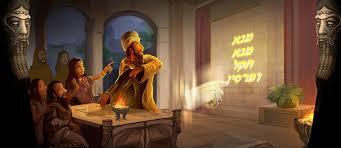
Look at the wall (5:5): The raucous crowd didn’t have to wait very long for God to crash the party. Suddenly, at the height of Belshazzar’s blasphemy, drunkenness, and immorality (to see link click Cp – Belshazzar’s Great Banquet), everything ceased; and a deathly silence swept over those gathered. Belshazzar and his guests quickly sobered up as the fingers of a human hand appeared and wrote on the plaster of the wall, near the lampstand in the royal palace. The king watched and saw the palm and fingers of the hand that did the writing. The reference to the fingers of God should not surprise us. Though ADONAI has no body, His actions are frequently described metaphorically as the acts of His hand. Indeed, there are three other notable Scripture references, God’s finger is at work. In response to the plagues, the Egyptian magicians remarked: This is the finger of God (Exodus 8:19). Exodus also describes the commandments as written by God’s finger on the stone tablets (Exodus 31:18). Finally, the heavens themselves are the work of His fingers (Psalm 8:3).261
During his extensive excavation of the ancient city of Babylon in the early twentieth century, the German archaeologist Robert Johann Koldewey (1855 to 1925) uncovered the banquet hall. It was fifty-five feet wide and over 170 feet long.262 A room that size would have had darker corners and other areas that were lit by torches and lampstands. The fact that the fingers began writing directly in front of a lampstand indicates that most, if not all, of the guests would have been able to see what was going on. During his excavations of this palace, Koldewey observed that the walls of the throne room “were washed over with white gypsum.” Again, archaeology confirms the biblical account.263 Along one of the long walls was a niche opposite the entrance in which Koldewey suggests the king’s throne stood.
Look at the king (5:6-7): When the Hand appeared and began writing its ominous message, Belshazzar was so terrified that his face turned pale. The meaning of the Aramaic term for face (see Ac – Introduction of Dani’el from a Messianic Jewish Perspective: Languages), can mean radiance or brightness. In 4:36 it refers to the splendor that was given back to Nebuchadnezzar after his humiliation (see By – Restoration: The King’s Deliverance). Belshazzar’s face was likely flushed and red from the wine prior to seeing the Hand of God. It then lost its brightness. Furthermore, the king found himself alarmed by his own thoughts. And he was so frightened that his legs became weak and his knees were knocking (5:6). Ha’Shem had turned the banquet hall into a courtroom and the king was about to be declared guilty.
In an effort to understand the message the king summoned the enchanters (Hebrew: ashshaph, refers to a class or wise men who were often consulted for their ability to interpret dreams, signs, and omens, and as such, were key figures in the king’s advisory team), sorcerers (Hebrew: kashaph, refers to the use of drugs, potions, or spells and is associated with “sorcery” or “witchcraft”) and diviners (Hebrew: gezar, primarily means to cut or divide. The term conveys a sense of separation or determination, often implying authority or finality in a decision being made. They were important in a theocratic society that was shaped by divine and royal decrees). Belshazzar said to these wise men of Babylon, “Whoever reads this writing and tells me what it means will be clothed in purple and have a gold chain placed around his neck, and he will be made the third highest ruler in the kingdom” (5:7). By now the reader of Dani’el cannot help but picture those men as incompetent fools, and they don’t disappoint our expectations. The king enticed them with the promise of great reward, virtually offering them royalty. To be third in the kingdom meant to rank only after himself and his father Nabonidus. That a coregency is intended is underlined by the purple garment and the necklace, surely pointing to royalty.264
Look at the wise men (5:8-9): History repeats itself. The wise men couldn’t interpret Nebuchadnezzars’ dream of either the enormous statue (see As – The Challenge of the Magi), or the enormous tree (see Bu – Agitation: The King’s Dream), and now they couldn’t interpret Belshazzar’s message on the wall. Then all the king’s wise men came in, but they couldn’t read the writing or tell the king what it meant (5:8). The message was written in Aramaic as Dani’el would soon make clear (see Cs – Dani’el Interpreted the Handwriting on the Wall). The fact that the wise men couldn’t read the writing did not mean that they could not make out the letters. It means that they could not read the words in the sense of giving them any meaning. Thus, they could not interpret what was written.265 So the king became even more terrified and his face grew more pale. His nobles were baffled (5:9).
The helplessness of the wise men, and therefore the helplessness of the king, forms a stark contrast with the brash confidence of the opening scene. The mirth had come to a sudden end. Once again, ADONAI had exposed the ignorance of the world and futility of human wisdom to discover or even to explain the mind and will of God (see First Corinthians An – The Foolishness of Worldly Wisdom).266 Belshazzar was about to hear the first strains of the death march of Babylon that would eventually erupt in the closing chapters of the Bible. For her sins are piled as high as heaven, and God remembers her evil deeds. Do to her as she has done to others. Double her penalty for all her evil deeds. She brewed a cup of terror for others, so brew twice as much for her. She glorified herself and lived in luxury, so match it now with torment and sorrow. She boasted in her heart, “I am queen on my throne. I am no helpless widow, and I have no reason to mourn” . . . for ADONAI Elohim is mighty that judges her . . . “The fancy things you loved so much are gone,” they cry. “All your luxuries and splendor are gone forever, never to be yours again” (Revelation 18:5-7, 8, and 14). But Jerusalem remains, the glorious City on the hill. And Dani’el, the keeper of the City of God, emerged from obscurity and became, once again, the symbol of God’s sovereign providence.267
Dear heavenly Father, Praise You for being the almighty Sovereign of the universe. No one can mock you and get away with it. Do not be deceived – God is not mocked. For whatever a man sows, that he also shall reap. For the one who sows in the flesh will reap corruption from the flesh. But the one who sows in the Ruach will reap from the Ruach eternal life (Galatians 6:7-8). The heart attitude behind deeds follows a person. A life of faith may bring blessing into a hard life. Ruth had a rough beginning but trusted ADONAI. But King Belshazzar only mocked God and met his unexpected death on the night of his great banquet. You are so worthy of all our love! May our hearts be full of faith like Abraham and like Ruth, then may our lives be full of deeds sown in love for You. In Messiah Yeshua’s holy Name and power of His resurrection. Amen
Leave A Comment