





Dani’el Interpreted the Handwriting on the Wall
5: 13-29
Dani’el interpreted the Handwriting on the wall DIG: In what ways do you see the king’s spiritual values pass down (or not) through generations? What was Belshazzar’s attitude toward Dani’el; what was Dani’el’s attitude toward the king? What does his rejection of the king’s gift say about him? What did mene, mene, tekel, upharsin mean?
REFLECT: What lessons from history do you think stand as particularly relevant reminders to us today? Then and now, does it seem that God is quick or slow to judge such blasphemous behavior? What handwriting from God on your wall do you need to read and heed? Why do people fail, like Belshazzar, to learn from the past?
ADONAI had numbered the days of Belshazzar’s kingdom and brought it to an end because King Belshazzar had been weighed in the balance and found wanting. As a result, his former kingdom would be divided and given to the Medes and the Persians.
So far, most of the main characters – Belshazzar, the hand of God, the queen mother – have appeared suddenly and without introduction. In contrast, the author prepares us for Dani’el’s entrance. This is the third time that Dani’el intervened and succeeded where the Babylonian wise men had failed; in Chapter 2 (to see link click As – The Challenge to the Magi) when Dani’el was 18, and in Chapter 4 (see Bu – Agitation: The King’s Dream), when Dani’el was 67. But, when Dani’el appears this time, he reveals a new attitude, now that he is much older and wiser at 81 (see Co – The Feast of Belshazzar and the Fall of Babylon).
The king’s offer (5:13-16): So Dani’el was brought before Belshazzar. But the king didn’t address him as the man who Nebuchadnezzar made ruler over the entire province of Babylon and in charge of all its wise men (2:48), but as a slave who was brought in exile from Jerusalem. He wanted to remind Dani’el of his place: Belshazzar was king; Dani’el was captive. Then the king said to him, “Are you Dani’el, one of the exiles my grandfather the king brought from Judah (see the commentary on Jeremiah Gt – In the 37th Year, Jehoiachin Released from Prison)? What’s more, he twice begins his words with “I have heard,” showing that the king himself did not endorse the reports. He thus interrogated Dani’el as if he were a prisoner, saying, “I have heard” that the spirit of the gods [or God] is in you and that you have insight, intelligence and outstanding wisdom.” Now wise men were brought before me to read this writing and tell me what it means, but they could not explain it. Now I have heard that you are able to give interpretations and to solve difficult problems. Contrast this with what Nebuchadnezzar had earlier asserted: I know that the spirit of the gods [or God] is in you, and no mystery is too difficult for you. Here is my dream; interpret it for me (4:9). Belshazzar’s flattery was more temporary and his request for an interpretation more conditional, when he said: If you can read this writing and tell me what it means, you will be clothed in purple and have a gold chain placed around your neck, and you will be made the third highest ruler in the kingdom. Belshazzar’s speech revealed that his expectations were not that high, but he offered the same reward to the aged Israelite that he did earlier to the hapless Babylonian magi.272
Dani’el’s response (5:17): Dani’el didn’t miss the slight. The abruptness, and the way he was spoken to indicates the prophet’s annoyance and dislike for the second-rate monarch. Sixty-three years earlier, when Dani’el was a young man, he spoke to Nebuchadnezzar very respectively about his dream. No wise man, enchanter, magi, or diviner can explain to the king the mystery he has asked about, but there is a God in heaven who reveals secrets and He has shown King Nebuchadnezzar what will happen in the end times. As for me, this secret has been revealed to me, not because I have greater wisdom than anyone else alive, but so that your majesty may know the interpretation and that you may understand what went through your mind (2:26-30).
But, Dani’el answered Belshazzar, “You may keep your gifts for yourself and give your rewards to someone else. Nevertheless, I will read the writing for the king and tell him what it means (5:17). Dani’el begins by refusing the gift. He will interpret the writing on the wall free of charge. We will return to this topic again soon because, as it turns out, Dani’el reluctantly accepted the gift (5:29). However, for now he alerts the king that his primary motivation is not worldly reward. Indeed, perhaps having read the inscription already, Dani’el knew that the gift meant nothing. The king actually had nothing to give.
However, before giving the interpretation, Dani’el delivered a stinging rebuke to the king. Beginning with Samuel in his relation with Sha’ul (First Samuel Chapters 13 and 15), a major role of the prophet of God has been to serve as the conscience of the king. True, this role was primarily directed toward the Israelite king. When the latter fell to temptation of power and forgot who the ultimate King was, the prophet was there to remind him (also see Nathan’s relationship with David in Second Samuel 12, Elijah’s with Ahab in First Kings 18, and Jeremiah’s with Jehoiakim in Jeremiah 36). Now Belshazzar hears Dani’el.273 He begins his indictment of Belshazzar with the rehearsal of God’s humiliation of King Nebuchadnezzar for his sin of pride.
The sin of Nebuchadnezzar (5:18-21): The prophet began his interpretation: Your Majesty, the Most High God gave your father Nebuchadnezzar sovereignty and greatness and glory and splendor. Because of the high position he gave him, all the nations and peoples of every language dreaded and feared him. Those the king wanted to put to death, he put to death; those he wanted to spare, he spared; those he wanted to promote, he promoted; and those he wanted to humble, he humbled. But when his heart became arrogant and hardened with pride, he was deposed from his royal throne and stripped of his glory. He was driven away from people and given the mind of an animal; he lived with the wild donkeys and ate grass like the ox; and his body was drenched with the dew of heaven, until he acknowledged that the Most High God is sovereign over all kingdoms on earth and sets over them anyone he wishes.
The point of Dani’el’s speech was clear: King Nebuchadnezzar had had something to be proud about, yet ADONAI had humbled him. Belshazzar, who certainly fell short of his grandfather’s achievements, should have learned from his experience and humbled himself as well. Instead, although Belshazzar knew full well what had happened to Nebuchadnezzar (5:22), he still exalted himself against YHVH, wickedly desecrating the Temple vessels from Jerusalem by using them in an idolatrous act of worship (see Cp – Belshazzar’s Great Banquet). He had praised powerless idols, while neglecting the one true God who gave him his very life. Dani’el brought this charge against him with his interpretation.274
The sin of Belshazzar (5:22-24): But you, Belshazzar, his grandson, have not humbled yourself, though you knew all this. Instead, you have set yourself up against the LORD of heaven. You had the goblets from his temple brought to you, and you and your nobles, your wives and your concubines drank wine from them. You praised the gods of silver and gold, of bronze, iron, wood and stone, which cannot see or hear or understand. But you did not honor the God who holds in his hand your life and all your ways. Therefore, he sent the hand that wrote the inscription.
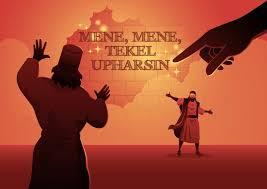
The interpretation of the writing on the wall (5:25-28): Then, on October 12, 539 BC, Dani’el read God’s message: This is the inscription that was written: mene, mene, tekel, upharsin (5:25). All three Aramaic words (see Ac – Dani’el from a Messianic Jewish Perspective: Languages) are measures of weight, decreasing from a mina (mene), to a skekel (1/60th of a mina), to a half-shekel (parsin). Dani’el interpreted what those words meant:
Mene (Hebrew: mina) – numbered: God has numbered the days of your reign and brought it to an end (5:26). The term mene corresponds to the Hebrew word mina, which comes from the root manah. This root has two meanings: to number or to appoint. Dani’el told Belshazzar that God had numbered his kingdom. In other words, YHVH had counted the number of years allotted to the Babylonian Kingdom and to the rule of Belshazzar. He had fixed a limit as to how long it would last, and the time had come for it to end.
Tekel (Hebrew: shekel) – weighed: You have been weighed on the scales and found wanting (5:27). The application to King Belshazzar is that he was evaluated according to ADONAI’s standard of righteousness and failed to meet it.
Upharsin (Hebrew: half-shekel) – meaning divided: Then the second meaning of meme comes into play. God had appointed those through whom the end would come: Your kingdom is divided and given to the Medes and Persians (5:28). In fact, a specific king, Cyrus, had been appointed to bring the Babylonian Empire to an end. His arrival was prophesied more than 150 years earlier by Isaiah, long before Cyrus was born (see the commentary on Isaiah Ia – The Deliverance by Cyrus the Great). While the handwriting itself had the plural pharsin, Dani’el decided to explain the singular form, peres. The Aramaic term corresponds to the Hebrew verb paras, meaning to divide or to break in two. Yet, it is also the root of the Hebrew noun paras, meaning Persia. Belshazzar’s kingdom would be divided and given to the Medes and the Persians was also prophesied by Isaiah (see the commentary on Isaiah Ei – The Oracle Concerning Babylon).275
Read with a different vocalization of the Aramaic letters, the sequence becomes a series of verbs: Numbered, numbered, weighed, divided. As Dani’el himself explained it, ADONAI had numbered the days of Belshazzar’s kingdom and brought it to an end because the king had been weighed in the balance and found wanting. As a result, his former kingdom would be divided and given to the Medes and the Persians.276
Dear heavenly Father, praise You that You are a God of steadfast love and that You judge sin. Those who plant injustice will harvest disaster, and their reign of terror will come to an end (22:8 NLT). And Belshazzar’s reign of terror would come to an end that very night (5:30). Sometimes it seems like the wicked always prosper (Psalm 37 and 73), but You promise to right all the wrongs in this life because You are righteous and holy. To the One who sits at Your right hand. Amen
Leave A Comment