




The Second Coming of Yeshua Messiah to Bozrah
Isaiah 63: 1-6
The second coming of Yeshua Messiah to Bozrah DIG: Edom (symbolic for God’s enemies) means red. What might the symbols here mean? Whose blood is it? How is this the opposite of the salvation coming to Jerusalem? What does this picture of God as warrior add to the other images of Him in 62:1-12? How does the divine Warrior here in 63:1-6 parallel the divine Warrior in 59:15b-21? What does He mean when He says: The year of My redemption has come?
REFLECT: Does this scene seem harsh or righteous to you? Does it worry you or give you comfort? Why? Where do you think you will be when this scene plays itself out? Why do you think the world rejects this message? How do you feel about Yeshua as a divine Warrior (Joshua 5:1315; Numbers 21:14)? Isaiah 60:1 to 63:6 portrays what the coming Kingdom of God will be like. It will include judgment of those who rebelled against Him. Is this comforting or disturbing to you? Why?
The Lion of the tribe of Judah, the Root of David, has triumphed.
This passage forms an independent oracle on the final triumph of God over Isra’el’s enemies, which is preliminary to the redemption. The image presented is one of the most impressive and awe-inspiring in the TaNaKh and it is difficult to say which is most to be admired, the dramatic vividness of the vision, or the discretion which conceals the actual work of slaughter and concentrates the attention on the Divine Hero as He emerges victorious from the conflict. A solitary and majestic figure, in blood-red clothing, is seen approaching from the direction of Edom. A question of surprise escapes from the prophet’s lips as he sees the singular and startling apprehension; and a brief reply comes from afar. The Hero is none other than the God of Isra’el.
Once again the single-handed aspect of the Messiah’s Second Coming is shown (Isaiah 59:15b-29). A watchman (see 62:6) is standing at some high point in Jerusalem looking to the southeast to Bozrah. It is located about 25 miles southeast of the southern end on the Dead Sea in what is today Jordan. It was an important city in Edom and was a sheep-herding center. The name means grape-gathering.
The watchman sees a very graphic figure coming toward him from the land of Edom and the city of Bozrah (in Hebrew) or Petra (in Greek). The origin of the Second Coming is Bozrah (Isaiah 34:1-7). Habakkuk also brings this point out. God came from Teman (Ta-MAUN), The Holy One from Mount Paran (Habakkuk 3:3). Teman is just north of Bozrah towards Jerusalem. So for Yeshua to get to Jerusalem, God would have to come from Teman. Teman and Mount Paran are both in the vicinity of Bozrah and are located in the same Mount Seir. The watchman asks: Who is this coming from Bozrah, from Edom (Isaiah 63:1a)?
The Bible clearly pinpoints the beginning of the Second Coming at the city of Bozrah. But why Bozrah? Because that is where the believing remnant will be hiding in the last days (Micah 2:12-13), which is why the antichrist and the armies of the world are drawn to Bozrah. Satan knows that Isra’el is the apple of His eye (Deuteronomy 32:10) and he knows Scripture (Matthew 4:1-11). So he and his armies are drawn, like a fish with a hook in their mouths, to Bozrah to destroy the Jews once and for all (Jeremiah 49:12-13). But this would not be a permanent home for the believing remnant; it was a temporary home. That is why Zechariah 12:7 to 13:1 says that the LORD will save the tents of Judah first. In other words, when Yeshua Messiah comes back a second time, He will come to Bozrah first, saving the believing remnant, before going to Jerusalem through Teman.
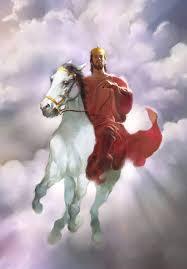
The watchman enters into a discussion with this fast approaching figure. He asks: Who is this coming from Edom, from Bozrah, with His garments stained crimson (Isaiah 63:1b). The Hebrew word for red is of the same root as Edom, therefore red (adom) is a wordplay on Edom (edom). A winepress was usually a shallow pit with a hole on the side leading out to a container. As individuals trampled on grapes in the press, the juice flowed through the hole into the container. Obviously some juice would also splatter on the workers’ clothes. The watchman continues to ask: Who is this, robed in splendor, striding forward in the greatness of His strength (Isaiah 63:1c)?
The divine Warrior answers: It is I, speaking in righteousness, mighty to save (Isaiah 63:1d). Who is this Person? The One whose constant characteristic is speaking what is righteous. The idols cannot do this for they do not know either the past or the future (Isaiah 43:9). Only One has the power that is mighty to save. This is an important point. These verses are ultimately not about judgment or destruction – they are about salvation. Because the enemy is destroyed, His people are delivered (52:7-12). What did the watchman see? He saw the arm of the LORD (Isaiah 59:1), Yeshua Messiah marching toward Jerusalem. The salvation that was announced in Isaiah 62:11 will then be seen.
But now the divine Warrior has approached close enough for the watchman to see more details. He noticed that His clothing, though brilliantly shining with the Sh’khinah glory, is nevertheless stained with blood. That raises the second question. Why are your garments red, like those of one treading the winepress (Isaiah 63:2)? In Isaiah’s day, people would get into the winepress barefooted and trample out the grapes. The red juice would spurt out the ripe grapes and stain their garments. The Hebrew actually reads: Why is there such redness in your garments? In Revelation 19:13 we are also told that He is dressed in a robe dipped in blood. Several commentaries say that the blood Messiah is stained with is His own blood that had been shed for the believing remnant. But this is not His own blood, but that of the enemy!
Next, we learn that He has come from the trampling of the nations, or defeating the antichrist and the armies of the world. He did it all by Himself. The Warrior’s answer to the question above begins here and continues through verse 6. There was no one to help Him in His awful task. Earlier He had said: I saw that there was no one, I was appalled that there was no one to intervene but Me; so My own arm worked salvation for Me and My own righteousness sustained Me (Isaiah 59:16). So Yeshua declared again: I have trodden the winepress alone; from the nations no one in the whole world was with Me (Isaiah 63:3a). Yeshua Messiah was alone on the cross, and He will be alone in His judgment. How would it be possible for the millennial Jerusalem to exist? Only because Messiah made it possible.
The watchman sees that there is blood on His beautiful garments just as if He had trampled the winepress. The word blood here is nesah, meaning squirting blood. We are told clearly that two armies will return with Him. One is an angelic army (Matthew 16:24), the other is the army of believers (Jude 14-15; Revelation 19:14a). But neither the angles nor believers participate in any of the fighting. The image used here is the treading of the winepress. Yeshua Messiah declared: I trampled them in My anger and trod them down in My wrath; their blood spattered My garments and I stained all My clothing (Isaiah 63:3b).
God’s wrath is also pictured as being like a winepress. He attacked the enemies of His people and trampled them under foot like grapes, so that their lifeblood spurted out and spattered His garments. This imagery is used in Haggai 2:16, and also in Revelation 14:19-20 where the final treading of the nations is viewed as the treading of the grapes in the great winepress of God’s wrath. They were trampled in the winepress outside the City, and blood flowed out of the press, rising as high as the horses’ bridles for a distance of 1,600 stadia, or about 180 miles, or 300 kilometers.
Now comes the explanation: For the day of vengeance was in My heart, and the year of My redemption has come (Isaiah 63:4). But doesn’t all this carnage merely suggest a heavenly tyrant out of control? Is this not blood lust? No! But what about the word vengeance? Doesn’t that convey a mean spirit of revenge and bitterness? It might if it were by itself, but the parallelism in the context of the verse speaks volumes. What is the vengeance about? Payback? No, it’s about redemption, about breaking the power of sin and evil so that those who are held captive can go free. The very thing that Isaiah prayed for in Isaiah 62:12 is now being fulfilled when Messiah says: The year of My redemption has come.
I looked, but there was no one to help, I was appalled that no one gave support; so My own arm worked salvation for Me, and My own wrath sustained Me (Isaiah 63:5). This verse reemphasizes that Messiah will fight alone. There was no one else in the world that could help. There is no one else in the world that can save Jerusalem from the invading armies of the antichrist. Therefore, God’s own arm worked salvation for the Jews. This is the ninth and last of nine references to the arm of the LORD in Isaiah (Isaiah 30:30 and 32, 40:10, 50:2, 51:5 and 9, 52:10, 53:1, 59:1 and 16, 62:8). His own wrath sustained Him during this campaign.
The results are seen. Messiah says: I trampled the nations in My anger (Isaiah 63:6a). Paul records a similar thought: and then the end will come, when He hands over the kingdom to God the Father after He has destroyed all dominion, authority, and power. For He must reign until He has put all His enemies under His feet (First Corinthians 15:24-25). After capturing five Amorite kings, Joshua summoned all the men of Isra’el, and he said to the army commanders who had come with him, Come here and put your feet on the necks of these kings. So they came forward and placed their feet on their necks.
This is a form of public humiliation of defeated enemy leaders and was usually the climax of warfare in the ancient Near East. When the statue of Sadam Hussein was brought down in front of an international audience, the people trampled it and hit it with their shoes to show their contempt for him. The monuments of ancient Egypt, Assyria, and Persia give numerous illustrations of the custom of conquerors trampling on the vanquished. In the cave at Beit el Walley in Nubia is a hieroglyphic description of Ramses II trampling on his enemies. It reads, “Kol, the strange land, is beneath your sandals.” At the foot of a wooden mummy case in the British Museum are painted the soles of two shoes, and on each is the figure of a man with his arms and hands tied behind him, and his feet tied at the ankles. In this helpless state he is supposed to be trampled on by the wearer of the shoes. It was a very expressive illustration of mingled triumph and contempt. These customs strikingly illustrate the text and numerous parallel passages (Psalm 8:6, 110:1, 119:118; Isa 14:19, 25:10, 28:3 and 18; Lam 1:15, 3:34; Dan 8:13; Micah 7:10; Malachi 4:3; Luke 21:24; Rom 16:20 and Heb 10:29).318
The Lion of the tribe of Judah, the Root of David, has triumphed (Revelation 5:5). Here Ha’Shem says: In My wrath I made them drunk and poured their blood on the ground (Isaiah 63:6b). The lifeblood shed and therefore His wrath was decisively finished. To those who do not fully understand the true nature of ADONAI, verses like this seem contrary to the character of ADONAI. They believe that the LORD is love, and that is true. The LORD is love. But if a person rejects Messiah, the sacrifice, he or she becomes the sacrifice. On the cross, God the Father poured out His wrath on God the Son as a punishment for sin (Isaiah 53:5). So anyone who rejects His sacrifice is cursed. This is what we see in the Second Coming, a world who has rejected Messiah being held accountable. Those who reject this truth only want to see the LORD as love because they want to be able to sin with no accountability. The truth does not set them free, they choose to believe a lie, and in the end they will spend eternity apart from Messiah and His love. Then He will say to those on His left: Depart from Me, you who are cursed, into the eternal fire prepared for the devil and his angels (Matthew 25:41). Their death is only the result of refusing to avail themselves of His death.
Therefore, Isaiah has given a vision of how his prayer and the angels’ prayer of Isaiah Chapter 62 is going to be fulfilled. These verses describe how salvation will come, how His reward is with Him, how His judgment is with Him, and how He will save His redeemed ones. However, it is a clear teaching of Scripture that the Second Coming cannot occur until the Jewish people ask for it. That is what Isaiah describes next.
Dear heavenly Father, praise you for being such an awesome God of forgiveness when there is repentance. It is so wonderful that You paid the very costly ransom (Second Corinthians 5:21) to redeem your people from their bondage to sin, and all you ask is a heart of love (Matthew 22:37-40) that puts you first and trusts in Messiah as Lord and Savior (Romans 10:9-11). It is reassuring that you have not changed your plan for entrance into heaven. Entrance to Your Holy home in Heaven has always been thru a true faith that loves into Action. Abraham was a great example of faith that acts in Love (Genesis 15:6, Romans 4:3). Love is what you look for in the hearts of both Isra’el and in the church. Love is crucial. Love repents of sin and turns to you in trusting faith. Thank you for including in your holy Word, several passages that show how important repentance was in the past (Jeremiah 15:19, Ezeki’el 18:21-22, Matthew 3:2, Mark 1:15, Luke 13:3, Acts 2:38, 3:19), is now (Second Peter 3:9, First John 1:9), and will be the key that unlocks your return at the end of the Tribulation (Psalm 79:1-13, 80:1-19, Isaiah 53:1-9, 63:7 to 64:12).
Someday every knee will bow before Messiah Yeshua. It is wise to bow now before him in love and repentance. Have this attitude in yourselves, which also was in Messiah Yeshua, who, though existing in the form of God, did not consider being equal to God a thing to be grasped. But He emptied Himself – taking on the form of a slave, becoming the likeness of men and being found in appearance as a man. He humbled Himself – becoming obedient to the point of death, even death on a cross. For this reason God highly exalted Him and gave Him the name that is above every name, that at the name of Yeshua every knee should bow, in heaven and on the earth and under the earth, and every tongue profess that Yeshua the Messiah is Lord – to the glory of God the Father (Philippians 2:5-11). Thank you for your great love, kindness and gracious offer (Ephesians 2:8-9) of forgiveness to all who repent and turn to Messiah Yeshua (John 14:23) in love. In Messiah Yeshua’s holy name and power of His resurrection. Amen
Leave A Comment