




The Arrival of an Angel
10:1 to 11:1
The arrival of an angel DIG: Was Dani’el physically standing on the bank of the Tigris River? Why was Dani’el mourning? How did he mourn? Who was the messenger? Who heard the message? How did Dani’el initially react? Why would he expect a swift answer to his prayer? Why had the powerful high-ranking angel been delayed? For how long? What kind of power structure did the angel reveal? What three activities are demons generally involved in? Was the angelic being’s message to Isra’el or to the Church? What was the actual prophecy?
REFLECT: What word does God have for us that will help us maintain our faithfulness over the long haul? How can Dani’el’s mourning help believers today? When you face circumstances in life in which it seems God’s agenda is not being accomplished, how do you decide whether to sit back and let God do His work or to jump in and “help God out” a little bit? How does it make you feel to think that a whole spiritual war is being waged around you between the power of God and the power of evil? In what ways is prayer a powerful weapon in that war?
Dani’el prayed, and angels went to war.
The background (10:1-3): Verse one provides the date of Dani’el final vision. In the third year of Cyrus king of Persia (to see link click Ag – Cyrus and Darius), a revelation was given to Dani’el, who is called Belteshazzar. In 536 BC, Dani’el was about eighty-five years old, and had been in Babylon for a little over seven decades. The message was true, meaning it was fulfilled, and it concerned a great war. In other words, it did not refer to a single battle, but to a long, continuous period of trouble for Isra’el. The understanding of the message came to him in a vision. Its message was true and it concerned a great conflict (10:1). Dani’el claimed to have understood the vision, but, in reality, the only thing he realized was that it meant trouble for the Jewish people. As he admitted in 12:8, he didn’t comprehend every detail.360
Dani’el shifted from a third-person narrative to a first-person description of the occasion when he received the vision. At that time I, Dani’el, mourned for three weeks (10:2). In the first year of Cyrus, the first party of Jewish exiles had returned to Jerusalem in response to Cyrus’ decree (see the commentary on Ezra-Nehemiah Ag – The First Return). But they found life there far from easy. They rebuilt the altar of the Temple but almost immediately ran into powerful opposition from the Samaritans (see Ezra-Nehemiah At – Opposition during the Reigns of Cyrus and Ahasuerus). That opposition, on top of the difficulties of scratching out a living in their new home, cause the returned exiles to stop working on the Temple, a hiatus that would continue for more than fifteen years until the time of Haggai (see Ezra-Nehemiah Ay – Haggai: The Strait Talker) and Zechariah (see Ezra-Nehemiah Az – Zechariah: The Visionary). The third year of Cyrus would therefore have been a time of discouragement for God’s people, both in Judah and Babylon.
That disheartening news caused Dani’el to mourn for three weeks. It was not a total fast from all food; rather, he ate no choice food; no meat or wine touched his lips; and he used no lotions at all until the three weeks were over (10:3). Dani’el fasted and abstained from anything that would have brought him pleasure, such as putting oil on his face for refreshment, as a sign of happiness, or to protect it from the sun (Psalm 45:7 104:15, 121:6; Proverbs 27:9). As the next verse will show, the period of Dani’el’s fast included the week of Passover, which is typically a time of feasting rather than fasting. The fact that his fast persisted through the Passover festival in the middle of the first month was both a sign of the seriousness of his commitment to mourn and an implicit cry to God to repeat His ancient acts of salvation in Dani’el’s own day. It was his way of identifying with the difficulties and trials of those who had returned, and a crying out to God for their ultimate deliverance.361 Under the Torah, Passover could only be observed where the Ark of the Covenant was kept. Initially, this was in Shiloh, then in Jerusalem. Thus, Dani’el did not violate the Torah.362
Dani’el’s solidarity with his brothers and sisters, even at a great distance, should be a challenge to us. The Church around the world is one family of God’s people. When one suffers, we should all sorrow; when one rejoices, we should all celebrate (1 Cor 12:26). We should especially remember the persecuted Church. In many parts of the world there are those who suffer severely for their allegiance to Messiah. The writer of the Hebrews urges his readers to remember those in prison as if you were their fellow prisoners, and those who are ministered as if you yourselves were suffering (Heb 13:3). Of course, in most cases we cannot write to these people personally, to assure them of our support. Nevertheless, we can do what Dani’el did, which was to fast for a time from some of the luxuries that are a routine part of our lives, and devote ourselves to praying for those persecuted believers in their time of desperate need. Such an act is also good for us when we are tempted to grumble about the difficulties and challenges of our present situation. It reminds us to be thankful for ADONAI’s mercies to us and to pray for God’s people undergoing trials. Abstinence also helps us to keep in mind that this world is not our home (Heb 13:14). Like the believers under persecution, we too are engaged in a spiritual battle against a powerful opposition, a battle that rages around us at all times.363
The Messenger (10:4-6): At the end of the three-week period of mourning, the vision began. On the twenty-fourth day of the first month of Nisan, as I was standing on the bank of the Tigris River (10:4). Dani’el was there physically, not merely in vision as before (see Ck – The Ram and the Male Goat). Three weeks earlier, sometime after the New Moon, Dani’el had begun his fast. It continued through the completion of Passover (see the commentary on Leviticus Dy – Pesach), Unleavened Bread (see Leviticus Dz – Hag ha’Matzot), and Firstfruits (see Leviticus Ea – Rasheet).

I looked up. This phrase is used elsewhere in the TaNaKh to describe the beginning of a visionary experience (for example Zechariah 1:18, 2:1, and 5:1). And there before me was an angel appearing as a man. He was dressed in linen, like a Hebrew priest (Exodus 28:5, 39, and 42). Angels, who dwell in the Presence of God, who is light, are themselves clothed with light, and Dani’el saw something of heaven’s Shekinah glory reflected in this angel who visited him.364 This angel wore a belt of fine gold from Uphaz around his waist. His body was like topaz, his face like lightning, his eyes like flaming torches. His arms and legs like the gleam of burnished bronze, indicating that his body had a fiery appearance, and his voice like the sound of a multitude (10:5-6). Some commentators see this person as a theophany of Messiah because of its resemblance to the LORD in Revelation 1:12-16. But, in 10:13 we are told the angel required Micha’el’s assistance in his conflict with the chief demon of Persia. There is something unbiblical about the possibility of God needing any help.365 This angel was, then, probably a very powerful high-ranking angel.
Dani’el’s Reaction (10:7-11): Dani’el had taken other men to the Tigris River with him. But he was the only one who saw the vision; those who were with him did not see it, but they knew something strange was happening. Overwhelmed with terror, they fled and hid themselves. This situation is reminiscent of Paul’s Damascus road experience (see the commentary on Acts Bc – Sha’ul Turns from Murder to the Messiah), where Paul’s companions also saw nothing, though they heard a sound and stood speechless.366 Dani’el, however, was left alone, gazing at this great angel, trembling and helpless. He had no strength left and his face turned deathly pale. Then he heard the unnamed angel speaking, and as Dani’el listened to him, he fainted and fell, face first, onto the ground. The powerful angel had come to give Dani’el a special revelation concerning the Jewish people and what would happen to them in the “end times.” A hand touched me and set me trembling on my hands and knees. The angel said, “Dani’el, you are very precious to God, so listen carefully to the words I am about to speak to you, and stand up, for I have now been sent to you.” And when he said this to me, I stood up trembling (10:10-11).
The Message Delayed (10:12-14): As Arnold Fruchtenbaum relates in his commentary on Dani’el, then the high-ranking angel revealed the reality about the unseen world and the angelic war that is going on in the heavens. According to verse 12, the angel was supposed to arrive on the same day that Dani’el began his fast. Then he continued, “Do not be afraid, Dani’el. Since the first day that you began to pray for understanding and to humble yourself before your God, your request has been heard in heaven. I have come in answer to your prayer. As has been suggested in 10:2, Dani’el’s fast may have been in response to the problems surrounding the rebuilding of the Temple and Jerusalem. The angel consoled Dani’el by explaining that on the day the prophet began to humble himself before ADONAI, his words were heard in heaven, and the holy angel was dispatched to answer Dani’el’s prayer. Dani’el would have been familiar with the possibility of a speedy response from YHVH because in 9:20-21, the angel arrived before Dani’el had even finished his prayer. This time, however, the unnamed angel arrived after twenty-one days.
Verse 13 explains the reasons for the angel’s delay. But the prince of the kingdom of Persia, opposed me for twenty-one days. This prince of the kingdom of Persia was a fallen angel of high rank. One-third of all the angels God created, including cherubs and seraphs, fell with Satan (Revelation 12:1-5). In the same way that Ha’Shem has a hierarchy of holy angles, the Adversary has a hierarchy of demons. It is obvious that the organization of demons is an imitation of the organization of holy angels, with similar ranks and orders. Satan and his demons, who were once a part of the divine order of creation, were fully aware of the hierarchical structure that God had set up in heaven. The TaNaKh speaks of demons who function as rulers over nations, such as the prince of the kingdom of Persia in 10:3, and the prince of Greece in 10:20. The Devil uses his demons to thwart God’s plans. This is especially true in relation to Isra’el because the great dragon wages a special war of hatred against the Jewish people, both as God’s chosen people and as the source of the Messianic line. So, the ruler of demons did not want Dani’el to be given this vision of Isra’el’s future or to record it, so he sent a very powerful demon to stop God’s high-ranking angel. When Dani’el prayed, Satan’s fallen angels and God’s holy angels went to war.
Then Micha’el came to help me, because I was detained there with the kings of Persia. In the angelic realm, there is only one archangel (Jude 9 and Revelation 12:7) who has authority over all the other angels. On his way to Dani’el, the holy angel had been engaged in a spiritual battle with kings (demons) of Persia for twenty-one days. Besides being the archangel, Micha’el also serves as the chief prince, or guardian angel, of Isra’el (Dani’el 12:1). God’s holy angel was weaker than the demon who fought against him for twenty-one days. However, Micha’el was stronger than the Adversary’s demon. So once Micha’el arrived, he was able to fight the fallen angel of high rank alone, so God’s holy angel was released to take his message to Dani’el.
In a general sense, demons are involved in three main activities. First, they try to thwart the purposes of ADONAI as we have just seen in 10:12-14. Another example is described in Revelation where demons will aid in gathering the nations for the Campaign of Armageddon to try to halt God’s plan for the Second Coming (see the commentary on Revelation Eg – I Saw Three Evil Spirits That Looked Like Frogs). A second general activity of demons is to extend Satan’s authority over the world by doing his bidding (see the commentary on Ephesians Av – Salvation from Sin). This activity is the reason Paul urged believers in Ephesus to put on the armor of God (see Ephesians Cb – The Armor of God). A third general activity of demons is to do ADONAI’s bidding. Demons can be, and are, being used by Ha’Shem to carry out His own purposes, plans, and will. For example, in First Samuel 16:14, a demon was used to torment King Sha’ul. In First Kings 22:19-23, a lying demon was used to arrange for the death of Ahab (see the commentary on Elijah and Elisha Be – Micaiah Prophesies against Ahab). In Second Corinthians 12:7, a demon was allowed to be used to keep Paul humble. YHVH will use demons to carry out His own purposes, and nothing of what happened in Dani’el 10 was outside His permissive will (Job 1:6-12 and 2:1-6).
In verse 14, the angelic being explained the purpose of his coming: Now I have come to explain to you what will happen to your people in the future, for the vision concerns a time yet to come. The angel’s message was intended for Isra’el and not to the Church (see the commentary on Jeremiah Eo – I Will Make a New Covenant with the People of Isra’el: The Church’s Relationship to the B’rit Chadashah). Furthermore, the angel gave a hint of the prophecy by stating that parts of the message referred to a time yet to come, meaning in the far eschatological future. All the remaining prophecies in Chapters 11 and 12 had such a broad scope that it would take a very long time for them to be fulfilled.367
Touched by an Angel (10:15-19): Once again, the words of the unnamed angel’s introductory message were overwhelming. While the angelic being was saying this to Dani’el, he resumed his prostrate position and bowed his face to the ground. Once again he was rendered speechless. Then one who looked like a man touched Dani’el’s lips (kind of like angelic first aid), and he opened his mouth and began to speak, saying: I am overcome with anguish because of the vision, sir, and I feel very weak. How can I, your servant, talk with you, sir? My strength is gone and I can hardly breathe.” His weakened condition prevented him from not only communicating with the angel but also from listening to the prophecy. There was just no strength left in him, nor did he have any breath. In other words, Dani’el feared that he would suffocate if the conversation continued. Then the angel touched Dani’el for the third time. Again the one who looked like a man touched me and gave me strength. Then the powerful angel continued to comfort Dani’el, reminding him that he was very precious to God (9:23 and 10:11). He was not to fear, but to have shalom (peace). Then the angel encouraged Dani’el to chazak va’chazak, be strong now; be strong. Those words of encouragement finally strengthened Dani’el to the point that he was able to hear what the angelic being had to say. When he spoke to me, I was strengthened and said: Speak, sir, since you have given me strength.
The Prophecy Given (10:20-11:1): So he said: Do you know why I have come to you? Slightly paraphrased, the angel asked, “Now that you have been strengthened, are you able to comprehend what I said earlier and why I came to you? The absence of a response suggests that the question was rhetorical. The angelic being in the likeness of a man explained what he would do after delivering the prophecy in the next two chapters to Dani’el. Soon I will return to fight against the prince of Persia, and after that, the prince of Greece will come. The holy angel would return to battle the chief demon of Persia who had stopped him earlier. The angelic warfare against that demon had to continue in order to preserve the advantage Micha’el had gained in 10:13, which assured the rebuilding of the Temple and Jerusalem. However, at some point in the future the demon of Persia would be defeated and the angel’s battles would shift from the demon of Persia to the demon of Greece. In other words, the time would come when the chief demon of Persia would be defeated along with the Medo-Persian Empire (see Az – The Second Empire: Chest and Arms of Silver). Then Greece would become the dominant power, and the Jews would fall under the control of the Greeks (see Ba – The Third Empire: Belly and Thighs of Bronze). At that time, the holy angel would have to stop his battle with the chief demon of Persia and begin another war with the guardian demon of Greece, being supported, once again, by Micha’el, Isra’el’s guardian angel. But first I will tell you what is written in the Book of Truth. This could refer to a book in heaven that records everything that was, is, and is to be. Presumably this Book of Truth contains the course of history of the Gentile nations and the Israelites as God’s people, a portion of which is about to be revealed to Dani’el. Indeed, some parts of this book were turned into what we now know as the Bible. From this book, the unnamed angel knew that Micha’el would be with him in the war against the demonic domains. The angel made sure to add that Micha’el was “your” guardian angel. The Hebrew term for “your,” chem, is plural. Micha’el was not the guardian angel of Dani’el . . . but of Isra’el.
In summary, every nation has its own leading guardian angel as well as a guardian demon. As the guardian of Isra’el, Micha’el fights on behalf of the Jewish nation, especially during the times of the Gentiles (see Ao – The Times of the Gentiles), when Isra’el is under Gentile domination. He is aided by holy angels such as the one who was talking to Dani’el. Therefore, this powerful angel and Micha’el were fighting against the leading demon of Persia and would fight against the demon of Greece in the future.
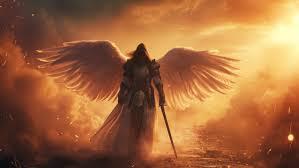
The unnamed angel who was speaking to Dani’el explained in 11:1 that he had assisted Micha’el in the past. And in the first year of Darius the Mede, I (the unnamed angel) took my stand to support and protect him (Micha’el). So the relationship between the powerful angel and Micha’el was mutual. Just as Micha’el came to help the angel in his battle against the prince of the kingdom of Persia in 10:13, so had the holy angel once helped Micha’el. Two years earlier, Micha’el and this unnamed angel fought a spiritual battle against Satan’s demons. The Hebrew word for to take one’s stand, amad, has a military connotation. The spiritual battle in the heavens was militaristic in nature. Historically, this was roughly the time when Cyrus and Darius began taking a pro-Jewish stance (see Dp – The Deliverance of Darius). ADONAI stirred up the spirit of Cyrus king of Persia to make a proclamation throughout his realm that the Jews could voluntarily return to their land (see Ezra-Nehemiah Ai – The Decree of Cyrus). Micha’el and the powerful angel fought the demons attacking the returning Jews from Babylon all the way back to their Promised Land. From the perspective of Chapter 11, these events were in the past.368
Leave A Comment