




Sh’ol
In the Dispensation of Torah (see the commentary on Exodus, to see link click Da – The Dispensation of the Torah), sh’ol (Hebrew) was the place of departed spirits. It had two subdivisions. The first was called Abraham’s side (a place of comfort and peace), or Paradise (Luke 23:43), and the second section was a place of torment (see the commentary on The Life of Christ Hx – The Parable of the Rich Man and Lazarus). Only the Righteous of the TaNaKh went to be with Abraham, and only on the basis of faith in the God of Abraham, Isaac, and Jacob. And just like those in the Dispensation of Grace (see the commentary on Hebrews Bp – The Dispensation of Faith), those without faith, go to a place of everlasting torment, which in the Brit Chadashah is called hades or hell (Greek). Salvation is always by faith (Ephesians 2:8-9). Those in Paradise stayed there until Messiah descended into sh’ol (hell) during the three days in which His body lay in the tomb, and led the Righteous of the TaNaKh into heaven (Ephesians 4:7-10). However, all those throughout the ages without faith will go to, and remain in, sh’ol (hell) until it is thrown into the Lake of Fire at the end of the Messianic Kingdom (see Revelation Fp – The Lake of Fire is the Second Death). There, those who hate God will be in torment for all eternity.
Knowing this, what is our responsibility to evangelize others? As believers, we should want people to go to heaven. To that extent, we should all know how to present the Gospel message in a clear and concise way. But the urgency of our Gospel message is greatly enhanced when we realize what people are being saved from! We want to see people saved from eternal punishment, a punishment that never ends. Conscious existence in a body resurrected and suited for eternal punishment. I think we sort of comfortably distance ourselves from that reality. Certainly in general in the Church it is looked over and ignored. But in truth, it turns out to be the first thing that we talk about when we talk about the Gospel. What are people being saved from?
Today our society is so depraved that it imposes virtually no consequences on their behavior. People get so used to sinning without consequences that when you introduce the idea that they will pay in full, forever for every sin they have ever committed, that is just alien to their thinking. People sin without immediate consequences. And to try to convince them that there are somehow, down-the-road, decades from now (if they live that long), deferred eternal consequences is a hard sell. For example, you might tell someone: Because of your stubbornness and your unrepentant heart, you are storing up wrath against yourself for the day of God’s wrath, when his righteous judgment will be revealed (Romans 2:5). Unbelievers are not getting away with anything: No fornication, adultery, no sin in the mind, no sin in behavior, no lie, no deception, no cheating; unbelievers are not getting away with any of it. They are just storing up wrath. All of which will be confronted and justly punished forever by YHVH in a place called sh’ol (hell).
This is not new. Speaking of the faithfulness of ADONAI to discipline His people (see the commentary on Deuteronomy Ad – The Song of Moses), Moshe recorded: For My anger has been fired up. It burns to the depths of sh’ol (Deuteronomy 32:22a). Our Lord’s first sermon in the B’rit Chadashah was on sh’ol (hell). Yeshua is a hell-fire Preacher. On the Sermon on the Mount, He said: But I tell you that anyone who nurses anger against his brother will be subject to judgment; that whoever calls his brother, ‘You good-for-nothing!’ will be brought before the Sanhedrin; that whoever says, ‘You Fool!’ incurs the penalty of burning in the fire of Gei-Hinnom (Matthew 5:22, also see verses 29-30)! He speaks of the fiery sh’ol (hell) as if He assumed everyone already knew about it because sh’ol (hell) was a very well known part of their biblical understanding. Later Messiah declares: Do not fear those who kill the body but are powerless to kill the soul. Rather, fear him who can destroy both soul and body in Gei-Hinnom, the unquenchable fire, having no rest day and night (Matthew 10:28 and 38; Revelation 14:11b). Yeshua said that the Pharisees were guilty of producing sons of Gei-Hinnom and being sons of hell themselves (Matthew 23:15).
Yes, Yeshua Messiah was a hell-fire Preacher.
When we talk about salvation, the word sh’ol (hell) has to be used because we are talking about being rescued. Salvation is a word that means deliverance or saved. And the question is . . . saved from what? Contemporary society has corrupted this idea and offers many psychological and even material substitutes for sh’ol (hell). They say, “Well, Jesus wants to save you from loneliness, or He wants to save you from purposelessness, or He wants to save you from anxiety, or poverty, or failure, or sickness, or disappointment. No. He desires to save you from sh’ol (hell). The message of Scripture is that salvation is a rescue, a rescue from a real place called sh’ol (hell).
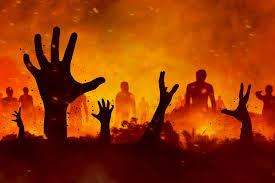
Yeshua talked more about sh’ol than everybody else in the Bible combined. And He defined it as conscious, eternal punishment. He continually spoke about it and He warned sinners to escape sh’ol (hell) because of its horrible reality. The Parable of the Rich Man and Lazarus mentioned above is a story about a rich man who went to sh’ol. Yeshua tells us that this is where the lost go after death, it was a place of torment, of thirst, of agony, and of fire. Once you’re there, you’re there forever. No escape. This is our Lord’s description of sh’ol. Was the Son of God wrong about that? No. Annihilationism (Soul Sleep) is not true, and universalism is also not true because the Bible teaches us that the ungodly are forever excluded from His presence.
Proof of that is in Matthew 25:46, where we see an inescapable, contrasting, parallel. These, our Lord says: will go off to eternal (Greek: aionion) punishment, but the righteous into eternal (Greek: aionion) life. Both words eternal are identical in Greek. So if sh’ol (hell) isn’t eternal then heaven isn’t eternal. If there is eternal life, then there has to be eternal punishment. Was our Lord wrong about this? If the Lord was wrong, why was He wrong? Was He ignorant of the truth? If He was, then He’s not the Lord of all. He’s not the way, the truth and the life (John 14:6). No. He wasn’t wrong and He wasn’t ignorant.
But precisely because of this eternal punishment, there are those who say, “Does the punishment really fit the crime?” Well, Ha’Shem determines that, doesn’t He? And YHVH has determined that the crime is heinous enough that it should be judged in this way. And that is the hurdle that most people have trouble getting over. How can a temporal sin or sins result in an eternal punishment? It seems excessive. Let me help you with that.
The amount of time that a sinner sins is irrelevant. If the sinner dies at fifteen-years-old, or thirty-five, or a hundred and ten; the amount of time a sinner sins is irrelevant. Crimes against the infinitely holy and exalted God are infinitely wicked and the punishment fits the crime. Infinite crimes against an infinite God deserve an infinite punishment. And here’s the key. Sinners go to sh’ol (hell) and never repent. Never. They continue to rebel. Every description of sh’ol (hell) indicates to us that it is not a remedial experience. It is not a place to reform sinners. It is punitive justice. They remain God-haters forever so that the punishment never catches up with the sin. In sh’ol (hell) they continue to curse God, blaspheme God, and despise Messiah. So the punishment never catches up to the sin because the sinning never, ever, stops. People don’t go to (sh’ol) hell and then never sin again . . . and just get punished over and over for what they did in this life. They go to sh’ol (hell) and keep on sinning forever, so the punishment never catches up with the sin (see the commentary on Jude At – Enoch, the Seventh Generation from Adam, also Prophesied about These People)!
The Bible says: Someone who blasphemes against the Ruach Ha’Kodesh never has forgiveness, but is guilty of an eternal sin (Mark 3:29). From a theological standpoint, we need to understand the nature of God. His honor and His glory can be clearly seen in the wicked. YHVH, because He is holy and because He is absolutely righteous and just, MUST punish sin. Read what Isaiah says about that: For just as the new heavens and the new earth that I am making will continue in my presence,” says ADONAI, “so will your descendants and your name continue. Every month on Rosh-Hodesh (new moon) and every week on Shabbat, everyone living will come to worship in My presence,” says ADONAI. “As they leave, they will look at the corpses of the people who rebelled against Me. For their worm will never die, and their fire will never be quenched; but they will be abhorrent to all humanity” (Isaiah 66:22-24). It is the character of God that is at stake. So sh’ol (hell) is God’s hell where He punishes those who refuse to give Him honor and glory. They will remain forever rebellious, God-haters, lovers of sin and blasphemers of the Ruach. They act against His mercy, His grace, and His sovereignty.
Finally, the Bible speaks of sh’ol (hell) in very specific words: agony, banishment, brimstone, contempt curse, darkness, deprivation, destruction, distress, eternal, fire, teeth-grinding, guilt, hopelessness, loneliness, pain, suffering, pressure, prison, punishment, ruin, separation, shame, smoke, sulfur, torment, trouble, trash heap, and weeping. There are many roads to sh’ol (hell). In one sense, every sinner goes there on the road of his or her own sinful choices. They go there on the road of pride, or they can go on the road of lust. They can go as a self-righteous religious leader or they can go as a killer. There are many roads to sh’ol (hell). On the other hand, there is only one way to escape (sh’ol) hell. For God so loved the world that He gave His one and only Son, that whoever believes in Him shall not perish but have eternal life (John3:16).
How do you evangelize people? In the parable that Jesus told about the rich man and Lazarus, the rich man, who was being tormented in sh’ol (hell), is seen pleading with Abraham, saying: I beg you, father, send Lazarus to my family, for I have five brothers. Let him witness to them, so that they will not also come to this place of torment (Luke 16:27-28). Abraham replied: They have Moses and the Prophets; let them listen to them. That’s a reference to Scripture. But he said: No, father Abraham, if someone from the dead goes to them, they will repent. This indicates that the rich man’s fate was not due to his being rich but his lack of repentance. Abraham said to the rich man, “If they do not listen to Moses, that is the Torah, and the Prophets, which means the entire TaNaKh, then they will not be convinced even if someone rises from the dead” (Lk 16:29-31). Again, how do you evangelize people? You lead them to the holy Scriptures. They are the only persuasive means that the Ruach Ha’Kodesh uses to regenerate and rescue lost souls from sh’ol.6
Leave A Comment