




Paul’s Chains
1: 12-14
Paul’s chains DIG: How does Paul decide if an event like jail is good or bad? How did Paul’s circumstances open up new areas of ministry for him rather than restrain him? How did ADONAI use Paul’s chains to advance the Gospel? How did Paul’s circumstances encourage many of the believers in Rome?
REFLECT: What kinds of “chains” has ADONAI used in your life? How can I be set free from the petty pursuit of my own comfort, to devote my life to a cause bigger than myself, the cause of Yeshua the King? How can I be set free from the fear of what others may do to me, to lay my life on the line for Messiah?
The Good News meant that for both Jews and Gentiles, Torah is a blueprint for living.
Paul now transitions to current news on himself and the work of ministry. Though it may seem counter to what we would understand today, Paul shares that his imprisonment was an excellent opportunity for him to share the Gospel. Empowered by his faith in Yeshua, Paul looks beyond his own needs and suffering to encourage the work of the Good News. Verses 12 through 14 are a single sentence in the Greek.
Now, brothers, I want you to know that what has happened to me has helped in advancing the Good News (1:12 CJB). Paul’s imprisonment brought the Good News of Yeshua, a Jewish message, to the heart of the pagan Roman Empire.33 The apostle did not merely say that the Gospel had continued to make progress in spite of adversity; rather, the adversity itself had resulted in the advancement of the Gospel. Far from trying to evoke sympathy from his readers by expressing resignation, Paul went out of his way to make sure that the Philippians were not overly concerned about him; indeed, he gave a glowing report of his ministry intended to bring joy to their hearts (verse 18). However, we should note that implicit in this statement is a recognition of the sovereign workings of ADONAI in human affairs, though the point may seem veiled when Paul says: what has happened to me.34
Paul could say to his persecutors what Joseph said to his brothers after they sold him into slavery: It was not you who sent me here, but God; and He has made me a father to Pharaoh and lord of all his household and ruler over all the land of Egypt . . . As for you, you meant to do me harm, but God meant it for good (Genesis 45:8 and 50:20a). Countless numbers of believers have been able to echo that truth. Job could have expressed it to his three “comforters,” Esther to Haman, Jeremiah to the false prophets and rulers of Judah, and the apostle John to those who exiled him to Patmos. As always, our Lord can turn efforts to thwart His Kingdom into means of advancing it. ADONAI’s supreme act of using the Adversary’s schemes to accomplish His purposes was, of course, His Son’s work of redemption on the cross. By His death and resurrection, Yeshua Messiah conquered sin and death, defeated Satan, and provided redemption for all in every age who trust in Him.
Paul made it clear in Rome that the source of eternal life (see The Life of Christ, to see link click Ms – The Eternal Security of the Believer) was only available to both Jew and Gentile because of the work and acceptance of the Jewish God, the Jewish Messiah, and the guidance of the Jewish Scriptures.35 It meant that for both Jews and Gentiles, Torah was a blueprint for living (see Deuteronomy Bk – The Ten Words).
As a result, it has become clear throughout the whole praetorian (palace) guard (1:13a NIV). The praetorian guard was originally composed of some ten thousand handpicked soldiers. It had been established by Caesar Augustus, who was emperor at the time of Yeshua’s birth (Luke 2:1). These men were dispersed strategically throughout the city of Rome to keep the general peace and especially to protect the emperor. Later emperors greatly increased their numbers, and Tiberius built them a conspicuous fortified camp to make sure they had a high-profile presence in Rome. Members of the palace guard served for twelve (later sixteen) years, after which they were granted the highest honors and privileges, including a very generous severance pay. Eventually, they became so powerful that they were considered “king-makers,” who not only protected but also chose Rome’s emperors.
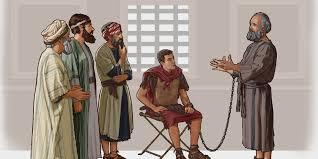
And to everyone else that I am in chains for Messiah (1:13b NIV). Paul was guarded by a Roman soldier all the time. Paul’s chain was somewhat longer than a modern handcuff, about eighteen inches long. One end was attached to the prisoner’s wrist, the other to the guards. The chain was not removed from the prisoner as long as he was in custody, making both escape and privacy impossible. Although the apostle was allowed to live in his own rented quarters, he was chained in that manner to a series of soldiers for a period of two years.36
Over those years, it’s possible that several dozen different soldiers were assigned to guard Paul, each one becoming his captive audience. At times his rented room would be filled with people, to whom the apostle would evangelize. And after they left the Roman guard would sit beside him, probably filled with many questions as to the meaning of the Good News which the strange prisoner spoke. At other times, when all had gone, and especially at night, when the moonlight shone on the distant slopes of Mount Soracte, the soldier and the apostle were left to talk, and in those lonely hours John would tell soldier after soldier the story of his own proud career in early life, of his opposition to Messiah, and his ultimate conversion. He would make it clear that he was being held as a prisoner, not for any crime, not because he incited rebellion against Rome, but because he believed in Him whom Roman soldiers had crucified, under Pontus Pilate, was the Son of God and the Savior of the world. And as his testimony spread, and the soldiers talked to one another, the whole praetorian guard sympathized with the meek and gentle apostle, who always showed himself to be so kind to the men as they shared, however involuntarily, his imprisonment.37
Trusting in Yeshua Messiah gave Paul such strength (Colossians 1:26) and comfort (Second Corinthians 1:3ff) that, far from needing these from others, he, from his house arrest, could strengthen other believers who were free, and comfort those worrying about him that despite his circumstance, the Good News was advancing.38 And because of my chains most of the believers here have for more courage to speak the Word of God without fear (1:14 Greek). His strength became their strength, as his example touched them. The apostle’s fellow believers discovered that, like the cowardice they once experienced, courage is contagious. Although influential and disruptive, those who criticized and slandered Paul (see Ap – Paul’s Critics), were in the minority.
Sometimes ADONAI has to put “chains” on His people to get them to accomplish things that could never happen any other way. Young mothers may feel chained to the home as they care for their children. But God can use those chains to reach people with the message of salvation. Susannah Wesley was the mother of nineteen children, before the days of labor-saving devices and disposable diapers. Out of the large family came John and Charles Wesley, whose combined ministries shook the British Isles. At six weeks of age, Fanny Crosby was blinded, but even as a youngster she was determined not to be confined by the chains of darkness. In time, she became a mighty force for God through her hymns and Gospel songs.39
If you are a believer who has been taken captive by God’s grace in Messiah, how has the mercy that you received influenced the way that you view life’s frustrations and setbacks? When your agenda is thwarted as Paul’s plans to reach Spain were, do you follow his lead in looking around in the situation that you would never have chosen for yourself, eager to see and seize unexpected opportunities to show the kindness of Yeshua, and speak about His grace to people whom you would not have met otherwise?40
Dear heavenly Father, praise You for Your infinite wisdom and love that is able to turn hard and difficult situations to both mature me and bring glory to Your holy Name! Now to the King eternal, immortal, invisible, the only God, be honor and glory forever and ever (First Timothy 1:17). It brings comfort that when trials come to me, that the trials did not miss Your attention. You were not busy, nor did You look away for a minute; but You use trials to mature and grow me for Your glory. These trials are so that the true metal of your faith (far more valuable than gold, which perishes though refined by fire) may come to light in praise and glory and honor at the revelation of Messiah Yeshua (First Peter 1:7).
And for Paul, imprisonment was not a slip or an afterthought, but it was carefully integrated into how to mature believers throughout the centuries to come. Paul’s time in Rome was very useful to him to have time to stay put in one place and write encouraging messages about Your truth to the several churches. When times get hard, it is so important to look into Scripture and see how very often You take hard situations and turn them to glorify You, for Joseph, David, Paul and others. Thank You that I can always count on You, even when times are difficult, You are always with me. To the one who sits at Your right hand. Amen
Leave A Comment