




Live in Harmony
4: 2-3
Live in harmony DIG: How might the attitudes of these women harm the church? How might others help? What is the book of life? When was it written? Whose names are included? Why would Luke be the most likely person identified as Paul’s true companion?
REFLECT: Infighting can be like a cancer in the body of the local Church. Believers still have their old sin nature. So how can we live in harmony and prevent the kind of disagreements that we see here at Philippi? Who is your true companion?
When conflict arises that threatens the health of the Body,
it is imperative for fellow believers to get involved.
The question naturally arises as to how Paul’s command to stand firm (to see link click Bl – Stand Firm in the Lord) was to be applied. His answer, introduced by the phrase in this way, unfolds in verses 2-9. He lists seven basic, practical principles that lead to spiritual stability: (1) living in harmony (4:2-3), (2) maintaining a spirit of joy (4:4), (3) maintaining a gentle spirit (4:5a), (4) being calm in every situation (4:6a), (5) reacting to problems with prayer and petition (4:6b), (6) thinking about godly virtues (4:8), and (7) obeying God’s standard (4:9).
The fellowship and support of the Body of Messiah is an important factor in developing and maintaining spiritual stability. The general strength of the fellowship comes from the strength of each individual. The more isolated a believer is from the Body, the more spiritually unstable he or she is likely to become. The church should be a place where people support each other, hold each other accountable, and care for each other. It should be a place where believers restore those who have fallen into sin, and bear one another’s burdens (Galatians 6:1-2). The church is to warn those who are idle and disruptive, encourage the disheartened, help the weak, and be patient with everyone (First Thessalonians 5:14). Paul knew that this could only take place in an atmosphere of harmony. As a result, any threats to the church’s unity must be confronted. So he dealt with the problem of harmony directly by naming the two women who were involved, and encouraging a third person to help resolve the crisis. He didn’t want the conflict to spread, people taking sides, and the whole congregation to become embroiled in controversy, undermining its stability.164
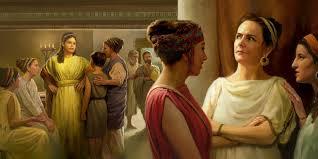
(1) Now I appeal to Euodia and I appeal to Syntyche; please, because you belong to the Lord, settle your disagreement (4:2 NLT). While the content of the verse itself is direct, the historical context that led to Paul’s words here is less so. The wording of the sentence is carefully chosen. To ensure that each woman feels equally singled out, Paul mentions each by name and repeats the verb: I appeal (Greek: parakalo, meaning to strongly urge) to Euodia and I appeal to Syntyche. It is consistently used to issue a call to action of some sort, whether mental, spiritual, or physical. Reaching out to his estranged mother, a second-century A.D. letter records a son using this same verb when he wrote: “I beseech [parakalo] you, mother, be reconciled to me.” This was no mere suggestion; Paul was making a personal appeal to those two women.
We know nothing about Euodia and Syntyche other than what we can learn from the text here. The name Euodia means good journey or success. The name Syntyche means with luck or lucky and has also been found in various inscriptions. Some have suggested the possibility that one of these women was in fact Lydia, who was the key person in the founding of the church at Philippi (Acts 16:14-15). However, there is simply no direct evidence for such a claim, and it must remain, at best, in the realm of speculation.
Regardless of their identity and specific role(s) in the church, the content of the appeal is quite clear: settle your disagreement or be of the same mindset. Once again, Paul uses the key verb root parakeleo, which refers to a mindset, a way of thinking and evaluating life and acting accordingly. In the Greek text Paul’s words are almost identical to 2:2, as the following translation reflects: settle your disagreement (Greek: auto phronein) (4:2 NLT);
be of the same mindset (Greek: auto phronete) (2:2 Greek). This connection suggests (at the least) that the disagreement between Euodia and Syntyche was an example of the kind of disunity endangering the Philippian church. But it is also possible that this disagreement was in fact the main source of disunity in Philippi, as others began to line up with one or the other in this dispute. Either way, the problem was significant enough for Paul to address these two women directly by name, something he rarely did.
The basis of their shared mindset should have been because they belonged to the Lord. Just as believers are to rejoice in the Lord (4:4), and stand firm in the Lord (4:1), Euodia and Syntyche needed to be of the same mindset and agree in the Lord. This statement takes on even more significance when we remember that Paul appealed to the mindset of Messiah Himself in his initial appeal for unity in the church (2:1-11). Such agreement does not mean uniformity, but rather a willingness to set aside personal agendas for the greater good of unity around the Gospel and its progress in the world. The Lord Yeshua Messiah had to be more important than their petty dispute. They needed to focus on Him until His unifying power caused their specific differences to fade into relative insignificance and caused the disagreement to disappear.165
Having addressed the two women in the conflict, Paul now turns to address a third party to get involved. So, I ask you, my true companion (Greek: suzugos), to help these two women (4:3a Greek). The challenge is knowing whom Paul is asking for help. Several possible explanations for the identity of this person have been offered. Some believe he was a person that Paul knew, but chose not to name. But in the immediate context Paul named Euodia, Syntyche, and Clement, why would he not have named that person? It is unlikely that Paul is speaking to a person named Suzugos since there is no such name known in the Greco-Roman world. The Philippians surely knew who he was, whether or not Paul named him.166
The Greek word suzugos itself, therefore, indicates the closest kind of relationship – indeed a co-worker – with Paul. If we are correct in identifying this true companion as one of his co-laborers in Paul’s itinerant ministry, then it cannot refer to Timothy, who was coming later than this letter was written. Of the others who were available, the most likely candidate was Luke. Two things make this plausible, if one considers Luke as the person to be identified with the “we-passages” in Acts (see the commentary on Acts Bx – Paul’s Vision of the Man of Macedonia: A closer look at the “us” or “we” passages and sea passages). First, the “we” narrative takes Luke to Philippi in Acts 16, where it stops until Paul’s return to Philippi some four to six years later in 20:1-5. Luke clearly intends his readers to infer that he had spent those intervening years in Philippi. If so, then, as one of Paul’s most trusted companions, it seems reasonable that the apostle had asked Luke to help settle the disagreement between Euodia and Syntyche.
Second, if our view of the date and place of this letter is correct (see Ac – Philippians from a Messianic Perspective), then Luke had recently been with Paul during the earlier period of this same imprisonment when Paul wrote the letters to Colossae and Philemon (Colossians 4:14 and Philemon 23). The letter to Philippi, however, seems to have been written toward the end of Paul’s house arrest (2:24), is especially noticeable for its lack of mention of the names of any of Paul’s companions. All of this makes perfectly good sense if Luke had at some earlier point left for Philippi – and was perhaps the catalyst of their recent revival of material support (4:10). None of this can be proven, of course. Nevertheless, it fits all the available historical data, and the epithet my true companion would be especially fitting for Luke, especially in light of the affectional language in Colossians 4:14.167
Paul also had a personal reason for wanting Euodia and Syntyche to be reconciled: for they had shared his struggle in the cause of the Gospel (4:3b NASB). Euodia and Syntyche may have been two of the women who heard Paul preach when he first came to Philippi (see Acts By – Lydia’s Conversion in Philippi). If so, they witnessed the turbulent events that marked the birth of the Philippian church (see Acts Bz – Paul and Silas in Prison). The tragic conflict between those two women reveals that even the most mature, faithful, and committed people can become so selfish as to be embroiled in controversy if they are not diligent to maintain unity.168 The mention of Euodia and Syntyche who worked along with the rest of my co-workers leads Paul to mention Clement (4:3c NASB). Almost nothing is known about Clement other than what is indicated here. Both Origen (184-254) and Eusebius (263-339) identify a church father as the later bishop of Rome by the same name; however, whether this is the same man mentioned by Paul here remains a matter of speculation.
Paul concludes his appeal for the true companion to intervene in the disagreement with a theological reminder that their names are written in the Book of Life (4:3c Greek). This book is the register where ADONAI keeps the names of the redeemed (Exodus 32:32; Psalm 69:28; Dani’el 12:1; Malachi 3:16-17; Luke 10:20; Revelation 3:5, 13:8, 21:27). Just as the names of Roman citizens were recorded in an official register to ensure that their rights and privileges were safeguarded, so too believers have their names written in God’s heavenly register from all eternity past (Matthew 25:34; Ephesians 1:4; Second Timothy 1:9). This will ensure that we will be vindicated the final day (see the commentary on Revelation Fo – The Great White Throne Judgment).169 The Book of Life is also a Jewish concept connected to both the Great White Throne Judgment and the High Holiday liturgy of Rosh Ha’Shanah, when at the blowing of the shofar all Isra’el declares, “May Your Name be inscribed in the Book of Life“ (Leviticus 23:23-25; Micah 7:19; Matthew 24:31).170
By mentioning the Book of Life, Paul reminds all involved of their common ground at the foot of the cross, regardless of their position in the church or role in the disagreement. It is so amazing that ADONAI writes our names in the Book of Life! From before the foundation of the world God wrote the names of His people in His book, and then sent His Son to redeem us. So, our lives should reflect the reality that our true citizenship is in heaven (see Bj – A Tale of Two Citizenships) as we await the return of the Kosher King to start His Messianic Kingdom (see the commentary on Revelation Fh – The Dispensation of the Messianic Kingdom).
For some, our temptation is to avoid confrontation and stay out of situations that we should intervene in. For others, the tendency is to poke their nose into places where they don’t belong. In both cases, the root is often the same: fear of mankind rather than fear of the Lord. In the Body of Messiah we are responsible for one another. When conflict arises that threatens the health of the Body, it is vital for fellow believers to get involved.171
Dear heavenly Father, praise You for not ignoring problems, but rather You deal with issues with kindness and wisdom. Ignoring issues is what often happens in this world, but that is not how You want Your children to act. You want us to immediately deal with any problems with fellow believers before worshipping You. If you are presenting your offering upon the altar, and there remember that your brother has something against you, leave your offering there before the altar and go. First be reconciled to your brother, and then come and present your offering (Matthew 5:23-24). May we live following Your excellent example of focusing their lives on the eternal joy of living with You in heaven. Let us run with endurance the race set before us, focusing on Yeshua, the initiator and perfecter of faith. For the joy set before Him, He endured the cross, disregarding its shame; and He has taken His seat at the right hand of the throne of God (Hebrews 12:2). In Messiah Yeshua’s holy Name and power of His resurrection. Amen
Leave A Comment