




The Third Cycle: Shamgar
3:31 and 5:6-7
The third cycle: Shamgar DIG: How did Shamgar’s name show the Canaanite influence on the Jews? What is Shamgar known for? In what ways were Shamgar and Samson similar? What is remarkable about his battle with the Philistines? As far as his judgeship was concerned, what was his association with Ehud?
REFLECT: Between Othniel, then Ehud, and now Shamgar, how has the pattern of how God judged shifted before our eyes? Ha’Shem remains the Judge, and He Himself is the Great Deliverer; but how He judges is up to Him? Have you, your family, or your church taken on a Canaanite lifestyle? How can you change that?
With a total of twelve judges, there were actually twelve cycles, but the author does not detail all twelve cycles, only seven. Shamgar is one of those not detailed.
After Ehud came Shamgar, son of Anath. Shamgar is an unlikely hero. In the time of the judges, many would know Gideon, some would know Samson or Deborah, and perhaps even Jephthah; but, who in the world is Shamgar? These two verses are all that recorded Scripture says about him. He is the first of the judges that are not detailed. Shamgar is a Hurrian name, used of a people known in the Bible as the Horites. He was a Jew who was the son of Anath, a name dedicated to the goddess Anath. Among the Canaanite deities, Anath was the Canaanite goddess of sex and war. The name shows Canaanite influence on the Jews. Certain characteristic features of the narratives concerning the judges, like rebellion, there is no mention that Isra’el did evil in the sight of ADONAI; repentance and restoration are also missing in connection with Shamgar. Nor is there any direct mention of any Philistine oppression or its duration. The length of time when the land enjoyed rest is also missing. His is the shortest of all twelve accounts.
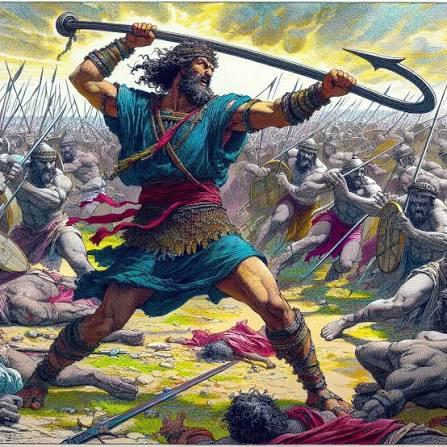
He struck down six hundred Philistines with an oxgoad. God’s instruments of retribution seem to have an interesting, if odd, collection of tools. Shamgar’s oxgoad joins Ehud’s dagger (3:16), Jael’s hammer and tent peg (4:21), Gideon’s shofars and torches (7:16), the woman’s millstone (9:53), and Samson’s jawbone (not his but a donkey’s) (15:15). Ha’Shem’s judges had plenty of variety. While Ehud employed great planning and deception (see Aq – The Second Cycle: Ehud), Shamgar seemed to act almost impulsively. While both required dexterity, Ehud relied on stealth to assassinate Eglon, while Shamgar relied on brute strength to impale six hundred Philistines. He was a farmer at war. Six hundred warriors was a common troop configuration (cf. the six hundred warriors sent by the tribe of Dan to conquer Laish in 18:11; also see First Samuel 13:15, 14:2, 27:2; and Second Samuel 15:18).79 The six hundred may be Shamgar’s lifetime total, and not a result of a one-time battle. But we really don’t know. The Hebrew for oxgoad is malmad, and was used to urge oxen to move forward, and was as much as eight feet long. It was pointed at one end with a metal tip, and had a chisel-shaped blade on the other end for scrapping a plowshare, and so it could be effectively used in place of a spear.80 They, like Eglon, got the point of the message.
Here was a man who obeyed YHVH and defeated the enemy even though his resources were limited. Instead of complaining about not possessing a sword or a spear, Shamgar gave what he had to the LORD, and the LORD used it. The few words that are recorded about Shamgar give the impression that he was a man of persistent courage, which, of course, was born out of his faith in ADONAI. To stand his ground against the enemy, having only a farmer’s tool instead of a soldier’s military equipment, highlights Shamgar as a brave man with steadfast courage.81
He also rescued Isra’el (3:31 NIV). The word also connects Shamgar with Ehud. His judgeship may have inspired after Ehud’s restoration, but before Ehud’s death. That is why the historical notation, after Ehud died (4:1) continues after the death of Ehud, not Shamgar. So it might be very well that Shamgar’s actions occurred within the period of Ehud’s judgeship. The next cycle (see As – The Fourth Cycle: Debrah) shows that he was a contemporary of Debrah and Barak, and so may have appeared about the same time that the Philistines were beginning to settle in the coastal plain. As a result, Deborah and Barak are viewed as following Ehud, not Shamgar.82
In the days of Shamgar son of Anath, in the days of Jael, people avoided the main roads because they were afraid of the Philistines or didn’t want to pay the heavy tolls, and travelers stayed on back roads. The situation was that of total destruction of communication and trade. Verse 7 describes the total lack of leadership in Isra’el. There were few people left in the villages of Isra’el – until Deborah arose as the mother of Isra’el (5:6-7 NLT). The theme of these verses is the impoverished, pitiful condition of Isra’el under the Philistine yoke. They describe the situation in the land prior to Debrah and Barak rising up and restoring the nation. Shamgar and Jael are viewed as contemporaries, which further demonstrates that Shamgar’s judgeship came within the same time period as Ehud.83
While Ehud’s deceptive ways are a step down from the heroic Othniel’s, Shamgar’s lack of details surrounding him clearly signal to the reader the narrator is depicting a downward trend in Isra’el’s story. While Ha’Shem does save Isra’el from her enemies, His chosen means of doing so may not be easy to predict or explain. This trend will only accelerate in the accounts that follow, an acceleration accentuated by the striking links between Shamgar and Samson, both who contest the Philistines, both act alone, and both use an unlikely weapon. Shamgar confronts the Philistines and successfully delivers Isra’el, while Samson, the wayward Nazirite, constantly courts Philistine women and fails to deliver Isra’el. Thus, the appearance of Shamgar is both positive and negative. On the one hand, he is a reminder that YHVH uses he most unlikely characters; but on the other hand, he represents the loss of nerve among the Israelites by the fact that he had to act alone, without tribal support.84
The dilemma faced by the Israelites in the dark days of the judges is not without parallel in the Church today, which is often at the mercy of the world. Dependence on secular business ethics and methodologies has increased in the Church as godliness and genuine spirituality among its leaders has decreased. But a Church that has permitted itself to be squeezed into the mold of the world should not be surprised to find itself held hostage by its enemies. The Lord is under no obligation to those who bear His Name in vain, or to those who claim to be the people of God but act like Philistines. However, He remains sensitive to the groaning of His people and waits to demonstrate His power and His grace in freeing them from the tyranny of evil and their own foolishness. ADONAI is resourceful and often rescues them through unexpected agents in spite of His people and their leaders.85
Dear heavenly Father, praise You for being such an awesome Savior! You are the Savior of the whole world! Besides you there is no Savior. Before Me no God was formed, and there will be none after Me. “I, I am ADONAI – and there is no savior beside Me (Isaiah 43:10c-11). You care so tenderly for your children. For I am Adonai your God, the Holy One of Israel, your Savior. (Isaiah 43:3a). The only wise response to one who can predict the future is for all the ends of the earth to turn to you and be saved. Turn to Me, and be saved, all the ends of the earth. For I am God—there is no other. By Myself I have sworn—the word has gone forth from My mouth in righteousness, and is irrevocable: that to Me every knee will bow, every tongue will swear. (Isaiah 45:22-23). Thank you for being the strength and wisdom behind Shamgar’s being Israel’s savior. Words cannot even begin to express my gratitude for being the Savior of the world. Yet will I triumph in ADONAI, I will rejoice in the God of my salvation (Habakkuk 3:17-18). I rejoice in You, my awesome Savior! In Messiah’s holy Name and power of His resurrection. Amen
Leave A Comment