




The Curse of Jotham
9: 7-21
The curse of Jotham DIG: How did Jotham expose the truth about Abimelech as a leader? Why did the olive tree reject the offer to become king? The fig tree? The vine? What was the danger in offering the thornbush to be their king? What was Jotham’s warning? What was the main point of Jotham’s fable?
REFLECT: How do you get things off of your chest that you think are wrong? Are you as direct as Jotham? Have you ever turned down what seemed like a great job opportunity? Why did you turn it down? What is your more useful purpose? Do you know any Abimelech’s? How can you distance yourself from them?
Abimelech lacked any useful qualifications to become a good king,
because he seized his rule by guile and maintained it by force.

So far Abimelech’s plot seemed to be going according to plan . . . except for one small problem. As noted at the end of 9:5, one of Gideon’s sons, Jotham, the youngest, had hidden from his half-brother Abimelech and managed to escape his sword. The author had mentioned this small detail only in passing and had immediately resumed the main plot line concerning Abimelech, as if the supplanter would have it all his way. But the early reference to Jotham created an expectation for a complication in the plot. And we are not disappointed. Here in verses 7-21 the focus shifts to this young boy, who is presented as a positive character in contrast to Abimelech, whose name, my father is king, reflected his ambition. Jotham’s name is an expression of godly faith: ADONAI is perfect. This will be confirmed by the way in which YHVH resolves the problems raised by Abimelech’s conduct. In contrast to Abimelech who sought to rule by sheer power, Jonathan is powerless. Since he was the only survivor of a family murdered by his half-brother, he couldn’t enter Shechem to make his point. Therefore, he needed to speak from Mount Gerizim outside the city, and he had to flee for his life after his speech. And precisely because he was powerless, he chose a powerful rhetorical device – the fable.222
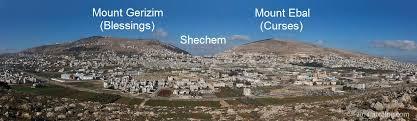
Approximately a century and a half before, six of the tribes had stood on the slopes of Mount Gerizim and thundered out their “Amens” to the blessings of the Torah, pronounced by the Levites (see the commentary on Deuteronomy, to see link click Fd – Blessings and the Curses). Now Jotham stood on the same mountain, using it as a bully pulpit from which to denounce the shameful actions of the Shechemites. It is unlikely that he stood on the summit of the mountain; a convenient crag seems to be indicated, from which he could be heard, and from which he could beat a hasty retreat. A ledge halfway to the top is popularly called “Jotham’s pulpit.” Ironically, for the leading citizens of Shechem it became a mountain of curse.
Shechem was a natural amphitheater between Mount Gerizim (750 feet above the valley) and Mount Ebal (1,400 feet above the valley). Voices carried a long way there. It was used as an open-air pulpit in the great religious ceremony of Joshua (see the commentary on Joshua Bh – The Covenant at Mount Ebal), which itself was a fulfillment of the provisions of Deuteronomy above.
Addressing the leading citizens of Shechem who were responsible for Abimelech’s rise to power, Jotham makes what ranks as one of the most powerful speeches in the TaNaKh, the story of the trees in search of a king. It is interesting that the principle of kingship itself is not condemned. The main point is that a worthless person, Abimelech, had been chosen. The implication is that the sons of Gideon, including Jotham himself, would have been a more desirable choice, although this is not specifically stated.223
Preamble to the fable (9:7): The fable itself is of importance as an ancient illustration of a story with a moral message, and it bears comparison with Nathan’s rebuke of David (Second Samuel 12:1-4), and the message of Jehoash, king of Isra’el to Amaziah king of Judah (Second Kings 14:9-10). It was a protest against the shameful treatment given to Gideon and his descendants, and a prophecy of the effect of Abimelech’s rule. The main thrust of the speech doesn’t lie in the fable itself (verses 8-15), but in his application of it to the present situation (verses 16-21).224 When Jotham was told that the leading citizens of Shechem made Abimelech king (see Bi – The Conspiracy of Abimelech), he went and stood on Mount Gerizim and shouted to them, “Listen to me, rulers of Shechem, so that God may listen to you” (9:7 NIV).
First, the Olive Tree (9:8-9): One day the trees decided to choose a king and they came to the olive tree first. An especially fitting choice of a metaphor for a scene set in the fertile valley of Shechem where, even today, beautiful groves of olive trees flourish. The picture of the trees going to anoint a tree (whether olive, fig, vine, or thornbush) symbolically represents men choosing one of their own kind as king (Deuteronomy 17:15). They said to the olive tree, “Be our king!” But the olive tree rejected their offer by making a distinction between the greater and the lesser. The greater was represented by the statement: Should I quit producing the olive oil that honors both God and mankind? It honors God because olive oil was used for anointing the priesthood and used for the lampstand in the holy place of the Tabernacle. And it honors mankind since olive oil was used for anointing as a refreshment of the skin and for food. The lesser would be just to wave back and forth over all the other trees (9:8-9 Hebrew)? In other words, why should the olive tree become king, reigning over all the other trees, and abandon the more useful purpose it already had?
Second, the Fig Tree (9:10-11): Next, they said to the fig tree, “You come and reign over us.” But the fig tree also rejected the offer with a difference between the greater and the lesser. The greater was represented in the question: Should I leave my sweetness and my good fruit? The fig maintains its sweetness when either fresh or dried. The Hebrew word for good fruit means produce. The yield of a fig tree is two or three crops a year, not just one as with other trees. Therefore, the lesser would be to just to wave back and forth over all the other trees (9:10-11 NLT)?
Third, the Vine (9:12-13): Then the trees made the same offer to the vine, “Come and be our king,” which also rejected it with a difference between the greater and the lesser. The greater is represented by the question: Should I quit producing my new wine that cheers both God and mankind? The wine cheers God because of the drink offerings of the Torah (Exodus 29:38-41; Numbers 15:1-16); and it cheers mankind because, as Psalm 104:15 reveals: wine gladdens the heart. This is great of course. So, why choose the lesser just to wave back and forth over all the trees (9:12-13 NLT). Therefore, the olive tree, the fig tree, and the vine all rejected the offer of being king because they felt that they already had a more useful purpose.225
Fourth, the Thornbush (9:14-15): The fable reaches its climax when all the trees turn to the thornbush and say: “Come and be our king.” While the other trees that were asked to become king were all productive members of the landscape, yielding delectable fruit and useful byproducts; however, the thornbush yields only thorns. If anything, it’s dangerous and a danger to the farmer because if it catches fire, it can destroy the whole crop. Thus, the trees, having failed to tempt the useful trees to leave their usefulness for the sake of status, as a last resort, offered the kinship to the lowest grade of plant life, and therefore any other option would be better than the thornbush. And the thornbush replied to the trees, “If you truly want to make me your king, come and take shelter in my shade.” The image of the trees “seeking cover” beneath a thornbush is absurd, not only because of the size, but also because the thornbush offers neither shade nor cover, it has thorns! The story continues: If not, let fire come out from me and devour the cedars of Lebanon, which are symbolic, as in Isaiah 2:12-13, for the proud, and in this case, the proud rulers of Shechem (9:14-15 NLT). In short, “Make me your king, or I will destroy you.” The point of all this is that Abimelech can offer no comfort to Shechem, and, in fact, he will be the source of its destruction (see Bk – The Destruction of Shechem).
The Application of the fable (9:16-20): Then Jotham made the application of the fable. First, in verses 16-19 he made the application in the case of righteousness: Now make sure you have acted honorably and in good faith by making Abimelech your king, and that you have done right by Gideon and all of his descendants. Have you treated him with the honor he deserves for all he accomplished? If the rulers of Shechem had acted righteously in all that they did to Gideon, and remembered that [he] fought for [them] and risked his life when he rescued [them] from the Midianites, then all was good (9:16-17 NLT). But today you have revolted against my father and his descendants, killing his seventy sons on a single stone made by Abimelech, the son of a female slave, king over the rulers of Shechem because he is related to you (9:18 Hebrew). Jotham’s basic charge is that they corrupted goodness into expediency, and covenant faithfulness into tribalism. Then Jotham returned to the train of thought suspended at the end of verse 16. So if you have acted honorably and in good faith toward Gideon and his family today, then rejoice in Abimelech, and let him also rejoice in you (9:19 NIV). There is a bit of sarcasm here. It’s as if he was saying, “May you find much happiness with this thornbush of yours.”226
Second, comes the application in the case of unrighteousness: But if you have not acted in good faith, then may the result be mutual destruction: May fire come out from that thornbush Abimelech and devour the citizens of Shechem and also consume Abimelech himself (9:20 NLT). So Jotham explains that the worthless Abimelech is just like the thornbush. He lacked any constructive or useful qualifications to become a good king, because he seized his rule by guile and maintained it by force. Although he promised to protect those who had been persuaded to appoint him, in the end he destroyed them and himself with his self-centered recklessness.227
Jotham’s Escape (9:21): Knowing that his half-brother Abimelech would not rest in his crusade against his family until every member had been killed, and having invoked the curse upon Shechem and Abimelech, Jotham escaped and lived in Beer (meaning well) because he was afraid of him (9:21 NLT). Beer was mentioned in Numbers 21:16 as a place where the Israelites stopped as they were traveling around Mo’ab on their way to Canaan. It was probably located on the edge of the desert, where it served as a watering place for nomads and traders. Its main appeal for Jotham was probably its remoteness from Shechem . . . and therefore from Abimelech. Jotham probably went into hiding for the three years that Abimelech was still living (9:22). David later sought sanctuary for his family in the same general area during the reign of Sha’ul (First Samuel 22:2-4).228
Abimelech considered himself to be a stately tree of great value, but Jotham said he was nothing but a useless weed. What a blow to his pride! When the rulers of Shechem chose Abimelech as their new king, they didn’t get useful olive oil, tasty figs, or cheerful wine, they only got thorns – fuel for fire. In reality, Abimelech was trying to wrestle “the kingdom” away from ADONAI (Judges 8:23), and the LORD permitted him to have a limited amount of success. But God was still on the throne and would see to it that Abimelech’s selfish purposes would not end well.
It’s a dangerous thing for us to think more highly of ourselves than we ought to think. Paul reminds us: For by the grace given me I say to every one of you: Do not think of yourself more highly than you ought, but rather think of yourself with sober judgment, in accordance with the faith God has distributed to each of you (Romans 12:3). We all need to discover the gifts God has given to us and then use them in the place where He puts us. Each member of the Body of Messiah is important (First Corinthians 12:12-31), and we all need one another, and to minister to one another. Since there is no competition in the work of the Lord (John 4:34-38; First Corinthians 3:5-9), there’s no need for us to promote ourselves. The important thing is that ADONAI receives the glory.229
Dear heavenly Father, praise You that You are so very great and wise! Living to please You is such a joy! It is so much more fulfilling to seek to please you than to chase after worldly power. Earthly rewards are nice to get, but they are not of value for eternity. The best reward to seek after is the eternal reward of Your abiding Presence, that you have promised to those who love You. Yeshua answered and said to him: If anyone loves Me, he will keep My word. My Father will love him, and We will come to him and make Our dwelling with him (John 14:23). Better than having one’s name written as a city ruler, is to have one’s name written in the Lamb’s Book of Life, because of one’s trust in You. In Messiah Yeshua’s holy Name and power of His resurrection. Amen
Leave A Comment