





Be Faithful to Your Spouse
5: 15-23
A proverb is a short and memorable saying designed to be our blueprint for living in the world that ADONAI has created. It is important to note that proverbs are not promises; they are generally true principles, all other things being equal.
At this point, the father switches strategy. He moves from warning about wicked behavior (to see link click Bb – Do Not Commit Adultery), to encouraging proper behavior in the context of sexuality. Again, the idea seems to be that the best defense against the charms of the adulterous woman is a vital relationship with the husband’s proper sexual partner, the wife. ADONAI is not a prude. He created sex. Therefore, the Torah does not discourage sexual relations for a moment; it just puts in the proper context heterosexual marriage.
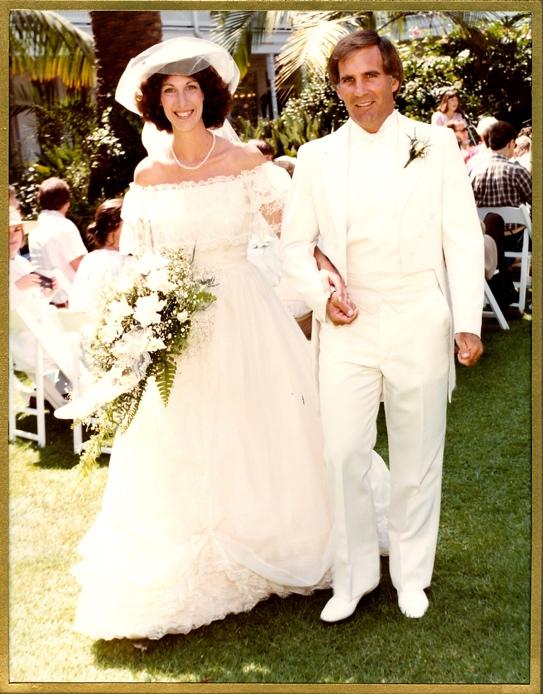
The metaphors (5:15-17): The wise father uses tasteful, but clear, metaphors to urge his son toward a vital sexual relationship with the wife of his youth. He urges his son to drink water from his own well and running water from his own cistern (5:15 NIV). These highly erotic images refer to his wife (Song of Songs 4:10-15). So here, the father advises his son to find sexual fulfillment with his own wife rather than another woman. Then, in the next verse, the father uses similar imagery to refer to male sexuality. Why spill the water from your springs abroad, streams of water in the streets (5:16 Hebrew). The father tells the son that sexual relations are proper in the home, not with other women outside the household. His sexual vitality should be spent on his wife, not on others. Let your streams of water be yours alone, never to be shared with strangers (5:17 NIV). This is a picture of our wedding at the Hotel Del in Coronado, California in 1984 (you do the math).
The prayer (5:18-20): You have every right, therefore, to see by faith, ADONAI, our High Priest, raising His hands of blessing over your marriage bed (see the commentary on Numbers Bb – The Aaronic Blessing). Thus, verse 18 adds a prayer. The wise father prays over the married sexual experience of his son and daughter-in-law. May your fountain be blessed, and may you rejoice in the wife of your youth (5:18 NIV). Then Solomon further characterizes the wife of his youth in terms that are erotic and reminiscent of the Song of Songs. But, in the latter it is the male term gazelle (Song of Songs 2:9 and 17, 8:14) that is used rather than the female term.132 The breasts of a man’s wife are soft to the touch and graceful in appearance like a doe (Song of Songs 4:5 and 7:3). She is like a loving doe, may her breasts satisfy you always, may you be lost in her love forever, not the affections of an adulterous woman (5:19 CSB). By two rhetorical questions Solomon pointed out the foolishness of loving someone else’s wife. My son, why be captivated with another man’s wife? Why embrace the breasts of an adulterous (Hebrew: zarah) woman (5:20 NIV)?133
The decision (5:21-23): The father has saved his most powerful argument for last. He grounds his teaching in theology, that is, the LORD’s omnipresence (verse 21) and His justice (verses 22-23). Thus far, he has warned concerning human dangers of adultery. He has told his son that a liaison with another woman looks good but has bitter consequences. That relationship leads to death, not life (5:5). It saps strength and vitality. But the ultimate motivation for not entering into an illicit relationship is because ADONAI clearly sees what you are doing, He watches all that you do (5:21 Hebrew). Because God is watching, and the consequences for the adulterer will be heaped upon his own head. An evil man is held captive by his own sins, they are ropes that catch and entangle him (5:22 NLT). If he is not drunk by the love of his wife, then he will be drunk by his own stupidity, which will result in his death. Those who are unfaithful will die from lack of self-control; they will be lost because of their great foolishness (5:23 Hebrew).
Thus far, we have talked about ethics, but not theology proper. It is true that ADONAI is only mentioned once in Chapter 5. He is described as continuously watching human behavior in order to motivate the son to stay on the right path (5:21). However, the relationship between the son and his wife and the adulterous woman, when read within the context of the whole book, reflects the relationship between the son and Lady Wisdom (see Am – Lady Wisdom’s Rebuke of the Foolish) and the foolishness of the world (see the commentary on First Corinthians An – The Foolishness of Worldly Wisdom).
The biblical argument will come soon (see Chapters 8 and 9), but here we will see that Lady Wisdom represents God’s wisdom, and ultimately God Himself, while her dark counterpart, Foolishness, represents the way of false gods and goddesses, and ultimately those deities themselves. Throughout the Bible the marriage metaphor is used for relationship with God. The common point of reference is that they are the only two mutually exclusive relationships that humans should enjoy. One has more than one parent, and may have numerous children, friends, and so forth, but only one spouse and only one God: ADONAI.134
Dear heavenly Father, praise You for being such a wonderful and faithful God. You model how important it is to always be faithful. Your love, ADONAI, is in the heavens, Your faithfulness up to the skies (Psalms 36:6). Your love and faithfulness are something to be excited about and to share with others! I will sing of the love of Adonai forever. To all generations I will make known Your faithfulness with my mouth. (Psalms 89:2). It is good to praise Adonai and to make music to Your Name, Elyon, to declare Your love in the morning and Your faithfulness at night,92:1-2). Your faithfulness is the best protection. Under [Your] wings [I] will find refuge. [Your] faithfulness is body armor and shield (Psalms 91:4b-c). I can rest in the knowledge that Your love and faithfulness will endure forever. For ADONAI is good. His lovingkindness endures forever, from generation to generation, and His faithfulness to all generations (Psalms 100:5, 119:90a). We will follow your example of faithfulness for we know that You always walk in wisdom. In Messiah Yeshua’s holy Name and power of His resurrection. Amen
Leave A Comment