




Interpretation: The King’s Danger
4: 19-26
Interpretation: The King’s danger DIG: List the risks you think Dani’el may have faced in telling the king the bad news of the dream. Nebuchadnezzar was warned of God’s coming judgment and yet did nothing about it. Why? What keeps the king (and us) from repenting even when we are confronted with our wrongdoing? Whom do you credit for your prosperity? What “tree” of yours has been cut down to size?
REFLECT: How does Dani’el’s courage in speaking God’s truth to the king relate to our responsibility to speak God’s Word in your world? What kind of burden do you think it would be to know the future and all the hard times that you were going to have to face over the next seven years? If you knew what hardships you were going to face, how do you think you would approach God differently?
When we refuse to submit ourselves to God as creatures made in His image,
we are in grave danger of descending to the level of animals.
Dani’el’s reluctance (4:19): After hearing the description of Nebuchadnezzar’s dream (to see link click Bu – Agitation: The King’s Dream), Dani’el (also called Belteshazzar), visibly shaken, was speechless for a moment and his thoughts terrified him. When Dani’el received God’s interpretation he was terrified because he saw what lay ahead for the Babylonian monarch. So the king, recognizing Dani’el’s agitated state, said: Belteshazzar, do not let the dream or its meaning alarm you, essentially mitigates Dani’el’s responsibility for the contents of the interpretation. Only at the insistence of Nebuchadnezzar did Dani’el finally open up. Tactfully trying to prepare the king for the bad news, Dani’el answered: My lord, if only the dream applied to your enemies and its meaning to your adversaries (4:19)! This was a typical Jewish curse. We get the impression that Dani’el had a great personal concern for Nebuchadnezzar, and as they had worked together in the affairs of Babylon, he had sought to introduce the king to the One True God.
The meaning of the tree (4:20-22): The tree you saw, which grew large and strong, with its top touching the sky, visible to the whole earth, with beautiful leaves and abundant fruit, providing food for all, giving shelter to the wild animals, and having nesting places in its branches for the birds. The description of the tree reaching to the heavens (4:11) reminds us once again of the attempt by the rebels of the Tower of Babel to build a tower that reached to the heavens (Genesis 11:4a). And years before, Dani’el announced to Nebuchadnezzar, “You are this head of gold” (see Ay – The First Empire: A Head of Gold), and now he announced: Your Majesty, you are that tree! As the center of the Babylonian world empire, the king provided protection and sustenance to the people who lived in Babylon’s vast boundaries. So far, it was good news, for Nebuchadnezzar would have been quite happy to see himself in the role of the cosmic tree (Ezeki’el 31), the center and pivotal point of the entire universe. You have become great and strong; your greatness has grown until it reaches the sky, and your dominion extends to distant parts of the earth. ADONAI had given Nebuchadnezzar authority over the entire known world as a divine grant; however, a grant that the Babylonian king never chose to exercise.
The meaning of the decree (4:23-26): Then came the bad news. As a result of Nebuchadnezzar taking credit for all these achievements, he was in great danger because his heart had become proud. The king should have learned from his first dream that the Most High God ruled the kingdoms of men and no earthly throne was secure. The Babylonian Kingdom would end one day and Ha’Shem would raise up another kingdom to take its place. (Az – The Second Empire: Chest and Arms of Silver). In the episode of the fiery furnace, Nebuchadnezzar witnessed the miracle of the three faithful Jewish men, and he had decreed that no one speak against their great God (3:29). But now Nebuchadnezzar was about to meet that Most High God and receive severe discipline from His hand.160
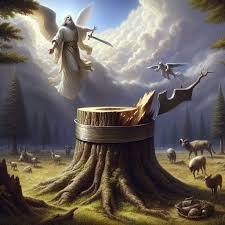
Your Majesty saw a holy one, an angelic messenger, coming down from heaven and saying: Cut down the tree and destroy it, but leave the stump, bound with iron and bronze, in the grass of the field, while its roots remain in the ground (4:23a). While much of what was said up to this point was a repetition of Nebuchadnezzar’s own words (4:13-15a), Dani’el then presented the king with a startling bit of new information. Dani’el reveals the reference of the tree symbol. It is Nebuchadnezzar himself; and he was also the subject of coming judgment. As the tree will be desolated, so he will be desolated. The Divine Lumberjack would bring the tree crashing to the ground, removing it from its place of influence and glory.161
But there was even worse news for Nebuchadnezzar. Dani’el continued: This is the interpretation, Your Majesty, and this is the decree the Most High has issued against my lord the king: Just as the subject of the dream will be reduced to an animal-like state, so you would be reduced from his humanity and become beast-like. You will be driven away from people and will live with the wild animals; you will eat grass like the ox. At night you will not come inside like a man, but remain in the open field. Thus, in the mornings you will be drenched with the dew of heaven (see Bx – Humiliation: The King’s Discipline). Years later, Dani’el would tell Nebuchadnezzar’s grandson Belshazzar that his grandfather lived with the wild donkeys (5:21). Seven years will pass by for you until you repent, and acknowledge that the Most High is sovereign over all kingdoms on earth and gives them to anyone he wishes. The command to leave the stump of the tree with its roots means that your kingdom will be restored to you when you acknowledge that Heaven rules (4:23b-26).
As Warren Wiersbe relates in his commentary on Daniel, the grand lesson ADONAI wanted the king to learn – and the lesson we must learn today – is that YHVH alone is sovereign and will not permit mortals to usurp His throne or take credit for His works. We are but creatures, and God is the Creator; we are only His subjects, but He is the King of kings. When men and women refuse to submit themselves to God as creatures made in His image, they are in grave danger of descending to the level of animals. It’s worth noting that the LORD used animals when He wanted to describe the great empires of history (see Bz – Dani’el’s Vision of Four Beasts), and that the last great world dictator is called the beast (see the commentary on Revelation Dn – All the Inhabitants of the Earth Worship the Beast).
Men and women are made in the image of ADONAI, but when we leave God out of our lives and resist His will, we can descend to the level of animals. Don’t be like the horse or the mule, warned King David, who was guilty of acting like both (Psalm 32:9). Like the impressive stallion, he rushed into sin when he committed adultery with Bathsheba (see the commentary on the Life of David Dc – David and Bathsheba), and then like a stubborn mule, he delayed confessing his sins and repenting (see the Life of David Dd – Nathan Rebukes David). When Messiah confronted Sha’ul of Tarsus on the Damascus Road, He compared the pious rabbi to a stubborn ox when He said: It’s hard for you to kick against the goads (Acts 9:5 and 26:14).162
Dear heavenly Father, praise Your love and wisdom that graciously lives within all who believe in You. Yeshua answered and said to him: If anyone loves Me, he will keep My word. My Father will love him, and We will come to him and make Our dwelling with him (John 14:23). Because You desire to bless, You warn using trials and problems. Both King Sha’ul and Sha’ul of Tarsus had trials; but only Sha’ul of Tarsus obeyed you.
Like clay hardening in the sun, so King Sha’ul’s heart remained proud and did not follow Your clear commands spoken by the prophet Samuel. On the one hand, King Sha’ul’s actions were prideful and showed that he thought more about himself than about wanting to please You. Sha’ul’s heart could have softened by the warmth of Your love, but he chose pride. On the other hand, Sha’ul of Tarsus’ heart melted like wax before You. He had been a blasphemer, and a persecutor of Your people (Acts 8:1-3). But after You struck him with blindness, his heart softened to obedience. His change of heart meant that You could use him as a choice instrument to carry Your Name before nations and kings and Bnei-Yisrael (Acts 9:15b).
You are always gracious, calling people to come back to You in repentance. The Lord is not slow in keeping His promise, as some consider slowness. Rather, He is being patient toward you – not wanting anyone to perish, but for all to come to repentance (Second Peter 3:9). May we wisely seek You when trials and problems come upon us and remember that life on this earth will soon be over with its trials. For I consider the sufferings of this present time not worthy to be compared with the coming glory to be revealed to us (Romans 8:18). In Messiah Yeshua’s holy Name and power of His resurrection. Amen
Leave A Comment