




Humiliation: The King’s Discipline
4: 28-33
Humiliation: the king’s discipline DIG: How long suffering had Ha’Shem been with King Nebuchadnezzar? Why didn’t he respond? What happened to Nebuchadnezzar when he began eating grass? Why did that happen to him? How long did it last? What extra-biblical evidence of Nebuchadnezzar’s madness is there?
REFLECT: How has ADONAI been long suffering with you? How long did He give you? How did you respond? When has your pride affected your life? Have you recovered from that episode? What did you learn? What is the very nature of pride look like? How can you help others avoid the mistakes of pride?
Pride comes before a fall.
The use of the third person in these verses is to be understood as a literary device to show that the king himself was unable to give an account of what happened while he was out of his mind. Up to this point Nebuchadnezzar seems to be the one in control, seemingly the master of his own fate. But after Dani’el’s interpretation (to see link click Bv – Interpretation: The King’s Danger), it is obvious that the Most High God is in control of both the world and the king’s fate.167 These verses were probably written by Dani’el and inserted in the official royal document, but Nebuchadnezzar picks up the narrative in verse 34. Luke followed a similar approach in Acts 23:25-30. Neither the Babylonian king nor the Roman officer was inspired by the Ruach Ha’Kodesh when they spoke, but Dani’el and Luke were led by the Spirit to include their writings in what we know as the Bible.168
Sadly, the warning of the dream (see Bw – Exhortation: The King’s Decision) was ignored by Nebuchadnezzar. A whole year went by, during which the king had plenty of time to repent and live his life differently. Instead, he mistook the merciful delay of God’s judgment as a sign that the warning could safely be ignored. Yet, all the events foretold in the dream did happen to King Nebuchadnezzar because God’s Word never fails to fulfill its purposes (4:28).169 ADONAI graciously gave Babylonian Monarch an entire year in which to obey His warning and repent of his sins, but the king refused to yield. Pride had so gripped his heart that he would not submit to the Most High God. Solomon tells us that when a crime is not punished quickly, people feel it is safe to do evil (Ecclesiastes 8:11). YHVH waited patiently in the days of Noah and gave mankind one-hundred-and-twenty years to turn from their sins, but they refused (First Peter 3:20 and Genesis 6:3). He gave Jerusalem almost forty years of grace after the religious leaders turned Yeshua over to the Romans to be crucified, but then they came and destroyed the Temple and the City. Just think how long suffering He has been with this present evil world (Second Peter 3:9).
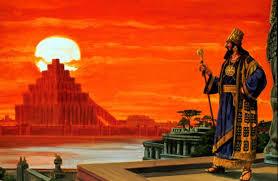
Twelve months later, as the king was walking on the roof of the royal palace of Babylon, he thought: Isn’t this the great Babylon I have built as my royal residence, by my mighty power and for the glory of my majesty (4:29-30)? Baylon was one of the preeminent cities in history during Nebuchadnezzar’s reign and was undoubtedly the most magnificent and probably the largest city on earth. Herodotus, the ancient Greek historian, visited Babylon about one hundred years after Nebuchadnezzar’s death and was overwhelmed by its grandeur. Eight gates provided access to the city, the most celebrated of which was the Ishtar Gate on the north side. This was a massive double tower rising to a height of forty feet and decorated with dragons of Marduk and bulls of Hadad. A bridge four hundred feet long spanned the Euphrates River and connected the east and west parts of the city. And not to be forgotten, Babylon also boasted of the famous “hanging gardens,” which the ancient Greeks considered one of the seven wonders of the world.170
When the king gazed out upon all of that grandeur, his heart was filled with pride, and pride is one of the sins that God hates (Proverbs 6:12-19). Pride leads to disgrace, but with humility comes wisdom (Proverbs 11:2 CJB). God opposes the proud but shows favor to the humble (Dani’el 4:6b; Proverbs 3:34; First Peter 5:5). It was pride that transformed the angel Lucifer into the Adversary (Isaiah 14:12-15), and it was pride that brought about the downfall of King Uzziah (Second Chronicles 26:16-21).
Even as the words were on his lips, a solemn Voice came from heaven interrupting the king’s egotistical boastings and announced that his time of probation had ended: This message is for you, King Nebuchadnezzar, your royal authority has been taken from you (4:31). We never know when ADONAI’s voice will speak or His hand will touch our lives. Whether it’s the call of Moses in Midian (Exodus 3), the drafting of Gideon to lead the Israelite army (Judges 6), the opportunity of David to kill a giant (First Samuel 17), the summons to the four fishermen to leave all and follow Messiah (Matthew 4:18-22), or the warning that life has come to an end (Luke 12:16-21), the LORD has every right to break into our lives and speak to us. What the king had learned from Dani’el’s interpretation of the dream (see Bv – Interpretation: The King’s Danger), he now heard from heaven! No one knows when their hour will come (Ecclesiastes 9:12a).171
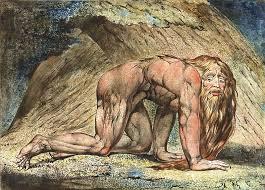
You will be driven away from people and will live with the wild animals; you will eat grass like the ox. Nebuchadnezzar appears to have suffered from a case of zoanthropy, the delusion that one has become an animal. This mental condition came upon him as divine judgment for his pride.172 Since Nebuchadnezzar had a beastly heart, God allowed his brutish nature to be revealed openly. It’s likely that Dani’el and the other officials managed the affairs of the kingdom until the king returned to the throne. That in itself was a strong witness to Nebuchadnezzar of God’s grace and Dani’el’s faithfulness.
Seven years (see the commentary on Genesis Ae – The Number Seven) will pass by for you until you acknowledge that the Most High is sovereign over all kingdoms on earth and gives them to anyone he wishes. Immediately what had been said about Nebuchadnezzar was fulfilled. He was driven away from people and ate grass like an ox. His body was drenched with the dew of heaven until his hair became matted and coarse from lack of care and came to look like the feathers of an eagle, and his uncut nails grew to look like the claws of a bird (4:32-33). Critics of the Bible contend that there is no external or historical evidence to support the biblical account of Nebuchadnezzar’s madness, which is not true. The following five examples of extra-biblical evidence are not exhaustive.
The first example concerns the archives of Nebuchadnezzar. There are no records of the king’s actions or decrees 582 and 575 BC. This is unusual in that the rest of his reign is well documented. Asserting that the ancient writers make no mention of this sickness in regard to Nebuchadnezzar, liberal critics of the Bible hold that the record cannot be historical. To this it may be replied, for one thing, that such an omission in official records is only to be expected. Kings only wrote matters that put them in a favorable light. They omitted events that put them in an unfavorable light. Another example of this is when the Assyrian king Sennacherib omitted his defeat after one hundred and eighty-five thousand of his troops were killed by the Angel of ADONAI outside Jerusalem. He never mentioned it in his annals.
A second example comes from the third century BC. Berossus, a Babylonian priest and astronomer of that era, recorded that after forty-three years in power, Nebuchadnezzar suddenly fell ill. Berossus’ text was preserved by Josephus, who quoted it at length in Against Apion (1:20). The reference to the illness that preceded Nebuchadnezzar’s death is unusual because sickness was typically omitted in ancient records. The fact that Berossus mentioned it may be a reference to the uniqueness of Nebuchadnezzar’s illness.
A third example came roughly a century later by the Greek historian Abydenus. Three statements from him are relevant to the discussion of Nebuchadnezzar’s madness. First, he wrote that Nebuchadnezzar was “possessed by some god or another.” This phrase was used in ancient times to indicate that someone was mentally ill. Second, he stated that Nebuchadnezzar suddenly vanished for a period of time, which parallels Dani’el’s statement that the king lived in the fields like an animal. And third, that the events described in Dani’el 4 and this quotation happened near the end of Nebuchadnezzar’s reign.
A fourth example is found in the British Museum, which houses a clay tablet with the designation BM34113. Several lines of this tablet describe Nebuchadnezzar’s erratic behavior, including that “his life appeared to be of no value to him.” It has also been suggested that an Aramaic fragment excavated from Qumran Cave 4 in 1952 and attributed to Babylon’s last king Nabonidus is actually recounting Nebuchadnezzar’s madness.
And the last example comes from Nebuchadnezzar’s son-in-law, Nabonidus. In a prayer attributed to him, Nabonidus appears to describe what happened to the king rather than to himself. Either directed at himself rather than the king as a polite gesture or to save his head. “I was smitten [with a malignant disease] for a period of seven years, and became unlike men. [But when I confessed my sins] and faults, God gave me a magician. He was a Jew from [those exiled in Babylon]. The king gave an explanation [of his absence], and wrote an order that honor and [great glory] should be given to the Name of the [Most High God].”173
As Iain Duguid relates in his commentary on Dani’el, it is worth noticing where Nebuchadnezzar’s eyes were directed at the beginning of his time of judgment. At the beginning of the episode he was on his lofty perch, walking on the roof of the royal palace, from where his eyes could roam sideways and downward, comparing his glory to that of other men and glorifying himself. He thought of himself as the center of the universe, the tree from which everything else received its nourishment (see Bu – Agitation: The King’s Dream). This is exactly what pride does: it locates the self at the center of the universe, glorying in its own accomplishments, and putting everyone else down. Its eyes are always directed sideways or downwards, comparing oneself with others, and endlessly trying to outdo them. In its very nature, pride has to be cleverer than someone else, or more attractive than other people, or a better cook, or a faster runner, or a more skilled gardener, or whatever. Pride is never satisfied in what has been accomplished because it lives to defeat others, regardless of the contest. Thus, the eyes of pride are always fixed on oneself and one’s’ performance, in a way that leaves no room for looking upwards to God.174
Dear heavenly Father, praise You for being the perfect loving and wonderful heavenly Father of all who believe and follow You. Children love to take pride in their fathers and You are absolutely the best father that ever could be! But having a holy fear of You is so wise. The fear of ADONAI is the beginning of knowledge, but fools despise wisdom and discipline (Proverbs 1:7). When someone’s haughty pride makes them full of themselves, it’s like a cancer growing that will destroy them. Humility, thinking of oneself in a humble way that puts God first is what blesses a person (Proverbs 22:4). Do not be wise in your own eyes; fear Adonai and turn away from evil. It will heal your body and refresh your bones (Proverbs 3:7-8). Delighting in obeying You and humbly following your Torah is what makes a person sure-footed so as not to slip nor stumble. From ADONAI a man’s steps are made firm, when he delights in His way (Psalm 37:23). Thank You for being such a wise and wonderful heavenly Father who delights in helping and guiding me. In Messiah Yeshua’s holy Name and power of His resurrection. Amen
Leave A Comment