




Dani’el’s Vision of Four Beasts
7: 1-28
Dani’el 2 gives us the perspective of the times of the Gentiles from a human viewpoint as something majestic, but Dani’el 7 gives us the perspective from God’s viewpoint as something dreadful.
Dani’el is one of the most significant books in the Bible in terms of the chronology of future events because it contains essential information concerning the key figures and time sequences of the far eschatological future. It is difficult to understand prophetic chronology without consulting the book of Dani’el. There are visions in Dani’el that detail what YHVH would do beginning in the sixth century BC until the Messianic Kingdom. Thus, Dani’el can be seen as the foundation for the key themes of biblical prophecy. Dani’el did not attempt to write history when he wrote his book; rather, he was developing a theme.183 Here is an overview of Dani’el’s prophecies in chronological order:
602 BC prophecy of the Great Statue (2:1-45) when Dani’el was 18.
553 BC prophecy of the Four Beasts and the Ancient of Days (7:1-28) when Danie’l was 67.
551 BC prophecy of the Ram and Male Goat (8:1-27) when Dani’el was 69.
539 BC prophecy of the Fall of Babylon (5:1-31) when Dani’el was 81.
539 BC prophecy of the Seventy-Weeks (9:1-27) when Dani’el was 81.
536 BC prophecy of the Future Nations (11:2-45) when Dani’el was 84.
536 BC prophecy of the Future of Isra’el (12:1-13) when Dani’el was 84.
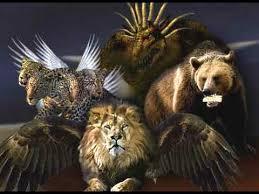
This far eschatological prophecy provides the interpretation of Nebuchadnezzar’s vision. In order to understand the Times of the Gentiles (to see link click Ao – The Times of the Gentiles), Chapters Two (see Aq – Nebuchadnezzar’s First Dream) and Seven must be viewed together. An angel told Dani’el that the four beasts represented four empires, the same sequence of empires that Nebuchadnezzar had seen in his dream in Chapter Two. However, there, the king saw a great and impressive statue made of valuable metals, while here, Dani’el saw dangerous beasts that ruthlessly devoured peoples and nations. To the human eye, the nations of the world are like Nebuchadnezzar’s great statue, impressive and important; but from ADONAI’s viewpoint, the nations are merely ferocious beasts that attack and seek to devour one another.184 We can compare these chapters in three ways. First, they are visionary. In Chapter 2 the visionary was a pagan king, Nebuchadnezzar, but in Chapter 7 the visionary was Dani’el himself. Secondly, we can compare the interpreters. Dani’el was the interpreter in Chapter 2, but an angel was the interpreter in Chapter 7. Thirdly, we can compare the two perspectives.
In Chapter 7 four empires are pictured as four beasts. They describe four temporary Gentile Empires, with an emphasis on the fourth, which goes through several stages. Finally, the Fourth Empire will be destroyed by the Fifth Empire, the Kingdom of Messiah, which will last for a thousand years (see Revelation Fh – The Dispensation of the Messianic Kingdom), before the onset of the Eternal State (see the commentary on Revelation Fq – The Eternal State).185The different stages would be viewed as follows:
Dani’el’s Visions – 7:1-14 (Cb)
The Kingdoms of This World – 7:1-6 (Cc)
The Kingdom of Satan – 7:7-8 (Cd)
A Vision of the Heavenly Court – 7:9-12 (Ce)
The Kingdom of Messiah – 7:13-14 (Cf)
Leave A Comment