

Bx – Honesty and Justice 11: 16-22

Honesty and Justice
11: 16-22

A proverb is a short and memorable saying designed to be our blueprint for living in the world that ADONAI has created. It is important to note that proverbs are not promises; they are generally true principles, all other things being equal.

A gracious woman takes hold of honor (11:16a Hebrew). This is a contrasting proverb. The first contrast between the two cola is found in the subject of the verb: gracious, which is clearly contrasted with violent. Someone who is characterized by grace; thus, someone who acts for the benefit of others, not expecting anything in return. She is respected and loved by others for her actions. Her reward will be honor. But violent men will only take hold of wealth (11:16b Hebrew). On the other hand, violence implies a willingness to take what is wanted, by force if necessary. The reward for such violence is wealth (Ps 73), which sounds good on the surface, but at the end of his life, his wealth will only slip through his fingers like dry sand (see The Life of Solomon, to see link click CoThe Bitterness of Disappointment). That is, wealth without honor. To be sure, Proverbs does not regard wealth as bad in and of itself, and in the right context it indeed signifies a blessing from ADONAI (3:9-10, 8:17-21). But Proverbs also recognizes that evil people can obtain wealth (13:11) and that such wealth will often harm those who have it (21:6).

A faithful (Hebrew: chesed) man will be rewarded, but a cruel man only does harm to himself (11:17 Hebrew). Two classes of people are contrasted in this proverb. It offers itself as an observation, but as such, it also clearly intends to give implicit advice. After all, one course of action leads to reward, while the other to harm. In the first cola, a faithful man is characterized by chesed. This is the kind of love that ADONAI shows to those who are bound in a covenant relationship with Him (see Ruth AfThe Concept of Chesed). It is a love where the interests of the other person are supreme. One who loves another in such a way protects and does not harm the other person. This would be contrasted to cruel people, who harm others for their own gain. The paradox of the proverb is that those who look out for others because of covenant love find that their lives are better. On the other hand, those who are cruel to others only end up hurting themselves.

The profits of the wicked are illusory; but those who sow righteousness gain true reward (11:18 Hebrew). Here we have another observation of how different actions lead to different consequences. By making this observation, Solomon is interested in influencing people’s behavior. After all, it is clear which is preferable: illusory prophets or righteous true reward. The point of the parable is to encourage righteous deeds leading to true reward. Just what constitutes wicked and righteous deeds are not detailed, but are made obvious throughout Proverbs as it describes the actions of the wise/righteous over those of the foolish/wicked. The prophets of the wicked are illusory because they don’t last that long. Proverbs is aware that the wicked may have wealth, but either it will not last (13:11), or else it will actually harm the one who has it (21:6).

Genuine righteousness leads to life, but the pursuit of evil brings death (11:19 BSB). This observation, like the previous two, clearly describes opposite actions that lead to opposite conclusions. Once again, the consequences are such that they are intended to influence behavior. The nature of genuine righteousness and the pursuit of evil are not specified, but the rest of the book fills out the picture.247

For two and a half years, the House of Shammai and the House of Hillel disputed. The House of Shammai argued that it would have been better [alternatively, easier] for man had he not been created, and the House of Hillel argued that it was better for mankind to have been created. In the end, a vote was taken, and it was decided, “It would have been better for man not to have been created, but now that he has been created, let him examine his deeds.” Others say, “Let him consider his future actions” (Babylonian Talmud, Eruvin 13b, cited in Telushkin, page 216). The sages Shammai and Hillel, who lived just before the time of Yeshua, knew the biblical view of the human heart. For all of us have become like one who is unclean, and all our righteousness is like a filthy garment, and all of us wither like a leaf, and our iniquities carry us away like the wind (Isa 64:6). As a result, there is none that does good, no not one (Ps 14:3). Yet, by using wisdom, people could choose what path to take. In other words, people could override their crooked hearts.

There are two paths presented to us in this proverb. The crooked heart is an abomination to ADONAI, but He delights in those who are blameless (11:20 Hebrew). The first was an abomination to ADONAI. This is a frequent term in Proverbs and describes the ones whose ways are repulsive to God. The second way is a delight to Him. This word is used in ADONAI’s favor. For believers, who are empowered by the Ruach Ha’Kodesh, this is a choice. It is not merely a warning to unbelievers. Paul speaks of this when he says: Those who identify with the old sin nature set their minds on the things of the old sin nature (Romans 8:5). So, Paul’s teaching and Solomon’s are similar. Those who follow the worldly desires that are universal in human hearts will commit abominable acts before God.

On the other side of the coin are those who accept no compromise. Their way is blameless. This description does not necessarily refer to perfection, for it is used of mortal humans such as Job, who was said to be blameless and upright (Job 1:1). In the book of Job we see him as sinning by doubting ADONAI, so we know that blameless isn’t the same as “perfect.” Rather, it means not subject to judgment. We should follow the path that is blameless or innocent. Whenever we speak, our words should be truthful and from pure motives.

Proverbs 12:22 gives a contrast identical to that of 11:20. ADONAI detests lying words, but He delights in those who tell the truth (12:22). Lying lips or dealing faithfully – that is the choice between being repugnant to Ha’Shem and being acceptable to Him. When Isaiah stood before God he realized that his lips were unclean (Isaiah 6:5). He may have meant that he had some sin issue, such a lying, to deal with. Or it may have been that dishonest lips represented the general sinful condition of mankind. Whatever the case may have been, we ought to take seriously the need to be honest in everything we say. The Lord will reward those who deal faithfully, and with honesty and justice.

The converse is that Ha’Shem will judge those who lie and deceive. One way He does this is through natural consequences, as Solomon recognized. Godliness guards the path of the righteous, but wickedness undermines the sinner (13:6). The person who is honest is protected when something goes wrong. But the one who is dishonest will often be found out. His own dishonesty will ruin him. As stated above, it is important to note that proverbs are not promises; they are generally true principles, all other things being equal.

Believers in Messiah are called to a high standard of honesty. Not only did Solomon recognize that honesty is essential in our relationship with YHVH, but Yeshua also thought so. He called on believers to be so known for their honesty, that their taking oaths would be unnecessary. Rather, our Lord said: Just let your “Yes” be a simple “Yes,” and your “No” be a simple “No;” anything more that comes from the evil one (Matthew 5:37). The next time you consider using a little lie to get something you want, remember how ADONAI views it.248

You can be assured that the wicked will not go unpunished, but the descendants of the righteous will be delivered (11:21 Hebrew). In the first colon, punishment of the wicked is stated, though not specified. Based on the fact that this phrase occurs in the revelation of the name of YHVH (Exodus 34:6-7), this verse implies that Ha’Shem stands behind the proper punishment of the wicked. The second colon shows the benefits of righteousness. After all, the benefits not only go to the righteous but are also extended to their children.

Like a gold ring in a pig’s snout, is a beautiful woman who lacks discretion (11:22 Hebrew). The picture this proverb conjures up in our minds is striking, powerful, and memorable. The gold ring is small, but expensive and attractive to look at. The pig is ugly and dirty, but there is more here for the Jewish audience. The pig is considered unclean, according to Leviticus 11:7 and Deuteronomy 14:8. In fact, the pig is considered the apex of all animals and foods that are unclean. But, the emphasis here is on the pig as the personification of indiscretion. After all, the pig rolls in the mud and feces, eats scraps, and is generally a mess. Solomon, though, is writing from the perspective of the man. As one looks at the pig and only sees the gold ring, so is a man who is so enamored by a woman’s physical beauty that he doesn’t recognize her lack of discretion. The sage is warning those who will listen that her beauty is not worth all the problems that her indiscretion will inflict on him. Later, in the acrostic poem concerning the virtuous wife (see Dy – Wisdom for Women), Solomon will affirm that what is really important is not charm or beauty, but rather her fear of ADONAI.249

Dear Heavenly Father, praise You that You are totally righteous and just. Righteousness and justice are the foundation of Your throne. Lovingkindness and truth go before You (Psalm 89:14). Someday everyone will stand before You and want to enter Your holy heaven. With righteousness and justice You will allow only those who are clothed in Messiah’s righteousness. He made the One who knew no sin to become a sin offering on our behalf, so that in Him we might become the righteousness of God (Second Corinthians 5:21).

How comforting it is that it is not the wealthy who will get into heaven, nor those who are the best dressed, not the wealthiest, but only those who believe in You as their Lord and Savior. For if you confess with your mouth that Yeshua is Lord, and believe in your heart that God raised Him from the dead, you will be saved. For with the heart it is believed for righteousness, and with the mouth it is confessed for salvation. For the Scripture says, “Whoever trusts in Him will not be put to shame” (Romans 10:9-11).

Thank you for opening heaven’s doors to all who love you. For you are all sons of God through trusting in Messiah Yeshua.  For all of you who were immersed in Messiah have clothed yourselves with Messiah.  There is neither Jew nor Greek, there is neither slave nor free, there is neither male nor female – for you are all one in Messiah Yeshua (Galatians 3:26-28). 

You will look into the hearts and you will see who really loves you. Only those whose hearts have been made holy by washing in the blood of the Lamb- Messiah Yeshua’s blood will be able to enter heaven. They overcame him by the blood of the Lamb and by the word of their testimony, and they did not love their lives even in the face of death. (Revelation 12:11). You will welcome into heaven all whom You have made Your children because they trust in You (John 1:12). In Yeshua Messiah’s holy Name and power of His resurrection. Amen

2025-11-14T10:58:24+00:000 Comments

Bw – Security in Wisdom 11: 10-15

Security in Wisdom
11: 10-15

A proverb is a short and memorable saying designed to be our blueprint for living in the world that ADONAI has created. It is important to note that proverbs are not promises; they are generally true principles, all other things being equal.

The whole city celebrates when the godly succeed; they shout for joy when the wicked die (11:10 NLT). While it is people who are righteous or wicked, the influence of their character goes far beyond themselves. This proverb makes this observation by saying that the presence and prosperity of the righteous and destruction of the wicked are good for the whole city. What would that look like? The flourishing of the righteous means that they would hold positions of influence and authority. Occupying governmental positions where righteous behavior would lead to security in the community and the alleviation of oppression. On the other hand, the wicked encourage injustice and oppression. Therefore, their absence benefits the community as a whole.

By the blessing of the upright, a city is raised up; but the words of the wicked tear it down (11:11 CJB). We can see the obvious relationship between verses 10 and 11. The first colon is especially close to the first colon of verse 10. However, here the positive elements of society are referred to as the upright; that is, those with integrity reflecting in godly actions. We could also call them the righteous of the TaNaKh. As they are blessed, the whole city benefits. That blessing may come through an increase in material prosperity, through better health, through a good reputation, or through advancement through positions of influence. The blessing is unspecified, allowing us to fill in all of these other possible tangible expressions.

Whoever despises his neighbor lacks heart, but the one who has understanding (2:2) keeps silent (11:12 Hebrew). The contrast in this proverb is between one who despises his neighbor and one who remains silent. Reading the second colon in light of the first leads us to believe that the silence points to the despising neighbor. In other words, the fool (here described as the one who lacks heart) verbally abuses the neighbor while the wise (here described as the one with understanding) does not respond. The characterization of the fool as the one who lacks heart is interesting. The heart is the core of our personality. Earlier the godly father had encouraged his son to: store my commands in your heart (3:1). Fools have nothing inside to share with others or even sustain themselves. In this context, the expression may more specifically point to a lack of discernment or judgment. We have already seen this phrase in 6:32, and 10:13 and 21. On the other hand, the wise are characterized by using few words (13:3, 15:4, and 17:28).

A gossip betrays a confidence, but a trustworthy person keeps a secret (11:13 NIV). Again, we can see a connection with the previous proverb. One way of despising a neighbor is by gossip and revealing a secret (Proverbs 16:28, 18:8, 20:19, 26:20, 26:22; Romans 1:29 and Second Corinthians 12:20). The wise person, though, knows better and keeps silent. Slander, closely associated with gossip, is also connected with the foolish, “He who covers up hate has lips that lie, and anyone who slanders is a fool.” Slander involves speaking to third parties about a person with the intention of harm, not help. The wise, here called a trustworthy person (which implies someone who is true to their word), does not engage in such sinful behavior. The wise person might rebuke someone, but it would be done with the intention of helping that person, not hurting them (24:25; 25:12, and 27:5).

For lack of guidance a nation falls, but victory is won through many advisors (11:14 NIV). The point of this observation is clear. Planning is pivotal for the survival of a city. In this, we seem to be getting back to the topic of verses 10 and 11, where it is the wise who are good for society. Without guidance a city falls, but with counsel the city will have victory. The language suggests a military situation and reminds us of Solomon’s anecdote: Here is something else I have seen as wisdom under the sun, and it seemed important to me: there was a small town with few people in it; and a great king came to attack it; he surrounded it and built massive siege-works against it. Now there was found in it a man who was poor but wise, and by his wisdom he saved the city (Ecclesiastes 9:13-15a).

Guidance and counsel come only from those with wisdom after all. So it is the wise who are needed at times of crisis. Guidance may have the specific sense of military strategy here in 20:18 as well as 24:6 (the latter is very close to 11:14 in thought as well as wording). Solomon’s anecdote goes on to show the limitations of wisdom, at least for the one who possesses it: Yet afterwards, nobody remembered that poor man. So, although I say that wisdom is better than strength, nevertheless the poor man’s wisdom is despised; nobody pays attention to what he says (Ecclesiastes 9:15b-16). Proverbs, though, are not concerned about the ultimate value of wisdom in and of itself. It simply makes the point that military planning by those who possess wisdom is a valuable, indeed lifesaving service.

Whoever puts up security for another will surely suffer, but whoever refuses to shake hands in a pledge is safe (11:15 NIV). The book of Proverbs calls on people of means to be generous toward those in need (29:7 and 14). However, it frequently warns against helping others make loans. In the first place, the Torah is against loans with interest to fellow Israelites (see the commentary on Leviticus, to see link click EtThe Poor and Interest). My people among you who is needy, do not be like a moneylender and charge him interest. If you take your neighbor’s cloak as a pledge, return it to him by sunset, because his cloak is the only covering he has for his body. What else will he sleep in? When he cries out to Me, I will hear, for I am compassionate (Exodus 22:25-27).245

Today, this would be analogous to cosigning for a loan. Isra’el’s sages urge that the theme of 6:1-19 is not to discourage people from lending money or performing acts of loving-kindness. Lending was intended as a means of helping a fellow Israelite, not as a money-making transaction as it is today. Interest could be applied to a loan to Gentiles, but even then, an unreasonably high interest rate was illegal. Exorbitant interest often resulted in injustice (Second Kings 4:1; Nehemiah 5:1-11) which the Torah sought to prevent. The warning of 6:1 is not so much against borrowing or lending but against being held accountable for another person’s high-interest loan. The tenor of the proverb seems to be that a person could lose money from securing a loan for a Gentile. Putting up security is referred to frequently in Proverbs 11:15, 17:18, 20:16, 22:26-27, 27:13.246

The consequence of this teaching is especially painful for my family. In 1928 my grandfather foolishly cosigned a loan to enable a relative to buy a farm. But in 1929 the stock market crashed and America entered the Great Depression. My grandfather couldn’t pay the bank for the loan that he cosigned and lost the thousand-acre farm that had been in our family for 110 years, the land deed being signed by President James Monroe. My grandparents and my mother, a child at the time, were economically ruined as a result (see BdAvoid Foolish Financial Entanglements).

Dear heavenly Father, praise You for graciously giving wisdom to all who seek it from You. But if any of you lacks wisdom, let him ask of God, who gives to all without hesitation and without reproach; and it will be given to him (Ja 1:5). Your wisdom is amazing! You created the entire universe by Your Word! You hold together the atoms of the universe together! For by Him all things were created – in heaven and on earth . . . All was created through Him and for Him. He exists before everything, and in Him all holds together (Col 1:16a and 17). Thank You for being gracious in giving wisdom to those who ask for it. In Messiah Yeshua’s holy Name and power of His resurrection. Amen
2025-11-14T10:23:47+00:000 Comments

Bv – Security Through Righteousness 11: 1-9

Security Through Righteousness
11: 1-9

A proverb is a short and memorable saying designed to be our blueprint for living in the world that ADONAI has created. It is important to note that proverbs are not promises; they are generally true principles, all other things being equal.

False scales (11:1a CJB): The necessity of honest trading is stressed in Hebrew ethics (see the commentary on Deuteronomy, to see link click EvHonest Weights and Measures). This book refers to the subject again in 26:11 and 20:10 and 23. Prophetical denunciations of the use of false weights and measures are found in Amos 8:5 and Micah 6:11. The Talmud includes several regulations to ensure honest dealing between seller and buyer, “The shopkeeper must wipe his measures twice a week, his weights once a week, and his scales after every weighing.” This proverb applies the book’s teaching on honesty and deception to business practices. The point is very clear: ADONAI hates cheats and loves those who charge what is fair. The term false (Hebrew: mirmah, meaning deceit, guile or treachery) is used elsewhere in Proverbs (12:5, 17 and 20, 14:8 and 25, 20:23).

Are an abomination to ADONAI (11:1b CJB). The phrase abomination to ADONAI is used a number of times in the book (3:32, 11:20, 12:22, 15:8-9 and 26, 16:5, 17:15, 20:10 and 23) to indicate the utmost divine censure against something. It offends God’s moral order. The list of abominable things includes depravity, corruption, deceit, hypocrisy, wickedness, and pride. But accurate weights please Him (11:1c CJB). Whatever Ha’Shem hates must be avoided. So, to be accepted by God in one’s transactions, one must deal honestly.

Pride (Hebrew: zadovn) leads to disgrace (11:2a CJB). In a number of places in Proverbs (3:5 and 7, 6:17, 11:114, 25:6-7, and so on), fools are associated with pride and the wise with humility. This proverb fits that pattern. Pride does not allow fools to listen to advice or learn from their mistakes. The consequence is, therefore, unavoidable. They are doomed to repeat their foolish behavior, and this brings disgrace on them. In 13:10 we learn that those showing pride get themselves in arguments, probably because they would rather fight than listen to those who would criticize them. In that verse, the prideful are contrasted with those who would listen to advice (also see 21:24).

But with humility comes wisdom (11:2b CJB). Those who are humble do not put up defenses and thus allow themselves to hear criticism and change their behavior in a positive manner. This is reflected in Micah 6:8 where we read: He has told you, O man, what is good and what does the LORD require of you but to act justly, and to love mercy, and to walk humbly with your God? It, along with acting justly and loving mercy is a characteristic of a person who obeys the mitzvot of ADONAI. The whole principle is paradoxical. When people hold themselves in high estimation, they will be vilified; but the more they are aware of their weaknesses, the more they will achieve a success that will bring them glory.

Honesty guides the upright, but the crookedness of the faithless destroys them (11:3 Hebrew). Their integrity is their standard conduct and proves a reliable safeguard against error and danger. Again, this is another version of the contrast drawn between the wise and the foolish. Specifically, it highlights innocence and dishonesty as their respective traits. Innocence implies a kind of transparency that is completely missing from the faithless. What one hears and sees honestly reflects those with integrity. After all, they have nothing to hide. Yet, the faithless conceal, which ultimately leads to their destruction.

Riches won’t help you on the day of wrath, but righteousness can save you from death. The day of wrath does not refer to an end-time judgment (not a focus in the wisdom books), but rather to a future time of disaster such as military invasion, famine or other crisis that can sweep away carefully gathered wealth.240 The righteous are directed by honesty (11:4-5a Hebrew). Rabbi Abraham Cohen states, Righteousness leads him along the safest route to his desired goal, removing all obstacles from his path (3:6). Proverbs has nothing against riches. In fact, the book suggests that wealth can be a blessing from God for wise behavior (3:9-10 and 15-16, and 10:22). Indeed, 10:15 suggests that the wealth of the rich can protect someone against the troubles of this world. The present proverb, however, makes it clear that such protection is limited and certainly not as helpful as righteousness.241 But the wicked are trapped by their own wicked desires (11:5b and 11:6b Hebrew). Like a dog returns to its vomit, the wicked will repeat their own evil deeds.242

Very few of the blatantly wicked get away with their crimes forever. Even Mafia types – famous gangsters like Al Capone – have their day of wrath, their judgement day. Some pay in ways that we never see. Perhaps they escape jail, but they live in their own prison, outcasts because of their crimes. Many a womanizer dies a lonely death, with no woman to love and care for him because he did not love and care for any woman. Many a cheat ends up poor, because no one would trust him to do business with him. The consequences of evil, though there are exceptions, eventually catch up with most of us.

“Crime doesn’t pay,” the saying goes. In a sense, this “Retribution Principle,” that humility brings wisdom and faithlessness destroys the wicked, is common sense. Dishonest, cruel, or immoral deeds have a way of being found out and of bringing trouble to those who practice them. This is the law of natural consequences, but it goes much deeper. Justice is a part of human nature, built into us by our Creator. As wisdom was the first of God’s great words and built into the fabric of the universe (see BlWisdom’s Existence before Creation), we shouldn’t be surprised by the Retribution Principle. The principle of reward and punishment is fundamental to existence in this universe. We are moral beings made in the image of God who is just.

Opposed to the wicked, the righteous walk on a level, straight path. That is, life’s bumps and curves are smoothed out before them, making life easier to live. In fact, the righteousness (Hebrew: tsedaqah) of the upright will deliver them from perils (11:6a BSB). The word translated deliver has the sense of being snatched out of danger. When danger comes upon them, the upright (Hebrew: tamim) often find themselves snatched out of danger (see Revelation ByThe Rapture of the Church). Perhaps a financial shortfall comes to them, but ADONAI meets their needs. Perhaps they experience loss, but they do not add to their grief the guilt that the loss might be a judgment for sin. The way of innocence is smooth and straight.

There is certainly a sense in which divine providence will bring blessing to the righteous and curses to the wicked. As 17:13 says: If you repay good with evil, evil will never leave your house. However, there is also a fundamental law of the universe – requiring no special act of divine providence – by which the wicked will be hurt by their own deeds. As the apostle Paul says so eloquently: Do not be deceived – God is not mocked. For whatever a man sows, that he also shall reap. For the one who sows to the flesh will reap corruption from the flesh. But the one who sows to the Ruach will reap from the Ruach eternal life (Galatians 6:7-8). The righteous, in the sense now of the redeemed, are not saved by their good deeds, but they are characterized by them. As a result, let us not live according to our old sin nature and reap its curses, but surrender to the Ruach Ha’Kodesh and receive His rewards.243

When the wicked die, their hopes die with them, for they rely on their own feeble strength (11:7 NLT). The finality of death is an important reminder, as death puts an end to any future plans and money-making schemes. The wicked have no hope beyond the grave, but that is not the point being made here. This optimistic proverb suggests that in the end people get what they deserve. The righteous are delivered from trouble, but the wicked come to take his place (11:8 CJB). It implies that the righteous sometimes find themselves in distress, trouble of some sort that arouses anxiety. But, eventually they will be delivered from that distress. Even more encouraging to those who desire to see things work out so that the righteous get their reward and the wicked get their just punishment.

Such teaching would help the righteous get through their struggles. We see this developed in Psalm 73. Asaph confesses that at one point he was confused and even angry as he struggled in life but saw his wicked neighbors living what seemed to be carefree lives. I envied the arrogant when I saw the prosperity of the wicked (Psalm 73:3). Finally, through what seems to amount to a divine revelation of sorts, he recognized that present realities obscured the real nature of things. When I tried to understand all this, it was too hard for me, that is until I entered the sanctuary of God; then I understood their final destiny (Psalm 73:16-17). Ultimately, everyone gets what they deserve (see the commentary on Revelation FoThe Great White Throne Judgment). It is important to understand that proverbs are not promises; they are generally true principles, all other things being equal.

With his mouth the godless man destroys his neighbor, but through knowledge the righteous are delivered (11:9 BSB). This proverb contrasts the effects of fools (here described as godless) and the wise (here named the righteous). The contrast is between the mouth of the godless and the knowledge of the righteous. In the first colon, we are likely to understand this to mean that the speech (advice, counsel) of the godless leads to harm to those who listen to them because it lacks knowledge. And in the second colon, the knowledge of the righteous, when spoken, allows not only the righteous but also their neighbors to navigate life’s difficulties. This theme will continue in the next few proverbs.244

Dear heavenly Father, praise You for always being perfectly just and fair. Righteousness and justice are the foundation of Your throne. Lovingkindness and truth go before You (Psalm 89:14). Though things may look unfair when we see a wicked person prospering, For I envied the arrogant, when I saw the prosperity of the wicked (Psalms 73:3). Yet in the end – for all eternity, the wicked will only endure pain and torment and the righteous will rejoice with you forever in your eternal home. They do not have any wisdom to point their compass towards heaven. So they say: “How does God know? And does Elyon have knowledge?” (Psalms 73:11).

Yet, when I place the situation in Your hands, and think of how long eternity is, then I know their time of false happiness will be over in a blink and in its place, they will come to ruin and destruction. Until I entered the Sanctuary of God, and perceived their end. Surely You put them in slippery places. You hurled them down to destruction. How suddenly they became a ruin – terminated, consumed by terrors. Like a dream when one awakes, thus when You arise, my Lord, You will despise their form (Psalms 73:17-20)

The only way to have security for all eternity is to trust God and believe in Him.  But whoever did receive Him, those trusting in His name, to these He gave the right to become children of God (John 1:12). God will give His children Messiah’s righteousness and clothed in His righteousness; they will be able to live in heaven. He made the One who knew no sin to become a sin offering on our behalf, so that in Him we might become the righteousness of God (Second Corinthians 5:21). In Messiah’s holy Name and power of His resurrection. Amen

2025-11-15T13:30:41+00:000 Comments

Bu – Wise Words on Wise Speech 10: 27-32

Wise Words on Wise Speech
10: 27-32

A proverb is a short and memorable saying designed to be our blueprint for living in the world that ADONAI has created. It is important to note that proverbs are not promises; they are generally true principles, all other things being equal.

Wise Words on Wise Speech

The fear of ADONAI is at the heart of wisdom according to 1:7 (also see 14:26-27, 15:16 and 33, 16:6, 19:23, and 22:4). So again, this proverb contrasts the fate of the wise, who are righteous, with that of the foolish, who are wicked. One who fears ADONAI will act in a way that conforms to His will. Later Yeshua would say: If you love Me, you will keep My commands (John 14:15). But those who do not (the wicked) will ignore His commands. Everything being equal, living in a way that conforms to God’s will adds length to life. After all, such a one lives in conformity with the way YHVH set up the world at creation. To take one example, the mitzvah and wisdom of Proverbs insist that it is Ha’Shem’s desire that sex be enjoyed within the commitment of marriage. The rebels who ignore this command bring great danger upon their lives, whether from sexually transmitted diseases (known in antiquity) or from the revenge of the other woman’s husband (6:30-35). Though not specified by this proverb, it is possible that the years of the wicked are cut short by Ha’Shem Himself, either through human means or divine intervention (10:27 CJB). The purpose of this proverb is to motivate people toward fear of ADONAI. But since all things are not always equal, sometimes the righteous of the TaNaKh die young.

Both the righteous and the wicked have hope for the future, but when the future comes, the wicked’s hope is dashed, while the righteous experience joy. The hope of the righteous brings joy, but the expectation of the wicked comes to nothing (10:28 NIV). This may be seen as a general statement, with the previous verse serving as an illustration. Proverbs are not promises; they are generally true principles, all other things being equal. Both the righteous and the wicked hope for long lives, but the years of the wicked can be cut short, thus, their hope is destroyed. On the other hand, the days of those who fear ADONAI, who are righteous, are lengthened, and therefore their hope leads to happiness. Again, the purpose of the book of Proverbs is to motivate toward righteousness and away from wicked actions. We see a similar idea in 10:24.

The path of ADONAI is a stronghold to the upright, but destruction awaits those who do evil (10:29 Hebrew). This proverb picks up on the path metaphor that is frequently encountered in Chapters 1-9. Typically, there is a contrast drawn between two paths: the straight and narrow path, provided by ADONAI, leads to life; and the other, a wide and crooked path, leads to death (see The Life of Christ DwThe Narrow and Wide Gates). Reading this proverb in light of the previous descriptions of the path, we would have to say that the reason the path of ADONAI is a ruin for those who do evil is that they avoid it by choice. On the other hand, the upright used here is another term to refer to the godly wise, who find that they are protected, presumably from life’s problems, including those perpetrated by doers of evil (Psalm 27 ).

This is the fourth and last proverb in a row that contemplates the fate of the righteous of the TaNaKh and the wicked. The righteous will never be moved, but the wicked will not remain in the Land (10:30 CJB). Here we have the question of relative stability. While the righteous will never be moved, or shaken, the wicked will be expelled from the Land. When one is shaken, it is the result of great trouble. Therefore, the wicked will live lives of great instability. In particular, they will not be allowed to grow roots in the Promised Land. We have seen this threat leveled against the wicked already in 2:21-22 (also see 10:25). This proverb draws a relatively rare explicit connection between proverbial wisdom and land theology. The principle behind this proverb is developed further in the Psalms (see Psalms BqDelight Yourself in ADONAI).

Here we have a contrast drawn between the wise and the foolish (here called the corrupt tongue, which we also see in 2:12 and 14). The mouth of the righteous brings forth wisdom, but the corrupt tongue will be cut off (10:31 CJB). The focus is on their respective speech, here represented by the mouth and the tongue (paired also in 15:2, 21:23, 26:28, and 31:26). The righteous are praised because their speech is wise and thus has the effect of wisdom in general . . . promoting life and avoiding death. However, the corrupt tongue meets its appropriate fate when it is cut off (Psalm 12:3).237 The term cut off means to be severely separated from the community and God’s covenant, which could involve physical death, loss of inheritance, or excommunication. Being cut off from Isra’el is a recurring theme in the TaNaKh, appearing as a divine sanction against those who are unfaithful to God.238

The lips of the righteous find favor, but the mouth of the wicked only knows deceit (10:32 Hebrew). Solomon had a lot to say about what we say. In fact, tongue, mouth, lips, and words occur almost 150 times in Proverbs. On average, a reference to speech appears five times in each of the thirty-one chapters. A key statement on the subject appears in Proverbs 15:2: The tongue of the wise makes knowledge appealing, but the mouth of a fool only belches out foolishness. Again, the wise is contrasted to the foolish. Interestingly, both types of people reveal themselves to others by how they use their tongue/mouth. But  you and I realize that the root problem is not the mouth, but the heart. The lips of the wise spread good advice, but the heart of a fool has none to give (15:7 Hebrew). Yeshua would later expound on Solomon’s words when He taught: The good man out of the good treasure of his heart brings forth what is good; and the evil man out of the evil treasure brings forth evil; for his mouth speaks from that which fills his heart (Luke 6:45). Just as a bucket draws water from a well, so the tongue dips down and draws up whatever fills the heart. If the source is clean, that is what the tongue communicates. If it is contaminated, the tongue will expose it.

All of us, at some time or another, struggled to keep our tongue under control. Because we are fallen, selfish creatures, we naturally use words to serve our own interests – often at the expense of others. And, of course, all of us have suffered the cuts of another’s verbal barbs. In his book of Proverbs, Charles Swindoll relates four unhealthy ways an uncontrolled tongue reveals a depraved heart. We all need to pay attention to them.

1. Deceitful flattery: Food obtained by fraud may taste good, but later the mouth is full of gravel (20:17). In the end, people appreciate honest criticism far more than flattery (28:23).

What is flattery? Nothing more than insincere compliments spoken with deceitful motives. It is excessive praise verbalized in hopes of gaining favor in the eyes of another. The difference between affirmation and flattery is motive. If we hope to say something to another that will ultimately benefit ourselves, it’s flattery. If we speak for the ultimate benefit of the hearer, we either affirm or rebuke, whichever the situation demands.

2. Gossip and slander: A worthless person, a wicked man, goes about spewing crooked speech. Signaling their deceit with a wink of an eye, a nudge of the foot, or the wiggle of their fingers. Their perverted hearts plot evil, and they constantly stir up trouble (6:12-14). A fool’s mouth is his ruin; his lips are the snare of his soul. Rumors are choice morsels that sink deep into one’s heart (18:7-8).

Who hasn’t been hurt by the wagging tongue of a gossip? By gossip, I mean any talking that causes people to divide into camps. Usually this speech reduces someone in the estimation of the hearer. Gossip almost always conveys false or exaggerated information maliciously. Throughout Scripture, ADONAI reserves some of His harshest remarks for gossip. He hates this sin. When you receive information that could defame or harm another, consider these questions and responses:

Does this information involve you or affect you directly?
If not, let the chain of gossip end with you.
If so, discuss the matter only with the people directly involved.

What is the motive of the person who conveyed this information?
If it is not love, either rebuke that individual or remove yourself from the conversation. If the motive is misguided love, offer to facilitate a constructive
discussion between the gossip and the victim.

Above are two kinds of destructive speech that use ulterior motives. When we flatter someone, we deceive that person in order to gain an advantage for ourselves. When we gossip, we lower people in the eyes of others. Both involve deception. Now, let’s consider destructive confrontation. While it is direct and open, unlike the cowardly ways of flattery and gossip, the effect is nonetheless harmful.

3. Arguments, striving, and angry words: Take the time now and read Proverbs 14:16-17, 15:4, 17:14, 18:6, 25:15, and 29:11. You will also profit from a careful examination of the following: Do not make friends with a hot-tempered person, do not associate with one easily angered, or you will learn to be like them and endanger your soul (22:24-25). By arguments and striving I don’t mean expressions of differing opinions or even constructive confrontation. Intelligent thinking and unguarded, open conversation must leave room for everyone to express themselves freely and without fear. Naturally this will lead to occasional differences of opinion. Arguments and striving, however, have to do with negative attitudes such as stubbornness and rigidity. This person responds to virtually every negative experience with venom because he or she remains angry with everyone about everything. Because anger begets anger, and strife follows this person like a dark cloud. Solomon warns us that this kind of anger can be a learned trait. Associate with a habitually angry person and you will soon become like him or her.

That said, we must recognize anger as a natural, healthy response when someone harms or offends us. Nowhere does ADONAI condemn anger as a sin in itself. He warns us that unresolved anger can lead to transgression: An angry person starts fights; a hot-tempered person commits all kinds of sin (29:22), and may give the Adversary an opportunity to destroy relationships. Be angry, but don’t sin; do not let the sun go down before you have dealt with the cause of your anger (Ephesians 4:26-27). Therefore, God urges us to candidly confront our offenders in order to resolve the issue face-to-face. If that person apologizes, you have won them over (see the commentary on The Life of Christ Gi If a Brother or Sisters Sins, Go and Point Out Their Fault).

4. Boasting: One who promises a gift but doesn’t deliver is like clouds and wind that bring no rain (25:14). There is more hope for fools than for people who think they are wise (26:12). Don’t boast about tomorrow, for you don’t know what the day may bring. Let someone else praise you, not your own mouth, a stranger and not your own lips (27:2).

Boasting most often occurs when we speak too highly of ourselves or our own achievements, but it’s actually possible to boast without saying a single word. Some luxury cars are marketed as status symbols, as are some upscale neighborhoods and certain brands of clothing. ADONAI has nothing against people acquiring nice things if the purpose is to enjoy their use. But when someone buys them to advertise personal success, that person has become guilty of boasting.

Boasting is really a symptom of a much deeper problem known as pride, a condition of the heart that craves attention and loves to take center stage. Our Lord hates pride and considers our personal self-exaltation a personal affront. In fact, He places haughty eyes, that is, a superior attitude, at the head of a list of what He hates, a list that includes lying, murder, rebellion, and slander (see BfWhat God Hates). As the proverb warns us: Pride goes before destruction, a haughty spirit before a fall (16:18 NIV). Beware of boasting, both our own boasting and the boasting of those around you. Even if you’re not headed for a fall yourself, be careful that someone else’s pride doesn’t take you down with them.239

Dear heavenly Father, praise You for Yeshua, Your Word, the Light and life of the world (John 1:1 and 4-5). Words are important. Words reveal what is in the heart. God promises to live in the hearts of those who love him. Yeshua answered and said to him: If anyone loves Me, he will keep My word. My Father will love him, and We will come to him and make Our dwelling with him (John 14:23). Holy Father God, You are always pure and spotless and cannot tolerate any sin, so it is important to be careful about the words we use. I want the words that come out of the mouth to encourage others, reflecting the wisdom and love of God. In Yeshua Messiah’s holy Name and power of His resurrection. Amen

2025-11-14T01:19:55+00:000 Comments

Bt – Where Your Treasure Is There Your Heart will be Also 10: 22-26

Where Your Treasure Is There Your Heart will be Also
10: 22-26

A proverb is a short and memorable saying designed to be our blueprint for living in the world that ADONAI has created. It is important to note that proverbs are not promises; they are generally true principles, all other things being equal.

While studying the book of Proverbs, I have discovered four principles that helped me understand money management from ADONAI’s perspective. These aren’t tax-saving tips or strategies for gaining wealth, although doing things God’s way certainly doesn’t hurt. The Lord is more concerned about how our handling of money affects our spiritual life and how our finances impact our relationship with Him and His people.

1. Those who honor God with their money are blessed in return. The blessing of ADONAI is what makes people rich, and He doesn’t mix sorrow with it (10:22 CJB).

Honor ADONAI from your wealth and with the firstfruits of all your produce. Then He will fill your barns with grain, and your vats will overflow with good wine (3:9-10 ESV).

Adversity pursues sinners, but prosperity will reward the righteous (13:21 CJB).

I believe that you can tell much more about one’s dedication to ADONAI by looking at their bank statement than by looking at their Bible. Again and again throughout Scripture, we read of the blessings that God grants (not all of them tangible, by the way) to those who honor ADONAI from their wealth. In a practical sense, that means giving generously to both improve the lives of those less fortunate and enable those who do not know Messiah to hear the Good News. Although believers have a solemn duty of supporting the ministry of their local Messianic synagogue or their church, many find great joy in giving to ministries that accomplish Kingdom work that they feel is important. For some, that’s feeding the poor. Others financially support efforts to carry the Gospel to foreign lands, provide health care to mothers in need, combat human suffering, or supply clean water to remote villages. For more on tithing see the commentary on The Life of Christ Do – When You Give to the Needy Do Not Do It to be Honored by Others: seven principles of scriptural giving.

2. Those who make riches their passion lose much more than they gain. Don’t wear yourself out trying to get rich. Be wise enough to know when to quit. Because in the blink of an eye, wealth disappears, for it will sprout wings and fly away like an eagle (23:4-5 NLT). Who hasn’t been tempted by some get-rich-quick scheme? And think of the thousands of people who are drawn into the broad and juicy appeal of investors who promise a killing. Beware of statements like, “It’s a once-in-a-lifetime opportunity!” and “Get in on the ground floor!” When you hear this kind of stuff, listen for the flapping of eagles’ wings and instead listen to the wisdom of Solomon’s words (Proverbs 28:19-20 and 22).

As you examine your bank records, how much money did you give to your place or worship and meaningful charities in comparison to the amount you spend on entertainment and clothes. How much of your discretionary spending can you set aside for giving? If the amount seems insignificant, remember that a single dollar goes a long, long way in underdeveloped countries.

3. Wisdom gives wealth guidance. If you have a choice between wisdom and wealth, wisdom is much to be preferred! With wisdom, you stand a better chance of gaining more wealth, but wealth cannot buy wisdom. And should you be fortunate enough to gain wealth, wisdom will keep you out of trouble.

Choose my instruction instead of silver, knowledge rather than pure gold (8:10 NIV). For wisdom is more precious than rubies, and nothing you desire can compare with her (8:11 ESV) . . . Riches and honor are with Me, enduring wealth and righteousness. My fruit is better than gold, even fine gold, and My yield is better than choice silver (8:18-19 ESV).

How much better to get wisdom than gold! To get understanding is to be chosen rather than silver (16:16).

Wisdom provides the recipient of increased finances with the restraint needed to avoid economic disaster. Furthermore, wisdom helps us maintain that essential equilibrium, for much wealth can be a heady thing to deal with. In all human history, riches have never made anyone honest or generous or discerning; wisdom must come aboard to steer our vessel around those dangerous shallow reefs.

4. Increased riches bring increased complications. As I examine the biblical record, I find several complications dealing with wealth in the book of Proverbs.

A false sense of security: The rich think of their wealth as a strong defense; they imagine it to be a high wall of safety (18:11).

A sudden burst of many new “friends:” Wealth makes many “friends,” but poverty drives them away (19:4).

The increased probability of arrogance and pride: Rich people think they are wise, but a poor person with discernment can see right through them (28:11).

Increased moral temptations: Don’t lust in your heart after her beauty, or let her captivate you with her eyes (6:25 NIV). For a prostitute will bring you to poverty, but sleeping with another man’s wife will cost you your life (6:26 NLT). Can a man scoop fire into his lap (surely suggestive of the man’s genitals) without his clothes being burned? Can a man walk on hot coals without his feet being scorched (6:27-28 NIV)?232

A fool finds pleasure in his wicked schemes, finding amusement and satisfaction in it. It’s the fool’s moral superficiality that enables him to enjoy sin; he had no deep sense of his sinfulness. But a person of understanding delights in wisdom (10:23 NIV). The idea is that doing evil is something that fools actually relish, not something that circumstances force on them. As a result, this proverb suggests that there is something in fools that makes evil a natural result of their character, and then compares to the wisdom that lives in believers.233

The fears of the wicked will be fulfilled; the hopes of the godly will be granted (10:24 NLT). According to simplistic retribution theology, the righteous prosper and the wicked suffer. Despite its presence in both Jewish and Christian beliefs, in Job and Ecclesiastes, retribution theology is not always true. One cannot assume that all suffering is a judgment for sin. In the context of Proverbs, this statement is presented simply as a general, but not all-inclusive truth.234

However, as Derek Leman describes in his book Proverbial Wisdom and Common Sense, it is a frightful truth about the justice that ADONAI has built into the universe that the wicked often meet the end they fear the most (see the commentary on Esther BfSo They Impaled Haman on the Pole He Had Set Up for Mordecai). The word fear (Hebrew: megovrat) speaks of what a fool dreads, and is used only six times in Scripture. In Isaiah 66:4, it is used of the exact same truth as here (see the commentary on Isaiah KsThe Rejection of the Tribulation Temple). Psalm 34:4 speaks of what the righteous dread – from which ADONAI rescues them. The word speaks of horror, a fear that breaks down courage and starts knees trembling.

Who has not experienced the fear of sin? Perhaps the occasion was a lie, once told not able to be taken back. The fear of being caught in a lie hits right in the gut. Perhaps the occasion was a theft, and the fear is prosecution by the law. This very fear often leads to more wickedness, as thieves, fearing capture, have been known to kill potential witnesses or pursuers. Perhaps the fear is over a lingering dishonesty, perhaps a lack of integrity at the workplace. Or maybe a sexual sin. Whenever our thoughts turn to a hidden sin there is a paralyzing fear. This is a slow death, as stress eats away years of life. Some say only the good die young, but in reality, the wicked probably die younger.

But there is a fear that gives life. There is a fear that is born out of love and respect. This is a deep-seated submission and a very real fear of a greater power. That greater power, ADONAI Himself, is more to be feared than all of the pain this life can bring. As Yeshua said: Do not fear those who kill the body but cannot kill the soul. Rather, fear the One who can destroy both soul and body in hell (Matthew 10:28). We do not fear ADONAI because we can’t trust Him; instead, we fear His power, as a child fears the power of a decent and loving father. Thus, there are two paths, both described by fears. The wicked fear the consequences of their sin. The righteous fear ADONAI. One fear leads to death, the other to life. One fear is a constant dread; the other fear leads to eternal security (see The Life of Christ Ms The Eternal Security of the Believer).235

Like the previous proverbs, this one contrasts the wicked and the righteous. When the storm has passed, the wicked are gone; but the righteous are firmly established forever (10:25 CJB). This is obviously a figurative storm, in which the wicked will not weather the consequences of their evil deeds. However, the righteous have roots that help them survive catastrophes. Once again we turn to the words of Messiah: Therefore, everyone who hears these words of Mine and puts them into practice is like a wise man who built his house on the rock. The rain came down, the streams rose and the winds blew and beat against the house; yet it did not fall, because it had its foundation on the rock. But everyone who hears these words of mine and does not put them into practice is like a foolish man who built his house on sand. When the rain came down, the streams rose, and the winds blew and beat against that house, and it fell with a great crash (Mt 7:24-27).

This verse completes the bookends of verses 22-26. The synthetic parallelism of verse 22 where the second line simply continues the thought of the first line and takes it a step further: The blessing of ADONAI is what makes people rich, and He doesn’t mix sorrow with it, is mirrored here: Lazy people irritate their employers, like vinegar to the teeth or smoke in the eyes (10:26 NLT). This proverb is based on a simile. The key to its interpretation is to unpack the two analogies of lazy people sent on a task. Most people have had smoke in their eyes at some point in their lives and know the experience to be irritating, painful, and debilitating. The experience of vinegar on the teeth is a bit harder to describe particularly since we are not certain exactly what vinegar was like in ancient Isra’el. However, since the noun is constructed from the verb (hms) that means to be sour, we get the idea. The sages were particularly rough on lazy people as the epitome of foolish behavior (6:6-11, 10:4, 12:11 and 24, 24:30-34 etc). They are at their most vivid and sarcastic best when describing them. Of course, those who employ lazy people or ask them to do a task are going to be bitterly disappointed. Their laziness will certainly delay them if not keep them from doing that task at all.236

Dear heavenly Father, praise You that the treasure of being received into Your heavenly home is worth far more than anything which earth can offer. I also heard a loud voice from the throne, saying, “Behold, the dwelling of God is among men, and He shall tabernacle among them. They shall be His people, and God Himself shall be among them and be their God. He shall wipe away every tear from their eyes, and death shall be no more. Nor shall there be mourning or crying or pain any longer, for the former things have passed away” (Revelation 21:1-4). Earthly treasures will one day disappear; but the treasure of having You abiding in me is for all eternity! But we have this treasure in jars of clay, so that the surpassing greatness of the power may be from God and not from ourselves (Second Corinthians 4:7). Thank You for rescuing me from sin’s grip of death, for saving me (Acts 16:31). Praise You for perfecting me so I can produce the peaceful fruit of righteousness. Now all discipline seems painful at the moment – not joyful. But later it yields the peaceful fruit of righteousness to those who have been trained by it (Hebrews 12:11). In Messiah Yeshua’s holy Name and power of His resurrection. Amen
2025-11-13T23:57:48+00:000 Comments

Bs – Discipline and Correction 10: 17-21

Discipline and Correction
10: 17-21

A proverb is a short and memorable saying designed to be our blueprint for living in the world that ADONAI has created. It is important to note that proverbs are not promises; they are generally true principles, all other things being equal.

He who observes discipline is on the path to life. Learning from one’s mistakes is a key to gaining wisdom. One must pay attention to the discipline/correction given by one’s teachers in order to mature. This proverb contrasts those who do the right thing and learn from their mistakes with those who try to live oblivious to constructive criticism. The path image is used here for one’s life, and those who willingly submit to discipline, either from an autoreactive figure in your life or from the Lord, enhance their lives. However, those who ignore correction are making a mistake (10:17 Hebrew).

He who covers up hate has lips that lie, and anyone who slanders is a fool (10:18 CJB). Cola 1 (a single unit of poetry) implicitly criticizes anyone who hates another but pretends otherwise. Such people, by definition, are liars since they don’t express their dislike for the other person. Cola 2, however, intensifies the offense since slanderers may continue to conceal their hate from the object of their hate, but they gossip about that person to others. Proverbs understands that it is important to be open and honest with one’s words. If there is a legitimate gripe about something, the wise person will rebuke the other, with the purpose of helping to restore the relationship. Here, however, there is no intention other than to hurt, belittle, or demean the other person. Through such actions, relationships are destroyed.

Sin is not stopped by many words, but the wise hold their tongues (10:19 NIV). Proverbs consistently teaches that fewer words are better than many words. Those who control their tongue will have a long life; but those who speak rashly will come to ruin (13:3 Hebrew). Even fools seem wise when they keep silent; with their mouths shut, they seem pretty intelligent (17:28 NLT). Words are powerful and should be spoken prudently (1:4a). The more one says, the more likely that your words can be taken out of context, or even worse, that you can say something stupid or unwittingly offensive to others. The time and the situation must be right for the words that we speak. In addition, Proverbs teaches that our words must follow some reflection about their impact on others. The heart of the righteous thinks before speaking, but the mouth of the wicked pours out evil words (15:28 NLT).228

A wise person restrains his tongue because he knows speaking too much may cause him to fall into sin. In the TaNaKh it says: I will watch what I do and not sin in what I say. I will hold my tongue when the ungodly are around me (Psalm 39:1 NLT). And in the B’rit Chadashah we learn that when we put bits into the mouths of horses to make them obey us, we can turn the whole animal. Or take ships as an example. Although they are so large and are driven by strong winds, they are steered by a very small rudder wherever the captain wants to go. Likewise, the tongue is a small part of the body, but it makes great boasts. Consider that a great forest can be set on fire by a small spark. The tongue is also like a fire, a world of evil among the parts of the body. It corrupts the whole body, sets the whole course of one’s life on fire, and is itself set on fire by hell (James 3:3-6 NIV).

The tongue of the righteous is as choice as silver, but the heart of the wicked is worth little (10:20 Hebrew). The idea seems to be that words reflect what is going on inside. Solomon uses the words tongue and heart as parallel terms because they are inseparably linked, Yeshua would later say: The things that come out of a person’s mouth come from the heart, and these defile them (Matthew 15:18). Righteous words, however, are as choice as silver because it expresses wisdom and lead people toward the path of life.229

Again, the contrast is between the wise/righteous, whose behavior leads to the path of life, and the foolish/wicked, whose behavior leads to the path of death (to see link click CiLife or Death). And again, the contrast is drawn between contrasting two body parts, here the lips and the heart. The lips of the righteous feed many, but fools die for lack of heart (10:21 Hebrew). The lips stand for the speech, or the words, of the righteous. What the righteous say to others encourages, edifies, and builds them up. The verb feed (Hebrew: raah) is often translated to shepherd in other contexts. The picture of the proverb draws is of the righteous person guiding his listeners to refreshing pastures. They do this, not just for themselves or even for the other person, but for many. The righteous, therefore, help to build a godly community.230

As Derek Leman relates in his book Proverbial Wisdom and Common Sense, an anonymous writer gives us this thought: “We are all like those walking along a path backwards. No one can see the way until we have passed it, but those who are further on ahead can see the stones and ditches that we are coming to, and if we listen to their directions, we can avoid many hard falls and ugly slips.” Only fools think they know it all. Wise people think of knowledge and experience as a vast repository, from which every person has drawn at least a little, but from which no one has gleaned everything. The wise person realizes – the more he learns – that knowledge and experience are nearly infinite realms. Therefore, as the old saying goes, the more you learn, the more you realize there is to learn.

Solomon says: He who observes discipline is on the path to life; but he who ignores correction is making a mistake (10:17). Times of discipline are times of learning opportunities. Parents who discipline their children hope that they will learn not to repeat the behavior that led to the punishment. Foolish children fail to learn and the discipline is often repeated. Adolescents begin following their wayward friends and often end up in trouble. Very few make it through adolescence without falling into some sort of dishonesty, immorality, or excessive thrill-seeking experience. A wise teenager learns from the first time he is disciplined. Adults are not immune to discipline. Authorities over us, at work, the government (see the commentary on Romans DeRespecting Civil Authority), or in the congregations of God, for example, may apply discipline in various ways. The fool responds to discipline by despising the one administering it. The wise person looks truthfully at himself, sees the root cause of the failure, and makes changes.

Those who ignore such correction are making a mistake (Hebrew ta’ah), which in some forms means to wander aimlessly. However, in this verse, ta’ah occurs in the form that suggests active causation, meaning, to lead astray or to cause confusion. In other words, the one who ignores correction, according to Solomon’s words, causes himself to be led astray. This is a willful error. The person who ignores correction is not passively making a mistake, but deliberately making a choice. The choice is between listening to what we know is right in the correction that we are receiving, or in maintaining our own pride and refusing to listen. Given the choice, fallen human nature usually goes with pride and self-will. Stern discipline awaits anyone who leaves the path, Solomon says (15:10a). Having already led himself astray according to 10:17, the unteachable person then leaves the path of wisdom. Wisdom’s path is smooth and easy to travel. The ground of folly is rough and filled with pitfalls.

Neon signs will not accompany the rebuke that may make a huge difference in our lives. No booming voice from heaven is likely to call out, “Listen to this man, he is telling you the truth.” We may survive dozens of corrections, not listening to any of them and yet avoiding the consequences. But we are playing Russian roulette. The unheeded rebuke that will do us in may come in a small voice. It may be a quiet suggestion that we pass over in ignorance, “I’m sure I’m right and he isn’t.” It may be from a person we are too proud to listen to, or from an enemy. But the wise person is open to learning from anyone, no matter who it is.

Solomon says: whoever accepts correction will be honored (13:18). When those in authority over us see that we learn from our mistakes and from their correction, they will reward us with greater trust. Many employers would rather have someone who can learn and grow than someone who is an “expert.” The “expert,” if he is stagnant, will be left behind as situations and the rules of the game change. In the larger sense, those who habitually pay attention to discipline and correction are rewarded in all of life. Always learning from others and growing, and new doors open for them. This is the path of wisdom.231 The bottom line is that since you are a child of God, you need to be ready and willing to listen to your heavenly Father and do your best to obey Him (see the commentary on Hebrews CzGod Disciplines His Children).

Dear heavenly Father, praise You for Your steadfast love that cares so much for me. What comfort it is for me to keep my eyes on eternity and know that when You discipline, it is out of a heart to purify to protect me. Wisdom trusts You at all times, even in times of discipline. What a blessing it is to know that You can turn discipline into something that yields peace and righteousness. Now all discipline seems painful at the moment – not joyful. But later it yields the peaceful fruit of righteousness to those who have been trained by it (Hebrews 12:11). Wisdom listens with a heart of love and respect for You, even when disciplined. Wisdom thinks what can I learn from this discipline? Abiding in the vine is the only way to produce fruit. Abide in Me, and I will abide in you. The branch cannot itself produce fruit, unless it abides on the vine. Likewise, you cannot produce fruit unless you abide in Me (John 15:4). When disciplined may I run back to You in love, with a humble heart, seeking forgiveness. In Messiah Yeshua’s holy Name and power of His resurrection. Amen
2025-12-12T16:04:20+00:000 Comments

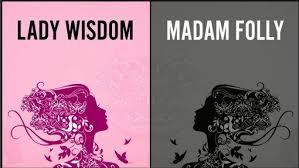
Br – Lady Wisdom and Madam Folly 10: 1-16

Lady Wisdom and Madam Folly
10: 1-16

A proverb is a short and memorable saying designed to be our blueprint for living in the world that ADONAI has created. It is important to note that proverbs are not promises; they are generally true principles, all other things being equal.

The title, the proverbs of Solomon (10:1a NIV), implies that this begins a distinct collection, ending 22:16. No longer are there relatively long discourses of a father or Lady Wisdom to a son, but now we have a collection of proverbs. Even though Chapters 1-9 constitute a different section from what follows in Chapters 10-31, we are to understand the theological message of those earlier chapters as casting their long shadow across the individual proverbs in this second major section of the book.215 Even though the topic heading is the same as the opening of the entire book 1:1 and drapes his covering over the entire book, there are sections within the book that he did not author, as evidence in the titles in 22:17, 24:23, 30:1, and 31:1. Yet, this section can be attributed to him in the sense that he authored many of them, adopted and adapted others, and gathered still more to give a comprehensive set of cameos that tell it like it is. Solomon wrote about 84 percent of the book, all of it of course being inspired by the divine Author, the Ruach Ha’Kodesh.216

A wise son brings joy to his father, but a foolish son brings grief to his mother (10:1b NIV): What we see here is a contrast between a wise son and a foolish son; the wise son has chosen to listen to Lady Wisdom (to see link click BnLady’s Wisdom’s Invitation to Life), and the foolish son has chosen to listen to Madam Folly (see BoMadam Folly’s Invitation to Death). The wise son is contrasted with a foolish son in 13:1 with a mocker, and in 15:20 with a foolish man. A son who has become wise, by heeding his parents’ teachings (see AkObey Your Parents), brings joy to his father, a fact stated several times in Proverbs (15:20, 23:15 and 24, 27:11 and 29:3). A foolish son (1:7), on the other hand, brings grief to his mother. This does not mean that a foolish son does not grieve his father, as is clearly stated in 17:21 and 25, and 19:13; nor does it mean that a mother’s heart is not filled with joy by her son’s wisdom. The use of “father” in the first part of the verse and “mother” in the second part of the verse is typical of proverbial literature. Both parents experience either joy or grief, just as both are involved in teaching the son (1:8, 4:3-4, and 6:20).217 This proverb is a good illustration of an antithetical (contrasting) proverb, constructed mainly from antonyms (wise/foolish; glad/sorrow; father/mother).

Prosperity and want (10:2-5): These proverbs all concern wealth and want. While God’s overt involvement in causing the righteous to flourish is usually not explicitly mentioned, it is a theological belief of the book that ADONAI always sustains the order of creation. This makes it appropriate to introduce this idea early.218 Wealth gained by wickedness does not profit, but righteousness delivers from death (10:2 NLT). At first glance, the connection between cola 1 (a single unit of poetry) and cola 2 seems vague. While wickedness and righteousness are opposites and provide a kind of contrast, the first cola appears to be about wealth, whereas the second does not. However, a closer look shows that the two parts of the verse are related and combine to say that there is something more valuable than wealth. And wealth cannot save us from death.219

ADONAI will not let the godly go hungry, but He refuses to satisfy the cravings of the wicked (10:3 NLT). The way of ADONAI is a stronghold to the upright, but destruction awaits those who do evil (10:29). What is Solomon’s point here? Actually, He is the unseen stronghold for the upright, for those who sincerely desire to please God and submit to His authority. He is an invisible obstacle in the way of the wicked, those who willfully reject God’s will and intentionally try  frustrate His plans. But Ha’Shem’s sovereign rule is so complete that He will accomplish His objectives and reward the faithful regardless of anyone’s opposition.220

However, though the meaning of the proverb is clear, the urgent question is, “What connection does it have with reality?” Is it really true that the righteous are well cared for by ADONAI and the wicked are ignored? Can this proverb be a barometer of our relationship with God, so that if we starve, we must not really be believers? Of course not (Psalm 37). That view is totally undermined by the books of Job and Ecc. We must remember that proverbs are not promises; they are generally true principles, all other things being equal.

Idle hands bring poverty, but diligent hands bring wealth (10:4 CJB). This is part of a collection of proverbs in Chapters 10-31 that describe the contrast between laziness and hard work (among other places see 6:6-11, 10:26, 12:11 and 24, and 24:30-34). This is an antithetical (contrasting) proverb with an observation of the consequences of laziness followed by an observation on the consequences of hard work. The former leads to poverty and the latter to wealth. This is a consistent message throughout the book of Proverbs. A wise son gathers in the summer, but he who sleeps during the harvest is a disgrace (10:5 CJB). Insight is a quality of the wise; disgrace is a moral evaluation of the fool. The contrast is between an industrious son and a slacker. Reflecting on 10:3, we may generally say that the righteous would be diligent workers and would therefore not go hungry because of their work. It is ADONAI who gives the believer wisdom and the drive to succeed. Again, this is a generalization, all things being equal.221

The righteous and the wicked (10:6-7): Both of these proverbs contain a contrast between the righteous and the wicked, linking the righteous with blessing (not just the hard work as in verse 4), and contrasting the enduring value of being righteous with the self-destructive path of the wicked.222 The godly are showered with blessings, but violence overwhelms the mouth of the wicked (10:6 Hebrew). The first colon associates blessings with the righteous. The word blessing is associated with the covenant in Deuteronomy. Indeed, one aspect of being righteous is being in a covenant relationship with ADONAI (Deuteronomy 28:2). The memory of the righteous is a blessing, but the name of the wicked will rot (10:7 BSB). There is a clear association between this proverb and the previous one. Here memory balances with names as synonyms, and righteous and wicked as antonyms. Blessing and rot play off each other as well.223

The babbling fool (10:8-10): These verses are tied together by the mention of the babbling fool coming to ruin at the end of both verses 8 and 10. The babbling fool is literally the fool of lips, implying that fools use their speech to promote foolishness. The wise of heart are glad to be instructed, but babbling fools’ lips will be ruined (10:8 Hebrew). Whoever walks with integrity walks securely, but those who follow crooked paths will be exposed (10:9 Hebrew). Beginning in 1:10-19, Proverbs has many allusions to the metaphor of life as a path. This proverb is an observation on the difference between those who live honestly and those who live deceptively. The point of the first colon seems to be that someone with a clear conscience allows one to live life openly and with boldness. The second colon issues a warning to those who live deceptive, evil lives that even though they pretend to be innocent, though they try to hide it, their evil will be found out. Whoever winks at evil, thus dismissing it, causes trouble, and a babbling fool will be ruined (10:10 Hebrew).

The importance of speech (10:11-14): These verses focus on the importance of speech for both the wise and the foolish. Verse 12 does not directly refer to speech, but the explicit mention of speech or the mouth in the surrounding verses implies that the hatred and love of this verse probably also refer to these attitudes being expressed in words.224 The mouth of the righteous is a fountain of life. As a fountain gives life-saving water, so the mouth of the righteous utters life-saving words. These might be words of encouragement or of rebuke to correct the errors of another. The life-giving words of the righteous are contrasted with the words of the wicked, which conceals violence (10:11 Hebrew), a word suggesting death.

Hatred stirs up strife, but love covers all offenses (10:12 ESV). The hateful person spreads rumors of his perceived adversaries, which stirs up strife. The wise person does not repeat such gossip, thus covering another person’s transgressions with love. Peter would later quote this verse when he wrote: Above all, love each other deeply, because love covers a multitude of sin (First Peter 4:8). Readers of the B’rit Chadashah will also recognize Paul’s comments on love (see First Corinthians CuThe Necessity of Love).

Lady Wisdom is found on the lips of the discerning (10:13a Hebrew). Notice there is a connection between discernment and wisdom. The person who speaks wisdom is prudent (1:4) and first considers a matter before commenting on it. Discernment comes from a diligent study of God’s Word, while wisdom comes from consistent obedience to the Word. The two operate together to give one wise speech. But the rod is found on the back of those who lack understanding (10:13b Hebrew). Fools, by contrast, do not consider their ways or examine their lives in light of God’s Word. Their speech is therefore mere empty gibberish. They might consider themselves to be “wise,” but the rod of correction awaits them. The wise store up knowledge, but the mouth of a fool invites ruin (10:14 NIV). This storehouse is filled up from the study of Scripture. As our storehouse grows, it will overflow into wise words. The fool however, is quick to respond, even though he is devoid of wisdom. As a result, his words will bring about his own destruction.225

The value of wealth (10:15-16): The rich man’s wealth is his fortress, but the poverty of the poor is their ruin (10:15 NLT). The point of comparing wealth to a fortress is to highlight how wealth can protect one against the dangers of life. A fortress can keep an invader out, so wealth can keep problems at bay. To give a modern example, take a plumbing example. If a pipe bursts, no problem. Just pay the plumber to fix it. On the other hand, if a pipe bursts in the home of the poor, what are they to do? Put it on their credit card and go down the road into debt? As we proceed through Proverbs, we will see that this is not the only perspective that it has on wealth (3:9-10, 22:22 to 23:11, 28:1-11, and 28:12-28).226

The wages of the righteous bring life, but the earnings of the wicked are sin and death (Proverbs 10:16 NIV); the profits of the wicked are deceptive (Hebrew: shaker); but those who sow righteousness gain true reward (11:18 Hebrew). As Derek Leman relates in his book Proverbial Wisdom and Common Sense, sitting around the table, the Jewish family observes the traditional Shabbat dinner. Mom lights the candles, saying the ancient Hebrew blessing as the family waits. The smell of the Shabbat meal tempts everyone as they wait. Dad lifts the cup and recites the prayer of sanctification. When he has finished drinking, mom says, L’chayim meaning to life. This is a short Jewish prayer, or a toast. It reflects one of the highest Jewish values: the wages of the righteous bring life.

Potentially, this could mean that the goal of the work of the righteous is their own life or the life of others. In other words, this verse could mean, “The righteous work to live,” or “The righteous work to help others live.” In either case, the contrast with the wicked would make sense, “The righteous are working to earn a living, while the wicked work to fund their sinful lifestyle.”

On the other hand, the work spoken here may refer to more than simply the occupational work of the righteous. It might also refer to voluntary labor, or any activity on behalf of others. Thus, the contrast would be, “The righteous spend their spare time promoting life, while the wicked spend their time enabling sin.”

A third possibility is that L’chayim refers to the favor of ADONAI in this life. YHVH bestows eternal life to His children. No one wants to be blotted out of God’s book of life, which prior to its use in Revelation 3:5 with regard to eternal life, was always understood as referring to this life. Moshe taught the people about God’s blessings and curses with regard to the Sinai Covenant, and said that they had a choice between life (blessing) and death (curse) (see Deuteronomy FqChoose Life). Perhaps the righteous labor of rewards in this life.

Whichever the case, the question of motive is raised by this proverb and asks the question, “Are you working for life or for sinful pleasure?” Is your motive for going to work to live a life of wanton pleasure? Or are you working to provide a life for yourself, for others, to promote life, and perhaps to please ADONAI and find His favor in this life? If not, Solomon says you are working for an illusion. The word deceptive in 11:18 is shaker, which refers to a lie, false hope, or uselessness. In other words, the wages promise something that is not delivered. Stolen bread looks sweet, but afterward it tastes bitter.

The whole idea is best summed up by Yeshua, who said: What will it benefit a person if he gains the whole world but forfeits his own life (Luke 9:25). Messiah tells of a rich fool whose crops prospered greatly one year. In considering what to do with his great wealth, the rich man decided to store it in silos. He wanted to live the easy life for the rest of his life. So, rather than using his excess to help others, he stored it up for his own comfort. But he was a fool because that was the very night that Ha’Shem was coming to claim his life. He would not enjoy the fruits of his selfishness. Our Lord’s application is short but sweet: That’s how it is with anyone who stores up wealth for himself without being rich toward God (Luke 12:21).227

Dear heavenly Father, praise You for Your gracious invitation to an eternal home of joy and peace for those who trust in You. Yeshua answered and said to him: If anyone loves Me, he will keep My word. My Father will love him, and We will come to him and make Our dwelling with him (John 14:23). Wisdom chooses the path of eternal joy where there is no shame. For if you confess with your mouth that Yeshua is Lord, and believe in your heart that God raised Him from the dead, you will be saved. For with the heart it is believed for righteousness, and with the mouth it is confessed for salvation. For the Scripture says, “Whoever trusts in Him will not be put to shame” (Romans 10:9-11). Great joy comes to all who believe in You and are adopted into Your family (Ephesians 1:5, John 1:12). It is so wise to make choices with eternity in view. An eternal life of joy and peace is of far greater value than any pleasures on earth that will vanish like smoke. In Messiah Yeshua’s holy Name and power of His resurrection. Amen

2025-11-12T19:23:38+00:000 Comments

Bq – The First Collection of Solomon’s Proverbs 10:1 to 15:33

The First Collection of Solomon’s Proverbs
10:1 to 15:33

We know that there are 375 proverbs in Proverbs 10:1 to 22:16 (375 being the numerical value of the Hebrew name Solomon) that form the second major section of the book; and this is divided into two parts as well. The first part, 10:1 to 15:33 includes mostly antithetical, or contrasting parallels of the wisdom of Solomon and the wicked fool. In the 185 proverbs of this section, language or speech seems to be the dominant theme. Proverbs 10:1a provides the title; then 10:b-16 focuses on wealth and speech; 10:17 to 11:31 deals with deeds and destinies; 12:1-28 is about speech and deeds; 13:1-25 is on good teaching, ethics, and learning; 14:1-31 focuses on living in wisdom; 14:33 to 15:4 emphasizes gentle speech; 15:5-19 stresses the importance of correction; and 15:20-33 records the consequences of both righteousness and wickedness.214

2025-11-04T12:01:37+00:000 Comments

Bp – Proverbs of Solomon 10:1 to 22:16

Proverbs of Solomon
10:1 to 22:16

We know that there are 375 proverbs in Proverbs 10:1 to 22:16 (375 being the number value of the Hebrew name Solomon) that form the second major section of the book; and this is divided into two parts as well. The first part (see BqThe First Collection of Solomon’s Proverbs) includes mostly antithetical (contrasting) parallels of the righteous sage and the wicked fool. In the 185 proverbs of this section, language seems to be the dominant theme. Proverbs 10:1a provides the title; then 10:b-16 focuses on wealth and speech; 10:17 to 11:31 deals with deeds and destinies; 12:1-28 is about speech and deeds; 13:1-25 is on good teaching, ethics, and learning; 14:1-31 focuses on living in wisdom; 14:33 to 15:4 emphasizes gentle speech; 15:5-19 stresses the importance of correction; and 15:20-29 records the consequences of both righteousness and wickedness.212

The second part (see CmThe Second Collection of Solomon’s Proverbs) of this collection has 190 sayings, with sayings and proverbs from ADONAI with the king and the court being prominent themes. Only a few of the verses in this second section are contrasts; most of the verses are either comparisons (in synonymous parallelism) or completions (in synthetic parallelism), with the conjunction “and” introducing the second line in many of the verses (see AcProverbs from a Messianic Perspective: Parallelism). The frequent change of subject from one verse to another may be intentional to force readers to grapple with and meditate on the thoughts in one verse before moving on to the next. However, occasionally, two or more consecutive verses are linked by a common subject or word.213

2026-02-05T13:12:05+00:000 Comments

Bo – Madam Folly’s Invitation to Death 9: 13-18

Madam Folly’s Invitation to Death
9: 13-18

A proverb is a short and memorable saying designed to be our blueprint for living in the world that ADONAI has created. It is important to note that proverbs are not promises; they are generally true principles, all other things being equal.

We now come to the climax of the first nine chapters. Previously, we have spoken of a path on which the son is encouraged to walk. That path represents life’s journey. The son has received instruction to stay on the right path and not to go astray on the crooked path. The previous chapters have warned of violent ambushes from evil men and the amorous advances of flattering women. These instructions have come to him from his parents, voiced by his father and from Lady Wisdom. In Chapter 9 a choice presents itself to him, and to us.207 The passage portrays two houses, one on either side of the road. On one side, a house stands open, with an elegant lady named Wisdom inviting us into her house of holiness. On the other side of the road, another house stands open, with a seductive woman (or man) named Folly inviting us into her macabre manor. It is decision time for the son and the simpleminded. Will they embrace Lady Wisdom of Madam Folly?208

The woman named Madam Folly is loud; she is undisciplined and without a moral compass (9:13 Hebrew). Unlike Lady Wisdom (to see link click BnLady Wisdom’s Invitation to Life), Madam Folly hasn’t prepared very much. She has no food to give and sends out no servant girls. Instead, her character is outlined, whereas Lady Wisdom’s character was only implied by her words and actions. Madam Folly personifies the rejection of wisdom based on the fear of ADONAI (see Ai The Fear of ADONAI is the Beginning of Wisdom). In an attempt to cover up her insecurities, she is pictured as being loud; attractive but unruly. Here, as elsewhere, Madam Folly offers immediate gratification, whereas Lady Wisdom offers long-term satisfaction.

Unlike Lady Wisdom, who prepared and searched out her guests, Madam Folly merely sat in her doorway on the heights overlooking the city (9:14 NLT). She has temporarily left her house on the street and ascended to the heights of the city so that she might attract more suiters. Opposed to Lady Wisdom, whose house is given some description, Madam Folly’s gets no depiction. Without a moral compass, she lacks any desire to leave her undisciplined state to seek out righteousness. Opposed to the woman of noble character (see Dy – Wisdom for Women), she embodies foolishness.

She calls out to men passing by who are minding their own business, inviting them to her home (9:15 NLT). Frequently, in Chapters 1-9 we have encountered the metaphor of the path as a reference to one’s life journey. So her invitation comes to those who are living life; she speaks specifically to the simpleminded (1:4). In other words, Madam Folly appeals to the same immature group as Lady Wisdom. They are rivals for the attention of the same group of gullible young men, thus creating the need for a decision.209

“Come in with me,” she urges the simpleminded. These are the same words Lady Wisdom used to invite the young men into her house of life. She is calling out for them to turn aside to her and what she has to offer. Her tempting offer is based on the assumption that what is forbidden or hidden must be better than what is offered by Lady Wisdom. To those who lack good judgment, she says, “Stolen water is sweet.” Stolen water is a subtle way of referring to adultery, stealing what belongs to another, as in 5:15-17 where water is used for sexuality. This is depicted as sweet and attractive. “And bread eaten in secret is tasty” (9:16-17 Hebrew) is parallel with stolen water, and suggests that what is done in her house will not be made known to others. It happens in private, away from prying eyes. This echoes the seductive words of the adulterous woman earlier in the book (see BiAvoid the Seductress). Her invitation started off in the same way as Lady Wisdom’s in verse 16, but now in verse 17, it sounds more appealing, as she offers forbidden fruit.210

The last verse of this section, though, shows the horrific consequences that will result from choosing the house of death. But (indicating that the wrong impression given by Madam Folly’s words will now be corrected) he doesn’t realize that the dead are there, and that those who accept her invitation are in the depths of sh’ol with no way out (9:18 CJB). Those who accept Madam Folly’s invitation go expecting to find life and renewed energy, but find death. While her invitation sounded very appealing, it is dangerously deceptive.

As Tremper Longman III relates in his commentary on Proverbs, the final chapter of the first part of the book brings to end several major themes and demands that the reader make a fundamental life decision. Here and there in the first eight chapters, we have encountered the idea that there is a path on which we walk and that this path stands for one’s life journey. We have already heard from Lady Wisdom, and while Madam Folly is a new character in the drama of the book, her human counterpart, the adulterous woman, has anticipated her. Both Lady Wisdom and Madam Folly issue invitations. We must decide.

Who is Lady Wisdom? Wisdom is clearly a personification of ADONAI’s attribute of wisdom. However, she is also associated with her influence over men. After all, we hear about the wise woman of Tekoa (see the commentary on the Life of David DlThe Wise Woman of Tekoa), and the queen of Sheba (see the Life of Solomon BuSolomon and the Queen of Sheba). But if Wisdom is a personification of ADONAI, then who is Madam Folly? To start with, she is the personification of foolish thought and behavior, but more. She too, represents deity, but in her case she stands for all the pagan gods and goddesses who desire to lure Isra’el away from the God of Abraham, Isaac, and Jacob. She stands for Marduk, Ba’al, Ishtar, Anat, Asherah, Chemosh, Molech – and the list can go on and on.

Again, the reader/son must make a choice, and this choice is fundamental for wisdom. In the final analysis, there is no wisdom apart from a relationship with Lady Wisdom, meaning ADONAI. In this regard, this metaphor reinforces the point of the “motto” of the book: The fear of ADONAI is the beginning of knowledge, but fools despise wisdom and discipline (1:7). There is no middle path. One is either wise or foolish, associated with one or the other of the two women. Furthermore, as we move into the second part of the book, Chapters 10-31, the very terms “wisdom” and “foolish” and their numerous related terms are full of theological meaning. For instance, Proverbs 10:1 states: A wise son makes a father glad, and a foolish son brings grief to his mother.

We now recognize the meaning of this verse like this. It states that a son who makes a father (who stands for both parents) glad is wise. To be wise means that one acts like one who is in a relationship with ADONAI. On the contrary, those who bring sorrow to the mother (again standing for both parents) show themselves to be fools, and that means they are acting like worshippers of pagan deities. In this way, the proverbs have important theological significance even when they do not explicitly name ADONAI or some well-known theological concept. Wisdom and foolishness themselves are such theological concepts. The two houses of Lady Wisdom and Madam Folly stand behind Yeshua’s teaching that contrasts the house built by a wise person and the one built by the fool (see the commentary on The Life of Christ DyThe Wise and Foolish Builders). The house built by Lady Wisdom withstands assault, while that by folly leads to destruction.211

Dear heavenly Father, praise You that You are full of steadfast love and mercy. Wisdom looks to the future and chooses to accept Your invitation of love, though trials may come. A future of eternal joy that never ends, is worth far more than any trials that may seem long and very hard now, in light of eternity, all earthly trials will be over in a blink! For I consider the sufferings of this present time not worthy to be compared with the coming glory to be revealed to us (Romans 8:18). But Madam Folly looks like an easy way to fulfill sensual desires; but in reality, it is a trap/a bottomless pit into pain and suffering. Following Madam Folly or doing good deeds to be seen by others is foolish and senseless. May Madam Folly’s words fall on deaf ears. May your loving call as Shepherd fall on ears that hear You and quickly to turn your love in faith – your steadfast love, almighty power, and never-ending mercy, love and care. In Messiah Yeshua’s holy Name and power of His resurrection. Amen

2025-11-03T10:30:09+00:000 Comments

Bn – Lady Wisdom’s Invitation 9: 1-12

Lady Wisdom’s Invitation
9: 1-12

A proverb is a short and memorable saying designed to be our blueprint for living in the world that ADONAI has created. It is important to note that proverbs are not promises; they are generally true principles, all other things being equal.

We now come to the climax of the first nine chapters. Previously, we have spoken of a path on which the son is encouraged to walk. That path represents life’s journey. The son has received instruction to stay on the right path and not to go astray on the crooked path. The previous chapters have warned of violent ambushes from evil men and the amorous advances of flattering women. These instructions have come to him from his parents, voiced by his father and from Lady Wisdom. In Chapter 9 a choice presents itself to him, and to us.198 The passage portrays two houses, one on either side of the road. On one side, a house stands open, with an elegant lady named Wisdom inviting us into her house of holiness. On the other side of the road, another house stands open, with a seductive woman named Folly inviting us into her macabre manor. It is decision time for the son and the simpleminded. Will they embrace Lady Wisdom of Madam Folly?199

Lady Wisdom’s Invitation (9:1-6): Lady Wisdom has built herself a house; she has carved seven pillars of wisdom (9:1 CJB). Wisdom is personified as a classy lady, opening her palatial home. But what is Solomon talking about in real terms? Taking the whole Bible into account, this is a picture of Yeshua as a wealthy and wise Friend who has thought of everything we need and provided it in full. The word “wisdom” here in English is singular, but plural in Hebrew . . . “wisdoms. It isn’t a numerical plural, it isn’t alternative wisdoms to choose from; it’s a plural of majesty, standing for wisdom in all its perfections and fullness. Messiah lacks nothing we need. Here is another biblical way of saying it: You satisfy me more than the richest feast (Psalm 63:5a NLT). Yeshua Himself said: I came that they may have life and have it more abundantly (John 10:10 ESV). The fact that Lady Wisdom’s house has seven pillars says the same thing – effort in hewing them out, wealth to finance them (ordinary houses did not have pillars), and perfection in completing them. If you think of our Lord as a really nice guy who, like Santa Claus, gives you everything you ask for (prosperity doctrine), then you don’t understand Him at all.200 He is the greatest expert in the universe on you, and He’s better at giving you what you need (including discipline), rather than what your flesh wants.

According to Rashi in Shabbat 116a, the “seven pillars” are the seven days of creation. The sages also note that this could refer to the completeness of the number seven (see the commentary on Genesis, to see link click AeThe Number Seven), the sum of the sun, moon, and five known planets, or just plain architectural beauty. The point is that Lady Wisdom has built a well-structured and completely outfitted house. Regarding creation, Rashi concludes, “With wisdom, has the Holy One, blessed be He, built the world.”201

She has prepared her food, mixed her wine, and also set her table (9:2 CJB). No junk food at this feast! Lady Wisdom has been very busy preparing a banquet of her best . . . for us. The mixed wine promises a celebratory mood. Such wine adds either honey or spices.202 The point of verse 2 is that what Messiah offers you is ready right now, and it couldn’t be more loving, generous, or honoring to you. But again, what is the reality behind the metaphor? Let’s think back over what we have learned thus far from the book of Proverbs. This table has been spread with wisdom and has delicacies to satisfy us in every area of life. From Chapter 1 we have learned that wisdom preserves us from violent people; from Chapter 2, wisdom enters our hearts with peace and conscience; from Chapter 3, wisdom improves us financially; from Chapter 4, wisdom elevates our status in society; from Chapter 5, wisdom makes sex better; from Chapter 6, wisdom gets us up off the sofa and successfully accomplishes worthwhile goals; from Chapter 7, wisdom protects us when we are tempted; from Chapter 8, wisdom opens our eyes to the joyous creation in which we live. And that’s just the beginning. We have not even gotten to the actual proverbs in Chapters 10-31. Messiah has set a good table for us.

Lady Wisdom has prepared a sumptuous banquet in her house and has sent out her young women to invite everyone to come (9:3 NLT). That is, her servants are getting the invitations out, but Lady Wisdom herself is speaking through them. It is a picture of the prophets and the apostles. It is a picture of faithful parents, Bible teachers, and Messianic rabbis and pastors today. The Bible says: When you received the word of God, which you heard from us, you accepted it not as the word of men but as what it really is, the Word of God (First Thessalonians 2:13 ESV). When you know that what you are hearing is biblical, you are hearing the Word of God. ADONAI is inviting you to the banquet. God is inviting us all into joys we have never known before, because they came down from heaven. She calls out from the heights overlooking the city, where many would hear the invitation. Madam Folly also called out from this high point (9:14) (9:3 NLT).203

We hear Lady Wisdom speaking of a specific group in the last three verses. Specifically, she addresses the simpleminded, who are also called those who lack understanding. This reference is neither to the wise nor to the foolish, but to the naïve or immature. These are the ones who vacillate between Lady Wisdom and Madame Folly. So Lady Wisdom wants to woo them into her home, she wants to teach them the path of life. “Whoever is simpleminded, let him turn in here!” she says to those who lack understanding (9:4 BSB). She thus invites them to come into her home and share a meal with them. Come and eat my food! Drink the wine I have mixed (9:5 CJB). In the ancient Near East, for a woman to invite a man to a meal has erotic overtones. What Lady Wisdom wants is an intimate relationship with the simpleminded. This reminds us of the erotic language used earlier, in the father’s admonition to the son to grow wise. She is a tree of life to those who embrace her, and those who hold her tight are blessed (3:18). So, Lady Wisdom issues the invitation to turn from simplemindedness and gain understanding. Leave your simple ways and you will live; walk in the way of understanding (9:6 NIV). We don’t hear any response, but by the end of the chapter, we hear the voice of another woman, Madam Folly.204

Ignore the mockers (9:7-12): Chapter 9 is divided into three paragraphs of six verses each. The first (verses 1-6) and third (verses 13-18) paragraphs mirror each other like bookends, each one with an invitation. Solomon is telling us, “This is an either/or decision. There’s no third option.” The invitation to wisdom stands open to everyone except the mockers (9:7 and 12). However, he welcomes both the wise and the simpleminded (1:4).205

Anyone who corrects a mocker will get an insult in return. Anyone who rebukes a wicked man will be insulted in return (9:7 Hebrew). A Rabbi, the Talmud reported, lamented the fact that nobody in his generation accepted correction, and if one told his neighbor, “Remove the splinter from your eye,” the answer was, “Remove the beam from your own eye.” So don’t bother correcting mockers; they will only hate you. But correct the wise, and they will love you. Instruct the wise, and they will be even wiser. Teach the righteous and they will learn even more (9:8-9 NLT). Every one of us needs someone to whom we can regularly turn to and say, “How am I doing?” And then we need to listen. Openness and humility are how we grow. Mockers are not like that. What is a mocker? A mocker is someone who never accepts correction. He thinks other people really need his opinions. He is easily offended. He is smarter than other people. Above them, actually. And if someone seems to threaten his superiority, he scoffs. He mocks. He mouths off. He belittles. This kind of person is dangerous. If you cross him, he will punish you – and claim it’s your fault.

We see this attitude abounding in the congregations of God today. At some point, we have all been let down. By now many of us have no reason not to be cynical mockers . . . no reason except for Yeshua. And He is reason enough. He will never let us down. He is why we humble ourselves and open up and listen. He is why the tone of our places of worship need not be sarcasm but reverence: The fear of ADONAI is the beginning of wisdom, and knowledge of the Holy One results in understanding (9:10 CJB). For through wisdom your days will be multiplied, and years will be added to your life (9:11 BSB). We revere Yeshua as the Holy One, which means He is outside of our categories, surprising us, especially as He loves us more than we love Him. The truth is, we have let Him down so many times. But here is His answer to us: I will not execute my burning anger . . . for I am God and not man, the Holy One in your midst (Hosea 11:9). The Holy One is sweet-natured. He is the easiest Person in the universe to get along with. He says: Those whom I love, I reprove and discipline (Revelation 3:19a NASB). But because it is His loving heart speaking into our lives, we open up and say, “Lord, I want to know how I can grow. Please tell me. I want to be conformed into Your image.” That humble eagerness is wisdom and the fear of ADONAI. It is reverence.

Revering Him makes all the difference. If you are wise, your wisdom will reward you; but if you are a mocker, you alone will bear the consequences of your mocking (9:12 Hebrew). As important as community is, I cannot borrow character from you, nor can you borrow character from me. Just being at church will not change us. Just because you sit in the garage doesn’t make you a car. No one gets a college degree by hanging out on campus blending in with the other students. Likewise, each of us must receive Messiah personally. We must seek Him and engage with Him personally. He is how we change. He is how we get wisdom when we ask for it. If any of you lacks wisdom, you should ask God, who gives generously to all without finding fault, and it will be given to you (James 1:5 NIV). And when He gives it to us, no one can take it away from us, no matter what they do. Good thing, given the world that we are all walking through.206

Dear heavenly Father, praise Your wonderful invitation to eternal life in heaven with You! For if you confess with your mouth that Yeshua is Lord, and believe in your heart that God raised Him from the dead, you will be saved. For with the heart it is believed for righteousness, and with the mouth it is confessed for salvation. For the Scripture says, “Whoever trusts in Him will not be put to shame” (Romans 10:9-11). Wise people are those who choose to do more than just know about Messiah, who choose to trust in Him that they might praise Him thru all eternity! So that we, who were first to put our hope in Messiah, might be for His glorious praise, sealed with the promised Ruach Ha’Kodesh (Ephesians 1:12, 13c). Thank You for your invitation to life thru Yeshua. In Messiah’s holy Name and power of His resurrection. Amen
2025-11-03T10:11:50+00:000 Comments

Bm – Whoever Finds Me Finds Life 8: 32-36

Whoever Finds Me Finds Life
8: 32-36

A proverb is a short and memorable saying designed to be our blueprint for living in the world that ADONAI has created. It is important to note that proverbs are not promises; they are generally true principles, all other things being equal.

The tug of war between Lady Wisdom and foolishness for the loyalty of the heart is constant in Proverbs. It will dominate the argument of Chapter 9. Here it is featured in a stark, yet simple, summary of how Lady Wisdom sees the issues. They are white and black. Since Lady Wisdom is the personification of Yeshua Messiah (to see link click BlWisdom’s Existence before Creation), the Lord can now rightly say: Now then, My children, listen to Me, for blessed are those who keep My ways (8:32 NIV). Listen to my instruction and be wise. Don’t ignore it (8:33 NLT). Other than salvation itself, the Wisdom of Messiah is the one and only true necessity in your life. And you must embrace Him completely. Blessed is the one who listens to me, watching for me daily at my gates, waiting for me outside my home which Wisdom built (8:34 Hebrew). Keep a constant look-out for her, and whenever possible be in close contact with her. Stress is laid upon an unfailing conformity with Lady Wisdom’s teachings. The principles are to be remembered and practiced in all circumstances, not only when they are convenient.

The two final verses of Chapter 9 unpack the most severe consequences of accepting or rejecting Lady Wisdom . . . seeing it as a matter of life and death. The way to eternal life is the outcome of embracing wisdom, while the way to death is the consequence of choosing foolishness. The promise of life is meant to be starkly contrasted with the shadowy threat of death.195 Therefore. We need to grab hold of Yeshua Messiah, the crucified Friend of sinners and never let go. For whoever finds me finds life and obtains favor from ADONAI (8:35 CJB). Wisdom gives life (3:18, 4:4 and 22, 7:2, 9:11, and 19:23), and ADONAI’s favor (12:2 and 18:22). The word favor (Hebrew: ratson), is used 14 times in Proverbs, and means acceptance, goodwill, or approval. It comes from the verb rastah, meaning to be pleased with. John said it this way: Whoever has the Son has life; whoever does not have the Son of God does not have life (First John 5:12).

One such man who had to make this choice was Nicodemus, and he was on the horns of a dilemma. He could plainly see the miracles that Yeshua was doing; yet, He did not fit the mold of Pharisaic Judaism, meaning, the Nazarene did not believe in the traditions of the elders (Mark 7:5). So he came to the Master by night. Yeshua, who knew what was in each person, understood what was really going on in Nicodemus’ heart. The Lord ignored his initial flattery and, instead, answered a question he didn’t even ask. Without confirming, denying, refuting or even acknowledging Nicodemus’ statement that He was from God, Yeshua gave an answer that demonstrated His omniscience. Messiah confronted Nicodemus with the fact that he had missed the mark of reaching the Kingdom. Immediately getting to the heart of the matter, He replied: Very truly I tell you, no one can see the kingdom of God unless they are born again (John 3:3). That is Wisdom. Our Savior called for nothing less than complete surrender. Without such a spiritual rebirth, He told His nighttime visitor, no one has any hope of attaining eternal life. There was no middle ground. No compromise.

Rejecting Lady Wisdom results in harm (6:32, 7:23, and 9:12b). But he who sins (Hebrew: chata, meaning to miss the mark) against me does violence to himself. All who hate me (Hebrew: sane, signifies a willful turning away from Lady Wisdom, not just an indifference to her) love death (2:18-22, 5:5, and 7:27). The irony is, if you protect yourself from Him, you do violence to yourself (8:36 Hebrew). Chata can refer to doing something against ADONAI or against a person (Ex 10:16), doing the opposite of what is right (Gal 5:17), doing something that will have negative results (Proverbs 24:33-34), and failing to do something you know is right (Num 15:27). As Romans 3:23 says, sin is a general term that falls short of the glory of God (Psalm 51:1-2). Thus, Wisdom is the path to life and foolishness is the path to death. These are our only two choices.196

Without Wisdom, there is no true life; however, with Wisdom, there is no true death. Solomon is unclear about any offer of eternal life, but Yeshua is very clear about the eternal security of the believer (see the commentary on The Life of Christ MsThe Eternal Security of the Believer). All of Yeshua’s disciples would do well to study wisdom. For us, the study of Wisdom is a form of worship. When we see God’s Wisdom principles in the world, our faith is strengthened and the truth of His Word is made clear to us. Wisdom is no secular study. It is part of the worship of ADONAI who made it. Wisdom reveals the hand of a wise Creator.197 But we have not yet heard the last from Yeshua’s personification of Lady Wisdom. As we turn to Chapter 9, we hear her voice again in a way that will help us to identify her more closely. In addition, we will be introduced to another woman: Madam Folly, Lady Wisdom’s rival.

2025-11-02T13:06:42+00:000 Comments

Bl – Wisdom’s Existence before Creation 8: 22-31

Wisdom’s Existence before Creation
8: 22-31

A proverb is a short and memorable saying designed to be our blueprint for living in the world that ADONAI has created. It is important to note that proverbs are not promises; they are generally true principles, all other things being equal.

To justify the high claims which Lady Wisdom has asserted on her behalf, Solomon advances a still loftier claim. Lady Wisdom declares that she was created by ADONAI before the universe came into being because He ordained for her part of His creative work which changed chaos into order. Wisdom is therefore, the first act of God’s creation, the firstborn, so to speak. She was there before anything else was created, and so witnessed the creation process herself. Indeed, the implication is that not only was she present, but that she also participated in the creation of the world. Her reference to herself as a craftsman (8:30) indicates that she assisted, in some way, in the task. The result of her participation is that she had an intimate, joyful relationship with both ADONAI and with the human race.

A typical ancient Near Eastern autobiography begins with a self-introduction like what we have seen in 8:12-21 (see Bk Those Who Seek Me Will Find Me). After the introduction comes a narration concerning accomplishments (see the commentary on Deuteronomy AhTreaty of the Great King), and this is what we have here in 8:22-31, a narration of the accomplishments of Lady Wisdom. The entire section describes the interrelationship between Lady Wisdom and creation. The implication informs us that in order to navigate life with its problems and pitfalls, then Lady Wisdom is the one to get to know. Who would know better how to act in the world than the One who helped to create it!

But before further exploring the relationship between ADONAI and Lady Wisdom, we need to ask, who is she anyway? One of the earliest clues we have for how Lady Wisdom was understood comes from the intertestamental books of Sirach and the Wisdom of Solomon. Sirach, also known as Ecclesiasticus, is a book from the second century BC, and it begins alluding to Proverbs 8:22-31, by saying, “Wisdom was created before all other things, and prudent understanding from eternity . . . it is He [God] who created her [Wisdom]; He saw her and took her measure, He poured her out upon all His works (Sirach 1:4 and 9).

Then Sirach 24 really reflects and expands on Proverbs 8:22-31. Indeed, it is largely modeled on that chapter. Here too we have a personification of Lady Wisdom. But rather than making a public address, she speaks to the angels. She describes how God guided her to take up residence in Isra’el among the nations of the earth. Among other differences Lady Wisdom sees between herself and those nations is how she identifies herself with Torah, saying, “All this [Wisdom] is the book of the covenant of the Most High God, the mitzvot that Moshe commands us as an inheritance for the congregations of Jacob (Sirach 24:23). Therefore, those who study Torah are those who grasp God’s Wisdom. This tradition is also found in the intertestamental Wisdom books as well, the Wisdom of Solomon, for example.

As Tremper Longman III relates in his commentary on Proverbs, the B’rit Chadashah describes Yeshua Messiah as the One in whom many of the themes in the TaNaKh find their ultimate expression (Luke 24:25-27 and 44-48). Yeshua is described as wise from the time of His youth (Luke 2:39-53) through His earthly ministry (Mark 6:2). Messiah recognized Himself as wise and condemned those who rejected His wisdom. In Luke 11:31, He tells a crowd of people: The queen of Sheba will stand up against this generation on judgment day and condemn it, for she came from a distant land to hear the wisdom of Solomon. Now someone greater than Solomon is here – but you refuse to listen to him. Although the Gospels demonstrate that Yeshua was wise; indeed, wiser than Solomon, Rabbi Sha’ul asserts that He is not simply wise, but is the very incarnation of God’s wisdom. Twice he identifies Messiah as the wisdom of ADONAI. In First Corinthians 1:30 he says: God made Messiah to be wisdom itself (NLT); then, in Colossians 2:3, he proclaims that in Messiah lie all the treasures of wisdom and knowledge (NLT). With this as background, it isn’t surprising that the B’rit Chadashah associates Yeshua Messiah with Lady Wisdom, especially as she is presented in Proverbs 8:22-31.

In Matthew 11, Yeshua addresses opponents who argued that John the Baptist was ascetic in his lifestyle, while the Lord was too celebratory. Notice His final claim in reply: For John came neither eating nor drinking, and they say, “He has a demon.” The Son of Man came eating and drinking and they say, “Here is a glutton and a drunkard, a friend of tax collectors and sinners.” But Wisdom is proved right by her actions (Matthew 11:18-19 NIV). When He said: Wisdom is proved right by her actions, Yeshua claimed that His behavior represented that of Lady Wisdom herself!

The association of Yeshua and Wisdom may be found elsewhere in the B’rit Chadashah as well. We recognize the great preface to the Gospel of John that reminds us of the language of Proverbs 8:22-21 (see the commentary on The Life of Christ AfThe Memra of God). The Word of God (the Logos, the Memra, or the Davar), who is Yeshua Messiah Himself, was in the beginning with God. He created everything that was (John 1:1-3 NLT). Indeed, the world was made through Him (John 1:10 NLT).

We can see this in Colossians 1:15-17 where Yeshua is described in language that is reminiscent of Proverbs 8:22-31. Messiah is the visible image of the invisible God. He existed before anything was created and He is the firstborn of all creation, for through Him God created everything in the heavenly realms and on earth. He made the things we can see and the things we can’t see – such as thrones, kingdoms, rulers, and authorities in the unseen world. Everything was created through Him and for Him. He existed before anything else, and He holds all creation together. While this is not a quotation from Proverbs, it’s hard to imagine someone well versed in the TaNaKh like Rabbi Sha’ul not recognizing that Yeshua isn’t the personification of God’s Wisdom in these verses. Paul declares: He is the firstborn of all creation; Wisdom is the firstborn in Proverbs 8; and Yeshua is the firstborn in Colossians. Rabbi Sha’ul is inviting a comparison. Wisdom is the agency of divine creation in Proverbs, and Messiah in Colossians. In Proverbs, Wisdom declares: By Me kings reign, and rulers make just laws. Rulers lead with My help, and nobles make righteous judgments (8:15-16). And in Colossians 1:16, Messiah made thrones, kingdoms, rulers, and authorities. The message is clear: Wisdom is the personification of Yeshua Himself; when Proverbs talks about Wisdom, she is talking about godly Wisdom, Yeshua’s Wisdom.

But we must be cautious. It is possible to overread these connections by not taking account of the genre of Proverbs 8:22-31. One clear example of misapplying the passage comes from an early theologian named Arius (260-336 AD), commonly recognized as heretical by the orthodox church. Arius and his followers noticed the connection between Yeshua and Wisdom and then applied all the characteristics of Wisdom to Yeshua. They pressed the language that Wisdom was created as the first of creation. Then they reasoned that since Yeshua was created, Yeshua was not God. But Wisdom is not a preincarnate form of the Second Person of the Trinity, and Yeshua is not a created being

In response, we simply point out that Proverbs is not a prophecy of Yeshua or any kind of literal description of Him. We must remember that the text is actually poetry and is using metaphor to make important points about the nature of God’s Wisdom. Indeed, even in the setting of the TaNaKh where Wisdom stands for the Wisdom of ADONAI, we would be wrong to press the language of creation literally as if at some point God were not wise and only later became wise just in time to create the world.193

Wisdom was here first (8:22-26): ADONAI created (Hebrew: qanah, meaning to make, by extension, to procure, especially by purchase, and by implication, to own) me from the beginning, before He created anything else (see AwADONAI’s Wisdom Founded the Earth) (8:22 NLT). In this autobiographical section, Lady Wisdom underlines the idea that she was created at the very beginning, before God’s other acts of creation in Genesis, saying: I was formed in ages past, at the very beginning, before the earth began (8:23 NLT). Wisdom is not depicted here as an actual heavenly being co-existing with God, but rather a personification of Himself. She recalls a time when there were no watery depths, I was born, when there were no springs bubbling up their waters (8:24 NLT). Since the Genesis account mentions the deep and waters in its second verse, Wisdom’s claim is a legitimate one. There was also the division of the waters above and the waters below on day two. Before the mountains were formed, before the hills, I was born; before He made the earth or its fields or the dust of the earth (8:25-26 NLT). All these are what happened on the third day. Throughout this text, Lady Wisdom’s humility should be noted. Her claims are unique, but not arrogant: She plainly recognizes the difference between her and her Creator – a crucial recognition. Twice she speaks of her own origin: I was born (8:24-25). This clear phrase helps us interpret her claim: ADONAI created me (8:22). Therefore, as important as she is to the divine plan, she is part of the creation, not the co-creator.

Wisdom during the creation process (8:27-31): The setting in Genesis is again days two and three. She says: I was there when He set the heavens in place, when He marked out the horizon on the oceans (8:27 NIV). I was there when He established the clouds above, when he established the springs deep in the earth. I was there when He set the limits of the seas, so they would not spread beyond their boundaries. And when He marked off the foundations of the earth (8:28-29 NLT). Wisdom was not only present at creation; she was also a participant in creation. I was His skilled craftsman by His side, I was filled with delight day after day, rejoicing in His whole world. If we catch her meaning, she was a cheerleader as the repetitions of rejoicing and delighting imply. Master craftsman is the usual translation of the pivotal word to describe Wisdom’s role and relationship to her Creator. But, a slight change in the Hebrew vowels produces a sense of a young and dependent child, a meaning which fits better with all the playfulness seen here. Like a gleeful little child, Wisdom is so excited by the majesty and power of the creation that she laughs about it daily with the Creator. And having my delight in the sons of men (8:30-31). Her joy reaches its apex in the creation of the human family on the sixth day. Remember that she had called out to the sons of men in 8:4. No wonder she cared about them; she had watched their mother and father come into being from the hand of God.194

2025-11-02T12:43:23+00:000 Comments

Bk – Those Who Seek Me Will Find Me 8: 12-21

Those Who Seek Me Will Find Me
8: 12-21

A proverb is a short and memorable saying designed to be our blueprint for living in the world that ADONAI has created. It is important to note that proverbs are not promises; they are generally true principles, all other things being equal.

Lady Wisdom’s lesson is now developed in two separate parts of ten verses each; the first pertaining to historic time (verses 12-21) and the second to prehistoric time (verses 22:31). The first emphasizes Lady Wisdom’s counsel (to see link click AmLady Wisdom’s Rebuke of the Foolish), understanding, strength, and practical use; and the second, her nobility and authority. Why choose wisdom instead of silver, knowledge rather than pure gold (8:10)? Verses 12-31 tell us why.

Up to this point Lady Wisdom has been praising the virtues of wisdom; now, personified, she speaks of herself. We begin with a typical Near Eastern introduction I, Wisdom, live together with good judgment. I have found knowledge, discretion and prudence (see 1:4 for a detailed discussion of all three words) (8:12 Hebrew). After the first-person speaker identifies herself as Lady Wisdom, she begins by telling us about those traits with which she is associated. Indeed, it may be that these traits – knowledge, discretion and prudence – are themselves personified in us. In a sense, we may consider these three characteristics her best friends. Where you find Lady Wisdom, there you will also find these three qualities.187

Those who fear ADONAI, a phrase which we recognize as an alternative description of those who are wise (see AiThe Fear of ADONAI is the Beginning of Wisdom), will hate evil. Therefore, I hate pride and arrogance, evil conduct and perverted speech (8:13 CJB). Whereas in practice, men and women sometimes combine the worship of ADONAI with unethical deeds, Lady Wisdom insists that His service, when correctly apprehended, is impossible without the rejection and loathing of all that can be classified as evil. The wise are defined not only by their positive qualities, but also by those characteristics that do not typify them. They are not evil; indeed, they hate evil. Some are bothered by the word hate here. Are believers to hate? Yes, we are to hate evil. But they object, well, ADONAI doesn’t hate does He? Yes, indeed He does (see Bf – What God Hates). We know there is darkness because of the light, and we know there is righteousness because of evil. So once again, we note the ethical quality of Lady Wisdom. This verse also distances the wise from pride and arrogance as well as from the foolish young men to whom she is addressing.188

Wisdom’s competence can be celebrated because it flows from the fear of ADONAI. It includes precisely what the young men needed to serve their nation and countrymen well. I have insight, common sense and sound judgment to make decisions and shape plans are mine. All of these characteristics allow such significant accomplishment, such effective disposal of problems, such powerful development of courses of action in politics and economics or justice that they can be described by the word power.189 Therefore, she can say: I have the power to give it to those in doubt (8:14 NIV). Wisdom makes a person courageous like a brave soldier. By Me kings reign, and rulers make just mitzvot, as the next clause implies, not as a despot, without regard of right and wrong (8:15 CJB). Rulers lead with My help, and nobles make righteous judgments (8:16 NLT).

The thrust of verses 14-16 is that Lady Wisdom will help those who wield power to exercise it in an appropriate and beneficial way in their community. This means that wisdom is extremely practical in leadership positions. The classic example of this is when Solomon asked for wisdom to govern God’s people and discern between good and evil in doing so (see the commentary on the Life of Solomon AsSolomon’s Wish). Immediately after this was given, he was tested in a legal dispute between two prostitutes over who was the true mother of the baby (see the Life of Solomon AtA Wise Ruling). Solomon used his wisdom by devising a shrewd test – ordering that the baby be cut in half to reveal the one woman who had true maternal instincts, with the result that all Isra’el understood that the wisdom of ADONAI was with Solomon to administer justice (First Kings 3:28).190

Now we are informed that Lady Wisdom is not hard to find, not hard to attain. But one must pursue her. I love all those who love me; and those who seek me will find me (8:17 CJB). As Yeshua instructs us: Ask and it will be given to you; seek and your will find; knock and the door will be opened to you. For everyone who asks receives; the one who seeks finds; and to the one who knocks, the door will be opened (Matthew 7:7-8). She loves those who love her and allows those who search for her to find her. The same theme is found in Chapter 2, and there we learn of the paradox that those who search and find Lady Wisdom do so because of the gift of God. And we find a striking parallel in the B’rit Chadashah where Rabbi Sha’ul tells us that it is by grace you have been saved, through faith – and you can’t take credit for this. – it is the gift of God (Ephesians 2:8).

As motivation for the pursuit, again, Lady Wisdom reminds us of the rewards that follow a relationship with her: enduring wealth and justice (8:18 NLT). Nevertheless, these verses in Proverbs are sometimes used by people who believe in the “prosperity gospel,” but that is to misuse them. First, there is no promise of abundant wealth, any more than there was a promise of long life and peace in 3:2. To claim a proverb as a promise is to misunderstand the type of literature it is. A proverb describes only a part, not the whole, of life, and so is not always applicable in a given situation or at a given time. Therefore, Yeshua, despite honoring the Father with His whole life, had neither a long life (3:2), nor barns overflowing with plenty (3:10). Second, the material prosperity is not limited with the size of the monetary gift, but with character (honoring the Lord). Such a character trait would involve not wanting to give wealth an inordinate place in one’s desires, so that truly honoring ADONAI would entail keeping your life free from the love of money because it is the root of all kinds of evil (First Timothy 6:10). The prosperity gospel misses the important emphasis in Proverbs on the theme of contentment by discovering your sweet spot in life (see Du – The Prayer of Agur).191

One key purpose of Chapters 1-9 within the book is that the young foolish men would strive to have their character shaped Lady Wisdom as they reject the path of foolishness. This emphasis on pursuing Lady Wisdom makes sense of verses 18-19, which outline financial incentives for seeking Lady Wisdom. For the second time in this chapter (see 8:10-12), wisdom, or better here, the consequence of being wise; my fruit (3:18), is better than gold, even the purest gold, my wages better than sterling silver (8:19 Hebrew). The rich should be shaped by wisdom, meaning that they should be committed to the righteous use of their wealth and power. The patriarchs, for example, were wealthy men. I walk steadily or continuously in righteousness, in paths of justice (8:20 NLT). Those who love me inherit wealth. I will fill their treasuries (8:21 NLT). Like many statements in Proverbs, this one is a generalization to which expectations should be noted. Lady Wisdom does not offer the promise of dishonest gain, or wealth at the expense of those in need, but of wealth rightly gained and to be used in agreement with her nature and values.192

2025-11-02T10:41:54+00:000 Comments

Bj – Lady Wisdom’s Call 8: 1-11

Lady Wisdom’s Call
8: 1-11

A proverb is a short and memorable saying designed to be our blueprint for living in the world that ADONAI has created. It is important to note that proverbs are not promises; they are generally true principles, all other things being equal.

The great paired images of the Seductress of Chapter 7 (to see link click BiAvoid the Seductress) and Lady Wisdom of Chapter 8 (see Am Lady Wisdom’s Rebuke of the Foolish) are contrasted by the concluding warning to stay far away from the seductress (7:24-27). Although very different in style and substance, these pictures of the adulterous wife and personified Lady Wisdom form two parts that are intended to be seen as one. The seductress moves covertly at twilight and speaks falsely; while Lady Wisdom moves publicly and speaks truthfully. Unlike the smooth, seductive, but deceptive speech of the adulterous wife, Lady Wisdom is straight, right and true, not twisted or crooked. The seductress leads her victims into slavery, impoverishment, and death; whereas Lady Wisdom’s words lead her followers into kingship, wealth, and life. The unfaithful wife inhabits the earthly and the mundane; but Lady Wisdom sores in heaven above space and time. Both rub shoulders in the city and appeal for the love of the uncommitted, gullible youth – the seductress physically, Lady Wisdom spiritually. The house of the adulterous wife is a death trap; while the mansion of Lady Wisdom leads to abundant life. The critical decision to love Wisdom like a member of his family (7:4) before entering the city is seen as a desperate warning to the simpleton (1:4) to avoid the seductress at all costs, as Lady Wisdom extols her virtues and rewards. Chapter 8 is the Second interlude from Lady Wisdom: Wisdom’s call to the Simpleminded (8:1-36).183

The father says (8:1-3): The passage begins with the third person voice of the father, who has been speaking throughout the book, introducing Lady Wisdom. In the first three verses he uses a figure of speech called personification. As he writes, he takes on the persona of Lady Wisdom. He encourages the young men to listen and take her message to heart by asking a question: Does not Lady Wisdom call out and Understanding raise her voice (8:1 NLT)! This question demands a positive answer. The first question is, “Does not Lady Wisdom call out?” We know that she does because she has already called out in Chapters 1-7. The second question, “Does not understanding raise her voice?” is quite similar to the first. In fact, they are so similar that it is hard to catch any difference between them. However, the general picture is clear. Lady Wisdom, also called Understanding, is shouting loudly. We must wait to discover her audience and her message. Beginning with such a rhetorical sentence grabs our attention, so we press on to find the answers.

The next two verses tell us of her location. Lady Wisdom calls out on the heights along the path (8:2a NLT). First, we note that she calls out along the path. Up to this point in the book, the path has been a frequent metaphor. It stands for a life journey, and the reader, who is identified with the implied reader (the son), is walking on the path. By mentioning the path in this way, Solomon informs us that as we live our lives, we will encounter this adulterous wife (or husband). But more than that, we hear that she is on the hilltop. Here and elsewhere, we see that Lady Wisdom is associated with the heights. When we get to 9:1-6, the significance of this aspect of her location will be developed further, but it is critical to fully understand her personification. The fact that she calls out from the heights near a path means that she is going to be heard by all those who pass by. She speaks fervently, with conviction. She doesn’t shut herself up in a monastery, or even at home, but she takes her stand at the crossroads (8:2b NLT), a place where many people will travel. We envision a large, energetic audience for Lady Wisdom as she delivers her message. By the gates at the entrance to the city, a place where important decisions were made, on the road leading in, she calls out aloud (8:3 NLT). Like the crossroads, the city gates were a busy, public place.184

Lady Wisdom calls (8:4-11): These verses may be called the preamble of Lady Wisdom’s speech. A new section begins in verse 12, signaled by a typical Near Eastern autobiographical introduction (see BkThose Who Seek Me Will Find Me). Her first words here, though, are intended to garner the attention of the sons of men, or the young men, that she addresses, so they will listen to her words. Verse 4 transitions from third-person about Lady Wisdom, to a first-person speech by her. She speaks directly to the young men, who, from verse 4 to the end of Chapter 8 are called fools and simpleminded. She begins in a way that enables us to identify her audience: I call to you, men, to all of you! I raise my voice to the sons of men (8:4 Hebrew). After her autobiography, as she again implores her audience to hear her, she refers to them as “sons.” Therefore, the audience presumed up to this point in Proverbs continues: young men who are beginning their professional and marital lives. They are at an impressionable crossroads, so the words of Lady Wisdom are especially timely.

Verse 5 provides another nuance to their identification. They are simpleminded and foolish. You who are simpleminded, use good judgment; you who are foolish, show some understanding (8:5 NLT). Obviously, as is clear from the first term, they are not hardened fools or “mockers.” They are naïve, immature, those who are capable of responding to her message appropriately. She wants them to understand prudence. As explained more fully in 1:4a, prudence describes one’s ability to use reason, in context and under the fear of ADONAI, to navigate the problems of life. Prudence carefully considers a situation before rushing in. It implies coolheadedness and is closely associated with wisdom and is the cure for foolishness.

In the next few verses we are struck by the ethical quality of Lady Wisdom. She raises her voice with a sense of urgence, declaring: Listen to me! For I have important things to tell you. Everything I say is right. For I speak the truth and detest every kind of wickedness. All the words of my mouth are righteous; none are crooked or perverted. To the discerning all of them are right; they are upright to those who have found knowledge (8:6-9 NIV). She uses words like truth and righteous. She distances her words from things that are crooked or perverted. She despises wickedness. Many proverbs to follow in Chapters 10-31 will concern speech, and we will see that the wise person emulates Lady Wisdom in this regard. Specifically, that means that they avoid speech characterized as gossip, rumor, lies, and slander. And by describing her speech in such a way, Lady Wisdom prepares the reader to receive the words that will follow in the rest of the chapter.185

The last two verses in this section utilize a motif that is most fully developed in Job 28. Choose my instruction instead of silver, knowledge rather than pure gold (8:10 NIV). See the similar metaphor used to accentuate the value of God’s reign in the B’rit Chadashah (see The Life of Christ FoThe Parable of the Pearl). When silver, a metaphor for wealth, is the reward of wisdom, it edifies; but when it is made the aim of one’s life, it corrupts (First Timothy 6:9-10). The words of Lady Wisdom are seen in terms of the most valuable things imaginable. For wisdom is more precious than rubies, and nothing you desire can compare with her (8:11 ESV). The idea that wisdom’s value exceeds material wealth is described in 8:18-21, which states that wisdom is needed to gain and appreciate wealth. Also, wisdom contributes to a person’s integrity and peace, something silver, gold, and rubies cannot do. And in Proverbs those qualities are of greater value than anything one could ever buy.186

2025-11-02T10:42:58+00:000 Comments

Bi – Avoid the Seductress 7: 1-27

Avoid the Seductress
7: 1-27

A proverb is a short and memorable saying designed to be our blueprint for living in the world that ADONAI has created. It is important to note that proverbs are not promises; they are generally true principles, all other things being equal.

In Solomon’s eleventh teaching (to see link click AjProverbs for the Youth) the king counsels his son to avoid the seductress. This is the last of four sets of instructions the father gives the son concerning proper sexual relationships: (1) Ap – Protection from Wicked People: Deliverance from the adulteress with seductive words; (2) 5:1-23; (3) BhWarning Against Adultery; and here (4). Previously, Solomon had warned us against sexual foolishness. But here in 7:1-27 he warns us about the strategies of sexual temptation. After looking at these strategies, we will then turn to the B’rit Chadashah to see the fuller relevance of it to us today – where we can all go for the love we crave.168

Like many of the lessons of the first part of the book, this one begins with an appeal to pay close attention to the teaching that follows. My son, follow my advice and store up my commands within you (7:1 NIV). Solomon saw something. He wanted his teenage son to see it too, so he could walk into adulthood fully alert. Obey my commands and you will live! Guard my instructions as the apple of your eye (7:2 Hebrew). For the son’s part, he is to guard this teaching as he would his own eyes. The father’s intention is to encourage his son to stay on the right path. The familiar phrase apple of your eye (Deuteronomy 32:10 and Psalm 17:8) refers to the pupil of the eye, which the ancients thought was a sphere like an apple. We protect our eyes because they’re priceless to us, and so should we honor and protect God’s Word by obeying it. Sexual sin often begins with undisciplined eyes and hands (Matthew 5:27-30), but the heart of the problem is . . . the heart. Tie them on your fingers as a reminder. Write them deep within your heart (7:3 NLT).169

He is to call Lady Wisdom (see AmLady Wisdom’s Rebuke of the Foolish), his sister. Love wisdom like a sister, make insight a beloved member of your family (7:4 NLT). If we love God’s wisdom as we love those in our family, we wouldn’t want to visit the house of the seductress.170 The purpose for developing an intimate relationship with Lady Wisdom is to block out an illicit relationship with the seductress. They will keep you from the adulterous woman, from listening to the flattery of a seductress (7:5 Hebrew). It is telling that the father mentions flattery as the first characteristic of the woman that might attract the son to an illegitimate relationship. It is not her beauty, but her appeal to the young man’s pride that is so dangerous.

The victim (7:6-9): The father now recounts a story to the son in order to make his point about the dangers of a relationship with a woman other than his wife. The first few verses simply set the scene. The father tells the son that he was looking into the street and noticed a young man who seemed to be minding his own business.171 While I was at the window of my house, looking through the curtain, I saw a simpleminded young man (1:4 and 22) who lacked common sense (7:6-7 NLT). The simpleminded person is related to the Hebrew verb meaning to be open. He is committed to keeping his options open, uncommitted, still exploring life, we might say. So this particular simpleton is feeling restless early one evening and takes a walk. He is curious. He has heard about a certain part of town (or certain sites on the Internet). So he goes there, probably thinking, “I’m strong, I can handle this. I need to see these things for myself anyway.”172 So, in his foolishness, he walked right into the area of temptation. He crosses the street near her corner, walking in the direction of her house. The path described as the one to her house, but doesn’t mean that he was heading to her house or even knows where her house is. But, the father is only the neighbor in the story. Twilight turns into evening, and finally night, dark and black (7:8-9 CJB). An omen of bad things to come.

The huntress (7:10-12): The father describes the event to his son as if it were unfolding before their eyes. Unexpectedly, almost as though she is lying to ambush him, the woman came out to meet him, dressed seductively with devious intent (7:10 NIV). She is not a prostitute, but she dresses like one. She keeps her real thoughts to herself. Her motives are hidden, and says what others want to hear or what she wants them to hear. This points out how dangerous she is. She doesn’t know what a relationship is. She has never experienced it. She can only role-play a relationship, but she never gives her heart away. Sex she gives, but herself she guards. This brainless young man has no idea what he is walking into.173 In terms of her actions, however, she is anything but silent. She is the brash, boisterous and defiant; the rebellious type. This description suggests just how much she lacks self-discipline. Never content to stay at home, she is out on the streets lurking at every corner looking for victims (7:11-12 Hebrew). Against her, the simpleminded fool has no chance. In the clutches of this scheming seductress, he is like puddy in her hands.174

The tactics (7:13:21): Then the father quotes the woman’s invitation to him. It begins with an unusual pick-up line, the ancient equivalent of, “I have just been to church.” She threw her arms around him and kissed him, and with a brazen look she said, “Just today I have made my peace offerings and fulfilled my vows” (7:13-14a NLT). She presents herself as a pious woman by covering her lust with sacred peace offerings (see the commentary on Leviticus AkThe Peace Offerings: At Peace with God). An Israelite would know that some of the food offered in this way would be returned to the offeror to eat at home that day or the next.175 To understand her excuse, it is helpful to know that the peace offerings made during the festivities at the Temple (and earlier at the Tabernacle) were part of an occasion of joy (Numbers 10:10). This suggests that, just as people use religious holidays today as an excuse for debauchery, so the Seductress here was using a festival as an occasion for wallowing in wickedness. You’re the one I was looking for, and I have found you (7:15 ESV)! Her motives remain hidden. She also has no apparent feelings of shame as she crosses all godly sexual boundaries. Her religious activity was only a pretense, an effort to cloud any sense of wrongdoing that she had. Nothing this woman says can be believed.

My bed is spread with beautiful colored linens from Egypt. I have perfumed my bed with myrrh, aloes and cinnamon. Only the rich owned furniture in their homes in this world. So this guy thinks he’s hitting the jackpot. A beautiful woman, a great feast, a luxurious setting, exotic experiences are all just waiting for him. Her sexual enjoyment appeals to all the senses, not just touch and taste (the peace offerings), but also sight (the colored linens) and smell (myrrh, aloes and cinnamon).176 Like Potifar’s wife (see the commentary on Genesis JiPotiphar’s Wife said: Come to Bed with Me!), she doesn’t mince words, saying: Come, let’s drink our fill of “love” till morning; let us delight ourselves with caresses (7:16-18 NLT).

Her final argument aims to remove the young man’s fear of her husband catching them in adultery. You have nothing to fear for my husband is not at home; he has gone on a long journey. He has taken his bag of money with him and will not be home until the moon is full (7:19-20 Hebrew). The offer was sin-with-no-regret. Her enticements are similar to Satan’s. Appealing to Eve’s lust for food and a sense of independent wisdom, the Adversary threw aside Eve’s reservation not to sin with the promise, “Nobody will ever know.”177 But if she is willing to betray her husband, why does Mr. Dimwit think she will be fair to him? When (not if) a man or woman tempts you with the assurance that no one will ever know, that person is really saying to you, “God doesn’t exist.” With persuasive words she led him astray; she seduced him with her smooth talk (7:21 NIV).

The kill (7:22-23): Finally, with her pathetic lies, she captures him. This young man, on impulse, falls for the temptation. Suddenly he followed her like an ox going to the slaughter, like a deer caught in a trap awaiting the arrow that would pierce his heart. He was like a bird flying into a snare, little knowing that it would cost him his life (7:22-23 NIV). But why like a dumb ox? Because the wages of sin is death (Romans 6:23). They just are. We cannot change that by any amount of wishful thinking. We must not think, “What happens in Vegas stays in Vegas.” It doesn’t. But by the time this young man feels the consequences, it will be too late.178

Thus, listen to me, my son, and pay attention to what I say. Solomon gave advice to his son to keep him out of the trap: Don’t be gullible, don’t let your heart turn to her ways or stray into her paths (7:24-25 NIV). In other words, stay far away. Don’t allow yourself to get close to falling into adultery. If the Adulteress comes and meets you on the road, turn the other way. Don’t walk in the red-light district if you want to avoid sin.179

He was not the only one. History is like a battlefield, with casualties of sexual foolishness lying everywhere. For she has been the ruin of many; numerous men have been her victims. It is no accident that Babylon’s most important female deity, Ishtar, was the goddess of love and war, because in this world of folly (see the commentary on First Corinthians AnThe Foolishness of Worldly Wisdom), sex and violence have long gone together. But Ishtar is a powerful goddess. In our modern world, studies now show that pornography can rewire the brain with addictive power, taking us prisoner.180 The result being: Her house is the road to the grave (see AfSh’ol). Her bedroom is the den of death (7:26-27 NLT).

But we can be wired back for intimacy with ADONAI and real relationships with others through God’s redeeming love. It is not good enough for us to know how foolish we have been. We also need to know how good it really is to be loved. Maybe you have noticed that something is missing from this entire passage here in Proverbs. The word “God” doesn’t appear anywhere in the text. But elsewhere in the Bible we find out how good it is to be loved by Him.

Don’t you know that your bodies are parts of the Messiah? So, am I to take parts of the Messiah and make them parts of a prostitute? Heaven forbid (Hebrew: chalilah, meaning that’s a contradiction, it makes no sense)! Sexual relations involve a union; the man and the woman become one flesh. The most essential meaning of the phrase one flesh, is sexual union (Mt 19:4-6a). Don’t you know that a man who joins himself to a prostitute becomes physically one with her? For the TaNaKh says, “The two will become one flesh” (Gen 2:24), but the person who is joined to the Lord is one spirit (1 Cor 6:15-17). The believer who commits porneia ends up getting the Lord involved in the act because he and Messiah are one (Jn 14:18-23, 15:4 and 7). Since the believer is one with Him, and he is one with the prostitute, our Lord is placed in an unthinkable position in Paul’s reasoning. Messiah is not personally tainted with the sin, any more than the sunbeam that shines on a garbage dump is polluted. But His reputation is dirtied because of the association. Not good.181

As Ray Ortland explains in his commentary on Proverbs, the concept of being “born again” (see the commentary on The Life of Christ BvJesus Teaches Nicodemus) is biblical, but it is often misunderstood. Many people need to be saved from their salvation. They have been “born again” in the sense that they have believed in Messiah by faith, but have failed to realize that there is a difference between ADONAI as savior and ADONIA as Lord. This is how First Corinthians 6:15-17 above shows us the difference.182

There is a difference between Messiah being the Savior of your life and Him being the Lord of your life. If you don’t surrender all the “sacred cows” of your life to Yeshua, then He is not the Lord of your life. You retain control of parts of your life that you don’t want to surrender. You might say, “Lord, I trust You with my marriage, but I need to be in control of my finances.” Or you think, “Lord, I trust You with my job, but I need to control my sex life.” If you think like that, you are only flirting with Him. You need to fully surrender. He loves you unconditionally even though you hold out on Him. But your relationship will suffer.

Here is what it means to be a believer. You become joined to the Lord Yeshua Messiah, in body and spirit, through His finished work on the cross. Through the baptism of the Ruach Ha’Kodesh, you are actually united with Messiah in such a way that what is true of Messiah is true of you, minus His deity (see the commentary on The Life of Christ KtI Am the True Vine). From head to toe, all that you are is not only for Messiah but also of Messiah. That includes your sexuality, married or single, because you are one with Messiah. You have been joined by grace to the Lord. You have been brought into union with the most loving Person in the universe. He is giving His love to you with all His passionate heart. The Bible is saying that Messiah and you have become one spirit, the way a married man and woman become one flesh. But to be one spirit is even more profound, more intimate, deeper and richer than to be one flesh. And Paul wrote to sinful believers. Throughout the B’rit Chadashah the Corinthian church was the biggest mess of all. Nevertheless, Messiah loves and redeems people that no one else can love. He loves you to this full extent. Will you believe it? Will you receive it? Will you make Him the Lord of your life and surrender everything to Him?

Dear heavenly Father, praise You that Your love is far more wonderful, more valuable, more comforting than any other joy, pleasure or earthly lover. Your steadfast love is such a great joy and comfort that it is better than life. David proclaimed what a comfort and rock of strength Your love was when he was in the midst of the wilderness and his life was in danger. David was comforted by knowing Your great love for him and he considered Your love even better than life! Since Your lovingkindness is better than life, my lips will praise You (Psalms 63:3).

You are never too busy for me. My help comes from ADONAI, Maker of heaven and earth. He will not let your foot slip. Your Keeper will not slumber. Behold, the Keeper of Isra’el neither slumbers nor sleeps (Psalms 121:2-4). You delight in hearing and answering my prayers. Now this is the confidence we have before Him – that if we ask anything according to His will, He hears us. And if we know that He hears us – whatever we ask – we know that we have the requests we have asked from Him (First John 5:14-15). Your wisdom always gives the best and perfect answer. But if any of you lacks wisdom, let him ask of God, who gives to all without hesitation and without reproach; and it will be given to him (James 1:5).

Following Your love is the wisest thing to do. Other loves may look flashy for a short time but they will soon be over. Your love is both deep, wide and eternal! I pray that from His glorious riches He would grant you to be strengthened in your inner being with power through His Ruach, so that Messiah may dwell in your hearts through faith. I pray that you, being rooted and grounded in love, may have strength to grasp with all the kedoshim what is the width and length and height and depth, and to know the love of Messiah which surpasses knowledge, so you may be filled up with all the fullness of God. (Ephesians 3:16-19). Thank You for offering me Your awesome love and having You as my heavenly Father. In Messiah Yeshua’s holy Name and power of His resurrection. Amen

2025-10-31T12:29:36+00:000 Comments

Bh – Warning Against Adultery 6: 24-35

Warning Against Adultery
6: 24-35

A proverb is a short and memorable saying designed to be our blueprint for living in the world that ADONAI has created. It is important to note that proverbs are not promises; they are generally true principles, all other things being equal.

In Solomon’s tenth teaching (to see link click AjProverbs for the Youth) the king counsels his son about the extremely significant area of life. The teaching is addressed to a son but applies equally to a daughter. There are two major sections. Here, in 6:24-35 he warns against sexual foolishness. In 7:1-27 the father warns us about the strategies of sexual temptation. We will look at each section, and then we will turn to the B’rit Chadashah to see the fuller relevance of it to us today – where we can all go for the love we crave.161

This is the third of four sets of instructions the father gives the son concerning proper sexual relationships: (1) ApProtection from Wicked People: Deliverance from the adulteress with seductive words; (2) 5:1-23; (3) here Warning Against Adultery; and (4) BiAvoid the Seductress. Here in 6:24-35, the father’s instruction builds on ideas found in Chapter 5, so the theological implications there are largely relevant for this section as well, though we will not repeat all the points made in Chapter 5.

While virtually every outlet in popular media bombards us with sexually oriented material – a phenomenon that previous generations faced – we also face another danger: the opportunities to commit adultery have never been more prevalent. Furthermore, we live in a society that is more accommodating than ever. In addition to the normal temptations that occur in everyday life, we can go online to a dating service for married people seeking affairs! So what can we learn from Solomon’s sayings when we are faced with the lure of a lustful lifestyle? How can we live beyond the grind of this kind of temptation? He originally wrote these for his son, so temptation is cast as a female. Of course, temptation doesn’t discriminate, it affects both genders equally.

First, my son, stay away from evil women (6:24a Hebrew). Solomon urged his son to fill his mind with God’s Word as a means of putting distance between himself and the sensual woman he finds tempting (see the commentary on Deuteronomy BrDo Not Commit Adultery). You might not be easily able to escape the physical presence of someone who wants to engage in an affair, but I highly recommend you make any sacrifice necessary to do so. At the very least, you can create emotional distance by nourishing your soul and, if you are married, by cultivating a deeper intimacy with your partner. The bottom line is this: put space between yourself and the lustful temptation.

Second, stay away from the smooth tongue of the adulteress that invites you (6:24b Hebrew). Believe it or not, most affairs aren’t all about sex. The potential for sexual tension exists anytime a man and a woman must spend significant time together, but most people do not cheat on their partners. A good marriage coupled with a secure, God-based self-image generally keeps us out of trouble. Yet very often, a normally straightlaced person is lured into an illicit relationship with compliments. In fact sexual predators use a person’s lack of confidence and relational dissatisfaction as opportunities to conquer.

Observe this vivid scene as Solomon describes how a tempter uses flattery to lure his or her prey: You’re the one I was looking for, and I have found you (7:15 ESV)! My bed is spread with beautiful colored linens from Egypt. I have perfumed my bed with myrrh, aloes and cinnamon (7:16-17 NLT). Come, let’s drink our fill of love till morning; let us delight ourselves with caresses (7:18 NLT). For my husband is not at home; he has gone on a long journey. He has taken his purse with him and will not be home until the moon is full (7:19-20 Hebrew). With persuasive words she led him astray; she seduced him with her smooth talk (7:21 NIV).

As you think about your own weaknesses and life circumstances, name some situations or locations you would be wise to avoid. Usually putting distance between you and potential sins requires planning. What will your plan for moral purity include?162

How does wisdom counsel us, when we men notice a beautiful woman who is not our wife? Wisdom says: Don’t lust in your heart after her beauty, or let her captivate you with her eyes (6:25 NIV). Don’t take that second look. The wise man looks straight ahead and keeps on walking. But the fool takes that second look, and a third, and eventually, like David, acts on it (see the commentary on the Life of David DcDavid and Bathsheba). God’s Word warns us about the lust of the eyes for a good reason (First John 2:16b). It starts with the eyes, works its way down to the heart, and goes from there. If only evil were always ugly, life would be simpler. If only there were warning labels on all the poisons. But in this world disaster can be attractive. Even Satan disguises himself as an angel of light (Second Corinthians 11:14).163

The force of the argument here is real-life consequences. For a prostitute will bring you to poverty, but sleeping with another man’s wife will cost you your life (6:26 NLT). A prostitute will cost you money, but a relationship with another man’s wife may well cost the son his life, as will be specified in verses 34-35. The Hebrew says a married woman hunts for a man’s life. This is likely an exaggeration. She is not necessarily thinking that she will lead to his demise, but that is the practical consequence of her seduction of him. But make no mistake, a zealous husband can be very dangerous.164

Solomon tells us two things about the practical consequences of sexual foolishness. He comments in a humorous and memorable way that it is sheer idiocy to think that one can get away unscathed. First, the pain to be experienced is inevitable (6:29-31): Can a man scoop fire into his lap (surely suggestive of the man’s genitals) without his clothes being burned? Can a man walk on hot coals without his feet being scorched (6:27-28 NIV)? People who play with fire inevitably get burned. Fire can only burn. I have never heard anyone say, “I committed adultery, and I’m so glad I did. My whole life has gotten better. That was the best decision I’ve ever made.” But I have heard them say, “If only I could relive that moment. If only I could go back and change what I did!” The pain is inevitable. So it is who sleeps with another man’s wife; no one who touches her will go unpunished (6:29 NIV).165

His punishment is not only inevitable but also fully deserved. People do not despise a thief if he steals to satisfy his hunger when he is starving (6:30 NIV). One might understand and have compassion for those who steal because they do not have enough to eat. Faced with starvation, who might not steal something in order to survive? Yet if he is caught, he must pay back seven times what he stole. Since they had nothing to begin with, they presumably would have to sell everything in his house (6:31 NIV). But there is no such pity for a man who commits adultery. Such a person receives no compassion; just the opposite, he receives only contempt. The adulterer receives no compassion because he shows no compassion. He lacks heart. He doesn’t care about the woman, her husband, or her children. If the offended husband ends up divorcing his wife, the adulterer doesn’t care. He only cares about satisfying himself.

Second, the adulterer will be shamed (6:32-35): Shame involves public exposure of a reprehensible act. Adulterous relationships may take place in private, but the consequences that flow from them will be both public and shameful. This shame will never go away. For the woman’s zealous husband will be furious, and he will show no mercy when he takes revenge (6:34 NLT). He will not accept any compensation; he will refuse a bribe, however great it is (6:35 NIV). That is a realistic look at how an offended husband reacts when he finds out someone has sex with his wife. If you are the offending man, do not expect forgiveness. I know of a businessman who had an affair with his secretary. The offended husband was a hunter with plenty of guns and he started calling the adulterer, threatening to kill him. He made his life a living hell. After living in fear for years, the adulterer finally had to get the police involved. He is an utter fool; for he destroys himself. He will be wounded and disgraced. His shame will never be wiped away (6:32-33 NIV). Even if he repents and is restored to God through Messiah, the memory in the family history will always be, “Grandpa was the one who committed adultery.” Sexual folly carries consequences. They are inevitable and cannot be compensated for. So we can praise ADONAI for being honest with us. He wants to help us walk in wisdom through the brothel of our modern world.166

Think of the most worrisome or difficult temptation you face. List the consequences you could suffer if you fall on a three-by-five card. Some consequences are more likely to occur than others, but list them all. Rank them in the order of severity. Keep the list handy when you face that temptation again.167

Dear heavenly Father, praise You for how gracious You are!  No temptation has taken hold of you except what is common to mankind. But God is faithful – He will not allow you to be tempted beyond what you can handle. But with the temptation He will also provide a way of escape, so you will be able to endure it (First Corinthians 10:13). Temptations come from the heart. But even the intentions of the heart are known to God. You will bless those whose hearts are true to You and delight in following You. Nothing is hidden from your sight! No creature is hidden from Him, but all are naked and exposed to the eyes of Him to whom we must give account (Hebrews 4:13).

Foolish selfish actions produce awful and long-lasting consequences. For the eyes of ADONAI range throughout the earth to strengthen those whose hearts are wholly His. You have acted foolishly in this matter (Second Chronicles 16:9a). A life of sin produces terrible consequences. Our holy and loving God becomes righteously wrathful at sin (John 3:36). It cost God great pain and shame to pay the debt of our sin (Hebrews 12:2). But on the other hand, there are wonderful consequences for a life of following You, God, even thru hard trials and troubles – a life of peace and joy with You. For I consider the sufferings of this present time not worthy to be compared with the coming glory to be revealed to us (Romans 8:18).

What a great joy to look forward to eternal life with you in Your glorious heaven where there will no longer be any pain, or mourning nor death! Behold, the dwelling of God is among men, and He shall tabernacle among them. They shall be His people, and God Himself shall be among them and be their God. He shall wipe away every tear from their eyes, and death shall be no more. Nor shall there be mourning or crying or pain any longer, for the former things have passed away (Revelation 21:3-4). In Messiah Yeshua’s holy Name and power of His resurrection. Amen

2025-10-31T12:22:57+00:000 Comments

Bg – Torah is Light 6: 20-23

Torah is Light
6: 20-23

A proverb is a short and memorable saying designed to be our blueprint for living in the world that ADONAI has created. It is important to note that proverbs are not promises; they are generally true principles, all other things being equal.

This is Solomon’s tenth teaching (to see link click AjProverbs for the Youth). He offers several insights about the value of placing God’s Word at the center of our lives. Let’s begin with Proverbs 4:4, where the wise king recalled the instruction of his own father, David, when he said: Let your heart hold (Hebrew: tamak) fast to my words, keep my mitzvah, and you will live (4:4). Take note of the words hold fast. In the Hebrew, the word translated “hold fast” means to grasp, have a firm grip of, or seize. It is the same verb, tamak, found in the Isaiah 4:10 statement of God’s promise to His covenant people: Do not fear, for I am with you; do not be dismayed, for I Am your God. I will strengthen you and help you; moreover I will uphold you with My righteous right hand (41:10). The word uphold is a translation of the same verb, tamak. This Hebrew word most often appears in two contexts: God’s people holding fast to biblical wisdom (3:18). As God’s Word gets a firm grip on you, it truly does uphold you!155

My son, obey your father and mother’s commands, and don’t neglect your mother’s teaching (6:20 NIV). Up to now, we have inferred to the teaching in this section as that of Solomon, and indeed he is the one who speaks. On the other hand, it is important to point out that he represents not only his own wisdom, but also that of the son’s mother as well. As the mother is mentioned elsewhere (see AkObey Your Parents), we point out that this is a rarity when compared with the wisdom teaching of other, related Near Eastern texts.

Always bind them to your heart. Perhaps the heart is mentioned here because it is the core of one’s personality. If one’s heart is disobedient, then disobedience will follow soon afterward. And tie them around your neck (6:21 Hebrew). Note 3:3, where covenant love and faithfulness are to be bound on the wise person’s neck. Also, 7:3 charges the son to bind the father’s teaching on his fingers. The image recalls the instruction ADONAI gave Isra’el upon entering Canaan. After commanding His people to love Him with all your heart and with all your soul and with all your strength (Deuteronomy 6:5), God said this: These words, which I am commanding you today, are to be on your heart. You are to teach them diligently to your children. Speak of them when you sit in your house, when you walk by the way, when you lie down and when you rise up. Bind them as a sign on your hand, they are to be as frontlets (phylacteries) between your eyes. You shall write them on the doorposts (Hebrew: mezuzahs) of your house and on your gates (Deuteronomy 6:6-9).

God’s covenant people took these words so seriously that they crafted little leather pouches, phylacteries, placed copies of important scriptures inside, and then literally bound them to their right hands and their foreheads. Faithful Jews do this for important ceremonies to this very day. The Israelites also attach mezuzahs to their doorposts. These small containers also hold important, handwritten Scriptures written on strips of paper. While there’s nothing wrong with these traditions, the LORD’s point is more practical. He wants His Word to permeate every household and to penetrate each heart. He wants our culture and lifestyle to revolve around Scripture. It’s great to have family devotions, but it’s even better to make the Bible as common in conversation as the weather, sports, daily news, public events, or neighborhood happenings.156

Then the father informs the son that his teaching will bring benefits all the time. When you walk, they will guide you; when you lie down, they will watch over you; when you awake they will speak to you (6:22 BSB). For their command is a lamp and their instruction a light (6:23a NLT), giving guidance to one’s conduct. As signaled by the initial “For,” this verse provides a reason to maintain obedience to the teaching of the parents in this passage, and they do so throughout the book. The command (not yet spoken) will illuminate the path – thus implying that the son’s journey will not meet unseen obstacles. That path is called the path of life because it promotes a long and rich life experience.157 Psalm 119:105 declares: Your word is a lamp for my feet, a light on my path. This suggests we should actively rehearse principles of righteousness in our minds. This mitzvah is the commandment our parents are to give us. For those who did not have the sort of wise upbringing that would help them in these areas, Solomon’s wisdom in the book of Proverbs is an apt substitute. And for those who were privileged to have boundaries and wisdom taught parents, Solomon calls for us to remember their lessons and heed them well.158

However, even though that path is well lit, staying on it is not easy. It involves corrective discipline (1:2 and 7). These two words are also frequently used in the book and refer to the hard work, suggestive even of physical punishment, that it takes to keep doing the right thing. The son’s own sin nature would be to give in to the strong temptations that might lead him to leave the right path, so corrective discipline is sometimes necessary. Although painful (see the commentary on Hebrews Cz – God Disciplines His Children) keeps us on the right path, leading us in the way of life (6:23b NLT).159

If you want to make Scripture a more natural part of your household culture, the transformation begins with you, regardless of your position in the family So don’t tell anyone, but try this experiment: For the next month, set aside fifteen minutes each day to read between ten and twenty verses of the Bible and then think quietly about them. Keep a record of comments people make about the changes they notice in you.160

Dear heavenly Father, praise You for Your Word. When I meditate on Your Word it reveals how great You are – it is the most peaceful and comforting thing that anyone can do! Renewing our minds is so important for everyone to do, especially for me. But whoever did receive Him, those trusting in His name, to these He gave the right to become children of God (John 1:12). A fresh look at life, by renewing our thoughts on You, is so encouraging and gives me the strength and wisdom to fight against worldly thoughts and to win the battle! Be transformed by the renewing of your mind, so that you may discern what is the will of God – what is good and acceptable and perfect (Romans 12:2b-c). In Messiah Yeshua’s holy Name and power of His resurrection. Amen

2025-10-30T14:40:37+00:000 Comments

Bf – What God Hates 6: 12-19

What God Hates
6: 12-19

A proverb is a short and memorable saying designed to be our blueprint for living in the world that ADONAI has created. It is important to note that proverbs are not promises; they are generally true principles, all other things being equal.

This is the father’s ninth teaching (to see link click AjProverbs for the Youth). In 6:1-19, Solomon gives us wisdom about three types of foolish men: the security (6:1-5), the sluggard (6:6-11), and the troublemaker (6:12-19). The topic here shifts from the lazy person (BeDon’t be Lazy) to the worthless, wicked rebel. First, the description of this type of rebel; and second, six, even seven reprehensible behaviors of people who can be called agitators (6:12-15) escalated to a list of seven things God hates about them (6:16-19). Although the rebel is not named in verses 16-17, the list of deceitful body language, repulsive anti-community schemes, and actions fits him to a tee. Each abomination does not represent a different person, but functions as the behavior of a type of person called worthless in 6:12. Above all, it holds his attitude and actions up as an abomination to God. These are not descriptions of any one person, but of people who deserve the title of worthless, and whose behavior God hates.148

Seven marks of the rebel (6:12-15): A worthless person, a wicked man, goes about spewing crooked speech (6:12 ESV). The Bible looks at the sneaky, disruptive person and calls him worthless. The Hebrew is b’liyya’al, meaning without benefit, prophet, or use. The Hebrew word comes over into the B’rit Chadashah as a name for the Adversary himself; What harmony can there be between the Messiah and darkness (Second Corinthians 6:14b)? The description moves from the rebel’s corrupt sayings to his sinister sign language. How do they sin? In little acts of non-verbal communication, but with a huge impact. Signaling their deceit with a wink of an eye, a nudge of the foot, or the wiggle of their fingers (6:13 Hebrew). These are the deeds of one who is worthless and wicked. They come from perverted hearts who plot evil, and they constantly stir up trouble (6:14 NLT).

But they will be destroyed suddenly, broken in an instant beyond all hope of healing (6:15 NLT). This is the point of the proverb. It asserts a doctrine of retribution. Wicked people may cause some trouble, and they may be shifty, but they will not escape punishment. Such a saying both warns against being evil as well as comforting those who think that shifty evil people are getting away with their immoral deeds.149 In reality, nobody is getting away with anything (see my commentary on Revelation FoThe Great White Throne Judgment). The context of the verse shows the progression of the wicked person’s actions, from crooked speech to deceitful body language, and finally to sowing conflict. Such a person should not be underestimated; his ways are not harmless, but a serious threat to those who are seeking to honor YHVH.

Seven abominations of God (6:16-19): There are six things that ADONAI hates, yes, seven that are detestable to Him (6:16 Hebrew). Verse 16 is known as a numerical saying; a typical wisdom form found prominently in Proverbs (see Proverbs 30:15, 18, 21, 24, and 29; Job 5:19; Ecclesiastes 11:2; Amos 1:6, 9, 13 and 2:1, 4, and 6; Micah 5:5). The clue to reading numerical sayings is that the focus of the message is often on the last item mentioned. The seventh example here: the person who stirs up descension in the congregation, draws together the remainder of the other descriptions.150

There is something of a contrasting parallel arrangement with the Beatitudes in Matthew 5 where seven blessed things answer these seven hated things. Moreover, the first beatitude (see The Life of Christ DbBlessed are the Poor in Spirit for Theirs is the Kingdom of Heaven) contrasts the first hated thing, and the seventh beatitude: Blessed are the peacemakers (Matthew 5:9a) with the seventh abomination.151

These are all socially destructive and anti-community activities. ADONAI longs for peace in Body, and the thrust of the biblical idea of peace is not simply the absence of overt conflict, but more so the presence of wholesome relationships. The language used here is very strong. This gives us some idea of the extent to which Ha’Shem is committed to building up the Body of Messiah. Conflict must not be allowed to fester.152

1. Haughty eyes (6:17a Hebrew): This refers to a proud look suggesting arrogant ambition. Solomon is starting at the top, and so the eyes are listed first; but they are also listed first because the pride seen in them is the opposite of the humility of wisdom. The term “haughty/high” is similarly used in Numbers 15:30 for the sin of the high hand, i.e., willful rebellion of defiant sin. Usage of “haughty eyes” in the TaNaKh is telling: it describes the pompous Assyrian invader in Isaiah 10:12-14 as well as the proud king in Dani’el 11:12. God will not tolerate anyone who thinks so highly of himself (Proverbs 21:4; Isaiah 2:11-17).

2. A lying tongue (6:17b Hebrew): This is the tongue of deception. The term is used in Jeremiah 14:14 to portray false prophets who deceive people in Psalm 109:2 to describe the deceiver who betrays – a passage that Peter applies to Judas in Acts 1:20. Deception in speech is harmful (Psalm 26:28), but in the end the truth will overcome it (12:19).

3. And hands that shed innocent blood (6:17c NIV): Solomon then moves down the body from the head to the hands. Genesis 9:6 forbids shedding human blood because people have been made in the image of God – no matter what one might think of them. But shedding innocent blood is an even greater crime. King Manasseh had filled the streets with innocent blood (Second Kings 21:16 and 24:4). Even King David was prohibited from building the Temple because he had shed much blood (First Chronicles 22:8).

4. A heart that devises wicked schemes (6:18a NIV): Appropriately, at the center of the list, is the heart, which represents the will, and here plots evil. Early on, ADONAI declared that the human heart was capable of doing this sort of thing (Genesis 6:5). Proverbs elaborates the theme by showing that the heart that schemes wickedness. Solomon will remind us later: Deceit fills the heart of those plotting evil (12:20).

5. Feet that are quick to rush into evil (6:18b NIV): Solomon now moves down the body to the feet that cannot wait to participate in evil deeds. This gives us the sense of urgency involved in the crime, emphasizing the enthusiasm for quickly following the inner compulsion. No step is spared, no second wasted, no base left uncovered in the execution of the plot. This captures the complete involvement in activities that bring pain to all concerned.

6. A false witness who pours out lies (6:19a Hebrew): Solomon returns to the theme of deception, but now focuses on perjury, or being a false witness, which is a direct violation of the Ten Words (see the commentary on Deuteronomy BtDo Not Give False Testimony). This character pours out lies (Psalm 40:4; Amos 2:4; Micah 1:14). The Pharisaic mitzvah on perjury, opposed to the view of the Sadducees, is stated by Josephus (Antiquities IV, 8:15), “If anyone is believed to have given false testimony, let him, if convicted, suffer the very same punishment as the one he testified against would have suffered.153

7. And the person who stirs up dissension in the congregation (6:19b Hebrew): This seventh thing God hates is the key to understanding the other six things. What He hates about haughty eyes is that their arrogance stirs up dissension and discord in the congregations of God; what He hates about a lying tongue is how its gossip and slander sow discord in the congregations of God, and so forth. ADONAI hates all discord with a passion. That’s what the word abomination means. Woe to those who split a congregation!

But God delights in unity: O how good and pleasant it is when God’s people live together in unity (Psalm 133:1b). Messiah Himself lives in the midst of our unity. Our unity is His cross becoming real in our hearts, as we demote self for His sake and lift Him up even more. We are saying to all the divisive, selfish idols of this world, “Yeshua is Lord, and you’re not! Messiah makes life sweet, and you don’t! The Son of God brings us together, and you can’t! You have no claim on us here. We belong to the Good Shepherd, and He will have the whole world know it by our strong and joyous unity in our Savior. He who was in the form of God made Himself nothing; He humbled Himself down to our level, even down to the level of a servant, all the way down to the level of a convicted criminal. Therefore, God is delighted to lift Him up (Philippians 2:1-11 paraphrased).154 Okay, now we know how to live!

Dear heavenly Father, praise You that you are the perfect balance of steadfast love and Holy wrath. It is so wonderful to know that Your great love is eternal and nothing can separate me (John 1:12) from Your awesome love! For I am convinced that neither death nor life, nor angels nor principalities, nor things present nor things to come, nor powers, nor height nor depth, nor any other created thing will be able to separate us from the love of God that is in Messiah Yeshua our Lord. (Romans 8:38-39).

It brings comfort to know that you are omniscient and knowing and guiding what happens in the future, including Messiah Yeshua’s reign for all eternity! I was watching in the night visions. Behold, One like a Son of Man, coming with the clouds of heaven. He approached the Ancient of Days, and was brought into His presence. Dominion, glory and sovereignty were given to Him that all peoples, nations, and languages should serve Him. His dominion is an everlasting dominion that will never pass away, and His kingdom is one that will not be destroyed (Daniel 7:13-14).

The secrets of men’s hearts are known to You. Your love is wise and no one can fool You by doing works that look good to people, for you see the heart and you know if the deed was done with a motive of love for You or out of selfish pride (2 Samuel 16:7). You will judge everyone in the world and Your judgement is always righteous and just. Righteousness and justice are the foundation of Your throne. Lovingkindness and truth go before You (Psalms 89:14). You look at the heart. It is sad that many who have done miracles in your name had hard hearts of pride and they will not get into heaven. Not everyone who says to Me, ‘Lord, Lord!’ will enter the kingdom of heaven, but he who does the will of My Father in heaven. Many will say to Me on that day, ‘Lord, Lord, didn’t we prophesy in Your name, and drive out demons in Your name, and perform many miracles in Your name?’  Then I will declare to them, I never knew you. Get away from Me, you workers of lawlessness (Matthew 7:21-23)!”

Life on this earth is only for a short wink of time. Then comes our eternal destiny, determined by the choice of who we have loved the most on earth, ourselves or you God. What is really important to do is living and loving you now, even when that brings persecution.

Being mocked and laughed at for our faith hurts; but in light of all eternity, I choose to stand for my faith in You. For I consider the sufferings of this present time not worthy to be compared with the coming glory to be revealed to us. (Romans 8:18). Trusting in You is the wisest thing anyone can do. “Do not let your heart be troubled. Trust in God; trust also in Me.  In My Father’s house there are many dwelling places. If it were not so, would I have told you that I am going to prepare a place for you?  If I go and prepare a place for you, I will come again and take you to Myself, so that where I am you may also be. (John 14:1-3). What joy it will be to live eternally in heaven with You our awesome heavenly Father, where the former things are gone, replaced with eternal joy and peace! He shall wipe away every tear from their eyes, and death shall be no more. Nor shall there be mourning or crying or pain any longer, for the former things have passed away (Revelation 21:1). In Messiah Yeshua’s holy Name and power of His resurrection, Amen

2025-10-28T13:16:27+00:000 Comments

Be – Don’t be Lazy 6: 6-11

Don’t be Lazy
6: 6-11

A proverb is a short and memorable saying designed to be our blueprint for living in the world that ADONAI has created. It is important to note that proverbs are not promises; they are generally true principles, all other things being equal.

This is the father’s ninth teaching (to see link click AjProverbs for the Youth). In 6:1-19, Solomon gives us wisdom about three types of foolish men: the security (6:1-5), the sluggard (6:6-11), and the troublemaker (6:12-19). The next topic that Solomon tackles is laziness. Like the matter of putting up security for another (see BdAvoid Foolish Financial Entanglements), his advice concerning laziness anticipates extensive advice in the latter part of the book. Proverbs is intolerant of lazy people; they are considered the epitome of foolishness. The quantity of proverbs on laziness and hard work is surprising (10:4-5 and 26; 12:11, 24 and 27; 13:4; 14:23; 15:19; 18:9; 19:15 and 24; 20:4 and 13; 21:25; 22:13 and 29; 24:30-34; 26:13-16; 27:23-27; 28:19). With the call to go and observe the activity of the industrious ant, we see here an example of the importance of observation in the development of wisdom principles. We are therefore not surprised to find the following description of the wise woman in 31:27: She watches over the affairs of her household and does not suffer from laziness.141

Solomon directs his hearers’ attention to the ant. A study of the ant’s behavior will direct the lazy person to grow wise. As we will see, in this case growth in wisdom means giving up lazy patterns of behavior and adopting a hardworking lifestyle similar to the ant. Take a lesson from the ants, you lazybones. Learn from their ways and become wise (6:6 NLT). What characteristics does the lazy person display? Think of the way syrup oozes slowly out of a bottle when it is cold. That’s the lazybones – sluggish and slow and hesitant when he should be decisive, active, and direct. His life motto is, “Don’t rush me.” The Bible says: As a door swings back and forth on its hinges, so the lazy person turns over in bed (26:14). He is lazy, constantly making the soft choice, losing one opportunity after another, day by day, moment by moment, until he lies there helpless in his wasted life. The people in life who succeed (for the most part) are those who can do what they don’t want to do. You spend ninety percent of your life doing what you don’t want to do, so you can spend ten percent of your life doing what you want to do. The lazybones spend ninety percent of his life doing what he wants to do, and ten percent of his life doing what he has to do.142

What does Proverbs say about the lazybones? Three things: First, the lazy person will not make up his mind. You lazybones, how long do you sleep? When will you wake up (6:9 NLT). The accusing question of how long presumes that the harvest has been in progress for some time, and, unless decisive action is taken immediately, judgment will fall. The rhetorical question implicitly warns the lazybones to repent of his foolishness and to get up quickly and redeem the time before it’s too late. The question, together with the repeated vocative “you” lazybones aims to wake him up out of his lethargy and, demanding an answer, holds him accountable. Here the full thought is: When will you wake up from your sleep and work?143

Second, the lazybones will not finish things. On the rare occasions when he finds the motivation to get going, it’s too much for him, and the impulse dies: Lazy people take food in their hand, but don’t even lift it to their mouth (26:15 NLT). He does not stick with a task all the way through to completion. He is a shallow person.

Third, the lazy person will not face reality. Rather than embrace the challenge of life, he dreams up excuses: A lazy man says, “There’s a lion outside! I’ll be killed if I go out into the street” (22:13 CJB). A lion walking along on Main Street? I doubt it. What’s really out there is life: a job, work, commitments, responsibilities, and a relationship with Yeshua.

What should the lazybones do? Go to the ant and take notes. How humiliating! The lazy person probably wouldn’t mind learning from C. S. Lewis or Max Lucado. The lazybones like to debate and speculate about theological issues with his buddies. But Lady Wisdom (see Am Lady Wisdom’s Rebuke of the Foolish) is saying, “Go watch the ant.” I don’t know anyone with a PhD in Antology. We all want to study big important things. And it is doubly humbling to go to an ant school, because the Hebrew word for “ant” is in the feminine gender. But we guys need this, because we are too often passive. We are so accustomed to being wait-and-see, hang-back, and critical and guarded that we do not even feel the shame of it anymore (see thelionwithin.us). The congregations of God filled with men energized, men working, men engaged, men with intensity, men of conviction and action – that is exactly what the world needs to see in us today. But to display Messiah strongly, we need to humble ourselves and admit our need and accept ADONAI’s simple remedy. It is so humbling that we, whom Ha’Shem created to rule over creation, need to learn how to live from an ant.144

What then can we learn from an ant? Three things: First, inner motivation. “Though they have no chief, officer, or ruler . . .” (6:7 NLT). This verse describes the ant as not having hierarchy in its social structure. The fact that modern scientific study has uncovered hierarchy in an ant colony is beside the point. This information was not available to the ancient Near East observer, so Solomon is speaking from the point of view of naïve observation. And without obvious social structure these creatures cope quite well.145

Second, hard work. They labor hard all summer (6:8a NLT). Under that hot sun she scurries around and gets the job done. You are at a Fourth of July picnic, you are relaxing, but the ants are carrying off the sugar one grain at a time, and they will be back for the Fritos. In 30:25 ants are described as having no strength, thus their success in gathering food is based on their diligence. I don’t know if ants sweat, but if they do they don’t care. They don’t complain. They are not above hard work. In fact, they seem to love it!

Third, future preparation. Gathering food for the winter (6:8b NLT). The ant works today for tomorrow. She is not hoping that life will go her way. She gets out ahead of the next season of life. Here is why that matters to you. There is a winter blast coming your way. I don’t know when, I don’t know how. And you don’t need to go looking for it. For it will come and find you. But your winter of discontent is coming. Are you getting ready, right now on this day of harvest? Are you stocking up on God’s Word? Are you exploiting today as an opportunity from God to become wisely prepared for tomorrow? One year from now are you going to be more fruitful for ADONAI? How will that happen? What is your plan?146

The final three verses apply the lesson of the ant to the lazy person by way of contrast. While the ant is industrious, those who are lazy are ridiculed for not getting out of bed. But you, lazybones, how long will you sleep? When will you wake up (6:9 NLT)? A little sleep, a little slumber, a little folding of the hands to rest, and poverty will come on you like a thief and your need like an armed man (6:10-11 BSB). As is typical of the overall teaching concerning laziness in the book of Proverbs, this section uses hyperbole and satire in the attempt to motivate those who are lazy to get to work. Verse 9 contains taunting questions, while verse 10 creates an imaginary statement of a lazy person. The lazybones says he just wants a little sleep, but we suspect that a little nap will become a long sleep to avoid the necessary work to sustain life. Verse 11 describes the results of a lazy lifestyle, which is poverty. In the first place, the onset of poverty is likened to a thief, and in the second place, it is likened to an armed man. In both cases, the simile describes individuals whose arrival threatens harm. It also suggests that poverty will sneak up on the lazybones suddenly. Again, the function of this description is to serve as a warning, with the hope that those who have the tendency toward laziness will stir themselves to get up and work.147

Dear heavenly Father, praise You for being so wonderful that it is a joy to labor on Your behalf. For you as Your child, I have many joys and perks. But whoever did receive Him, those trusting in His name, to these He gave the right to become children of God (John 1:12). Joys include: sonship (John 1:12), salvation (Acts 16:31), no shame in believing on Messiah (Romans 10:9-11), companionship and a friend always nearby (Hebrews 13:5c), a Heavenly Father whom your child can always run to for comfort (Psalms 23:4), wisdom (James 1:5) guidance (Exodus 15:23, John 16:13), a rest/trust in you that brings salvation (Isaiah 30:15), gladness (Psalms 30:11!

What a joy it is to minister for such a loving heavenly Father. It is not work to serve You, it is a joy. A time of rejoicing in the privilege of serving such an awesome Lord and Savior! We love You for clothing those who love You in Messiah’s righteousness. He made the One who knew no sin to become a sin offering on our behalf, so that in Him we might become the righteousness of God (Second Corinthians 5:21). May I follow Your obedience, no matter the cost of shame or pain, I look forward to living in heaven with You. Let us run with endurance the race set before us, focusing on Yeshua, the initiator and perfecter of faith. For the joy set before Him, He endured the cross, disregarding its shame; and He has taken His seat at the right hand of the throne of God (Hebrews 12:1c-2). In Messiah Yeshua’s holy Name and the power of His resurrection. Amen

2025-10-27T12:15:38+00:000 Comments
Go to Top