




The Kingdoms of This World
First Samuel 7: 1-6
The kingdoms of this world DIG: Who are these strange beasts? When you think of a kingdom, what kind of images come to mind? In Dani’el’s vision, empires are described as beasts. Describe the nations that are in the headlines today and the beasts that they most remind you of. Which beast was Dani’el living under?
REFLECT: How do you react to these dreadful “beastly” forces within our world? Within your life? Do you look at your life right now with God as something majestic, or is your life in the world something dreadful? What reason does ADONAI give you to trust Him and believe that He has the whole world in His hands?
Dani’el 2 gives us the perspective of the times of the Gentiles from a human viewpoint as something majestic, but Dani’el 7 gives us the perspective from God’s viewpoint as something dreadful. Thus, Chapter 7 elaborates on the prophecies that were made in Chapter 2.
Verse 1 introduces Dani’el’s dream visions by providing a date. In the first year of Belshazzar, grandson of Nebuchadnezzar, king of Babylon, Dani’el had a disturbing dream, and visions passed through his mind as he was lying in bed. The first year of Belshazzar corresponds to 553 BC, and he would rule for only fourteen years before his death (to see link click Ct – Belshazzar was Killed). In Aramaic (see Ac – Dani’el from a Messianic Jewish Perspective: Languages), the method of revelation is referred to both as dreams and visions. Dani’el was asleep when he received his visions, but as soon as he woke up he wrote down the substance of his dream while it was still fresh in his mind (7:1).190 By recording his vision, Dani’el invites the reader to be a spectator and observe the action as it unfolds before him. The shift to the first-person distinguishes the visions portion of the book from the court stories and gives one the impression that Dani’el is sharing excerpts from his personal journal. He stands before the Mediterranean with a storm brewing.191
The Great Sea (7:2-3): Dani’el said: In my vision at night I looked (Aramaic chazah, pointing to continuous action). Thus, he was continually gazing at his vision that night. What he saw was a great sea that was churning up, or being agitated. It’s not uncommon for an ocean to be stirred by storm fronts, but there was something peculiar about the disturbance of the great sea. It was moved by the four winds of heaven (7:2). The fact that the winds originated in heaven indicates that they represent something other than the natural movement of air. They symbolized the heavenly powers and forces by which Ha’Shem sets the nations of the world in motion. Hence, the winds point to God’s sovereignty. Whenever the word sea is used symbolically in Scripture, it always refers to the Gentile nations (Isa 17:12-13; Mt 13:47-50; Rev 13:1, 17:1; Eze 26:3). So these four great kingdoms would be Gentile kingdoms, and each kingdom would be distinct from the others. God, in His sovereign will, was allowing this to happen for His own purposes and glory.
So, the four great beasts came up out of the sea (7:3). The number four is significant because all the beasts came out of the Gentile nations. But who were these beasts? The Aramaic word cheivan, simply refers to wild animals. However, in 7:17 it is interpreted as referring to the kingdoms of this world. Hence, the four beasts represent four Gentile kingdoms, each one different from the others. Because Chapter 7 elaborates on the prophecies that were made in Chapter 2, the four kingdoms of King Nebuchadnezzar’s dream referred to the Babylonian, Medo-Persian, Greek, and Roman empires.
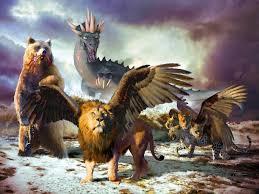
The first beast (7:4): The first beast, like the head of gold of Nebuchadnezzar’s statue, represented the Babylonian Empire (see Ay – The First Empire: A Head of Gold). So, the first Gentile kingdom was like a lion. The lion is the king of the beasts and it was used as a symbol of Babylon (Jeremiah 4:7, 49:19, 50:17 and 44). What makes this lion different from other lions was that it had the wings of an eagle. The eagle is the king of the birds and it was also used as a symbol of Babylon (Jeremiah 48:40, 49:22; Ezeki’el 17:3). Thus, the lion and the eagle were both used by Jeremiah to describe Nebuchadnezzar. Dani’el said: I watched until its wings were torn off and it was lifted from the ground so that it stood on two feet like a man, and the heart of a man was given to it. This is a description of the proud and self-sufficient King Nebuchadnezzar being reduced to a field animal to realize his dependence on God (see Bx – Humiliation: The King’s Discipline). But it also represents both Nebuchadnezzar and his empire, for as near as a man could become a beast, he became one. And as much as a beast can become a man, Babylon lost its beast-like nature and its animalistic characteristics and became more humane. This summarizes the experience of Babylon changing from the lust of conquest to the building of her culture.192
The second beast (7:5): The second beast, like the chest and arms of silver of Nebuchadnezzar’s statue, represented the Medo-Persian Empire (see Az – The Second Empire: Chest and Arms of Silver). So, the second Gentile kingdom looked like a bear. It was raised up on one of its sides because the Persians were stronger than the Medes. The bear is less majestic than the lion. Its bulky body appears less graceful and agile. Nevertheless, in the Bible it is frequently associated with great fierceness (First Samuel 17:34-36; Second Samuel 17:8; Proverbs 28:15; Hosea 13:8; and Amos 5:19). Indeed, the Medo-Persian Empire was fierce (Isaiah 13:15-18). Yet, it lacked the cohesive strength that made Babylon so formidable. In addition, just as a bear moves more slowly than a lion, so did the Medo-Persian Empire move more slowly in its military campaigns. The loss of speed was a result of its enormous size. They were conquered by sheer force of numbers. Finally, the bear had three ribs in its mouth between its teeth, indicating that it had already dismembered some prey. Most likely, the ribs represent three of the three historical conquests of the Medo-Persian Empire: Lydia in 546 BC, Babylon in 539 BC, and Egypt in 525 BC. At the end of the verse, the bear is encouraged to “get up and eat even more until you have your fill of flesh!” In other words, the Medo-Persian Empire was given the authority to conquer other nations.193
The third beast (7:6): After that, I looked, and there before me was another composite animal, part leopard, part bird, this third beast looked like a leopard. That third beast, like the belly and thighs of bronze, represented the Greek Empire (see Ba – The Third Empire: Belly and Thighs of Bronze), and the leopard was used as a motif for the Greek Empire (Jeremiah 5:6; Hosea 13:7). It is less majestic than the lion and less grand than the bear, but it is swifter and faster than both. With leopard-like swiftness Alexander the Great conquered the Medo-Persian Empire, including Egypt, Syria, and Isra’el. Within six more years, he covered more than 11,000 miles of territory, from Greece in the west to the borders of India in the east, which greatly extended Greek culture and influence. What made this leopard-like creature different from the rest was that it had four wings like those of a bird on its back. This made it twice as swift as the other two-winged lion and surely faster than the lumbering bear. Alexander’s empire had four divisions like the four wings: the first wing was Thrace, the second wing was Greece, the third wing was Egypt, and the fourth wing was Mesopotamia. Nearly two hundred years before Alexander was born, Dani’el received this prophecy that predicted the Greek Empire would be divided between four others. So, this beast also had four heads. Alexander’s untimely death in 323 BC left him without a successor after his two sons were murdered, and his empire was divided among his four generals: Lysimachus, Cassander, Ptolemy, and Seleucus. Ptolemy and Seleucus ruled the two kingdoms that had a direct impact on Isra’el’s history: Egypt and Syria. And the Greek Empire was given authority to rule (7:6b). This beast was the third of four Gentile empires to dominate Zion.
Summary of the first Three Beasts: The times of the Gentiles (see Ao – The Times of the Gentiles) began with the Babylonian Empire, which was represented by the golden head of Nebuchadnezzar’s dream statue, and the lion-like creature Dani’el saw in his vision. The second empire was the Medo-Persian Empire, symbolized by the silver arms and chest and the bear-like creature. Various aspects of this empire are described in 2:39a, 5:31 to 6:28, 7:5, 8:1-7 and 10:1 to 11:2. The brass belly and the leopard-like creature symbolized the Greek Empire. It began as a single empire under Alexander the Great, but it split into four separate empires upon his death. Extensive revelation regarding his empire can be found in 2:39a, 7:6, 8:7 to 27, and 11:3-35.194 So in his first vision, Dani’el saw the first three Gentile kingdoms, like animals that he was familiar with, a lion, a bear and a leopard. However, in the second vision (7:7-8), it changed drastically.
Dear heavenly Father, praise You that You are the Almighty Sovereign Ruler of the Universe! You are greater than any power, no matter how big or how strong they are. Sometimes it seems that life seems to be run by “beastly” forces, such as the government or our boss at work; yet it is such a comfort that You are sovereign over every government and every situation. Praise you that when those who love You come to live with You in heaven, there will be no crying, dying, mourning nor pain (Revelation 21:4); but for now, while still living on earth, Your children will face beastly trials of many kinds. You purify your children by trials so that they grow stronger in godly character. We also boast in suffering – knowing that suffering produces perseverance; and perseverance, character; and character, hope. And hope does not disappoint, because God’s love has been poured into our hearts through the Ruach Ha’Kodesh who was given to us (Romans 5:3b-5). Hope in trials is like an anchor of rescue. David so trusted in You that when he was in the wilderness in the midst of severe trials, he still looked to You, saying: Since Your lovingkindness is better than life, my lips will praise You. So I will bless You as long as I live. In Your name I lift up my hands. My soul is satisfied as with fat and oil, so my mouth praises You with joyful lips (Psalms 63:3-5). Your steadfast love is always right there with me in every moment of every trial. Thank you for your awesome love and care! In Messiah Yeshua’s holy Name and power of His resurrection. Amen
Leave A Comment