




The Kingdom of Messiah
7: 13-14
The Kingdom of Messiah DIG: What is the sequence of Dani’el’s four visions? How is this the climax of Dani’el’s vision? Where does the term the Son of Man come from? How many times does the Son of Man appear in the B’rit Chadashah? How long is the Kingdom? How did Yeshua use the term Son of Man?
REFLECT: When Kingdom is established, what are the things about our present world that you most look forward to being changed? What do you think “peace in the world” will feel like? Dani’el’s response to this prophecy was one of solemnity and sudden fright. What does Dani’el’s response tell you about him?
Yeshua is son of man and as Son of Man, very man and Very God.
The scene shifts again, this time from the courtroom and the judgment of the beasts (to see link click Ce – A Vision of the Heavenly Court) to the description of Messiah’s Second Coming (see the commentary on Isaiah Kg – The Second Coming of Messiah to Bozrah). These verses describe the setting up of the Kingdom of Messiah following the destruction of the Fourth Empire (Cd – The Kingdom of Satan). The sequence is that of the Second Coming; a seventy-five-day interval (see the commentary on Revelation Ey – The Seventy-Five Day Interval); followed by the establishment of the thousand-year reign of Messiah.
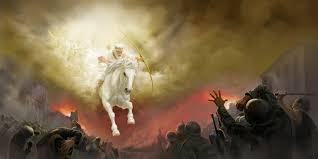
The Second Coming: Dani’el starts: As my vision continued at night, I looked (7:13a). The introductory formula here echoes the formula introducing his vision, “In my vision at night I looked” (7:2a), and forms book-ends for the literary unit (7:2-14). This construction serves to underscore the importance of the final scene as the climax of Dani’el’s vision.205 He saw a human figure described as one like a son of man (7:13b). The Aramaic phrase (see Ac –Introduction of Dani’el from a Messianic Jewish Perspective: Languages) for son of man is bar enash. The Hebrew equivalent is ben adam. It appears many times in the TaNaKh in reference to human beings. For instance, in Jeremiah 49:18, ADONAI declared that no ben adam, no human being, would ever again live in Sodom and Gomorrah. Another example is the prophet Ezeki’el, who used the phrase ben adam numerous times (for example in Ezeki’el 2:1). The Messianic reference of this title, however, does not come from Jeremiah or Ezaki’el, but from Dani’el. In the B’rit Chadashah, Yeshua is called the Son of Man eighty-eight times. In fact, this is one of Yeshua’s favorite titles for Himself (Matthew 8:20, 9:6, 11:19, 20:18; Mark 8:38; Luke 18:8; John 1:51).206
Yeshua had no qualms about confessing His own identity from Dani’el 7:13. When the high priest Caiaphas illegally placed Yeshua under oath and demanded that He declare if He was the Messiah, the Son of God (Matthew 26:63b; Mark 14:61b). But refusing to answer this question would be equivalent to a denial of His deity. Therefore, Yeshua answered the startled Sadducee: The words are your own (Matthew 26:64a CJB). The Lord always says the right things at the right time and here He called attention to the words of His accuser, not His. This accusation was inadmissible because rule number 14 said that a person could not be condemned on the basis of his own words (see The Life of Christ Lh – The Laws of the Great Sanhedrin Regarding Trials). It was as if Yeshua was really saying, “Caiaphas, whatever your concept of the Messiah is – I am” (Mark 14:62a). And as such, He had a unique relationship with ADONAI as His Son (Psalm 2).
But just to be sure there was no misunderstanding, the Lord added more detail: I tell you that one day you will see the Son of Man sitting at the right hand of the Powerful One (or HaG’vurah, a common substitute for the actual name of God) and coming on the clouds of heaven (Mathew 26:64b; Mark 14:62b; Psalm 68:4; Isaiah 19:1). To those educated rabbis and priests, the messianic phrase Son of Man would arouse a clear image of the appearance of the Messiah. In Psalm 110:1, the Messiah is invited to sit at the place of honor. Dani’el spoke of his vision of the coming Messiah on the clouds of heaven (7:13c). Those standing in judgment of Yeshua knew those verses all too well. So it was quite obvious that the maverick Rabbi from Nazareth was claiming to be much more than merely a good rabbi or even a prophet. No, He claimed to be the unique Messiah sent from the God of Isra’el.207 Just before Messiah leaves heaven to come to the earth, He will approach the Ancient of Days (7:9), with the angels leading Him to the throne of God the Father (7:13d). This verse makes it very clear that the Son of Man and the Ancient of Days are distinct beings. This points to a plurality in the Godhead. The Son of Man is submissive to the Father, yet He is given eternal authority over all the nations of the world and is worshiped by them.
The Messianic Kingdom: He was given authority, honor, power and sovereignty over all nations of the world, so that people of every race, nation and language would worship Him. His rule is eternal – it will never end, and His Kingdom will never be destroyed (7:14). How did Dani’el respond to this great revelation? He was deeply troubled and his face turned pale, but he kept the matter to himself (7:28). Again, it is important to keep the sequence of Dani’el’s visions in mind. In the first vision, he saw three beasts surfacing from the great sea (see Cc – The Kingdoms of This World). In the second vision, he saw the fourth beast rise to power. This beast had ten horns, and a little horn emerged (see Cd – The Kingdom of Satan). In the third vision, the Ancient of Days held court in heaven, and the fourth beast was destroyed (see Ce – A Vision of the Heavenly Court). The fourth vision deals with the Second Coming of Messiah. Then the times of the Gentiles will end (see Ao – The Times of the Gentiles) His Kingdom will be eternal and not be destroyed like Babylon, Medo-Persia, Greece or Rome. In the last stage of the Fourth Empire, all kingdoms will be replaced by the Kingdom of God.208
As Iain Duguid asks in his commentary on Daniel, so what are we to make of Dani’els vision of a God-man – one who shares our humanity, yet at the same time provides him with the fullness of the Deity in bodily form? It is far easier for us to understand it than it was for Dani’el, for we have the benefit of the hindsight of the prophecy’s fulfillment. The son of man was the perfect title for Yeshua to bear on His work, His strange work, and perform His task, His alien task (Isaiah 28:21), precisely because it combined in itself the strange ideas of “mere humanity” with the unparalleled glory of God Himself. In His earthly ministry, it was the “human” aspect of the son of man that was most prominent. We see him at dinner with a prostitute, stopping off for lunch with a tax-collector, blessing children, healing the poor, and ignoring the influential Pharisees and wealthy Sadducees. Ultimately, He hung pierced and bleeding on a cross; He died and was buried in a tomb, surely the most ungodly of acts. But His majesty, even though veiled while on the earth, was still present. He taught as one with unparalleled authority (Matthew 7:29), He forgave people their sins (Luke 5:24), and He spoke of possessing a Kingdom (John 18:36). Both divine and human aspects are present because Yeshua is son of man and as Son of Man, very man and Very God.
For the first disciples, the lesson that Yeshua was the son of man focused upon his humanity. They had to learn that salvation does not come through the arrival of a triumphal heavenly figure bearing a sword, and blasting his opponents with fire from heaven. Rather, it came through the arrival of a baby in a manger, who grew up to bear a crown of thorns and carry a cross. The Son of Man did not come to be served (as one might have expected), but to serve – and to give His life as a ransom for many (Mark 10:45). However, for the readers of the book of Revelation, the lesson of the Son of Man was reversed. They were in the situation of Dani’el’s hearers, suffering intense persecution for their faith, and so needed to be reminded of the central lesson of Dani’el 7. The Second Coming of our Lord will not be the same as His First Coming. Messiah is not eternally suffering upon the cross, but when the time is right, He will return as the Son of Man in glory on the clouds (Revelation 1:7), bearing a sharp sickle to bring final judgment on His enemies (Rev 14:14-20).209
Leave A Comment