




The Interpretation of Dani’el’s Visions
7: 15-28
The interpretation of Dani’el’s visions DIG: In what way were the four empires that the king saw in Dani’el 2 connected to the four beasts in Dani’el 7? Who are the kedoshim and what will they do? Why was a second interpretation needed? Who are the ten horns and the ten kings? What will happen to the antichrist?
REFLECT: What do you look forward to? What do you imagine the Kingdom of God will be like? What do you see yourself doing during His Messianic Kingdom? Who will you see there? Dani’el was deeply troubled by his vision. How do you feel about it? Does it cause you to fear the future, or does it give you comfort?
These verses record Dani’el’s reaction to the remarkable visions he had received and provide their interpretation. Dani’el made two separate requests to obtain all the desired information. The first request is given in verses 15-16 and leads to the summary interpretation in verses 17-18. The second request for further detail on the Fourth Empire is covered in verses 19-22 and leads to the detailed interpretation in verses 23-27.212
A summary interpretation (7:15-16): Like Nebuchadnezzar in Chapter 2, Dani’el was greatly troubled in spirit, by the visions that passed through his mind. Dani’el had previously seen ten thousand times ten thousand angels standing before the Ancient of Days (7:10). Presumably, Dani’el approached one of those angels standing there and asked him the meaning of his dream. The prophet Zechariah received similar aid from an unnamed angelic interpreter (Zechariah 1:9 and 2:3). Later, Dani’el will receive help from the angel Gabriel in the interpretation of two other visions (8:16 and 9:21). Consequently, we may speculate with good reason that it’s Gabriel seen here speaking to Dani’el. Thus, the angelic messenger told Dani’el a summary interpretation of the entire vision.213
The kingdom of man (7:17): The four great beasts are four kings that will rise from the earth. The Gabri’el’s summary statement establishes a connection between Dani’el’s vision (see Bz – Dani’el’s Vision of Four Beasts) and Nebuchadnezzar’s dream (see Aq – Nebuchadnezzar’s First Dream). The Four Empires that King Nebuchadnezzar saw in Dani’el 2 were the same Four Kingdoms that Dani’el saw in Chapter 7, represented by four beasts. Earlier, I pointed out that the four beasts emerged out of the sea (7:2-3). Here, Gabri’el declares that they arose out of the earth. Both statements are true. The fact that the beasts, or, better the kingdoms, emerged out of the sea highlights their Gentile identity. The fact that they will rise from the earth highlights their humanity. The prophecy refers to human, not divine, kingdoms ruled by Gentiles.
The Kingdom of God (7:18): Then Gabri’el provided a summary of the Fifth Empire that Dani’el saw in his dream (see Bg – The Fifth Empire: The Kingdom of God). But the kedoshim, meaning the holy ones of the Most High will receive the Kingdom and will possess it forever – yes, for ever and ever. In 7:14, it was revealed that at His Second Coming, the Son of Man would be given authority, honor, power and sovereignty over all nations of the world. Yet, here Gabri’el states that the people of the Most High will receive that kingdom and possess it forever. Again, both statements are true.
There are numerous verses in the TaNaKh where kadosh (holy) is used to refer to the people of Isra’el. For example, in Exodus 19:6, Isra’el is called a holy nation. Isra’el is referred to as a holy people in Deuteronomy 7:6; Psalm 26:19 and Psalm 16:3. The Israelites were to be holy (for example, Leviticus 11:44-45, 19:2, 20:26, 21:8). The amillennial and postmillennial interpretation of Dani’el 7:18 see the holy ones of the Most High as Christians, and “the kingdom” as a spiritual kingdom. However, the Church did not come into existence until Acts 2. Proponents of replacement theology tend to take passages that refer to Isra’el’s blessings allegorically, applying them to the Church. But, a literal interpretation requires that all verses be explained using the same method. Thus, the kedoshim, the holy ones of 7:18 and 21, are the Jewish people (Revelation 2:26-27). They will be co-heirs of the Kingdom that, according to 7:14, ADONAI will give to the Son of Man. The Jews will possess this Kingdom together with Messiah forever.214
A detailed interpretation (7:19-22): As related by Arnold Fruchtenbaum in his commentary on Dani’el, the summary interpretation did not satisfy Dani’el’s questions about the fourth beast. In particular, the little horn gave him the most trouble in his vision in 7:8 and 8:9. In verse 19, Dani’el focused on the beast himself. Then I wanted to know the meaning of the fourth beast, which was different from all the others and most terrifying, with its iron teeth and bronze claws – the beast that crushed and devoured its victims and trampled underfoot whatever was left (7:19). Dani’el wanted to know all about the fourth beast, again emphasizing that it was very different. He repeated that it was most terrifying, had iron teeth, and destroyed anything in its way. The one new element of the description was that it had bronze claws.
In addition, Dani’el also wanted to know more about the ten horns on the head of the beast. He noticed that when the little horn that came up, three of the original ten fell (Revelation 17:12-13 and 17) – the horn that looked more imposing than the others and that had the eyes of a man and a mouth that spoke boastfully. As Dani’el watched, this little horn was waging war against the Jewish people (see the commentary on The Life of Christ Jy – The Sheep and the Goats), until the Ancient of Days came and pronounced judgment in favor of the believing remnant, and the time came when they possessed His Kingdom (7:20-22). ADONAI alone has the authority to give the earth to whomever He chooses.
The Fourth Empire (7:23-26): These verses reflect Gabri’el’s detailed interpretation of Dani’el’s visions. He gave me this explanation. In verse 23a the Fourth Empire is seen in its united stage (see Bc – The United Stage). When Rome conquered the Greek Empire, it did so as a united force. Later, the empire would be split into a western and eastern power (see Bd – The Divided Kingdom Stage), but in this stage, the Fourth Empire was united. What made it different from all preceding empires was its policy of imperialism. When Babylon conquered other nations, it did not install Babylonians as their rulers. Instead, the empire selected leaders from among the subjugated populations and placed them under its control. This historical fact is demonstrated by the conquest of Judah. When Nebuchadnezzar destroyed Jerusalem, he chose Gedaliah, a Jew, to rule over the Province of Judah rather than a Babylonian (Jeremiah 41:2-3 and 52:30).
The Medo-Persians followed the same strategy. When they conquered a nation, they didn’t appoint Medes or Persians to rule its subjects, but rather chose leaders from the defeated country. Zerubbabel is an example of this policy. He was appointed as Isra’el’s governor by the Medes and the Persians (see the commentary on Ezra-Nehemiah Ag – The First Return). Nehemiah is another example (see Ezra-Nehemiah Bt – The Third Return). Although they were Jews, Zerubbabel and Nehemiah ruled under Medo-Persian authority. The Greeks utilized the same method. Under their rule in Isra’el, the Jewish high priest became the ruler of Judea. All of this, however, changed when the Romans conquered the known world. As soon as a nation was conquered, the empire would install a Roman native as the country’s new ruler. Consequently, the B’rit Chadashah frequently mentions Roman procurators like Pilate (Matthew 27:11-19 and Luke 23:13-14); Felix, (Acts 23:23-24), and Festus (for example in Acts 25:1-12).
At this point, the vision departs from the chronology established in Dani’el 2 (see Bb – The Fourth Empire: Imperialism). In that chapter, the next stage was the Divided Kingdom Stage (see Bd). Yet, rather than elaborating on, or at least mentioning this stage, verse 23b describes the third stage of the Fourth Empire (see Be – The One World Government Stage). It will be different from all the other kingdoms and will devour the whole earth, trampling it down and crushing it. Because Rome never conquered the whole earth, this prophecy has never been fulfilled. It is a far eschatological prophecy in which the antichrist will trample the entire world.
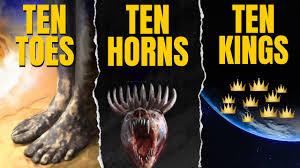
Verse 24a shows that there will be ten horns in that One World Government, which represent ten kings and the ten toes of 2:42. There are those today who say that the ten horns are the European Economic Community (EEC), or even the European Union (EU). But the ECC has been absorbed into the EU, which currently has twenty-seven member states. Therefore, this is a simple rule to follow regarding prophecy. One must not interpret biblical prophecy by current events, but interpret current events by biblical prophecy. There is one additional principle to keep in mind: Bible prophecy is never fulfilled approximately; it is always fulfilled precisely and as written. Much of what is presented as fulfillment is sensationalized prophecy books and based on a single similarity. However, one similarity does not fulfill biblical prophecy. There is no fulfillment until there is total fulfillment.
After the ten horns/kings, another king will arise, different from the earlier ones; he will subdue three kings (7:24b). This other king will be the antichrist. Once the three kings are killed, the other seven submit to his authority. The ten horns you saw are the ten kings who have not yet received a kingdom, but who for one hour will receive authority as kings along with the beast, or the antichrist. They have one purpose and will give their power and authority to the beast (17:12-13). The same point is made in verse 17. For God has put it into their hearts to accomplish his purpose by agreeing to give the beast their power to rule, until God’s words are fulfilled (17:17). The seven other kings will all agree to relinquish their power to the antichrist. With that decision, he will succeed in taking over the political control of the whole world, with the exception of Bozrah in Jordan where the majority of the Jews will take refuge (see Isaiah Kg – The Second Coming of Jesus Christ to Bozrah). The next goal of the beast will be to gain control of the world’s religious system. He will need to remove all opposition. This will include religious Babylon (see Revelation Dl – The Destruction of Religious Babylon), the two witnesses (see Revelation Dc – I Will Give Power to My Two Witnesses to Prophesy), believers born again during the Great Tribulation and, of course, those pesky Jews.
Then Gabri’el provided some new information regarding the little horn. He will speak against the Most High and oppress his holy people and try to change the set times (Aramaic term zimmin), which included the festivals (see the commentary on Leviticus Dw – God’s Appointed Times). In Esther 9:27, the Hebrew equivalent, zeman, refers to God’s Appointed Times. Thus, the little horn will attempt to alter the biblical feasts as Jeroboam did (see the commentary on the Life of Solomon Dd – Golden Calves at Dan and Bethel). Additionally, the antichrist will try to change “the law.” The Aramaic term for law, dat, can refer to a royal decree (as in Dani’el 2:13 and 15; Ezra 7:26), or the Torah (Dani’el 6:5 and Ezra 7:12). In the context of Dani’el 7:25, it could refer to religious law enacted by the government or, more likely, to the Torah (7:25a).
The antichrist will conquer three of the ten kingdoms during the first half of the Great Tribulation. During that time, Isra’el will be protected from war by a covenant it signed with the antichrist (9:27). Midway through the Great Tribulation, however, the antichrist will invade Jerusalem (Revelation 11:2), desecrate the Tribulation Temple (see Revelation Bx – The Tribulation Temple) and change feasts and the Torah. Gabri’el goes on to say that God’s holy people will be delivered into the hands of the little horn for three-and-a-half-years, forty-two months, or 1,260 days (7:25b). He will blaspheme YHVH (Revelation 13:5-6) and persecute the Jews (Matthew 24:16-22; Mark 13:14-20; Revelation 13:7-10). However, as we will see in verse 27, this dispensation will culminate in the Second Coming of Yeshua Messiah to Bozrah.
When Messiah returns at the end of that seven-year period. Among the very first casualties of Armageddon will be the antichrist himself (see Revelation Ex – The Eight Stage Campaign of Armageddon). The ease with which Messiah will kill the antichrist is described by Paul. And then the lawless one will be revealed, whom the Lord will slay with the breath of His mouth and destroy with the brightness of His coming (Second Thessalonians 2:8). Earlier, Dani’el revealed that he continued to watch the heavenly court because of the boastful words the little horn was speaking. He kept looking until the beast (the antichrist) was slain and his body destroyed and thrown into the blazing fire (7:11). Habakkuk 3:13 speaks in even more graphic terms: You went out to rescue Your chosen people, to save your anointed ones. You crushed the leader of the house of the wicked and laid him open from thigh to neck. And finally, Isaiah tells us: All the other kings of the nations, all of them, lie in glory, each in his own tomb. But you are discarded, unburied, like a rejected branch. You are covered with the slain in a mass grave, with those pierced by the sword, then fall like stones inside a pit, like a trampled corpse (Isaiah 14:18-19). Therefore, after the antichrist is killed, his resurrected body is thrown alive into the lake of fire that burns with sulfur (Revelation 19:20b). Then Dani’el summarizes his discussion of the Kingdom of Satan, by saying: the Ancient of Days will sit in His heavenly court, and the power of the antichrist will be taken away and completely destroyed forever (7:26).
The Kingdom of God (7:27): Finally, the angel Gabri’el provided the interpretation regarding the last kingdom of Dani’el’s vision. When the Kosher King returns, He will rule with His holy ones. Then the sovereignty, power and greatness of all the kingdoms under heaven will be handed over to the holy people of the Most High. His Kingdom will be an everlasting Kingdom, and all rulers will worship and obey Him (see Revelation Fi – The Government of the Messianic Kingdom). In summary, the Fifth Empire refers to the Messianic Kingdom, or the Kingdom of God. Isra’el, the Jewish people, will be serving under Him as the head of the Gentiles (Deuteronomy 28:1 and 13; Isaiah 14:1-2, 49:22-23, and 61:6-7, etc.).
Conclusion (7:28): In the last verse of the chapter, Dani’el commented on the impact the visions had on him. At this point the revelation ended. As for me, Dani’el, my thoughts were deeply troubling, and my face turned pale, but I kept the matter to myself, meaning that he documented his experiences, but did not share them with anyone.215
Leave A Comment