




Dani’el’s Vision of the Ram and Male Goat
8: 1-27
In Dani’el 8:1, the language reverts back to Hebrew (to see link click Ac – Dani’el from a Messianic Jewish Perspective: Languages), and remains that way to the end of the book. The sages teach that because these are Dani’el’s personal visions, the text is exclusively Hebrew. The message of Chapters 2 and 7 regarding the far eschatological significance of the four Gentile kingdoms is not repeated in Chapter 8. Instead, Chapter 8 is a vision report. It focuses on events that occurred during the second (see Bc – The United Stage: Rome) and third (see Bd – The Divided Kingdom Stage: East and West Balance of Power) kingdoms and, thus, primarily deals with the period between the sixth and second centuries BC. Dani’el did not attempt to write history when he wrote his book; rather, he was developing a theme.183
Here is an overview of Dani’el’s prophecies in chronological order:
602 BC prophecy of the Great Statue (2:1-45) when Dani’el was 18.
553 BC prophecy of the Four Beasts and the Ancient of Days (7:1-28) when Danie’l was 67.
551 BC prophecy of the Ram and Male Goat (8:1-27) when Dani’el was 69.
539 BC prophecy of the Fall of Babylon (5:1-31) when Dani’el was 81.
539 BC prophecy of the Seventy-Weeks (9:1-27) when Dani’el was 81.
536 BC prophecy of the Future of the Nations (11:2-45) when Dani’el was 84.
536 BC prophecy of the Future of Isra’el (12:1-13) when Dani’el was 84.
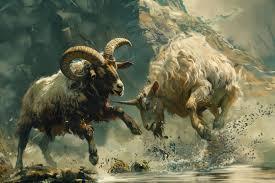
In Chapter 8, Dani’el had a vision of two animals. As in the previous chapters, these animals represent earthly kingdoms. The vision focuses on Alexander the Great (see Dv – Alexander the Great) and the ascent of Antiochus IV Epiphanes (see Dw – Antiochus Epiphanes), who was the most detestable Seleucid monarch. During his reign, he persecuted the Jewish people mercilessly and tried to do away with any worship of ADONAI. The fulfillment of Dani’el’s prophetic vision in Chapter 8 is described in detail in the Maccabean books. These apocryphal texts date back to the second century BC. They will be quoted extensively in the discussion of Chapter 8 because they demonstrate the accuracy of Dani’el’s prophetic vision. The accuracy of the Maccabean books has led some to believe that the book of Dani’el must have been written in the second century BC. However, I Maccabees lends credence to the traditional view that the book was written in the sixth century BC. In his final words, Mattathias, who helped to ignite the Maccabean Revolt against the Seleucid Empire, exhorted his sons to remain faithful to YHVH by citing the examples of three Jews in the blazing furnace and Dani’el in the lion’s den, “Hananiah, Azariah, and Mishael believed and were saved from the flame. Dani’el, because of his innocence, was delivered from the mouth of the lions” (I Maccabees 2:59-60). Mattathias passed away around 166 BC. So, there is no reason to dispute the reliability of his speech. Hence, the events of the book of Dani’el were widely known in the second century BC and, as a result, could not have been written after that time.217
Leave A Comment