




The Ram and the Male Goat
8: 1-14
The ram and the male goat DIG: Dani’el 7:8 refers to a “little horn,” and here in Dani’el 8:9 it refers to a “small horn.” Are these the same or different? Who would you say are the top five people, including Alexander the Great, who have shaped the world as you know it? Who is the ram? Who is the male goat?
REFLECT: Why did God speak so often in visions in Dani’el’s time, but not today? Who are the people that you know who speak with the same authority as Dani’el? Can you name anyone in politics who has been used by God even though they were unaware of it? What reason does Dani’el give you to trust God?
No matter how brutally the Gentile nations may treat the people of Isra’el, ADONAI uses the nations to accomplish His ordained purposes. His plans for Isra’el will be fulfilled no matter how much the nations may oppose His chosen people. There has always been a believing remnant.
For the first time since 2:38 Dani’el interprets his symbols. The ram with two horns represents the Medo-Persian Empire (8:20); the male goat is the king of Greece (8:21). This vision goes no further than the Greek empire. No mention is made of the setting up of the Messianic Kingdom as in 2:44 and 7:27. But, Dani’el emphasizes one specific despotic ruler who rises from one part of the divided Medo-Persian Empire. This focus will become even more detailed in Chapter 11 (to see link click Dw – Antiochus Epiphanes).218
The vision (8:1-2): In the third year of King Belshazzar’s reign, I, Dani’el, had a vision, after the ones that had already appeared to me (see Cb – Dani’el’s Visions). In my vision I saw myself in the palace of Susa in the province of Elam beside the Ulai Canal (one of the Persian royal cities, more than 200 miles east of Babylon). A century later the Persian king Ahasuerus built a magnificent palace there, which was where the events recorded in the book of Esther took place (see the commentary on Esther Ak – The King Gave a Grand Banquet in Susa, and Displayed the Vast Wealth of His Kingdom), and where Nehemiah was the cupbearer for king Artakhshasta (see the commentary on Ezra-Nehemiah Bu – Nehemiah Intercedes for Jerusalem).219 It is unlikely that Dani’el left Babylon and traveled to Susa to receive his vision. It’s more likely that ADONAI transported him to Susa just as He transported Ezeki’el to Jerusalem (Ezeki’el 8:3), and the apostle John to the wilderness (Revelation 17:3) and to a high mountain (Revelation 21:10). Since Dani’el was about to describe the victory of the Medes and the Persians over the Babylonians, God put him into the future capital of the Persian Empire.220 However, at the time of Dani’el’s vision, Susa was simply a small, unassuming town. The future palace of Susa had not even been built yet.
The ram (8:3-4): When he looked up, he saw a ram with two horns, standing beside the canal, and the horns were long (8:3a). There are four reasons to interpret the ram with the two horns as a symbol of the Medo-Persian Empire. First, the Bible itself identifies it as such: The two-horned ram that you saw represents the kings of Media and Persia (8:20). Second, in a Persian religious book known as the Bundahishn, the guardian spirit of Medo-Persia is portrayed in the form of a ram with pointed horns.221 Third, the Persian king bore the golden figure of a ram’s head when he stood before his army.222 And fourth, different nations in the Ancient Near East were represented by zodiac signs, and the sign for Persia was Aries, the ram.223 Additionally, the vision of the ram also develops previous revelations concerning the second Gentile empire. It is a further elaboration of the chest and arms of silver (see Az – The Second Empire: Chest and Arms of Silver), and the lopsided bear (see Cc – The Kingdoms of This World: The second beast).224
One of the horns was longer than the other but grew up later (8:3b). Rams normally have two horns, but these horns were unique. One horn grew up later yet grew longer than the other. These horns symbolize the two divisions of the empire. Persia would begin with less strength, but would eventually become much more powerful than Media due to the rise of Cyrus the Great. Centuries before he appeared on the scene, Isaiah called him by name, and even called him “God’s shepherd” (see the commentary on Isaiah Ib – Cyrus is My Shepherd and Will Accomplish All). It was Cyrus whom ADONAI chose to defeat the Babylonians and permit the Jews to return to the Land.
I watched the ram as it charged toward the west and the north and the south. No animal could stand against it, and none could rescue it from its power. The rapid progress of Cyrus during the ten years of 549 to 539 BC suggested a ram goring every beast that got in his way. By thrusting westward and northward into Asia Minor, he bypassed Babylon, only to capture it later and take the lands to the southwest and southeast. It did as it pleased and became great (8:4). Nearly two hundred years of history and national expansion, such as the world had never seen before, are summed up in this one verse.225 Why did YHVH call Cyrus? For the sake of Jacob My servant, of Isra’el my chosen (Isaiah 45:4a). No matter how brutally the Gentile nations may treat the people of Isra’el, ADONAI uses the nations to accomplish His ordained purposes. His plans for Isra’el will be fulfilled no matter how much they may oppose His chosen people.226
The male goat (8:5-8): According to Dani’el Chapters 2 and 7, ADONAI allots each Gentile empire a certain amount of time before terminating its dominion and transferring its power to another. This would also be the case with the Medo-Persians, as verses 5-14 prophecy. Again it must be remembered that from Dani’el’s perspective, none of what he saw in his vision had happened yet. At the point of his writing in 551 BC, the Babylonian Empire was still the most dominant monarchy in the world.227
As I was thinking about the ram, suddenly a goat with a prominent horn between its eyes came from the west. In Nebuchadnezzar’s statue, Greece was depicted as a belly and thighs of bronze (see Ba – The Third Empire: Belly and Thighs of Bronze), and a swift leopard (see Cc – The Kingdoms of This World: The third beast). Now, Dani’el sees Greece angrily crossing the whole earth without touching the ground, and like a leopard, Alexander was known of the speed in which his armies moved (8:5). The large prominent horn represents Alexander the Great. There are three reasons to interpret the goat as a prophetic symbol of the Greek Empire. First, the Bible itself identifies it as such: The shaggy goat is the king of Greece, and the large horn between its eyes is the first king, Alexander the Great (8:21). When he came to conquer Persia, he did so from Macedonia and Greece, which are both located west of Persia. Therefore, Dani’el stated that he saw the male goat coming from the west. Second, the zodiac sign for Greece was Capricorn, the one-horned goat. Third, the national emblem of Macedonia was a goat.228
Alexander was one of the great military strategists of history. He led the armies of Greece from victory to victory and extended his empire even beyond that of Cyrus had done with the Persian army. He was born in 356 BC, the son of a great conqueror in his own right, Philip of Macedon. Philip had united Greece with Macedonia and was planning to attack Persia when he was assassinated. Alexander, educated under the famed Aristotle, was only twenty in 336 BC when he succeeded his father as king. A year-and-a-half later (334 BC), he had launched his attack against the Persians. This focus will become even more detailed in Chapter 11 (see Dv – Alexander the Great).
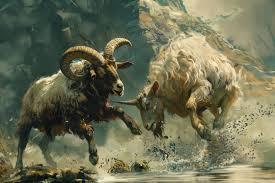
The destruction of the ram (8:6-7): The goat charging the ram in a fit of great rage rightly describes Alexander’s assault on the Medo-Persian Empire. The male goat came toward the two-horned ram I had seen standing beside the canal and charged at it in great rage (8:6). Hatred for the Persians had grown steadily since the time of Cyrus due to constant quarreling and fighting between Persia and Greece, and the Greeks were especially bitter over the invasions of Darius 1 (490 BC) and his son Xerxes (480 BC). Alexander was determined to avenge those assaults on his homeland. In his vision, Dani’el saw the goat attack the ram furiously, striking the ram and shattering its two horns. The ram was powerless to stand against it; the goat knocked it to the ground and trampled on it, and none could rescue the ram from its power (8:7). In that same year Alexander won the Battle of Granicus in Asia Minor, thereby bringing to an end the dominance of the Medo-Persian Empire. With his subsequent victories at Issus (333 BC) and Arbela (331 BC), the conquest of Medo-Persia was complete. Incredibly, after three years, Alexander had conquered the entire Near East. The details of this prophecy are so historically accurate that literary critics have attacked the book, saying that it must have been written after these events took place. But we worship an omniscient God who is outside of time. He can predict the past and the future. In fact, He causes the future to happen.
The division of the four horns (8:8): This verse prophetically describes what would happen to the Greek Empire after Alexander’s death. He carved out an empire of 1.5 million square miles, but at the height of his career, having conquered much of the known world, Alexander was taken ill with a severe fever (possibly malaria) and on June 13, 323 died at the age of 32. The goat became very great, but at the height of its power the large horn was broken off (8:8a). Alexander spread the Greek language and culture all over the world, an act that prepared the world for the Gospel by giving it a common language, Koine Greek, the language of the B’rit Chadashah.229
When Alexander died, he left two sons, Alexander IV and Herakles, both of whom were murdered. Historically, this prophecy was fulfilled by Alexander’s four generals. It took twenty years of infighting and struggle before the empire was successfully divided among four prominent horns. They grew up toward the four winds of heaven (8:8b). Cassander took Macedonia and Greece in the west; Lysimachus took Thrace and Bithynia in the north; Ptolemy took Egypt, Isra’el, and Arabia Petrea in the south; and Seleucus took Syria, Babylonia, and the territory in India in the east.230
The small horn (8:9-14): In contrast to the little horn (the antichrist) described in Chapter 7 (see Cd – The Kingdom of Satan), a small horn (Antiochus Epiphanes) emerges in Chapter 8. The little horn of Chapter 7 springs from the Empire of Imperialism (see Bb – The Fourth Empire: Imperialism). However, the small horn of Chapter 8 springs from the division of the Greek Empire of Alexander the Great. But they both had one thing in common. The hatred of the Jews by Antiochus in the past, foreshadowed the hatred of the Jews by the antichrist in the future.
The activities of the small horn (8:9-12): Dani’el begins by describing how the small horn rose to power. Out of one of them came another horn, which started small but grew in power to the south and to the east and toward the Beautiful Land (8:9). As we have already seen, after the death of Alexander the Great, his empire was divided into four parts with four of his generals taking control (8:8). Out of one of those horns, a small horn appeared who became the infamous Antiochus Epiphanes, the ruler of Syria from 175 to 163 BC, and known as one of the cruelest tyrants in history.
Antiochus gave himself the name Epiphanes, which means illustrious manifestation, for he claimed to be a revelation (epiphany) of the gods. He even had the word god (theos) put on the coins minted with his picture on it to look like the Greek god Zeus. In addition, he set up a statue of himself in the Most Holy Place in the Temple. And he had a passionate desire to turn the Jews into good Greeks. One of his first acts was to drive out the high priest Onias and replace him with Jason, a supporter of the Greeks. Jason was replaced by Menelaus, who actually bought the high priesthood. Believing a rumor that Antiochus had died, Jason attacked Jerusalem only to learn that Antiochus was very much alive (Oops). The angry king attacked Jerusalem and plundered the Temple. In 168 he sent an army of twenty thousand men under Apollonius to level Jerusalem. They entered the City on the Sabbath, murdered most of the men, and took women and children as their slaves. The remaining men fled to the army of Judas Maccabeus.231
The small horn grew until it reached the host of the heavens (Isra’el), and it threw some of the starry host (the army of Antiochus) down to the earth and trampled on them (8:10). In other words, Dani’el accurately prophesied that Antiochus would attack the Jewish people. The historical fulfillment of verse 10 is recorded in 1 Maccabees 1:29-32: Two years later the king sent to the cities of Judah a chief collector of tribute, and he came to Jerusalem with a large force. Deceitfully, he spoke peaceable words to them, and they believed him; but he suddenly fell upon the City and dealt it a severe blow and destroyed many people of Isra’el. He plundered the City, burned it with fire, and tore down its houses and its surrounding walls. And they took captive women and children, and seized the cattle (also see 1 Maccabees 1:37-38, 41-42, 48-50, 60-61, and 64). This quotation shows that while the Maccabean books are not inspired Scripture, they record the fulfillment of many of Dani’el’s prophecies and are important historical documents and are of the same value as the records of Josephus.232
But the king wasn’t satisfied, so he issued an edict to abolish the Jewish religion. Antiochus set himself up to be as great as the commander of the army of ADONAI, or the high priest; and took away the daily sacrifice from YHVH Himself, and God’s Sanctuary was thrown down, or desecrated. In addition, because of rebellion, the LORD’s people and the daily sacrifice were given over to Antiochus. He prospered in everything he did, and God’s truth (the Torah) was thrown to the ground or disregarded (8:11-12). He prohibited the Jews from honoring the Sabbath, practicing circumcision, obeying Jewish dietary mitzvot, and offering sacrifices. Any Jew found possessing a copy of the Torah was put to death. And he climaxed his campaign of terror on December 14, 168 BC, by replacing the Jewish bronze altar (see the commentary on Exodus Fa – Build Altar of Acacia Wood Overlaid with Bronze) with an altar to Zeus . . . and sacrificed a pig on it! What Antiochus did was a foreshadowing of what the antichrist will do when he puts his image in the Tribulation Temple and commands the world to worship him (see the commentary on Revelation Dr – The Abomination That Causes Desolation).233
The 2,300 evenings and mornings (8:13-14): Dani’el overheard two angels speaking, and from their conversation God’s prophetic timetable was revealed to him. Then I heard an angel speaking, and a second angel asking him, “How long will it take for the vision to be fulfilled – the vision concerning the daily sacrifice, the rebellion that causes desolation, the surrender of the Sanctuary and the trampling underfoot of the Lord’s people?” The question was asked for Dani’el’s sake, since the answer was given to him rather than the second angel. The first angel said to me, “It will take 2,300 evenings and mornings; then the Sanctuary will be properly restored (8:13-14).” In the Hebrew text, the conjunction “and” is missing. Instead of evenings and mornings, the Hebrew reads erev boker, or evening-morning. This expression refers to two parts of one day and the korban tamid, meaning a perpetual offering, since it was offered twice daily, once in the morning and once in the afternoon. Therefore, the duration that was prophetically allotted to Antiochus Epiphanes was 2,300 whole days.
To enforce his laws and ensure that the Jewish people engaged in idol worship, Antiochus sent his soldiers to villages throughout Judea. When the Syrians reached Modi’in, a town located about twelve miles northwest of Jerusalem, they demanded a local Levite leader, Mattathias, be an example to his people by sacrificing a pig on a pagan altar. The priest refused and he not only killed a Jew who stepped forward to do the Syrian’s bidding, but he also killed the king’s representative. Then Mattathias tore down the pagan altar. Antiochus responded swiftly by attacking the Jewish people of Modi’in and killing their men, women, children, and animals. One thousand people are said to have died on that day (1 Maccabees 2:38). That event triggered a major revolt, their October 7th you might say. In 167 BC, Mattathias and his five sons were joined in their fight for the liberation of their country by a group of devout and patriotic Jews (1 Maccabees 2:42). The priest’s family, which belonged to the Hasmonean dynasty, became known as the Maccabees. The name Maccabee means the hammar. It was applied to Judah, the leader of the five brothers, who kept hammering away against the Syrians until they were defeated three years later. After the victory, the Maccabees cleansed the Temple and initiated the Festival of Lights. As the Bible shows, Hanukkah was observed in the first century AD (see the commentary on the Life of Christ Hj – Then Came Hanukkah at Jerusalem, and It Was Winter), and it is still commemorated by the Jewish people today.234
The fulfillment of the prophecies of Dani’el 8:14 is recorded in 1 Maccabees 4:36-59, 2 Maccabees 10:1-9, and by Josephus in his Jewish Antiquities. The following quotation reflects 2 Maccabee 10:1-9, “Now Maccabeus and his followers, ADONAI leading them on, recovered the Temple and the City; and they tore down the pagan altars which had been built in the public square by the foreigners (the Syrians), and also destroyed the sacred grounds. They purified the Sanctuary of the Temple and made another bronze altar of sacrifice; then, striking fire out of flint, they offered sacrifices, and burned incense and lighted lamps and set out the bread of the Presence. And when they had done this, they fell prostrate and begged ADONAI that they might never again fall into such trials, but that, if they should ever sin, they might be disciplined by ADONAI Himself and not to be handed over to blasphemous and barbarous Gentile nations. It happened on the same day on which the Sanctuary had been profaned by the foreigners, the purification of the Sanctuary took place, that is, on the twenty-fifth of Kislev (November-December of the Jewish calendar) 164 BC. And as they celebrated for eight days with rejoicing, like Sukkot.
Since the dedication of the First Temple was such a joyous occasion, Solomon decided that the festivities should reflect the joyous seven-day festival of Sukkot (see the commentary on Numbers Fg – The Hag Sukkot Offering), followed by the eighth day assembly (see the commentary on Numbers Fh – The Eighth Day Assembly). Therefore, the dedication of the First Temple was observed for eight days with the lighting of lampstands. Three-hundred-and-fifty-two years later, the Maccabees decided to duplicate those same celebrations. This is why Hanukkah is celebrated for eight days. It is also the reason that lights became associated with the Feast of Dedication. The Temple was purified, the daily tamid offering was restored and Jewish worship began once again. Much later, the rabbis invented the legend of the miracle of Hanukkah: a small jar of oil kept the candles burning in the rededicated Temple for eight full days. However, this legend did not appear in any Jewish texts until 600 years after the first Hanukkah, and there is no historical record of any such miracle taking place.235 Thus, the real miracle of Hanukkah was in the Maccabean victory over Antiochus Epiphanes on December 14, 165 BC, and their Persian oppressors.
Therefore, bearing beautiful branches, and also palm fronds, they sang psalms of thanksgiving to ADONAI who had given success in cleansing His own Holy Place. They decreed by public ordinance and voted that the whole nation should observe those eight days every year. And this was the end of Antiochus Epiphanes, who died that same year from a divinely-inflicted disease!236
Dear heavenly Father, praise Your almighty power and omniscient wisdom! Your plans for Isra’el will be fulfilled no matter how much the nations may oppose His chosen people. You are always sovereign and totally in control. No matter who the monarch is, only You give Your permission to rule (Revelation 13:5). Just as You rescued Isra’el from the hands of the cruel Antiochus Epiphanes, so you will again rescue Isra’el during the Tribulation from a tyrant acting in a similar proud manner. It will be a terrible time. Death and martyrdom are to be preferred over following the beast. But what a joy for those experiencing trials to focus on the wonderful future that you promise to all who believe in You, an eternal home in heaven with You where there will be no crying, dying, mourning nor pain! I also heard a loud voice from the throne, saying, “Behold, the dwelling of God is among men, and He shall tabernacle among them. They shall be His people, and God Himself shall be among them and be their God” (Revelation 21:3).
Thank You that when politics and problems in the world seem insurmountable: No matter how brutally the Gentile nations may treat Isra’el, You use them to accomplish Your ordained purposes! How wonderful all the many great deeds you have done for Your people. You so graciously and mercifully conquered sin (Second Corinthians 5:21), You have promised to live within those who love You (John 14:23) and Messiah is making an eternal home in heaven for Your children. I am filled with hope when I remember how wonderfully You have worked to rescue Isra’el throughout history, and how you will rescue them on the last three days of the Tribulation when they come to recognize you as their Messiah (Zechariah 12:10). In Messiah’s holy Name and power of His resurrection. Amen
Leave A Comment