




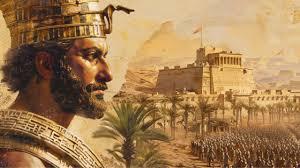
The Great Banquet of Belshazzar and the Fall of Babylon
5: 1-31
Dani’el is one of the most significant books in the Bible in terms of the chronology of future events because it contains essential information concerning the key figures and time sequences of the far eschatological future. It is difficult to understand prophetic chronology without consulting the book of Dani’el. There are visions in Dani’el that detail what YHVH would do beginning in the sixth century BC until the Messianic Kingdom. Thus, Dani’el can be seen as the foundation for the key themes of biblical prophecy. Dani’el did not attempt to write history when he wrote his book; rather, he was developing a theme.248 The banquet described in the introductory verses of Chapter 5 took place in 539 BC. Twenty-three years had passed since the events detailed in Dani’el 4 (to see link click Bt – The Dream of the Great Tree). Dani’el’s first vision in Chapter 7 took place fourteen years earlier in 553 BC, and his vision of Chapter 8 took place in 551 BC. By the time of the great banquet, Dani’el had been in Babylon for at least sixty-six years, and had already experienced additional information regarding the times of the Gentiles (see Ao – The Times of the Gentiles) and the transference of power from the Babylonian Empire to the Medo-Persian Empire. Therefore, the events of Chapter 5 would not have taken Dani’el by surprise. Here is an overview of Dani’el’s prophecies in chronological order:
602 BC prophecy of the Great Statue (2:1-45) when Dani’el was 18.
553 BC prophecy of the Four Beasts and the Ancient of Days (7:1-28) when Danie’l was 67.
551 BC prophecy of the Ram and Male Goat (8:1-27) when Dani’el was 69.
539 BC prophecy of the Fall of Babylon (5:1-31) when Dani’el was 81.
539 BC prophecy of the Seventy-Weeks (9:1-27) when Dani’el was 81.
536 BC prophecy of the Future Nations (11:2-45) when Dani’el was 84.
536 BC prophecy of the Future of Isra’el (12:1-13) when Dani’el was 84.
Dani’el 5 begins with the words King Belshazzar, and we are somewhat puzzled to find that the writer has suddenly dropped Belshazzar into our laps. We have just come from two chapters concerning Dani’el’s vision of four beasts (7:1-28), and his vision of the ram and male goat (8:1-17). Unexpectedly, we are staring Belshazzar in the face. Who is he? Where did he come from? We need to play some historical catch-up.
Nebuchadnezzar died in 562 BC, after a reign of forty-three years. However, in less than another twenty-five years all was lost. Evil-Merodach (561-560 BC), Nebuchadnezzar’s son, followed his father on the throne. But he was apparently assassinated by his brother-in-law Neriglissar, who had a tenure of about four years and was succeeded by his son, Labashi-Marduk. Unfortunately for him, he was killed within a month and one of the conspirators, Nabonidus, became king (555-539 BC). It seems that Nabonidus didn’t have designs on the throne himself, but may have been placed there as a “compromise candidate” by the conspirators. Some think that Belshazzar, Nabonidus’ son, was the real mover behind the conspirators. In any case, as far as the Babylonians were concerned, Nabonidus had a religious “problem.” He was a passionate disciple of the moon god Sin, to such a degree that he alarmed the Babylonian clergy, for he seemed intent on replacing the god Marduk from his supremacy among the Babylonian pantheon. This may have led to a “relocation program” for Nabonidus, because he spent the next ten years at Tayma, an oasis in the North Arabian desert, five-hundred miles from Babylon. His son, Belshazzar, acted as co regent with his father delegating control of the royal affairs to him, and being very pro-Marduk, kept the Babylonian clergy from revolting. Which is why we are suddenly staring Belshazzar in the face at Dani’el 5:1.249 He ruled until Babylon fell to Cyrus the Great in 539 BC. Because he was the city’s de facto king, he is considered the last ruler of Babylon.
This status fulfills a prophecy made by Jeremiah. Now I will give your countries to King Nebuchadnezzar of Babylon, who is my servant. I have put everything, even the wild animals, under his control. All the nations will serve him, his son, and his grandson until his time is up. Then many nations and great kings will conquer and rule over Babylon (Jeremiah 27:6-7). Jeremiah prophesied that Nebuchadnezzar’s family line would end with his grandson. Belshazzar was that grandson. His name means Bel Protect the King. It is very close to Dani’el’s Babylonian name, Belteshazzar, which means May Bel Protect His Life.250
It is not easy to reconstruct the events surrounding the fall of Babylon. The so-called Nabonidus Chronicle (preserved on a single clay tablet now kept at the British Museum in London) is incomplete, but it tells of the return of Nabonidus to Babylon to perform a new year festival. The date is missing, but “seventeenth year” is assumed, for the armies of Darius, were closing in. Darius was made king (9:1-2), called king (6:8), and exercised the authority of a king (6:9). He is called king twenty-eight times in Chapter 6. So the evidence suggests that Darius the Mede was none other than Cyrus king of Persia (see Ag – Darius and Cyrus).
The month Tashritu (the seventh month) is named in connection with the attack of Darius on the Babylonian army at Opis on the Tigris River and the revolt of the city and its massacre. “The fifteenth day Sippar was seized without a fight. Nabonidus fled, (but was captured by Darius). On the sixteenth day, the army of Darius entered Babylon without battle.” Presumably this was the event referred to in Dani’el 5:30, though it was during the next month that Darius entered the city in person on November 2, 539 BC. Thus, when the banquet began, Babylon was under siege.
In the light of this background, Belshazzar’s banquet was sheer chutzpah, the last fling of a terrified ruler unsuccessfully trying to drown his fears in alcohol. Little wonder that panic seized him and made a fool of him as soon as he realized his dangerous position. The fact that his father abandoned the capital and left him to face the fierce enemy alone arouses a certain amount of sympathy for this weak and blasphemous “king.”251
This chapter, verses 1 through 31 can be broken down in chiastic fashion, resulting in a mirror effect as the ideas are “reflected” back in the passage: A to A, B to B, C to C, with D being the turning point of the chiasm where the queen mother reintroduces Dani’el, since he was apparently a forgotten figure in the royal court.
A. Belshazzar’s Great Banquet – 5:1-4 (Cp)
B. The Handwriting on the Wall – 5:5-9 (Cq)
C. The Advice of the Queen Mother – 5:10-12 (Cr)
B. Dani’el Interpreted the Handwriting on the Wall – 5:13-29 (Cs)
A. Belshazzar was Killed – 5:30-31 (Ct)
Leave A Comment