




Dani’el’s Prayer
9: 3-19
Dani’el’s prayer DIG: What moves Dani’el to pray as he did? How did Dani’el prepare himself for his prayer? What was Dani’el’s attitude during his prayer? What had the exiles not done? How do you think it made God feel? What, specifically, had the Israelites failed to do? What was their punishment? On what basis did Dani’el make his appeal to ADONAI? What happened?
REFLECT: In Dani’el’s day, the hope of the Israelites was getting back to their home-land. How would you describe the hope of believers today? When Babylon fell, Dani’el turned back to the prophecies. What part of God’s Word do you turn to when you need to get your balance in the midst of transition? What is your response to this prayer, one of the greatest prayers in the Bible?
Dani’el’s prayer began with a confession of Isra’el’s national sin, and concluded with a strong plea for God to have mercy on His people despite their failure.
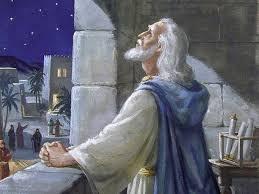
Dani’el correctly understood that the Babylonian Captivity would last exactly seventy years (to see link see Cw – ADONAI’s Word) and that it would, therefore, end soon. Throughout 9:3:19, Dani’el acted as if the Kingdom was about to be established. That assumption was made based on the information he had from reading Jeremiah and Isaiah. But that assumption was incomplete; he needed more information. He mistakenly believed that the Messianic Kingdom would be established at the conclusion of the seventy-seven year period. As a result, ADONAI sent His angel (see Cy – Gabri’el’s Intervention) to make things clear. This is an example of the LORD’s progressive revelation. The fulfillment of God’s Word is contingent upon prayer, so Dani’el prayed.
Acknowledgement of national sin and guilt (9:3-10): So Dani’el turned his face to ADONAI Elohim, emphasizing the God of the covenant, and pleaded with him in prayer and petition, in fasting, and in sackcloth and ashes (9:3). Three outward preparations for his prayer. All the three actions are symbols of remorse and mourning in the TaNaKh (Joshua 7:6; Second Samuel 1:2 and 3:31; Esther 4:1-3; Job 2:12 and 42:6; Ezeki’el 27:30). I prayed to ADONAI Elohim and confessed: “ADONAI, the great and awesome God, who keeps His covenant of lovingkindness (see Ruth Af – The Concept of Chesed) with those who love him and keep His mitzvot (9:4). That fact assured Dani’el that Isra’el would be restored. The same hope is mentioned in Nehemiah 1:5 and 9:32. Anyone who loves God and keeps His mitzvot will receive His chesed. The keeping of God’s commandments is the external manifestation of a believer’s love for God. Yeshua Messiah made a similar statement in John 14:15: If you love Me, you will keep My commandments.
We have all sinned, acted disobediently and wickedly, and as a result, rebelled. We have turned away from Your statutes (Hebrew: hachukkim, meaning to write into law permanently) and ordinances (Hebrew: hammishpatim, meaning a judgment of the court) (9:5). In four different ways, Dani’el acknowledged the sin and guilt of his people, while including himself (we). First, he confessed that all had sinned using the Hebrew word chata (see the commentary on Leviticus Aq – The Chatta’th Offering: Communicating God’s Forgiveness). This word refers to missing the mark. All of Isra’el had fallen short of God’s righteousness. Second, all had acted disobediently. Here Dani’el used the Hebrew word avah, meaning to bend or to twist. Hence, the Israelites acted disobediently when they turned from the right path of righteousness. Third, all had acted wickedly. Dani’el used the Hebrew word rasha, meaning to be wicked or to act wickedly as a result of having lost one’s relationship with ADONAI. Fourth, all the people had rebelled. The Hebrew term is marad. It refers to deviating from the Torah. In context, the Israelites had rebelled against the Torah; they had turned from God’s statutes and ordinances. In using the three terms chata, rasha, and avah, Dani’el made an indirect reference to First Kings 8:47, which states: But in the land of exile, they might turn to You in repentance and pray, “We have sinned (chata), acted disobediently (avah) and wickedly (rasha).” And another verse that contains all three terms is Psalm 106:6, where it says: Like our ancestors, we have sinned (chata); we have acted disobediently (avah) and wickedly (rasha).288
The Israelites were not only disobedient to the Torah of God, but also to the prophets of God. We have not listened to your servants the prophets, who spoke in Your Name to our kings, our princes and our ancestors, and to all the people of the land, but rebelled instead (9:6). The prophets were like the lawyers of the covenant. When the covenant was broken, they appeared in order to accuse the people with the ultimate intention of restoring their love and faithfulness to YHVH. Isaiah, Jeremiah, Ezeki’el, and many others were used by ADONAI to carry the message of warning and repentance, but they were largely unheeded. Isra’el’s persistent rejection of the prophets brought on the Babylonian Captivity (see Jeremiah Gu – Seventy Years of Imperial Babylonian Rule), as Second Chronicles 36:15-16 and Jeremiah 26:4-6 point out.
A covenant is similar to a treaty (see the commentary on Deuteronomy Ah – Treaty of the Great King). In simple terms, Ha’Shem made certain promises to the people, and in response they were to obey the Torah. Essential to the covenant were blessings and curses: If ADONAI’s people obeyed the Torah, He would bless them with security, fertility, and prosperity (see Deuteronomy Fe – Blessings for Obedience). But if they disobeyed the Torah, especially if they committed spiritual adultery, then they would be cursed with oppression from their enemies and exile.
Typical is the curse seen in Deuteronomy 28:64-68, a passage that clearly anticipates the Babylonian Captivity. ADONAI will scatter you among all peoples from one end of the earth to the other, and there you will serve other gods, made of wood and stone, which neither you nor your ancestors have known. Among these nations you will not find repose, and there will be no rest for the sole of your foot; rather ADONAI will give you there anguish of heart, dimness of eyes and apathy of spirit. Your life will hang in doubt before you; you will be afraid night and day and have no assurance that you will stay alive. In the morning you will say, “Oh, how I wish it were evening!” and in the evening you will say, “Oh, how I wish it were morning!” — because of the fear overwhelming your heart and the sights your eyes will see. Finally, ADONAI will bring you back in ships to Egypt, the place of which I said to you, “You will never ever see it again;” and there you will try to sell yourselves as slaves to your enemies, but no one will buy you. From Dani’el’s perspective, centuries after Moshe wrote Deuteronomy, Isra’el was suffering for having broken the covenant, and were experiencing the curses of the Torah.289
Thus, Dani’el cried out: ADONAI, you are righteous, but this day we are covered with shame – the people of Judah and the inhabitants of Jerusalem and all Isra’el, both near and far, in all the countries where you have scattered us because of our unfaithfulness to you (9:7). A distinction is made between that which belongs to God, namely righteousness, and that which belongs to Isra’el, namely shame. It is used in this sense in Second Chronicles 32:21. Isra’el was required to pay for her sins. She had become the scorn of the pagan Gentile nations. The result of her disgrace was the destruction of the Temple and her captivity in Babylon. At that time, the Jews were driven not only to Babylon, but also to Assyria and to Egypt. We and our kings, our princes and our ancestors are covered with shame, LORD, because we have sinned against you (9:8). Their land was overrun by the enemy, their great city of Jerusalem was destroyed, and their holy Temple was desecrated, robbed, and burned. No wonder the Jews were ashamed! But it was their own sins that had brought those disasters, because they had disobeyed the Torah and refused to obey God’s prophets.290
Dani’el spelled out Isra’el’s need for forgiveness, beginning with His attributes: ADONAI our God is merciful and forgiving (9:9a). The rabbis used this statement to elaborate on the extent of God’s compassion. They said that He is merciful, but He is more than merely merciful (4:34-35), for ADONAI is merciful and compassionate, slow to anger and rich in grace (Psalm 103:8), and ADONAI is good to all (Psalm 145:9a). The Hebrew word for mercies is rachamaw, which also means compassions. It appears in Lamentations 3:22, where Jeremiah declared: It is a result of ADONAI’s lovingkindness (Hebrew: chesed), that never ends; for His compassions never fail. In this passage, Jeremiah recalled God’s covenantal love for the people of Isra’el, and it gave him hope. Throughout the history of the Jewish people, a remnant has always survived because of ADONAI’s chesed. They have not been consumed by divine punishment, Replacement Theology (see the commentary on Galatians Ak – The Hebrew Roots Movement: A Different Gospel), or anti-Semitic attacks by either Hitler and Haman (see the commentary on Esther Au – Haman’s Plan to Annihilate All the Jews), because of ADONAI’s covenantal love. Regarding God’s forgiveness, Psalm 130:4 provides a result: But with You there is forgiveness, so that You will be feared (also see Exodus 34:6-7 and Nehemiah 9:17).
After reminding ADONAI of His attributes, Dani’el presented the reason for his plea. For we have rebelled against You. We have not obeyed ADONAI our God or kept the Torah He gave us through His servants the prophets (9:9b-10). In summary, Dani’el confessed eight specific sins that the people of Isra’el had committed: (1) they had sinned (9:5a); (2) they had acted disobediently (9:5b); (3) they had acted wickedly (9:5c); (4) they had rebelled (9:5d); (5) they had turned away from God’s statutes and ordinances (9:5e); (6) they had not listened to God’s servants the prophets (9:6); (7) they had been unfaithful to God (9:7); and (8) they had not obeyed ADONAI our God or kept His Torah (9:10).291
The punishment for sin and guilt (9:11-14): As Arnold Fruchtenbaum relates in his commentary on Dani’el, these next verses deal with the punishment for Isra’el’s national sin and guilt. In verse 11, Dani’el provided a summary of what had just been acknowledged in verses 3-10. Yes, All Isra’el has transgressed your Torah and turned away, refusing to obey You. Therefore the curses and sworn judgments written in the Law of Moses, the servant of God, have been poured out on us, because we have sinned against you (9:11). Because the chosen people had not obeyed ADONAI or kept His Torah, they received the curses of the Torah (Leviticus 26:14-39; Deuteronomy 28:15-68 and 29:20). Moses explained what would happen if Isra’el rebelled, including the threat of captivity. Everything Moses predicted came true because we have sinned against God. Dani’el included himself among the guilty.
Next, Dani’el showed that not only Moshe’s words, but also those of the prophets had been fulfilled. You have fulfilled the words spoken against us and against our kings by bringing on us great disaster. Under the whole heaven nothing has ever been done like what has been done to Jerusalem (9:12). Just as in the previous verse, the idea here is that the Torah proved to be true. The judgment of Isra’el confirmed the words of Moshe. It also confirmed the words of the prophets who spoke to the kings of Judah and Isra’el. They, too, predicted the Babylonian Captivity. The evidence is the great disaster that was brought upon Judah and Isra’el. That great disaster was the Babylonian Captivity and the barren state of the holy city of Jerusalem (see Jeremiah Ga – The Fall of Jerusalem).
The judgment of the nation was also confirmed by the Torah. Just as it is written in the Torah of Moses, all this evil has come on us, yet we have not sought the favor of ADONAI our God by turning from our sins and giving attention to Your truth (9:13). This verse contains both a confirmation and a proof. The phrase “all this evil has come on us” proves that these prophecies have been fulfilled. The Hebrew word for evil, ra, can refer to either sin or disaster. YHVH does not sin. Therefore, in this verse, the reference is to a disaster that Ha’Shem brought upon His people. He did so because of Isra’el’s failure. Yet, even while suffering the judgment, the people did not seek the favor of their God! In brutal honesty, Dani’el confessed the failure of the Israelites to plead for God’s mercy and grace even during the seventy-years of exile. Furthermore, he confessed that they didn’t turn away from their sins or seek out God’s instruction of His truth. That truth is found in the Scriptures, and the Torah laid out, in detail, what the consequences of sin would be, especially the sin of idolatry. Yet, Isra’el continually refused to obey. This led Dani’el to pray, and intervene for his people. ADONAI did not hesitate to bring the disaster on us, for ADONAI our God is righteous in everything he does; yet we have not obeyed him (9:14). Because of His righteousness, God must punish sin.292
The plea for mercy and grace (9:15-19): Dani’el’s prayer began with a confession of Isra’el’s national sin (9:3-14) and concluded with a strong plea for YHVH to have mercy (not getting what you deserve) on His people despite their failure. He started by remembering God’s past dealings with Isra’el. Now, ADONAI Eloheinu, you brought lasting honor to Your Name when You brought Your people out of Egypt with a mighty hand. Dani’el addressed YHVH as ADONAI Eloheinu. Dani’el was appealing to the God of the Exodus who had brought His people out of Egypt. The reference to Ha’Shem’s mighty hand emphasizes the miracles He wrought on behalf of His people. God made a name for Himself through the miracles of the Exodus (Nehemiah 9:9-10). Then Dani’el, again, admitted Isra’el’s failure: But we have sinned (chata), and are full of wickedness (rasha) (9:15).
Then, Daniel proceeded to plead for mercy on the basis of YHVH’s righteousness. ADONAI Eloheinu, in keeping with all your righteous acts, turn away your anger and your wrath from Jerusalem, your City, your holy Temple Mount (9:16a). It was God’s righteousness that required Isra’el’s punishment for sin. On the basis of that same righteousness, God should consider letting His anger and wrath be turned away.
Once again, Dani’el acknowledged Isra’el’s responsibility for the barrenness of Jerusalem. Our sins and the iniquities of our ancestors have made Jerusalem and your people an object of scorn to all those around us (9:16b). Babylon was merely a tool in the hands of God. It was the Jewish people who were responsible for the destruction of Jerusalem, not Nebuchadnezzar. The phrase “the iniquities of our ancestors” points to the Jewish generation that lived seventy years earlier. The punishment came because of their sins. However, the sin issue continued with Dani’el’s present generation. As a result, both Jerusalem and the Jewish people had become a source of embarrassment to all the surrounding Gentile nations. Dani’el’s point was that since God’s Name was linked with Jerusalem (First Kings 11:36 and 14:21; Second Kings 21:4 and 7; Second Chronicles 6:6 and 33:4; Ezra 6:12), and the Jewish people, that disgrace would also affect His reputation.
Therefore, Dani’el pleaded for grace (getting what you don’t deserve): Now, our God, hear the prayers and petitions of Your servant. This time, Dani’el addressed YHVH as Eloheinu, the One true God, and asked Him not only to hear his prayer, but also to respond to it. For Your sake, ADONAI, cause Your face to shine on Your deserted Sanctuary (9:17). Let your face shine is an everyday expression referring to God’s favor. In Numbers 6:25, it appears as a priestly blessing. In Psalm 80:3, it appears alongside restoration. In the context of the destroyed Temple, Dani’el was asking Ha’Shem to permit the rebuilding of His deserted Sanctuary (see Da – The Seventy Sevens: The decree of Cyrus). The basis of this request was ADONAI Himself. Through earlier prophecies, God had promised that the Temple would be rebuilt. Dani’el now encouraged YHVH to act on those promises.
Then Dani’el presented his request in 9:18: Give ear, O my God and hear; open your eyes and see the barrenness of the City that bears Your Name. There was only one city that was called by His Name: Jerusalem. We do not make requests of You because we are righteous, but because of Your great mercy (see 9:9a). If God’s response to Dani’el’s prayer depended on the Jewish people, it would not have been answered. Therefore, Dani’el appealed to the covenant-keeping God and asked Him, on the basis of His loyal lovekindness and mercies, to remember His promises.
ADONAI, shemah (Hebrew: listen)! ADONAI, selachah (Hebrew: forgive)! ADONAI ha’kashivah (Hebrew: hear) and va’aseh (Hebrew: act)! For Your sake, my Elohai, do not delay, because your City and Your people bear Your Name (9:19). The petition not to delay the fulfillment of the seventy years of the Babylonian Captivity may be an indication of concern that Dani’el had. He may have feared that YHVH might decide to begin the counting of the seventy years not from the first deportation, but from the second or third deportation (see Jeremiah Gt – In the Thirty-Seventh Year, Jehoiachin Released from Prison). If He did that, the captivity would be prolonged. Therefore, Dani’el prayed, “Elohi, please don’t delay!” Then he spelled out the basis for the plea and repeated it was for God’s own sake. This time, however, Dani’el added two other reasons. Because God’s City and people were linked with God’s Name, He should act for the sake of His own glory.293
ADONAI answered Dani’el’s prayer. The next year, Cyrus issued a decree that permitted the Jews to return to Judah, take the Temple vessels with them and rebuild the Temple (see Ag – Cyrus and Darius). What a remarkable ministry Dani’el had in Babylon! He was counselor to four kings (Nebuchadnezzar and Belshazzar of Babylon; Cyrus and Darius of Persia), intercessor for the people of Isra’el, a faithful witness to the God of Abraham Isaac, and Jacob, and author to one of the basic books of prophecy in the TaNaKh.294
Dear heavenly Father, praise You, the almighty Sovereign Ruler of the universe and the Omniscient God who always was, is now, and is the future. Holy, holy, holy is the Lord God of Hosts who was and who is and who is to come (Revelation 4:8b-c)! Thank You for being such a gracious God to be willing to act on the prayers of Your children who are interceding for others. How merciful you are to listen to humble prayers that plead for your mercy. Please show me how to draw closer to You and open the eyes and minds of those in my nation, and my friends. Please give them a moment of spiritual clarity, so that they may decide to accept You as their Lord and Savior. Please help them to know that trials here on earth will soon be over, and heaven’s joy will be forever! For I consider the sufferings of this present time not worthy to be compared with the coming glory to be revealed to us (Romans 8:18). In Messiah Yeshua’s holy Name and the power of His resurrection Amen.
Leave A Comment