




Dani’el in the Lion’s Den
6: 16-24
Dani’el in the lion’s den DIG: Describe the lion’s den. What was king Darius‘ attitude as he sent Dani’el into the pit? What was he hoping for? Why was the stone placed over the mouth of the lion’s den? How did the king react that night? How did he react the next day? How did the king treat the conspirators?
REFLECT: How have you been transformed by troubles? What parallels do you see between Dani’el’s betrayal and Yeshua? Between Dani’el’s vindication and Messiah’s? When in your life have you experienced ADONAI in the midst of the “lion’s den?” How has God alone been your rope out of the pit?
Dani’el’s God was the only One who could deliver him.
The text implies that the lion’s den was a pit with two entrances; a ramp down which the lions would enter, and an opening at the top by which food would normally be fed to them. The lions weren’t fed often or great amounts of meat so that their appetites would be intense in case there was to be an execution. Living at the gnawing edge of hunger would have been fatal for anyone subjected to this method of execution. Whether Dani’el was thrown in from the top or walked in from the bottom, there would be no way out unless someone lowered and let down a rope. Dani’el would be required to stay in the pit till morning.340
Darius’ decree (6:16-17): So Darius abandoned Dani’el to his fate in the lions’ den. Humanly speaking, Dani’el was left alone to face his fate. Yet, Darius’ last words to Dani’el point to a higher Source of help. Darius was obviously impressed by Dani’el’s faithfulness to his God, and the king expressed a simple hope that this God would somehow rescue his friend. The king said to Dani’el, “May your God, whom you serve continually, rescue you” (6:16)! The fact that Darius believed it was even possible that Dani’el could be saved indicates that the Jewish prophet must have been telling the Persian king of the great miracles that the God of Abraham, Isaac, and Jacob had performed. Dani’el’s testimony not only would have included YHVH’s miracles in Babylon, but also the wonders from Isra’el’s past, like the dividing of the Sea of Reeds.341
A stone was brought and placed over the mouth of the den, and the king sealed it with his own signet ring and with the rings of his administrators for added security, so that Dani’el’s situation might not be changed (6:17). To make sure that no outside help was given to Dani’el, the mouth of the lion’s den was covered with a large stone, which was then sealed with the signet rings of the king and his two administrators. That double sealing did not lock the mouth of the den as much as prevent tampering with it. If someone were to open it before the next morning, it would be noticed because the seal would be broken. This reminds us of the stone at our Lord’s tomb that was sealed by the Roman authorities; and yet, Yeshua came out alive!
Dani’el’s deliverance (6:18-23): This story contrasts with sharp irony the experience of Dani’el and Darius during the night. Then the king returned to his palace and spent the night without eating and without any entertainment being brought to him. Tossing and turning all night, he could not sleep (6:18). The waiting was difficult for Darius. He spent the night fasting instead of feasting. No musical instruments were brought before him. The king had a bad night, not unlike King Ahasuerus experienced in the story of Esther (see the commentary on Esther, to see link click Be – That Night the King Could Not Sleep). He was waiting until morning to come so he could legally open the lion’s den.
Darius’ anxiety over Dani’el’s fate can be seen that at the first light of dawn, the king got up and hurried to the lions’ den. When he came near the den, he called to Dani’el in an anguished voice, “Dani’el, servant of the living God, has your God, whom you serve continually, been able to rescue you from the lions” (6:19-20)? When the king said those words, he was actually confessing that Dani’el’s God was the living God, not an idol, and He had the power to deliver His faithful servant. It is clear that, contrary to all expectations, Dani’el actually spent a far more comfortable night in the pit than Darius did in his royal luxury. We can almost imagine the prophet leaning back on a warm, furry lion until he was interrupted by Darius’ question.342
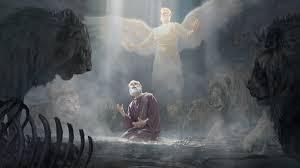
Dani’el answered: May the king live forever! My God sent His angel, and He shut the mouths of the lions. Dani’el’s survival attested to his innocence. Ordeals were broadly known in the ancient Near East.343 They took many forms, but perhaps the most well-known was the water ordeal. An individual suspected of a crime was thrown into a river. If they died, they were guilty. But if they survived, they were declared innocent and set free. The TaNaKh contains only one instance of ordeal (see Numbers Az – The Suspected Adulteress). The theology behind an ordeal is that ADONAI knows the heart in a way the human judges do not, and will make a righteous judgment. Dani’el’s survival then, was Ha’Shem’s judgment of innocence on His servant. Dani’el declared: They have not hurt me, because I was found innocent in His sight. Nor have I ever done any wrong before you, Your Majesty (6:21-22).344
What a stark contrast this provides! King Darius had at his disposal every pleasure that the ancient world had to offer, yet he couldn’t enjoy any of them, while Dani’el had nothing except the presence of his God, and His angel, and yet he enjoyed a peaceful night’s rest. This shows us that true peace does not come from possessions that we accumulate but from the presence and favor of ADONAI in our lives. What was meant to be a terrifying and deadly trial for Dani’el became a strengthening encounter with the angel. God was with him and preserved him safely through the ordeal. His fearsome lodging turned out to be a den with an angel rather than a den of lions: the angel shut the mouths of the lions and kept Dani’el safe.345 The king was overjoyed and gave orders to lift Dani’el out of the den. And when Dani’el was lifted up from the den, no wound was found on him, because he had trusted in his God (6:23).
The conspirator’s demise (6:24): King Darius came to realize that the conspiracy was directed as much against himself as it was against Dani’el (see Dm – The Conspiracy of the Royal Administrators). Relieved that the God of Isra’el had rescued his friend, Darius ordered the punishment of the conspirators. According to the common principle in the ancient Near East that anyone who made a false charge against someone else should be punished by receiving the same fate they had sought for their victim (see the commentary on Deuteronomy Do – Life for Life, Eye for Eye). The accusers set a trap for Dani’el, but they were caught in their own trap – and not only the accusers themselves, but their families as well. At the king’s command, the men who had falsely accused Dani’el were brought in and thrown into the lions’ den, along with their wives and children. But the experience of the conspirators was exactly the opposite of Dani’el’s. Before they reached the floor of the den, the lions overpowered them and crushed all their bones (6:24).
There are some liberal theologians who claim that Dani’el was saved by the fact that the lions were not hungry when he was lowered into the den. These are the same people who make excuses regarding the miracles of the Ten Plagues in Egypt, and try to explain away the worldwide Flood in the days of Noah (see the commentary on Genesis Cj – The Waters Rose and the Ark Floated on the Surface of the Water). But on average, male lions consume sixteen pounds of meat per day. If given the opportunity, even lionesses will eat up to fifteen percent of their body weight every day. They are notoriously gluttonous and will hunt even when they are not hungry. The description of the vicious attack on the conspirators and their families demonstrates that those lions were, indeed, ravenous. Hence the idea that they simply lacked the appetite is neither supported by scientific evidence nor by the account in Dani’el. His survival was a miracle, and it took divine intervention to make it happen.346
What was the difference in their fate? God was the One whose decision truly counted: the Most High God holds the power of life and death, not an earthly king. In saying: the lions have not hurt me, because I was found innocent in God’s sight, Dani’el was simply living up to his name, which means My God is the Judge. His experience in the lion’s den confirmed that basic truth. YHVH had judged him “not guilty” and so he emerged from the lion’s den without a scratch. God had indeed answered his earlier prayers and showed him His mercy. Equally, the conspirators’ fate demonstrated that they had been judged and found guilty by God, not just the earthly king, confirming the justice of their sentence of death.347
Dear heavenly Father, praise You for Your steadfast love, and for the peace that passes all understanding. You keep in perfect peace one whose mind stays on You, because he trusts in You. Trust in ADONAI forever, for the Yah ADONAI is a Rock of ages (Isaiah 26:3-4). I have no fear about the future and the unknown trials and troubles that it may bring. There is nothing outside of your control! Your mighty angel held back the lions in the den where Dani’el was thrown. Thank You for always caring for me and for using trials to polish and refine me to be purer and to shine more for You! These trials are so that the true metal of your faith (far more valuable than gold, which perishes though refined by fire) may come to light in praise and glory and honor at the revelation of Messiah Yeshua. (First Peter 1:7). In Messiah Yeshua’s holy Name and power of His resurrection. Amen
Leave A Comment