




The Second Cycle: Ehud
3: 12-30
The second cycle: Ehud DIG: What is the theme of the story of Ehud? What is the significance of knowing that Ehud was ambidextrous? What is the victory that Ha’Shem gave through Ehud? What is the tragedy of the story? How did the Israelites go through the different steps of the cycle with Ehud as the deliverer?
REFLECT: What do you think of Ehud’s plan and behavior? Do the means justify the ends? Would you allow your daughter to date Ehud? Do you admire him for his bravery or detest him for his deception? Where in your life would you like to experience God’s answer to one of your cries?
The judgment of God’s enemies in the past,
assures God’s people that He will judge His enemies in the future.
Rebellion (3:12a): As with the account of Othniel (to see link click Ap – The First Cycle: Othniel) and the other major judges, the account of Ehud (pronounced A-hood) begins with the revelation that once again the Israelites did what was evil in the sight of ADONAI (3:12a ESV). But unlike the account of Othniel, the precise nature of this evil is not identified, even though the introduction (see Al – Judgement for the Incomplete Conquest), and the first example of Othniel, suggests it was the worship of other foreign gods.69
Retribution (3:12b-14): Next the author introduces Isra’el’s new oppressor. So ADONAI gave Eglon, king of Mo’ab, power over Isra’el, because of the evil they had done (3:12b Hebrew). It was God who energized Eglon to be the oppressor against Isra’el even though they were His people. King Eglon enlisted the Ammorites and the Amalekites as allies, and then he went out and defeated Isra’el, taking possession of Jericho, the city of palms (3:13 NLT). Jericho had been destroyed by Joshua about sixty years earlier, it had been rebuilt, but not as a fortified city, and therefore it did not violate the curse of Joshua 6:26. The Israelites were subject to Eglon, king of Mo’ab for eighteen years (3:14 NIV).
Repentance (3:15a): As in other major sections in Judges, the plot turns when Isra’el cries out to YHVH. But when the Israelites cried out to ADONAI, He raised up one who would rescue them (3:15a Hebrew). The Israelites cried out to YHVH for deliverance as their ancestors cried out to God in Egypt (Ex 2:23). But again, this was not a cry of repentance or a plea for forgiveness; it was simply a cry of pain, a plea for divine help.
Restoration (3:15b-29): The restoration of Isra’el came in two stages.
First, the Assassination of Eglon (3:15b-26): Ehud the son of Gera the Benjamite, the deliverer, was primarily left-handed, although according to First Chronicles 12:2, the Benjamites were also known to be fierce warriors and ambidextrous. Now Ehud had a double-edged dagger, without a cross-shaft, about eighteen inches long and strapped it to his right thigh under his clothing (3:16 NLT). The advantage of Ehud, being ambidextrous, was that he could strap his dagger to his right side, the opposite of the side that he usually carried it so he could conceal his weapon. The king’s guards would have searched his left side where they would have expected a dagger to be. Ehud’s plan for assassinating Eglon was a masterpiece of strategy.70
Ehud had several problems to solve before assassinating King Eglon. First, he gained access to the king without making his guards suspicious. He accomplished this by making himself the leader of the group that brought the king his annual tribute. Seeing strangers at that time would not be unusual. The Israelites sent Ehud with tribute to Eglon, king of Mo’ab (3:15b NLT). Paying tribute would not only add to the king’s wealth, but it would also acknowledge the king’s authority over Isra’el. Eglon didn’t know Ehud was God’s appointed judge to deliver Isra’el; or he would have had him killed on the spot.71
Second, Ehud had to secure a private audience with the king without raising the suspicions of his guards. The way he did that was first by leaving the king’s presence together with his men after they had paid homage to Eglon. Then Ehud came back later alone as if he had a secret message for the king. He presented the tribute to Eglon, who was very fat, which provides the explanation for the account that follows. After delivering the tribute, Ehud started home with those who had carried the tribute. But when Ehud reached the quarries near Gilgal, he dismissed those with him and turned back (3:17-19a NLT). The Hebrew word for quarries is psillim, which means sculptured statues. They were sculptured statues of Canaanite gods, which illustrates Isra’el’s problem and the reason for her slavery in the first place. The sculptured statues of Canaanite gods were at Gilgal, which means they were erected at the very same place where Joshua had erected the memorial stones in honor of what God had done for Isra’el (see Joshua Av – The Memorial Stones at Gilgal). They were also erected in the place where The Angel of ADONAI had already departed, and may have been the reason for His departure from Gilgal. So, Ehud, after leaving Jericho, went as far as Gilgal, and then he turned back. Then comes the trap.
Again, the story moves swiftly, from Ehud’s turning back to his arrival, once more, in the cool upper room of the palace complex. This was a higher room that would allow the cool afternoon breezes to come through. It would have been a one-room apartment built on the corner of a flat roof, fitted on all sides with latticed windows, which shut out the sun in the heat of the day, but allowed for some privacy. In the summer time, it would have been the coolest part of the palace. This kind of upper room also tended to serve as a guest room (First Kings 17:19 and 23; Second Kings 4:10-11), or as a guest room of a palace (Second Kings 1:2). Often it was a very large room (Jeremiah 22:13-14).72
To accomplish his mission Ehud first had to get Elgon to dismiss his servants, which he did by saying: I have a secret message for you. This required a private audience with the king, something that Elgon (his curiosity aroused) was ready to give. So the king dismissed his servants with just a single word: Silence! They needed nothing else and left at once, leaving Ehud and Elgon alone (3:19 NLT).
The assassin now had the king alone and vulnerable. The judge of Isra’el walked over to Eglon, who was sitting alone in a cool upstairs room and Ehud said to him, “I have a message from Elohim for you” (3:20a NLT). Ehud used the generic term Elohim which could apply to any deity, so the king might have thought it was a message from the Canaanite gods. At any rate, Eglon seemed to take Ehud’s claim to be the bearer of a divine message, so out of respect he stood up to receive it. At that moment he had perfectly positioned himself to receive his judgment from the Jewish judge. The plan had worked perfectly. Ehud had to assassinate the king in a way that was quick and quiet, and that would catch him by surprise. Unknowingly, Eglon (whose name means small calf) had presented himself to Ehud like a sacrificial animal, ready for the slaughter.
What happens next happens quickly, but as we have already observed, it’s described in slow motion, almost like a series of still pictures rather than as one sudden action. At this point we are at the structural center of the narrative. There were nine verses before verse 21 and there will be nine verses after verse 21. The assassination of Eglon is the hinge on which the entire second cycle turns. It was a heroic act, like David’s slaughter of Goliath, which turns the tide and guarantees that it’s only a matter of time until the enemy forces as a whole will be overthrown.73
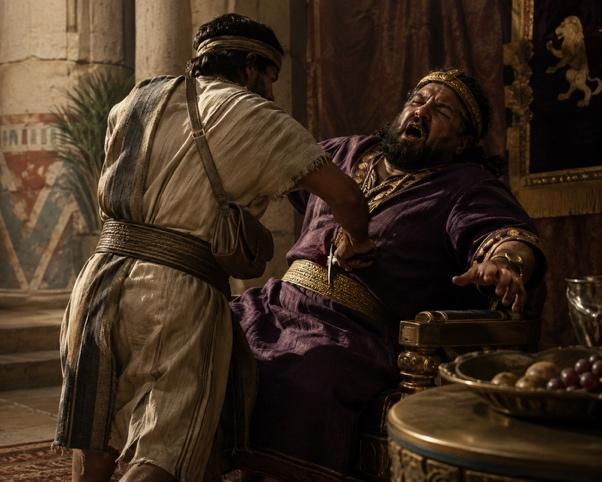
Ehud’s divine message, however, was not from a pagan god, nor was it even in the form of words. As King Eglon rose from his seat, Ehud reached out with his left hand (as if to shake hands with the king), drew the sword strapped to his right thigh (with his right hand), and plunged it into the king’s belly. The sword went in so deep that the handle disappeared around the king’s fat (Hebrew: cheleb), and his bowels emptied (3:21-22 Hebrew). The king was so very fat, it took the whole dagger, including the handle. The term translated fat is the sacrificial term used for the choicest parts of the sacrifice: all the fat (cheleb) belongs to ADONAI (see the commentary on Leviticus Ak – The Peace Offerings: At Peace with God). Ironically, then, the king being fat suggests that Eglon was a fatted calf ready for the slaughter. The downward motion of the dagger was with such force that it passed completely through his abdomen and projected from his anus. I think Eglon got the point of the message!
The narrator’s silence on the role of Ha’Shem in the assassination of Eglon is deafening. Prior to verse 28 there is no hint of any spiritual sensitivity in Ehud’s heart, nor any sense of divine calling. On the contrary, Ehud operates like a typical Canaanite of his time – cleverly, opportunistically, and violently, apparently for his own glory. But the narrator doesn’t seem to be concerned about the morality of the affair. He merely describes what happened from his point of view, and in doing so, reminds us that in the dark days of the judges the means necessary to restore His people were crude indeed.74
The next problem was how to escape from the palace without getting caught. This was accomplished by locking the door to the private upper room and delaying the discovery of the corpse. Then Ehud went out to the porch, closed and locked the doors of the upper room and escaped. After Ehud was gone, the king’s servants returned and found the door to the upper room locked and assumed that he was using the bathroom. When the king didn’t come out they finally overcame their fear of embarrassment, took a key and unlocked the door. There they found their master dead on the floor (3:23-25 Hebrew). All this took time. Ehud escaped while they delayed, and he passed beyond the memorial stone idols at Gilgal, which marked the end of Moabite territory and the beginning of Israelite territory. From there he escaped to Seirah to the central hill-country of Ephriam (3:26 ESV).
And second, the Defeat of Mo’ab (3:27-29): Ehud’s final problem was to rally the Israelites and attack the enemy. When he arrived, he began sounding the call on the shofar, which was often used in military contexts especially as a signal before and during a battle (Joshua 6:4-20; Judges 6:34, 7:8, 16-22; Jeremiah 42:14; Hosea 5:8; Amos 2:2), but here it is used to rally the troops for war. And the people of Isra’el went down with him from the hill-country of Ephraim, which included the tribal territory of Benjamin, and he was their leader. The people of Isra’el realized that it was time to rebel against the Moabites. He said to them, “Follow me, because ADONAI has given your enemy Mo’ab into your hands.” This was a very deliberate public presentation of himself to Isra’el as their judge/deliverer in the present battle. It is also an excellent example of how at least some of the people named in Chapters 3-16 became judges. So they went down after him and seized the shallow crossings (fords) of the Jordan River and didn’t allow anyone to pass (3:27-28 Hebrew). The victory would come by trusting YHVH and not by depending on their own strength. By guarding the shallow crossings, the Israelites prevented the Moabites from escaping or from bringing in fresh troops. Since Ephraim was one of the most powerful tribes in Isra’el, Ehud had excellent soldiers to command. Then the author summarizes the slaughter of the Moabites. At that time they struck down about ten thousand Moabites, the most able-bodied men. No one escaped the sword (3:29 Hebrew). We assume that Mo’ab’s defeat frightened their allies, Ammon and Amalek, and they fled the battlefield. It was a huge, overwhelming victory for Isra’el.75
Rest (3:30): So Mo’ab was conquered by Isra’el that day, and there was rest in the land for eighty years (3:30 NLT). This round number is approximately two generations, and was the longest period of rest found in the entire book of Judges. Given that the third cycle of Shamgar that follows immediately has no separate period of rest indicated, it is possible that the eighty years includes both Ehud and Shamgar. It’s the longest period of rest which followed the subjugation of Mo’ab was threatened only once, and Shamgar successfully defeated that threat. This possibility is strengthened by the fact that the beginning of the fourth cycle refers back to Ehud rather than Shamgar as the one whose death signaled the end of the period of rest (4:1).76
As previously mentioned (see Ae – The Cycle of Sin in Judges) there is a downward moral cycle in each of the seven judges that are detailed. Each of the detailed judges except Othniel, the first one, presents us with a moral dilemma when evaluating them. In the case of Othniel, there is only a positive characterization. But starting with Ehud, there is a mixture of positive and negative attributes; with a decline of the positive and an increase in the negative as we go deeper into the cycles. This serves to highlight ADONAI’s mighty restorations despite the growing shortcomings of His human deliverers. In this case, Ehud clearly does not possess the moral character of Othniel. He resorts to a complex process of deception in order to accomplish his task. However, Ehud is not as doubtful and manipulative as Barak, who is seen as more negative than Ehud’s. So, for example, Ehud restores Isra’el by effectively assassinating the leader of the enemy of God’s people; Barak will win a victory, but the leader of the enemy will escape him. Interestingly, and importantly, there will be more parallels between Ehud and Jael (4:21-22) than between Ehud and Barak (4:12-16).77
As related by Lawson Younger, Jr in his NIV Application Commentary on Judges and Ruth, this passage emphasizes the work of ADONAI in restoring Isra’el, His firstborn son (Exodus 4:22). And this story (as many others throughout the Bible) demonstrates the length to which God will go in order to save them from slipping irreversibly into apostasy. He accomplishes this despite the moral flaws in the human judges He raises up. This serves, in turn, to demonstrate His mercy and compassion, since Isra’el’s repentance is only temporary. Yet, YHVH hears the cry of pain and anguish of His people and acts on their behalf.
The judgment of God’s enemies in the past assures God’s people that He will judge His enemies in the future. Those who exploit, abuse, and seek to humiliate His people run the risk of humiliation by YHVH Himself. We can see this even today as those who have sought to destroy Isra’el have been humiliated. Eglon in particular, and the Moabites in general, had exploited the Israelites for eighteen years. The oppression brought Isra’el to the point of crying out to ADONAI, not in repentance, but in stress and pain. In God’s compassion for His people, He raised up a judge who was willing, without any assurances, to risk his very life to save Isra’el. The Jews could not be saved from Eglon, without judgment on Eglon.
On a human level, our context is quite different today from Isra’el’s day. Nevertheless, the question arises: How are we to wage spiritual warfare against those who abuse, exploit, and persecute the Church? And for believers in certain parts of the world today, this is not a hypothetical question, but a real and practical one. The only way we can win this spiritual battle is to use a better weapon we already have access to . . . the sword of the Spirit, the Word of God (see the commentary on Ephesians Ch – The Sword of the Spirit). The sword is alive! It is at work and is sharper than any double-edged sword (Greek: machairan meaning a short dagger) – it cuts right through to where soul meets spirit and joints meet marrow (Hebrews 4:12a). This is not to allegorize the passage and equate Ehud’s dagger with the Word of God. Rather, it is to acknowledge the role that the truth of the Word plays in the answer to the question posed above in the modern context.
Certainly the positive message of Ehud is in his willingness to risk his life for ADONAI. This is a lesson we can benefit from. So many believers today are hampered by an unwillingness to take any risk for God – to share their faith, to stand up for righteousness and justice, even to speak a word or encouragement to the demoralized – simply because we fear what others might say or think about us. Ehud demonstrates the kind of boldness of action for the Lord that should spur us to action in these types of situations.
Nevertheless, Ehud’s method of deception cannot be condoned as the ideal way to accomplish God’s will. While it heightens the suspense and functions to expose Eglon and the Moabites to greater satire, it poses a significant theological problem. While deceptive methods (whether in devious evangelistic methods, false prophecies, worldly church-growth methods, political involvement, etc.) may work, this should not be interpreted as ADONAI’s condoning of such things. The ideal way is the way of integrity, the way in which God worked through Othniel to accomplish His restoration of His people Isra’el in the first cycle.78
Dear heavenly Father, praise you for being such a loving heavenly Father who cares for me. You see all that happens to me. When hard times come into my life, You are right there, watching and seeking to use it to draw me closer to Yourself. Sometimes the trials/hard times come to help me grow strong in You. Just as You sent Ehud to rescue Isra’el, You sent Messiah to rescue me. Just as You hold Isra’el in the palm of Your hand, You hold me in the palm of Your hand. Just as Isra’el is the apple of your eye, You watch over and guard me. I know that You want only what is best for me, no matter what my walk with You looks like. Father, I love You; Yeshua, I love You, Ruach Ha’Kodesh, I love You. Thank you for Your Presence in my life. To the One what sits at His right hand. Amen
Leave A Comment