





The Response of the Tribes
5: 12-18
The response of the tribes DIG: Which six tribes responded positively to Debrah’s call to war? Which four tribes responded negatively? Why were Judah and Simeon not involved at all? How different was the response to Deborah’s call and Joshua’s call? Why did Ephraim enlist first and Ruben resist?
REFLECT: Some of the tribes responded to Debrah’s call to help, while others did not. How have you responded to God’s call on your life? How are you using your spiritual gifts? In your life, who is responding to your need for help? Who is not? How so? Where are you feeling somewhat abandoned?
Isra’el had no king, and everyone did whatever seemed right in their own eyes (21:25).
As Deborah’s victory song continues (to see link click At – Deborah’s Victory Song), Warren Wiersbe summarizes in his commentary on Judges. Deborah was grateful that the people offered themselves willingly in the service of ADONAI (5:2 and 9), and that the leaders offered did their share in recruiting soldiers from the tribes (5:13). Six tribes united in sending volunteers. Except for the people in the town of Meroz (5:23), the men of Naphtali responded, as did the men of Ephraim, Benjamin, Manasseh west (Makir), Zebulun, and Issachar. The phrase in verse 14: those who bear the staff of the scribe, may refer to the recruiting officers who wrote down the names of the soldiers. Zebulun and Naphtali are especially praised for risking their lives in the service of God and country.
However, there were four tribes that didn’t volunteer and do their share of fighting. The tribe of Reuben pondered the call to arms, but finally stayed home. They were probably considering Isra’el’s mitzvah of warfare, and examining their hearts to see whether they were exempt from going to war (see the commentary on Deuteronomy Dp – Regulations for a Holy War: Four military exemptions). Since Manasseh east (Gilead) was safe on the other side of the Jordan River, they also stayed home (5:17). Dan and Asher on the coast elected not to heed the call to battle.
Keeping in mind that during this period, Isra’el had no king, and everyone did whatever seemed right in their own eyes (21:25). When Joshua was the commander of Isra’el’s armies, ALL of the tribes participated, but when Barak summoned the forces, only half of them went to war against Jabin and Sisera (see As – The Fourth Cycle: Deborah – The Defeat of the Canaanites). The people of God today are not unlike the people of Isra’el when it comes to the call of ADONAI for service: Some immediately volunteer and follow the Lord; some risk their lives; some give the call serious consideration, but say no; while others keep to themselves as though the call had never been given.111
The Fifth Stanza (5:12-18): This first verse of the fifth stanza introduces two leaders: Deborah and Barak. Wake up, Deborah, wake up! Wake up, wake up, and sing a song! Arise, Barak! Lead your captives away, son of Abinoam (5:12 NLT)! It has become clear by this point that Deborah and Barak are not the only singers. In verse 11 we have heard others remembering (perhaps in song) the righteous deeds of ADONAI and His people. Now it seems that these common people address Deborah and Barak, urging them to more enthusiastic praise.112 This verse, then, serves as an introduction to the second part of the song. Deborah is called upon to strike up a song again, and calls upon Barak to lead away his prisoners of war. It is Barak who is called to arise because he is the deliverer. But Deborah plays the most important role, not as the deliverer, but as the prophetess; for as the prophetess, she represents the voice of God.
The second verse of the fifth stanza records the response of Isra’el and ADONAI to the call to go to war. Then down came a remnant of the nobles and the people. ADONAI came down for me against the mighty enemy (5:13 Hebrew). ADONAI is viewed here as summoning the enemies of Isra’el for this war. This marks the turning point in the struggle against the oppressor. Ha’Shem is viewed here as summoning the enemies of Isra’el for this war. This marks the turning point in the struggle against the oppressor.113
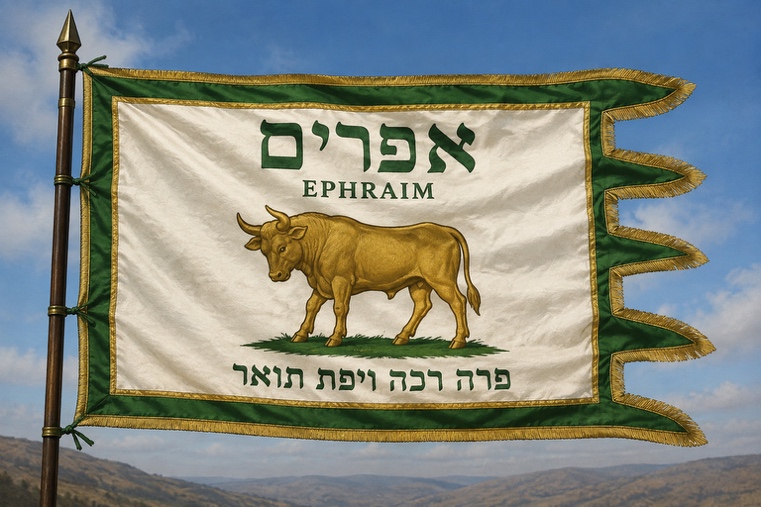
In verses 14 to 18 of the fifth stanza, Deborah describes the specific responses of the tribes, both positively and negatively. The list of troops is divided into three groups: the volunteers in verses 14-15a; the resistors in verses 15b-17; and the award winners in verse 18. She begins the volunteers with her own tribe of Ephraim: Some came from Ephraim, in the spirit of the Amalekites (see the commentary on Exodus Cv – The Amalekites Attacked the Israelites at Rephidim). Throughout the book of Judges, Ephraim is presented as the leader of the northern tribes (5:14a). However, while the volunteers did come from Ephraim, they displayed some “Amalekite” characteristics; that is, they were hostile and quarrelsome. At this stage of the book such a mixed report on the Ephraimites seems puzzling, but the negative aspect of it will be confirmed by the way they act in both the Gideon (see Be – Gideon’s call to Ephraim: The Complaint of Ephraim) and Jephthah (see Bs – The Judgeship of Jephthah: The War with Ephraim) episodes which follow.114
Benjamin is mentioned next. The Benjaminites were with the people who followed you, followed by Manasseh west. From Makir captains came down. Makir here does not just stand for the family of Makir, but for the tribe of Manasseh, because Makir was Manasseh’s only son. More specifically, Makir stands for part of the main branch of Manasseh located on the west side of the Jordan River (Joshua 17:1). From Zebulun those who bear the staff of the scribe. This tribe contributed the military leaders and was assigned territory in the Jezreel Valley where the battle took place. The leaders of Issachar were with Deborah and Barak (5:14b-15a Hebrew).115 There is no inference that Deborah took an active part in the battle; rather, those from Issachar were with her in the sense that they were supportive of her, responsive to her call. It was Barak who, in the next line, led the charge into battle. They also followed Barak, rushing, without hesitation, into the valley of Jezreel and staying close to him during the attack. The general impression is that Issachar, especially, distinguished itself by the wholehearted support it gave Deborah and Barak . . . which makes the contrast with Reuben in the second part of the verse particularly damning.
Now the language of unity and loyalty gives way to resistance. The poet emphasizes Reuben’s failure by placing its mention at the center of the overall poem. But in the tribe of Reuben there was great indecision. This tribe refused to participate. There is no reference to any leaders. They are pictured as sitting around the campfire, indifferent to the plight of their brothers. They wasted precious time in discussion instead of rushing into the valley like the tribe of Issachar did. But ultimately, they decided to stay behind with their livestock rather than marching out to assist God’s army. Issachar’s territory was directly adjacent to the Jezreel Valley, and therefore one of the tribes most affected. Reuben’s territory, on the other hand, was in the southern Transjordan. So in a sense, it could afford to stay uninvolved in a way that Issachar could not. But that was not how Deborah and Barak and their supporters saw it. Note the bitter taunt in the following question. Why did you stay among the sheep pens to hear the whistling for the flocks? In the tents of Reuben there was much hesitation and internal debate (5:15b-16 Hebrew).116
Similarly, the half-tribe of Manasseh east (Gilead) remained east of the Jordan (see the commentary Numbers Fz – Reuben and Gad Request Land). And the text asks: why did Dan stay in ships? This may imply that the migration of Dan to the extreme north took place before Deborah, and the Danites had united somewhat with the sea-faring Phoenicians (see Aj – The Failures of the Northern Tribes). But more likely Dan was still in the South, too entrenched in the shipping industry with the Phoenicians, as their clients, to participate in an anti-Canaanite war, since the Phoenicians were Canaanites. Asher sat unmoved at the seashore, remaining in their harbors, preferring life on the beach than battlefields (5:17 NLT).
To accentuate the contrast between those who participated and those who ignored the call, the fifth stanza ends with a focus on the heroism and courageous risk of Zebulun and Naphtali in the battle itself. But Zebulun risked their lives. This tribe is now mentioned for the second time in Deborah’s song and is thus given a special place of honor for their bravery. Barak’s tribe, Naphtali, also risked their lives on the heights of the battlefield (5:18). That tribe had the most to gain since their territory was in the Jezreel Valley.117
The tribes of Judah and Simeon are not mentioned as participants in the war, or chastised for staying away. This might imply that they were busy fighting the Philistines and therefore could not send a fighting force for Barak. If so, since they were already fighting the enemies of Isra’el, they would not be chastised for not sending any soldiers.118
Responding to the call of ADONAI can be difficult, especially in the postmodern world that we live in now. Oftentimes, to put yourself out there as a believer, one who loves the God of Abraham, Isaac, and Jacob, or one who loves Isra’el and prays for the peace of Jerusalem, can draw a big target on your back. I went to Isra’el in 2023 for Sukkot, and we left the day before the war started. When I got back to America, I bought a royal blue baseball cap with the star of David on the front of it and have worn it ever since. I plan on wearing it until the war is won. It’s my way of standing up for Isra’el and her right to exist. So far, I have been called “a terrorist” only once. But every other acknowledgement of my hat has been positive. Sometimes people say, “I like your hat,” or they give me a thumbs up. Other times I have people smiling at me for seemingly no reason. Let me be blunt, Satan wants the world to turn against Isra’el; ADONAI loves Isra’el. This is a real battle. How will you respond to the call?
Dear heavenly Father, praise You for Your awesome gift of righteousness (Romans 5:17) to all who believe in You (John 11:25-26). Ja’el showed her willingness to respond to Your call by her act of obedience in killing the general of Israel’s enemy. It would have been easier for her to turn away, but she put her belief in You into action. Likewise, all who have faith in You are to respond to Your call by more than lip service of admiration. May we follow Ja’el’s example and serve You even when we are alone and it is hard, for You are always with me to help and to guide me. Thank You that You have promised to never leave me. For God Himself has said: I will never leave you or forsake you (Hebrews 13:5). In Messiah Yeshua’s holy Name and power of His resurrection. Amen
Leave A Comment