





A Prophet Sent by ADONAI Confronts Isra’el
6: 1-10
A prophet sent by ADONAI confronts Isra’el DIG: Who were the Midianites? Who aided them in their raids on the Israelites? What were they interested in? What were the Israelites forced to do in response? What was the unknown prophet’s message? How was the function of his message different from Deborah’s?
REFLECT: What outcomes should be anticipated if we live in disobedience to God? Have the passing years blurred any of the hard lessons you had to learn in the past? Who, or what, have you been turned over to? What has it cost you? Have you cried out to the Lord? Who has ADONAI sent to remind you of His ways?
The Israelites were focused on getting help, when what they needed was repentance.
Rebellion (6:1a): Again the Israelites did evil in the sight of the LORD (6:1a BSB). After the remarkable victory of Deborah and Barak over Javin and his general Sisera (to see link click Aw – The Defeat of the Canaanites), Isra’el had forty years of relative calm and stability. But the passing years blurred the memory of the great deliverance and the next generation reverted to the easy-going syncretistic religion that again threatened to obliterate Isra’el’s distinction from their pagan neighbors.134
Retribution: The Midianites (6:1b-6): Having strayed once more from YHVH, Isra’el was abandoned to her own devices, and foreign domination was quick to follow. The anonymous prophet’s words of rebuke, that squarely lay the blame for the people’s predicament at their own doorstep. So He handed them over to the Midianites for seven years (6:1 NLT). The Midianites were descendants of Abraham and Keturah (Genesis 25:2), and they were involved in the sale of Joseph to Egypt (Genesis 37:25-36). They were defeated by Isra’el (see the commentary on Numbers Ea – Taking a Stand for God). But now, two centuries later, the Midianites had renewed their strength. One branch of the Midianites was the Kenites; Moses found shelter with them and married one of them, and they journeyed with Isra’el into the Promised Land. But the other clans of Midian were not pro-Isra’el.135
The Midianites were so cruel that the Israelites made hiding places. The Midianites were more interested in plundering the Israelite possessions and necessary supplies than exterminating them. Because they were nomadic, or Bedouin by nature, they had no desire for permanent settlement in the land. They came for the produce of the land, not after the land itself or the inhabitants. As a result of those raids, the Israelites hid their produce in the mountains, caves, and hollowed out wadis (6:2 NLT).
The plight of the Israelites is described in much more detail than in the previous cycles. Whenever the Israelites planted their crops, the Midianites came with the Amalekites, who had already been a problem in 3:13, where they were also described as being allied with Isra’el’s enemy Eglon. Another allied group was the people of the east. These were Bedouin raiders whose use of camels enabled them to take waterless journeys of several days, which nomads on donkeys simply could not do. Their strategy was to attack, camp, and destroy the crops as far away as Gaza, the southern end of the land (6:3-4a Hebrew). What they could not take with them as plunder, they destroyed. They left the Israelites with nothing to eat, taking all the sheep, goats, cattle, and donkeys. These enemy hordes, coming with their livestock and tents, were as thick as locusts; they arrived in droves of camels too numerous to count. And they stayed until the land was stripped bare. So Isra’el was impoverished, or literally Isra’el became small, which says as much about her emotional state as her economic condition. Isra’el was completely paralyzed before the Midianite menace. All these events fulfilled what God had warned would happen in Deuteronomy 28:50-51. Isra’el’s covenant unfaithfulness resulted in the covenant curse. Then the Israelites cried out to ADONAI for help (6:4b-6).136
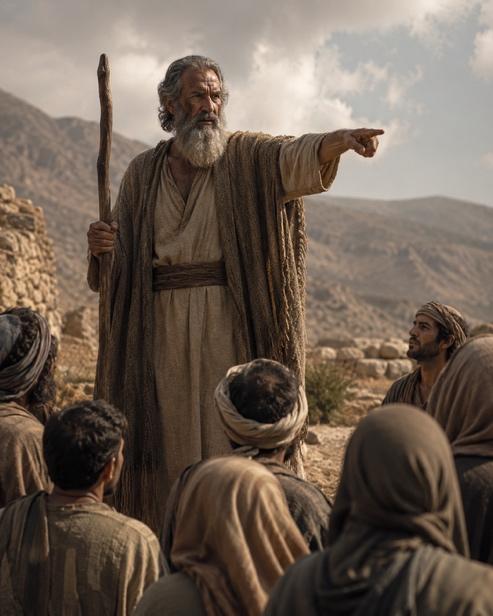
No Repentance (6:7-10): The response of Ha’Shem to the Israelites cry was quite different from the first four cycles. By sending an unknown prophet to confront the people and indicting them for their covenant unfaithfulness, God was implying that there comes a time when His patience turns to judgment.137 When the Israelites cried out to ADONAI because of Midian (6:7NLT), He immediately sent them a prophet, who appeared at exactly the same point in this fifth cycle as Deborah the prophetess had appeared in the previous one. But the function of this unnamed prophet contrasted sharply with that of Deborah. He doesn’t come to restore anything, but to accuse the Israelites of spiritual adultery and to tell them (by implication) that they had forfeited all right to restoration.138 The Israelites appear to have turned to ADONAI as a last resort. Their cry didn’t seem to have been any indication of repentance for sin because apparently they were not aware of the reason behind the Canaanite oppression until the LORD sent a prophet to point this out.139
While the prophet’s name was unimportant, his message was very important; it was from God to His covenant people. He brought home his point by declaring: This is what ADONAI, the God of Isra’el says: I brought you up out of slavery in Egypt (6:8 NLT). I rescued you from the hand of the Egyptians. And I delivered you from the hand of all your oppressors. I drove out your enemies and gave you their land (6:9 NLT). God reminded them that He said: I am ADONAI your God. This statement is reminiscent of when the LORD told Moses to tell the Israelites that I AM WHO I AM sent him to deliver them from Egypt (Exodus 3:14). In this title, YHVH was stating that just as He has always been faithful to His covenant people, He would continue to be faithful to them.
The point of the prophet’s message was this . . . despite all that God did for Isra’el in the past, it was simply not too much to ask for exclusive allegiance to Him now. Instead, they abandoned the LORD for the gods of the Amirites. They were focused on getting help when what they needed was repentance. The message of the unnamed prophet was a reminder of what ADONAI did for Isra’el in the Exodus and the conquest of the Land under the leadership of Joshua. Isra’el’s obligation was faith, loyalty, and obedience, but the prophet concluded by pointing out Isra’el’s failure: But you have not listened to Me (6:10 NLT). One might think God’s message to Isra’el was harsh, but nothing could be further from the truth. In His mercy, the LORD exposed their sin and the reasons for their distress, and in doing so, He gave them an opportunity to repent of their sin and experience restoration. The people needed to recognize that rejecting their false gods and being faithfully devoted to ADONAI was the only way they would experience true and lasting rest.140
This brief episode leaves us wondering how God will respond to the people’s persistent disloyalty. We know that the Midianite oppression represents God’s judgment, but we can’t help but expect further discipline. All this set the stage for the calling of Gideon (see Ba – The Call of Gideon). And if God raises a deliverer for Isra’el, it is an entirely gracious act because there has been no hint of repentance . . . nor any announcement of divine forgiveness. God’s subsequent intervention on Isra’el’s behalf must be interpreted in light of the people’s persistent apostasy.141
When you read the B’rit Chadashah epistles, you can’t help but notice that the apostles took the same approach when they admonished the believers to whom they wrote. The apostles repeatedly reminded the believers that ADONAI had saved them so that they might live obediently and serve the Lord faithfully. As God’s children, they were to walk worthy of their high heavenly calling (Ephesians 4:1) and live like people who were seated with Messiah in glory (Colossians 3:1ff). The motive for Godly living is not that we might gain something we don’t have, but that we might live up to what we already have in Messiah.
The purpose of Godly discipline is to make God’s children willing to listen to God’s Word. Often after spanking a child, parents will reassure the child of their love and then gently admonish the child to listen to what they say and obey it. ADONAI speaks to His children, either through the soft voice of Scripture, or the heavy hand of discipline; and if we ignore the first, we must endure the second. One way or another, the Lord is going to get our attention and deal with us.142
Those who lack the resolve to resist the lures of the world will likely face the disasters and destructions that these lures often bring. They may find that Ha’Shem is their opponent . . . not their friend. Certainly, fickleness in loyalty to the things of God occurs in the Church today. When believers run after the same gods as their worldly friends, they should not be surprised when God does not hear their prayers or react in the same way they think He should.
It is interesting that Ha’Shem formally indicates. Such language places the relationship into the forensic, legal context, where doubt is removed and clarity is added to the description of what is wrong in the relationship. That God still indicts His people is clear through various passages in the B’rit Chadashah. For example, in Revelation Chapters 2 and 3, several churches are indicted for their failures to God’s covenant. The Spirit of God carries on this same process with us individually.
In a practical sense, this passage addresses a common problem in the area of prayer. We turn to the LORD in a moment of need, even when we have not been walking in His ways. Yet, we expect ADONAI to answer our prayers because (and often for no other reason than) we are in need. Over and over again, the Bible (including the book of Judges) addresses this issue of manipulation in prayer (James 4:1-6). Our relationship with God is never a mechanical process.143
Dear heavenly Father, praise You for Your offer of a relationship of steadfast love to all who believe in You as their Lord and Savior. What a wonderful gift. That relationship is more important than anything else in the world. When sin breaks the relationship with You, true repentance should come quickly from a heart full of deep sorrow. People want things to go well in their lives, but what is needed is to recognize false gods, such as prideful use of time and money and pleasure, rather than being faithfully devoted to you ADONAI is the only way to experience true and lasting peace, joy and rest. You work in my life to guide me back to loving You. Often Your guidance is thru discipline. Even when You have to correct and discipline, the correction is done in love. My son, do not take lightly the discipline of Adonai or lose heart when you are corrected by Him, because ADONAI disciplines the one He loves and punishes every son He accepts (Hebrews 12:5b-6). True Repentance involves turning away from sin and toward You. The mind/heart changes from selfishness to surrender to Your will, with a joy for pleasing You. Thank You so very much, for being such a wise and loving God to see into the heart, guiding me into true repentance that You may graciously forgive. You are awesome! I love to praise and to worship You! In Messiah Yeshua’s holy Name and power of His resurrection. Amen
Leave A Comment