




The Call of Gideon
6: 11-24
The call of Gideon DIG: How would you describe Gideon? Who was The Angel of ADONAI? Why do people, especially believers, who turn their backs on God experience the consequences? What were Gideon’s objections? What was God’s response? God’s promise? How did God assure Gideon of His promise?
REFLECT: How might our circumstances impact our response to God’s calling? How does assurance of God’s Presence negate our excuse of inadequacy? What causes you to have difficulty trusting God? We can be encouraged to know that God calls unlikely people to do great things for Him. Memorize Judges 6:16.
Though Gideon considered himself inadequate,
God called him to deliver His people from the Midianites.
When we compare ourselves to others. This rarely has a positive result. It either leads to pride because we think that we’re better than others, or it leads to discouragement because we believe others are better than us. It is especially confounding when God calls a person to serve Him in some capacity when someone else seems a better fit to do it. God does this so that when that task is accomplished, He will receive the glory. Such was the case of Gideon.144
Restoration (6:11-24): Then the Angel of ADONAI came and sat under the great oak tree in Ophrah (a village not far from Shechem) that belonged to Joash the Abiezrite (6:11a CJB; Joshua 17:2). Abiezer was a small family of the tribe of Manasseh (Joshua 17:2; Judges 6:15; First Chronicles 7:18). When the Angel of ADONAI is mentioned in the TaNaKh, He is never a common angel, but the second Person of the Trinity, Yeshua Messiah. This is always a reference to the pre-incarnate Messiah. Significantly, the rabbis teach that the phrase the Angel of ADONAI is sometimes used to denote God Himself.
After introducing the father of the clan, the Bible introduces the son. His son Gideon was threshing wheat in a winepress in order to hide it from the Midianites (6:11b CJB). The name Gideon comes from the root gada, meaning to hack or break to pieces. It was a fitting name for one who would hack or break to pieces the altar of Ba’al to pieces (to see link click Bb – The Destruction of the Altar of Ba’al). Gideon had a second name, which will be revealed later. Normally, wheat was threshed on a slightly elevated flat area, so the wind could blow away the chaff. The Midianites would not expect that a winepress would be used for threshing wheat and thus it would be hidden.145
When the Angel of ADONAI appeared to Gideon; speaking prophetically, He said: You mighty warrior! Calling Gideon a mighty warrior is somewhat paradoxical, since he was trying to hide his activity of threshing wheat in a wine press! So, the Angel of ADONAI was speaking prophetically of what would be true of Gideon in the future. He will prove to be a mighty warrior, and thus it will be shown that God was with him (6:12)!
Gideon’s response began with a denial. Numerous commentators have noted similarities between Gideon’s call and those of Moses in Exodus 3 and Joshua in Joshua 1. He had two objections. First, his response to the LORD’s initial call was a dull, cynical question and diatribe about God’s treatment of the nation.146 Excuse me my lord (which does not by itself imply deity), but if ADONAI is with us, why is all this happening to us? And where are all the miracles our ancestors told us about when they said, “Didn’t ADONAI bring us up from Egypt?” But now ADONAI has abandoned us and handed us over to the Midianites (6:13 Hebrew). What Gideon said was true. ADONAI did deliver Isra’el into the hands of the Midianites; but he blamed God for it, not Isra’el, to whom the blame belonged.
ADONAI turned to him and said: Go in this strength of yours and rescue Isra’el from the hands of Midian. Haven’t I sent you (6:14 CJB)? Significantly, Gideon’s call didn’t come by a prophet, nor by any human being, but by YHVH Himself, through a theophany, a pre-incarnate appearance of Yeshua Messiah (6:15a Hebrew).147 But Gideon responded saying: Forgive me, ADONAI, how can I rescue Isra’el? Only at that point did Gideon begin to perceive that the Speaker was really YHVH. This same Person, earlier, called the Angel of ADONAI, is now called ADONAI (Hebrew: Adonay, an emphatic form of LORD, only used as a proper name for God) showing this was a theophany.148
Second, he objected by saying: My clan is the smallest in the whole tribe of Manasseh, and I am the youngest in my father’s house (6:15b KJV). Gideon’s objection here is an attempt to evade personal responsibility for the conquest because of his clan’s smallness. Though his clan, the Abiezrites (Joshua 17:2; First Chronicles 7:18) was small, his family appears to have significant power and authority in the clan (as revealed throughout the remainder of the fifth cycle). But ADONAI, speaking as if He is indeed God, answered him and said: Surely I will be with you and you will strike the Midianites as if they are one man; that is, as if he were facing an enemy of one, rather than a swarm of warriors (6:16 Hebrew). Only God could say that.
Verses 17 and 18 record Gideon’s request, which ends up being a request for a sign. Gideon is the first person in the TaNaKh to request a sign from YHVH. Normally, God initiates the signs – not by request, but His sovereign will. Gideon’s request for a sign is driven by two things. The first was his desire to confirm God’s favor on him, reflecting Gideon’s uncertainty about his own relationship with the One speaking to him. Second, wants to make sure God will be with him so he will receive the strength to defeat Midian as if they were one single man. This lack of confidence will continue until verses 36-40. At last Gideon begins to speak as someone who is addressing God. Gideon replied: If you are truly going to help me, show me a sign to prove that it is really You speaking to me (6:17 NLT). Please don’t go away until I come back and bring my offering to You. ADONAI answered: I’ll wait until you return (6:18 Hebrew).
Gideon hurried home. He cooked a young goat and a basket of unleavened bread from a measure of grain, which would make the offering somewhere between 35 to 45, depending on how he measured the grain. Either way, it was a rather large offering, even more so since the context is a time of great scarcity. Gideon’s offering isn’t in accordance with any Levitical sacrifice. It is apparently based entirely on his own evaluation of what was appropriate. Then, carrying the meat in a basket and the broth in a pot, he brought them out and offered them to the Person under the great oak tree. Nevertheless, in spite of Gideon’s motives, ADONAI accepted the offering. Then the Angel of ADONAI said to him, “Take the meat and unleavened bread on this rock, and pour the broth over it.” And Gideon did as he was told (6:19-20 NLT).
The Israelites had previously offered sacrifices to ADONAI at Bochim (2:5b). That did not mean that the Tabernacle was located there at that time. Normally, it would have been the place for offerings. However, since the Angel of ADONAI was a theophany (the preincarnate Yeshua Messiah) the Shechinah Glory (see Isaiah Ju – The Glory of the LORD Rises Upon You), the visible manifestation of God’s presence, made it permissible to sacrifice anywhere He appeared. This action will be repeated in Judges 6:20, 6:26, 6:28, 13:16-20, and also in Second Samuel 24:25. Any place where a theophany appeared, it was possible to make an offering at that place. This further shows that the Angel of ADONAI is indeed God Himself.149
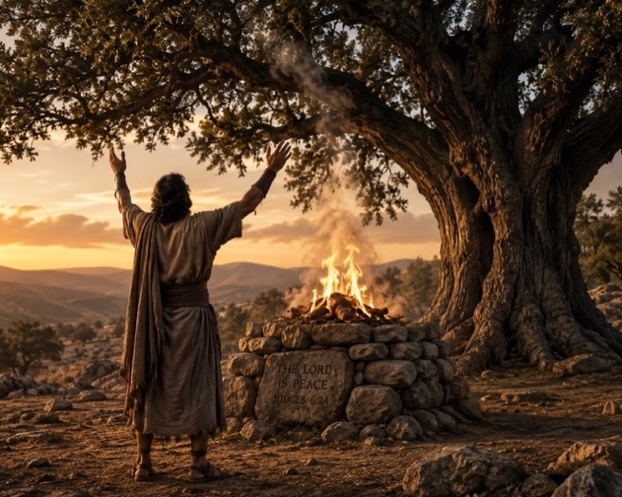
Then the Angel of ADONAI fulfilled Gideon’s request for a sign. touched the meat and unleavened bread with the tip of the staff that was in His hand. Fire sprang up from the rock and consumed the meat and unleavened bread, showing that Gideon found favor in the sight of ADONAI, thus addressing his personal concern. Then ADONAI vanished from Gideon’s sight (6:21 Hebrew).
When Gideon realized that He was the Angel of ADONAI, he cried out: Oh, My LORD! ADONAI! I have seen YHVH face to face (6:22 CJB)! After he had time to think about what had just happened, he realized that he had been talking to YHVH. All this shows that Gideon recognized that ADONAI and the Angel of ADONAI were the same Person, since merely seeing an angel would not cause that kind of response on the part of a Jew.150 But ADONAI reassured him, saying: Shalom to you, don’t be afraid, you won’t die (6:23 CJB). Gideon’s fear stemmed from widespread belief in the TaNaKh that seeing the face of God directly was fatal to sinful human beings. You cannot see my face, for man shall not see me and live (Exodus 33:20); however, after wrestling with God, Jacob marveled: I have seen God face to face, and yet I have lived (Genesis 32:30). Hence, the Jews regarded this experience as an omen of impending death. But here, the theophany made YHVH Himself “see-able.” At any rate, the danger of “seeing” had been removed with the withdrawal of the Angel of ADONAI. Gideon saw Him no longer.
In gratitude for what Gideon had experienced, he replaced the make-shift stone altar in verse 20 with a more permanent one. The Gideon built an altar there and called it ADONAI-Shalom. He gave it a name that condensed in two words all that he had experienced. ADONAI (who had appeared to him) and Shalom (the life-giving word that had been spoken to him). He built the altar in Ophrah in the land where the clan of Abiezer remained in Ophrah. The closing reference to this means that it remained there to this day (6:24 CJB), or at the time the book of Judges was written. The closing reference to Ophrah and the clan of Abiezer echoes the same words in verse 11 and acts like bookends to the intervening passage. At the same time it reminds us that Gideon had not been removed from the world by his encounter with the Angel of ADONAI. The realities of life in Ophrah were still there, and Gideon had to face them. But he would face them far richer because of the experience that he had just had.151
Dear heavenly Father, praise You for the riches of a loving relationship with You. Gideon’s experience with You brought him riches far beyond what any earthly accumulation of wealth could bring. May we realize that true riches are riches of eternal value! Thank You for my spiritual gift(s) and calling me to my ministry. Even though I sometimes feel inadequate to what you have called me to do, I know that you always equip the called. So I step forward in faith. In Messiah Yeshua’s holy Name and power of His resurrection. Amen
Leave A Comment