




The Sign of the Fleece
6: 33-40
The sign of the fleece DIG: How would you describe Gideon? Who is to blame for Isra’el’s problems? How many times did Gideon ask for a sign from God? What does this say about him? What lesson is God trying to teach him (and us) here? Who did Gideon fear? Why was God patient with Gideon’s quest for signs?
REFLECT: Where are you uncertain or afraid of God’s call to you right now? Where are you on your spiritual journey? What one thing do you fear? Are you still afraid when you step out in faith despite your fear? Is sending out a fleece today a good idea? In what area of your life do you want to trust God more?
Gideon’s fleece was not a sign of his spirituality, but a sign of his very weak faith.
Restoration: The Call to Arms (6:33-35): Here the author reminds us of the situation outside Oprah that had prompted Gideon to thresh his wheat in a winepress (6:11). Next year, same song, next verse. The armies of Midian, Amalek, and Bedouin raiders formed an alliance against Isra’el and had crossed over the Jordan River, camping in the Jezreel Valley. But this year something is different: the Spirit of ADONAI clothed Gideon (6:33-34a CJB). This should not be interpreted too differently from every other instance in which the Spirit is described as having come upon someone. This expression, reminiscent of Numbers 24:15-16, in which Balaam, the pagan Mesopotamian seer, spoke under the control of the Ruach, does not assume any particular level of spirituality on the part of the recipient. On the contrary, the divine intrusion into human experience seems to graphically describe YHVH’s arresting of men not prepared to solve Isra’el’s problems and His equipping them for the saving task. This will be seen in both of the cases of Jephthah and Samson.
It is easy for modern-day believers who are more familiar with the B’rit Chadashah concepts of “indwelling” and “being filled” to read these back into the TaNaKh. But they do not really equate. To be filled with the Spirit in the B’rit Chadashah speaks to spirituality, that is, one who is filled is controlled by the Spirit (Ephesians 5:18b-20). In the TaNaKh, the idea is that of empowerment for a particular task, though it’s apparent that the recipient might misuse that empowerment as Samson did in 14:19. The B’rit Chadashah equivalent is perhaps closer to the idea of giftedness.
So, in the case of Gideon, the Spirit’s work reflects God’s sovereign will to set things in motion for the restoration He has planned, not Gideon’s condition of faith. Although Gideon has popular support and a considerable fighting force, he hesitates. His almost immediate “fleecing” of God speaks to his unbelief, to his lack of spirituality. In fact, the fleecing incidents seen here are Gideon’s second and third requests for a sign from God, the first request was seen in 6:17, where he asked: If you are truly going to help me, show me a sign to prove that it is really You speaking to me.162 This lack of confidence will continue until verses 36-40.
Now Gideon’s career begins to follow the “textbook” pattern exhibited by Othniel (to see link click Ap – The First Cycle: Othniel). Both Othniel and Gideon were empowered by the Spirit to do what he had been chosen to do. The effect was immediate in both cases. Othniel judged Isra’el and went out to war (3:10); Gideon sounded the shofar, and the men of the clan of Abieser, his own clan, rallied behind him. He also sent messengers throughout the western tribe of Manasseh, Asher, Zebulun, and Naphtali, summoning their warriors, and all of them responded (6:34-35 Hebrew). The news of the blowing of the shofar had an electrifying and rapidly widening effect on the Israelites: beginning with the Abiezrites (Gideon’s own clan), then the Manassites (his own tribe), and finally to the other tribes in the north (Asher, Zebulun, and Naphtali). All these tribes were located adjacent to the Jezreel Valley, and were those most directly affected by the new invasion by the raiders.163
Remarkably, when Gideon summoned his clansmen, the Abiezrites, to battle against the enemy, the very people who had just called for his death (6:30) responded to the sound of the shofar and prepared for battle. Not only them, but the other northern tribes also responded. This raises an extremely important question. Why are Gideon’s clansmen, tribesmen, and countrymen so ready to respond to him? Were they impressed with his leadership ability or his courage? Did they recognize him as the mighty warrior addressed in 6:12? Not if we may judge (no pun intended) from his expressed perception of his standing within his own tribe (6:15) when ADONAI called him to restore Isra’el, or from the fear with which he destroyed the altar of Ba’al (6:25-32). Despite being clear about the will of God, being empowered by the Spirit, and being confirmed as the divinely chosen leader by the overwhelming response of his countrymen to his own call to battle, he uses every means available to try to get out of the mission to which he was called. The Spirit had to take possession of him (6:34a). As I have noted earlier and will see repeatedly later, if anything positive happens to Isra’el in the book of Judges, all the credit must go to God. 164
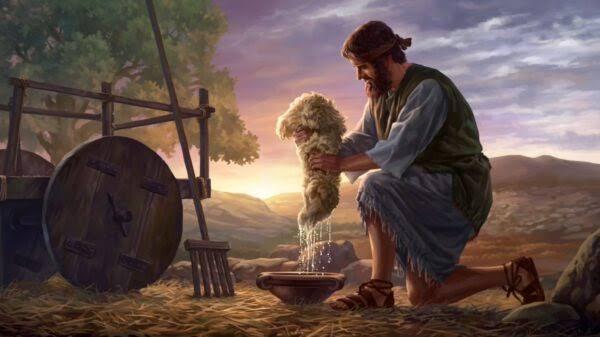
Restoration: The First Sign of the Fleece (6:36-38): Then Gideon said to God. It is not insignificant that throughout both of the fleecing incidents the divine personal name of YHVH is missing. Instead, the rather generic designation of Elohim (God) is used. Gideon said to God, “If you will rescue Isra’el through me, as You have promised, prove it to me this way. I will put a wool fleece on the threshing floor tonight. If the fleece is wet with dew in the morning but the ground is dry, then I will know that You are going to help me rescue Isra’el as You promised” (6:36-37 NLT). The basis for the request for these signs was Gideon’s need for assurance. He was still not the mighty warrior (6:12) he had been promised to be. The miraculous nature of the sign lay in the fact that, normally, the moisture in the fleece would be absorbed into the ground beneath it. The presence of the dew shows that the rainy season had ended and the dew season had begun, with April being the month of the change. The fact that Gideon was threshing wheat would mean it was the month of June. Remarkably, Gideon’s request was granted. It seems that YHVH was more interested in restoring Isra’el than to quibble with Gideon’s lack of faith. And it happened! He got up the next morning, squeezed the fleece and wrung out a whole bowl full of water (6:38 Hebrew).165
Restoration: The Second Sign of the Fleece (6:39-40): Then Gideon said to God, “Please don’t be angry with me, but let me make one more request. Let me use the fleece for one more test. The fact that Gideon sought further assurance from ADONAI showed how desperate he was. It may have occurred to him that since the threshing-floor was made up of bedrock, it therefore would not have absorbed the dew. Instead, he then asked for a more remarkable sign. This time let the fleece remain dry while the ground around it is wet with dew (6:39 NLT). The miracle here was that, under normal circumstances, the ground would dry up more quickly than the saturated wool. This request was also fulfilled.
The fleece was dry in the morning, but the ground around it was wet with dew (6:40 Hebrew).166It’s time to put this whole “putting out a fleece” madness to bed. Many believers have taken this narrative as a positive and adopted the practice of “putting out a fleece”- testing God in order to determine His will. For example, in a dating relationship someone might say, “God, if he sends me a card in the next six hours, then I’ll know you want me to marry him.” Yikes. Let me be as clear as possible: this passage is not an encouragement to use tests to find out the will of God! In fact, it is a sign of a lack of faith.
1. Gideon was not asking God to reveal what he should do. God had already told Gideon what he should do by special revelation (6:14 and 16). Gideon’s fleece was not a sign of his spirituality, but a sign of his very weak faith.
2. Gideon was trying to get a guarantee that the God who was speaking to him would grant him victory. This practice was a common practice in ancient cultures, but Gideon was seeking confirmation on his terms rather than God’s. In fact, Gideon’s test betrays a Canaanite theological perspective (see below).
3. Gideon was trying to get a guarantee that the God of Isra’el was greater than Ba’al. This the least known and yet most crucial piece of information in these verses. Ba’al was the Canaanite god of the storm. In one Ba’al tale, his weakness results in a drought of both rain and dew. In fact, Ba’al’s daughter, Talia, is thought to be responsible for the dew. Guess what the Hebrew word for dew here is? Tal. There is no doubt that Gideon here is testing God to see if he really is greater than Ba’al. Gideon (the one who fought with Ba’al in 6:25-32) isn’t quite convinced that Ba’al isn’t the real deal yet. So the fleece tests are the result of Gideon’s Canaanite way of thinking, and his lack of faith in YHVH, the God of Isra’el.
4. Putting God to the test is sinful. In Deuteronomy 6:16 God says: “You shall not put ADONAI your God to the test, as you tested him at Massah.” In 6:39 Gideon says: Please don’t be angry with me, but let me make one more request. Let me use the fleece for one more test. Gideon even uses the same verb for testing found in Deuteronomy 6:16. If we count Gideon’s request for a sign from God’s messenger Judges 6:17-18, he’s tested ADONAI three times so far.
So why does God put up with Gideon’s lack of faith? Why does He answer the tests? Why does He even offer a fourth sign later in Judges 7:8-14? The only answer to these questions is God’s covenant faithfulness, or His grace. The fact that ADONAI responded to Gideon’s Canaanite worldview isn’t meant to condone testing God or demanding signs. Instead, Ha’Shem’s patience shown to Gideon highlights the greatness of His grace towards both Gideon and Isra’el. He essentially holds Gideon’s hand throughout the entire process, thus addressing his lack of faith, his faulty theology, and his fear.
Yes, YHVH is patient with our lack of faith, with our faulty theology, and our fear. But the message is not to imitate Gideon, but rather to learn about God and ourselves from his experience. This narrative encourages us to believe God without the extra drama. Once again in Judges, Othniel’s simple faith stands out when contrasted with Gideon (3:7-11). Let’s learn from Gideon’s experience. ADONAI is greater than any false god, He is able and willing to save, and He is motivated by His grace. Don’t test God. Believe Him.167
Dear heavenly Father, praise You for being so absolutely wonderful, almighty, and loving! Thank You that when we are weak, You are strong. Thank You for listening to our prayers. Thank You for Your grace. Help me to understand that I already know Your will for me, because You have given me Your Word as a lamp for my feet and a light to my path (Psalm 119:105). When I want to know Your will for me I just need to read my Bible. And if I want to hear Your audible Word for me, I just need to read my Bible out loud. I believe in You. To the One who sits at Your right hand. Amen.
Leave A Comment