





Gideon’s Problem with Ephraim
7:24 to 8:3
Gideon’s problem with Ephraim DIG: How are the Ephraimites presented in the book of Judges? Why was Ephraim so upset with Gideon? How did their pride get in the way? How did Gideon deal with the complaints from the Ephraimites? What was the contrast between Gideon and Jephthah?
REFLECT: In what situations do believers struggle with pride? Where do you feel shut out? Since pride goes before destruction, where in your life do you need to be extra diligent regarding pride in your life? And if you say nowhere, then you need to be extra diligent. How do you deal with the pride of others?
The pursuit of the fleeing Midianites (to see link click Bd – Gideon’s Victory Over the Midianites) is temporarily interrupted by the parenthetical interlude of Gideon’s problem with Ephraim. Judges 8:4 will pick up where 7:23 left off.
The Call of Ephraim (7:24-25): Gideon also sent messengers throughout the hill country of Ephraim, saying: Come down to attack the Midianites (7:24a NIV). There was nothing novel or particularly creative about Gideon’s tactics; he called for reinforcements and ordered them to cut them off at the shallow crossing of the Jordan River at Beth-barah, just as Ehud had done (3:28). Those who answered the call, for the most part, were from the same tribes that had answered the first call: Naphtali, Asher, and the western tribe of Manasseh (6:35). Their quick response suggests that the 22,000 of 7:3 and the 9,700 of 7:8 had not dispersed completely, and that most of them were still relatively close at hand. Any shortfall was made up by sending messengers to call up volunteers from Ephraim was well. While all participated in the general pursuit of the enemy, it was the Ephraimites, in particular, who were ordered to seize the shallow crossings of the Jordan River as far as Beth-barah (7:24b Hebrew).181
This was accomplished, but apparently not in time to prevent at least some of the Midianites from escaping. They captured Oreb (meaning raven) and Zeeb (meaning wolf), the two Midianite commanders, killing Oreb at the rock of Oreb, and Zeeb at the winepress of Zeeb. The names of the places were obviously given after the execution to commemorate the fate of the two Midianite commanders. This was still remembered in Psalm 83:11 and Isaiah 10:26. Isaiah’s mention of it in the eighth century shows that it left its mark on the national consciousness for generations to come.182 They captured the two Midianite commanders and killed Oreb at the rock of Oreb, and killed Zeeb at the wine press of Zeeb. In terms of the formal shape of the narrative, what began at one wine press (6:11) ends in another (7:25a Hebrew). The raiders had been forced out of the Land, just as juice is pressed out of grapes. Gideon had rescued Isra’el from the hands of Midian (6:14), and the story might have ended here. But it was not meant to be. Gideon himself had apparently already crossed the Jordan River, and the Ephraimites followed suit, bringing the heads of Oreb and Zeeb with them (7:25b Hebrew).183
Gideon’s Problem with Ephraim (8:1-3): The tribe of Ephraim appeared to have enjoyed a supremacy over the other tribes during the earlier period of the settlement. Its territory in the central highlands preserved their central position from the many incursions of Isra’el’s hostile neighbors; as a result, they experienced far greater freedom to consolidate themselves than did the other tribes. The two most prominent sanctuaries during the time of the judges were Bethel and Shiloh, which functioned as a rallying-point of the tribes, were situated within its boundaries and this fact undoubtedly further increased its prestige.184
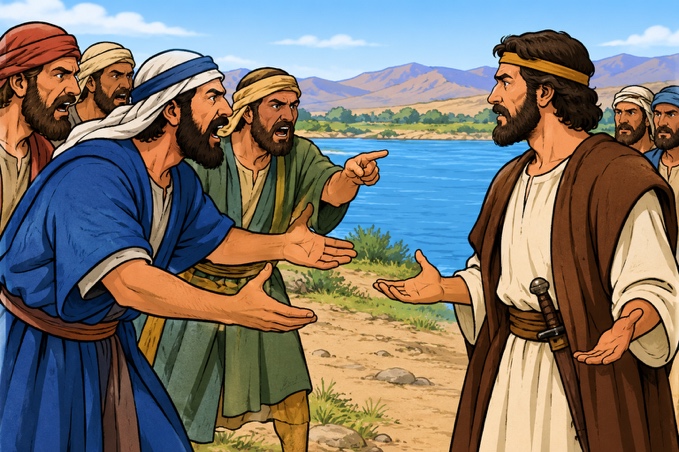
Knowing that they were a large and important tribe, second only to Judah, the Ephraimites were a very proud people. So the men of Ephraim asked Gideon, “Why have you treated us this way? Why didn’t you send for us when you first went out to fight the Midianites?” And they argued heatedly with Gideon (8:1 NLT). Earlier in 5:14a, the author pointed out that the Ephraimites displayed some “Amalekite” characteristics; that is, they were hostile and quarrelsome. So while rising to Gideon’s challenge, the Ephraimites were not pleased that they had been excluded from his earlier military strategy, a displeasure with economic (lack of plunder) as well as social (honor/shame) motivations. Gideon was from Manasseh, one of the two tribes of Joseph in the north, the other being the tribe of Ephraim. While Gideon’s appeal to the tribes of Asher, Zebulun, and Naphtali made sense because of their common territorial claim to the Valley of Jezreel, the Ephraimites probably expected to be called in light of their common lineage (see Aj – The Failures of the Northern Tribes: The Victory over Bethel) This confrontation was a very dangerous moment. The fact that the Ephraimites had just captured and executed Oreb and Zeeb demonstrated their capability. It would have been risky for Gideon to respond with force, and in any case, he had more urgent matters to attend to, like the escaping Midianites. His soothing words saved the day in the present. But the Ephraimites would continue to cause problems for Isra’el in the future (see Bt – Jephthah and the Jealous Ephraimites).
The response of Gideon is an excellent example of the maxim that a gentile answer turns away wrath, but a harsh, sarcastic word, stirs up anger (see the commentary on Proverbs Cj – A Soothing Tongue is a Tree of Life). He replied: What have I accomplished compared to you? Aren’t even the gleanings of Ephraim’s grapes better than the full grape harvest of his clan Abiezer (8:2 NLT)? God gave you victory over Oreb and Zeeb, the commanders of the Midianite army. What Have I accomplished compared to that (8:3 NLTa)? Gideon slyly made what was essentially a put-down appear to be a compliment. The metaphor he uses is drawn from the harvesting of grapes, contrasting the gleanings (those grapes left over after the harvesters have completed their work) with the full harvest. Gideon claims that even the gleanings of Ephraim’s late exploits in the battle outshine anything he has accomplished became they have captured the two Midianite leaders (the choicest grapes)!185
When the men of Ephraim heard Gideon’s answer, their anger subsided (8:3 NLTb). Placated by this flattery the Ephraimites calmed down, Gideon’s tactful activity having averted a potentially dangerous situation. Displaying the marked moral decline in the cycles of the judges, this is a stark contrast to the response of Jephthah in a similar crisis (see Bs – Jephthah Makes a Rash Vow).186 The problem with Ephraim will arise again, but then things will end up with far more tragic consequences (see the commentary on Proverbs Co – Pride Goes before Destruction). In the book of Judges, the Ephraimites are presented as self-centered, divisive, easily offended, and having an inflated estimation of their own importance within the nation itself.187
Dear heavenly Father, praise You for being such a loving, merciful and patient God! Thank You for the victories that Isra’el had in the past to defend herself, and for her victories today. You have said that she is the apple of Your eye (Deuteronomy 32:10; Zechariah 2:8; Psalm 17:8). You say in Your Word that she will remain a nation as long as the sun, moon, and stars shine at night (Jeremiah 31:35-36). But Satan hates Your people; and as a result, there will always be opposition. Lord, help me be on the right side of history and always defend Your Name and Your people. To the One who sits at Your right hand. Amen
Leave A Comment