





Gideon’s Victory Over the Midianites
7: 1-25
Gideon’s victory over the Midianites DIG: As you read Judges, identify how Isra’el continued its downward spiral of unfaithfulness to ADONAI? How does God test our faith? What was prophetic about the Angel of ADONAI’s description of Gideon as a “mighty warrior” in 6:12? How did God encourage Gideon’s faith? Why is ADONAI so intent on showing Gideon his weakness?
REFLECT: When have you had to trust God despite not understanding what He was doing or asking? Why does God choose the weak and lowly to bring about His purposes? In what ways might we try to do God’s work by our strength and for our own glory? How should knowing that ADONAI acts in unpredictable ways impact how we live? When is it difficult to trust God? Memorize Judges 7:2.
Strength made perfect in weakness.
Restoration: Here we see Gideon’s victory over Midian. He began with thirty-two thousand men, but God reduced the number to three hundred. This was to ensure that Isra’el knew the victory was by God’s power, not their own strength. The weakness of Gideon and of Isra’el can be seen in Chapters 6-8. One can trace this theme in Isra’el’s total helplessness (6:2-6), in Gideon’s lack of status and relative obscurity (6:15), in his fear of family and townspeople (6:27), in his need for additional assurance (6:36-40), in the radical reduction of his army (7:2-8), in his fear of the battle and his need for additional encouragement (7:10-15). So Gideon is not our conventional hero. Instead he, and Isra’el, are presented in their weakness. Second Corinthians 12:9 nicely sums up the main point of Gideon’s victory over Midian: ADONAI’s power is most fully displayed when His people are weak.168
The Division of the Armies (7:1): Early in the morning, Jerub-Ba’al (that is, Gideon as seen in 6:32) and all his men camped beside the spring of Harod, which bubbles out at the foot of Mount Gilboa. It seems that even though the author is on to the next phase of the account, the destruction of the altar of Ba’al (6:25-32) lingers in his mind. In the end, Gideon steps out and wins a great victory, but the name Jerub-Ba’al reminds us that he is a reluctant warrior.169 Ironically, the spring of Harod means the spring of Trembling, a fitting name for a spring that described the mental and physical state of Gideon and the majority of Gideon’s troops as they anticipated the looming battle. The camp of Midian was about five miles north of them with a force of 135,000 (8:10) in the Jezreel Valley near Mount Moreh (7:1 NIV). The Midianites were obviously aware of the presence of the Israelite army and their intelligence service knew the name of its leader (7:14), but it does not seem to have been regarded as a serious threat; probably they felt secure in their greatly superior numerical strength and the confidence gained by the success of the previous seven years.170
The First Reduction of Gideon’s Army (7:2-3): With the fleece, Gideon tested God twice (to see link click Bc – The Sign of the Fleece); now God will test Gideon twice. ADONAI said to Gideon, “There are too many warriors with you. If I let all of you fight the Midianites, the Israelites will boast to Me that they rescued themselves by their own strength.” As First Samuel 14:6 teaches, it is no problem for God to save with the few as easily as the many. So in keeping with Deuteronomy 20:8, Ha’Shem said to Gideon: Therefore, tell the people that whoever is timid or afraid should return home to Mount [Gilboa]. So 22,000 of them returned home, but 10,000 remained (7:2-3 NLT).
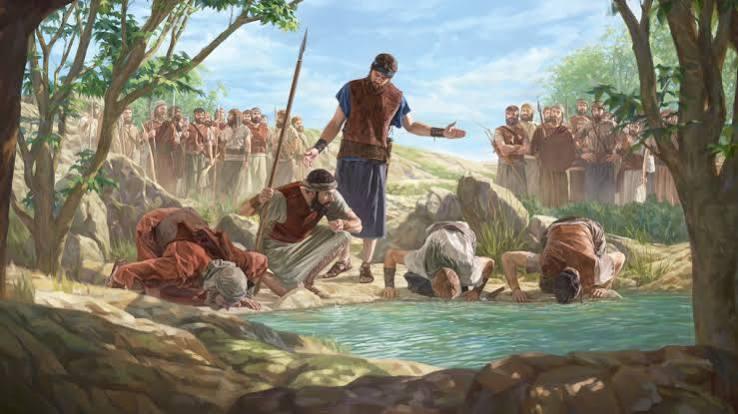
The Second Reduction of Gideon’s Army (7:4-6): But then the LORD told Gideon, “There are still too many!” This led to a second test. “Bring them down to the spring, and I will test them to determine who will go with you and who will not.” So Gideon took the men down to the water. There, ADONAI told him, “Separate those who cup the water in their hands from those who lap it up with their tongues like dogs.” Three hundred-men drank from cupped hands. All the rest got down on their knees to drink and lapped up the water like dogs (7:4-6 Hebrew). When the men went down to the spring to drink, all of them would have to get down on their knees, since it’s not possible to drink any other way. The issue was not who knelt and who stood, but who cupped their hands and brought it up to their mouth, and who would not. Thus, Gideon was given instruction on how to select men for his special cutting-edge forces. Those who were kept appeared to be the ones who bowed on their knees, but cupped their hands to bring up and drink the water from their hands, showing they were ready for sudden attack. The rest put their faces down to drink. The first test (of voluntary release) eliminated the fearful; here, the second test (of readiness at the stream) eliminated the careless.171
The Three Hundred (7:7-8): Then ADONAI said to Gideon, “I will use the 300 men that drank from cupped hands and give the Midianites into your hands.” Less than one percent of the original 32,000 (7:3) ended up following Gideon into battle. That handful of men represented the pure gold which YHVH desired in His service. Gideon sent all the others back to the base camp” (7:7 NLT). They would be called in later to participate in the fighting, even though they wouldn’t participate in the initial attack (see Be – Gideon’s Problem with Ephraim). However apprehensive Gideon might have been, he dutifully sent 9,700 Israelites home, but kept the three hundred, who took over the provisions and shofars of the others. Then Gideon took charge of the pathetically small band and prepared to face the vast army of Midianites. This passage ends with a statement concerning the enemy: Now the camp of Midian lies below him in the Jezreel Valley (7:8 NIV). This is a transitional statement setting the stage for what was about to happen next.
The Spying Out of the Midianite Camp (7:9-14): With the excess eliminated from Gideon’s forces, YHVH seems eager to get on with the battle. But this time ADONAI didn’t wait for Gideon to protest the reduction of his forces. Instead, God raised the issue Himself. Verses 9 to 11 record the sign to Gideon that finally convinced him that he would defeat the Midianites. That night ADONAI gave him both a command and a promise. The command was: Get up and attack the Midianite camp the promise was: because I have given you the victory. But if you are afraid to attack, go down to the camp with your servant Purah. Listen to what the Midianites are saying, then you will be strengthened to attack the camp. So he and Purah, his right-hand man, were to go down to the outposts of the camp (7:9-11 Hebrew). The fact that Gideon was fearful again showed that he was still not the mighty warrior (6:12) that he would become. However, the one indispensable requirement for a leader of God’s people is not fearlessness, but obedience. Humanly speaking, there were two good reasons for Gideon to be afraid. The first was the sheer numbers of the enemy. The Midianites, the Amalekites, and the Bedouin raiders had settled in the valley like a swarm of locusts. The second was the resources and provisions of the enemy. Their camels were like the grains of sand on the seashore – too many to count (7:12 NLT). So while Gideon was troubled by fearfulness, he wasn’t paralyzed by it any more than when he was told to destroy his father’s Ba’al altar (6:25-32); he went down to the enemy camp and received the strengthening he was promised.172
So with the stealth of spies, Gideon and Purah arrived and crept within earshot just as a man was telling his companion about his dream. Like the dreams in which God visited Pharaoh and Nebuchadnezzar, here He also provided an interpreter, in the form of a second Midianite.173 Generally speaking, when ADONAI communicated with or through pagans, He would do so by means of a dream. Only with Balaam did He use direct speech (see the commentary on Numbers Dn – Balaam’s Three Encounters with God). But for people like Pharaoh, Nebuchadnezzar, Laban, and Abimelech, the Philistine king of Gerar, He used dreams. The basic content of the man’s dream was this: I had this dream, and in my dream a loaf of barley came tumbling down into the Midianite camp. Barley was the poor man’s bread, and it represented Isra’el, made poor by famine and the Midianites. More specifically, it represented Gideon and his three hundred men. It hit a tenet, turned it over, and knocked it flat! This symbolized the defeat of the Midianites by Gideon. His companion answered: This can be nothing other than the sword of Gideon son of Joash, the Israelite victory over Midian and all its allies, meaning the Amalekites and the Bedouin raiders from the east (7:13-14 NLT).174 The strange dread that revealed itself in the dream was like the great fear that came over the citizens of Jericho before it fell to Joshua (Joshua 2:9). It is a supernatural, divinely induced fear, and the knowledge that it has already begun to take hold of the enemy was the perfect antidote to Gideon’s own fear (7:10). It was all the proof he needed. The impossible was about to happen again as it had in the past. The God of the Exodus was once again turning His face toward His people.175
The Preparation for War (7:15-18): With the problem of Gideon’s fearfulness being resolved, he was then ready to proceed with God’s agenda. When Gideon heard the dream and its interpretation, he was fully convinced that he would defeat the Midianites. Only then did he finally become the mighty warrior that YHVH had prophesied. So, he bowed down and worshiped ADONAI. Then He returned to the camp of Isra’el and issued the command: Get up! ADONAI has given you the victory over the Midianite camp (7:15).
Next, the preparation for the attack began. Having been assured of victory, Gideon immediately began to prepare for the battle. His actions and instructions in the next three verses demonstrate great concern for detail; but like ADONAI’s instructions to Joshua before the battle of Jericho (Joshua 6:1-5), the strategy appeared to be totally absurd. Dividing the 300 men into three companies, he placed trumpets and empty jars with torches in all of their hands (7:16 NIV). At the time the shofars were blown, the empty jars and torches could be held temporarily in one hand. The empty jars would be used to hide the light of the torches. The strategy was this: The sleeping enemy was to be surrounded on three sides, and then suddenly exposed to the light out of the darkness of night, in conjunction with the loud sounds of the three hundred trumpets, this would spread confusion and panic in the camp.176 Gideon’s instructions moved from the general to the specific. First, he said: Watch me and follow my lead. When I get to the edge of the camp, do exactly as I do (7:17 NIV). This led to specific instructions: When I and the 100 men with me blow our shofars, then you blow your shofars all around the whole camp and shout, “For ADONAI and for Gideon” (7:18 CJB)! The basic purpose was to make as much noise as possible. The goal was to confuse the enemy and convince them that they were surrounded by a very large army. The basic sequence would go like this: First, the blast of the shofars; then the crashing of the jars exposing the light in the darkness; followed by the battle cry; which was, in turn, followed by another blast of the shofars, culminating with alternating shouts and shofar blasts during the chaos and pursuit of the enemy.177
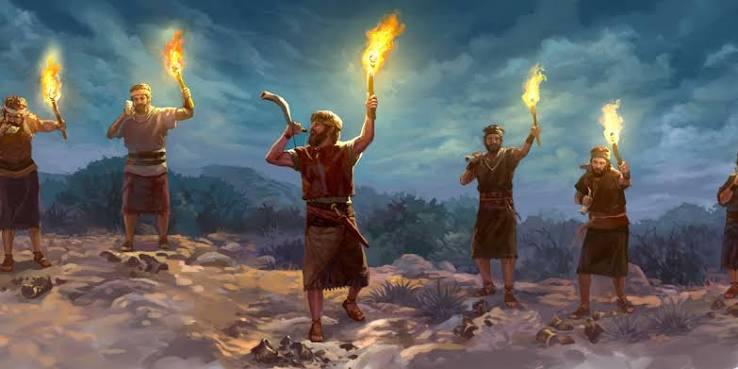
The Attack on Midian (7:19-23): Gideon’s attack was timed to perfection. He and the 100 men with him reached the edge of the camp at the beginning of the middle watch. The first watch went from 6:00 to 10:00 pm; the third watch went from 2:00 to 6:00 am; the middle watch, or the second watch, went from 10:00 pm to 2:00 am. They arrived at the beginning of the middle watch, which would mean just about 10:00 pm, meaning the sentries would have just come on duty and their eyes were not fully adapted to the darkness just yet. All was set. Then, the three companies blew the trumpets and smashed their jars. Grasping the torches in their left hands, holding the trumpets that they were to blow in their right hands, they shouted, “A sword for Ha’Shem and for Gideon” (7:19-20 NIV)! The sword here was used figuratively for the battle because Isra’el, at this point, didn’t have any swords. Only the Midianites had swords, which they would use against themselves. In this way, when an Israelite came upon a dead Midianite, he could take the sword from those who were slain. Adding his own name to God’s name, the sword for Ha’Shem and for Gideon, may have been the first step toward Gideon’s own downfall, as will be seen as the story progresses.
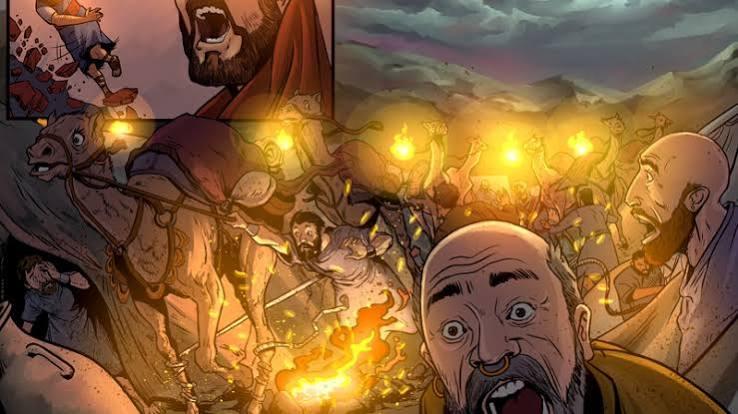
Everything went according to plan. Each Israelite stood at his position around the camp and watched as all the Midianites, Amalekites, and Bedouin raiders ran around in a panic, crying out as they fled (7:21 Hebrew). The Jewish army stood still and didn’t enter the camp itself. There was no need to enter because the mass confusion already caused was enough to win the battle. When the 300 Israelites blew their shofars, ADONAI caused the Midianites, Amalekites, and Bedouin raiders throughout the camp to turn on each other with their swords. The confusion and panic created Gideon and his three-hundred men was entirely ADONAI’s doing and resulted into massive infighting among Isra’el’s enemies.178 Those who were not killed fled down the Jordan Valley through the Beth-Shean Pass, and eventually crossing to the east side of the Jordan River, as far as Beth-shittah toward Zererah and as far as the border of Abel-meholah near Tabbath (7:22 Hebrew). This battle was the biblical use of psychological warfare at its best, and it resulted in bedlam. In the chaos, the Midianites and their allies killed each other by the sword, as they ran, cried out, and fled.
The flight of the enemy led to the general call of Isra’el to arms. Then Gideon sent for the warriors of Naphtali, Asher, and Manasseh, who joined in pursuit after the Midianites (7:23 NIV). This included the thousands who originally left Gideon, since now this turned into a mopping-up operation, and so the fear was gone. The quickness with which they responded suggests that the 22,000 of verse 3 and the 9,700 of verse 8 had not been dispersed completely, and that many of them were still relatively close to the battle ground. Any shortfall was made up by sending messengers to call up volunteers from the Ephraimites as well.179
Gideon was apparently a man of great potential and natural ability, but he lacked faith. He was timid in the midst of his potential. It took God’s call, signs, and arranging of events to change his heart. Are we the same? Perhaps ADONAI wants to use us in some way: teach a class, lead worship, be a greeter, lead a bible study, minister to the sick, be a counselor to youth or the down-and-out. But we are timid. We ask ourselves, “Can God really use me?” We want assurance. In fact, we demand it. Are we delaying God’s plan? Are we really trusting Him if He must give evidence after evidence that He desires (not needs) our participation? Fortunately, He doesn’t leave us wallowing in our potential. And when He brings us to trust Him and serve Him; and when we do, there is worship of Him.180
Dear heavenly Father, praise You for You are so wonderful in every possible way! Gideon was wise in following exactly what You said to do in Your plan for victory. Likewise, I also need to listen carefully to Your Word and follow it to defeat the enemy of pride/sin. To love and to obey is the wisest thing I can do. For it brings me shalom and hope. For I know the plans that I have in mind for you,” declares ADONAI, “plans for shalom and not calamity – to give you a future and a hope (Jeremiah 29:11). Though I may not completely understand the why behind what You say, trusting and obeying You completely is always the best plan! What joy it is to trust in Your great love for me. Obeying such a wonderful heavenly Father is a privilege! In Messiah’s holy Name and power of His resurrection. Amen
Leave A Comment