





The Conspiracy of Abimelech
8:33 to 9:6
The conspiracy of Abimelech DIG: Who was Abimelech? Who were his parents? Why did he go to Shechem? What did Abimelech do in order to become king? Why did Isra’el “forget” what Gideon and ADONAI had done? What was the substitute? What kind of a person would abandon their birth name and then name themselves? How would you describe Abimelech’s character? Who was Abimelech loyal to? Why did his brothers and the citizens of Shechem follow him?
REFLECT: Gideon’s people soon forgot about ADONAI. What can you do to help ensure that doesn’t happen to you? Who is God calling you to express kindness to this week? How will you? Why is it important that you don’t hang out with vain and reckless people? What do you hope your legacy will be after you die? Do you keep your obligations? How are truth and integrity displayed in your life?
His rule was secured by guile, maintained by force, and did not survive his death.
He was never a judge, much less a king.
It’s All in the Name (8:33-35): As Michael Hattin relates in his commentary on Judges, as a man of resolve, ruthless Abimelech must have had his eye on the kingship from the very day the Israelites had first raised the subject. It is reasonable to assume that at the time of Gideon’s great victory over the Midianites (to see link click Bd – Gideon’s Victory Over the Midianites), Abimelech was either not born yet or else very young, for at the killing of the Midianite kings Zebah and Zalmunna in the aftermath of the victory, Gideon’s firstborn son Jether was described as being only a boy (8:20). No doubt, however, the son of the concubine grew up with the stories of his father’s great victory and the reports of his father’s refusal to become king of Isra’el. However, Abimelech was made of more brutal stuff than his father. It is more likely that his pretentious name, which means my father is king, was not given to him by his father at all, but rather it was self-appointed! A careful reading of the relevant verse implies as much, for it says: He [Gideon’s] concubine who was in Shechem also bore him a son, and he made his name Abimelech (8:31 Hebrew).
Generally in the TaNaKh, when names are given to children by their parents, the verb vayikra (he called) is used, or vatikra (she called) if the mother gives it. The verb kara means to call and its usage in biblical Hebrew is quite similar to its usage in English – it frequently means to address another, and it can sometimes mean to assign a name. But here, the account does not say vayikra shmo Abimelech, but vayasem et shmo Abimelech, which translates literally as and he made his name Abimelech. The subject of the pronoun he in 8:31 may not be the father Gideon at all but rather Abimelech himself, and indicates that at some point the ambitious man renounced his birth name and instead adopted a name that was more in keeping with his future ambitions. Instead of reading the verse: and he [Gideon] made his name Abimelech, we may just as reliably read it as: and he [Abimelech] made his [own] name Abimelech! Gideon refused to become king over his people, but Abimelech rode on his father’s coattails in order to advance his own illegitimate and immoral claim. My father is king, essentially implies that I will succeed my glorious father as king in his stead.212
Gideon died when he was very old, and he was buried in the grave of his father, Joash, at Ophrah in the land of the clan of Abiezer. No sooner had Gideon died than the Israelites again committed spiritual adultery with the Ba’al’s, making Ba’al their god (8:32-33 Hebrew). The death of a judge once more led to the removal of restraint and a movement towards the Ba’al worship of their neighbors. So not surprisingly, as soon as Gideon died, all restraint was cast to the wind, and the nation rushed headlong into apostasy. The particular apostasy was Ba’al worship, specifically Ba’al-Berith (9:46), or lord of the covenant, which flourished in Shechem. Their true covenant was with YHVH but they were giving up all pretense of being faithful to Him.
Shechem was in the Israelite heartland, about 31 miles (50 kilometers) north of Jerusalem and 15.5 miles (25 kilometers) west of the Jordan River. On a positive note, it was there that Abraham had first built an altar to ADONAI after arriving in Canaan (Genesis 12:6). There, too, Joshua had called all the tribes together for a great covenant renewal ceremony after the completion of his campaigns of conquest (Joshua 24:1). But on the dark side of their history, Simeon and Levi slaughtered all the men of Shechem because of the rape of their sister Dinah by Shechem, the clueless son the mayor Hamor (see the commentary on Genesis Ie – The Slaughter at Shechem by Simeon and Levi).
The Israelites forgot ADONAI their God, who had rescued them from all their enemies surrounding them (8:34 Hebrew). YHVH and His mighty works were forgotten. He might be useful for a time of crisis, but the fertility gods appeared to offer more for their everyday existence. Shechem lay at the southern end of the valley separating Gerizim and Ebal, the mountains of blessing and a curse respectively (Deuteronomy Cq – A Blessing and a Curse). Therefore, it was a place of great symbolic importance. It was also significant in our present story from the fact that Gideon had a concubine there, and that Abimelech was his son by her (8:31).
Less surprising was the failure of the Israelites to remember Gideon. They also failed to show any kindness (Hebrew: chesed, meaning faithfulness or loyalty) to the family of Jerub-Ba’al in spite of all the good he had done for Isra’el (8:35 Hebrew). Many years had passed since his accomplishments, but the opulence of his family life may have aroused jealousy in the new generation, and the feeling might have been that he had already been sufficiently rewarded.213 Here, Gideon is ironically called Jerub-Ba’al, the Ba’al Fighter, while his son goes back to the worship of Ba’al.
Gideon was from the tribe of Manasseh (6:15), but Shechem was a city in Ephraim (Joshua 20:7 and 21:21). We can only speculate why Gideon had a concubine there. Was it an attempt to heal the tense relationship between himself and the Ephraimites that had flared up (see Be – Gideon’s Problem with Ephraim)? Or, to put the same issue more positively, was it a king-like political liaison intended to symbolically unite the two largest northern tribes under his authority as the new national leader? But why then a concubine rather than one of his many wives (8:30)? Or was it simply lust which he chose not to dignify with a marriage as a snub to the Ephraimites in retaliation for the problems they had given him? We don’t know. But what we do know is that it caused trouble . . . big trouble.214
The conspiracy of Abimelech (9:1-6): The sequel to the Gideon narrative is set in motion when Abimelech went to Shechem to speak to his mother’s brothers and all his mother’s clan. He said to them, “Ask all the rulers of Shechem,” literally the ba’al’s of Shechem, its original meaning is lord or owner, as in Joshua 24:11; Judges 20:5; First Samuel 23:11-12; Second Samuel 21:12.215 Abimelech’s evil thought was this: Which is better for you: to have all seventy of Jerub-Ba’al’s [Gideon’s] sons rule over you, or just one man (9:1-2a NIV).? In other words, one ruler is better than seventy rulers. However, there was no indication that any of the other sons had any such ambition. Thus far in the book of Judges, no judge was succeeded by a son. Through the whole course of his disastrous kingship, Abimelech sought to influence the rulers of Shechem through his relatives. His message to them was that a power struggle was under way and they were going to have to choose between him and the other seventy sons of Jerub-Ba’al (8:30).
Abimelech said: remember, I am your flesh and blood” (9:2b NIV). Abimelech will not speak again in the story until almost the very end (9:48 and 54). In all of his speeches, he commands others to take pains on his behalf. The first (9:2b) and the last (9:54) reveal Abimelech’s preoccupation with himself and his image. His argument was couched in a society where the cohesive power of faithfulness to YHVH and His covenant was declining; and tribalism, in the worst sense, was again on the rise. And the Canaanite blood-tie was the most convincing argument, indeed, Abimelech would act more like a Canaanite than a Jew.216
Abimelech’s brothers did not hesitate; they immediately pledged their support to him, and the rulers of Shechem followed suit. When the brothers repeated all this to the rulers of Shechem, they were inclined to follow Abimelech, for they said: He is related to us (9:3). If there was going to be a power struggle, they would stand with Abimelech.217
The rulers of Shechem immediately put their money where their mouth was by giving Abimelech seventy shekels of silver from the temple of Ba’al-Berith (9:4a NLT). So the funds came out of a temple dedicated to Ba’al. This was not a large amount, but it corresponded exactly to the seventy brothers that he would execute. Effectively, he murdered each one of his brothers in cold blood for the measly pittance of a single shekel! Abimelech’s disdain for the value of a human life and fraternal blood, already demonstrated at the very outset of his rule, will color the rest of his vicious career.218 Judas betrayed his Master for thirty pieces of silver (see the commentary on The Life of Christ Kc – Judas Agrees to Betray Jesus); and this “Judas,” Abimelech, betrayed his brothers in the same manner, including death.
And Abimelech used the silver to hire vain (Hebrew: reikim) and reckless (Hebrew: ufochazim) troublemakers who agreed to follow him (9:4b Hebrew). Two descriptions are used to describe the hired men. The first one is vain. The Hebrew word means empty, and denotes men with idle hands and empty stomachs, but with no desire to work or earn an honest living. These men were willing to sell themselves for any task. The second word used to describe these men is reckless, the type of men who followed Abimelech were idle and reckless, a bad combination indeed, devoid of any wisdom or moral understanding.
Abimelech traveled thirty miles with his troublemakers and went to his father’s home at Ophrah, and once there, on one stone, they killed [sixty-nine] of the sons of Gideon (9:5a NLT). The fact that they were killed on one stone would have required the killing to take place one at a time. This was not a quick slaughter of unsuspecting victims, but a calculated, brutal, act of murder (see the commentary on Deuteronomy Bq – Do Not Murder) trying to promote terror. The stone may be a reference to a sacrificial stone, as in First Samuel 14:33-35, and if so, would allow for the easy disposal of blood, since the matter of the disposal of blood was of great consequence (see Deuteronomy Cu – Do Not Eat the Blood). In this ritual slaughter of his half-brothers, he may have been seeking to avoid any adverse consequences by carefully disposing of the blood.219 However, when the blood is shed upon stone, and not on the earth which can absorb it (Ezeki’el 24:7ff), it is an indication that the murderer is completely reckless and without thought of Ha’Shem who avenges the crime. By murdering his half-brothers, Abimelech joined the ranks of other men in the Bible who committed fratricide, including Cain (Genesis 4), Absalom (Second Samuel 13:23ff), and Jehoram (Second Chronicles 21:4). Not very nice company. But there was one problem, the youngest brother, Jotham (see Bj – The Parable of Jotham), escaped and hid (9:5b NLT).
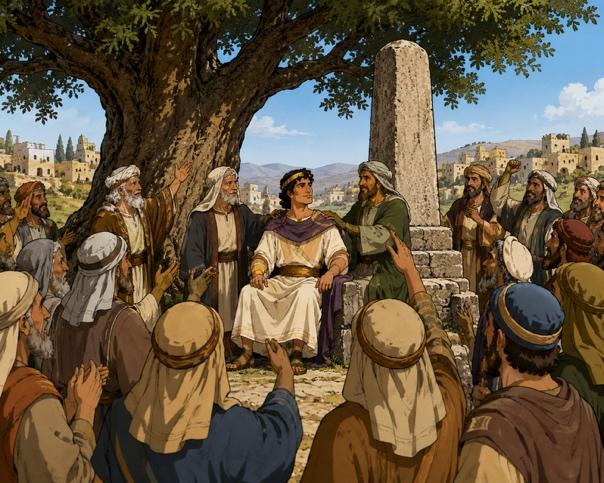 The bloody deed accomplished: Then all the leading citizens of Shechem and Beth-Millo gathered beside the great oak tree at the pillar of Shechem (Joshua 24:26) to crown Abimelech king (9:6 NIV). Now the temple at Shechem became an idolatrous place, representing Ba’al in a Canaanite-cult installation. The oak tree was sacred in the temple of Ba’al-Berith. Abimelech’s “coronation” was a farce, an empty ritual that was never accepted or blessed by ADONAI. The new “king” was just a selfish, godless man. He not only blasphemed God by the promises he made, but he defiled a place sacred in Jewish history.220 Abimelech’s kingdom, however, would be limited to four cities: Shechem, Beth-Milo, Arumah, and Thebez. His three-year rule was secured by guile, maintained by force, and did not survive his death. He was never a judge, much less a king.221
Dear heavenly Father, praise You for Your witness in Your Word. For all scripture is inspired by You and is useful to teach me what is true and make me realize what is wrong in my life. It corrects me when I am wrong and teaches me to do what is right (Second Timothy 3:16). After Gideon died, the Israelites forgot You, who had rescued them from all their enemies. Lord, I don’t ever want to forget about You. You have promised never to leave me or abandon me (Hebrews 13:5), You are so steadfast and I am so fickle. But You know my heart. In Messiah Yeshua’s holy Name and power of His resurrection. Amen
Leave A Comment