




Background to the Letter to the Philippians
In his commentary on Philippians, R. Sean Emslie starts by saying: You will receive power when the Ruach Ha’Kodesh comes upon you; you will be my witnesses both in Jerusalem and Judea, indeed to the ends of the earth (Acts 1:8). With these words, the mission to reach the world with the message of Yeshua began. Starting with Jerusalem and Judea, the message of Messiah spread among the Jews of the Land. The earliest Messianic Community was a movement of Jews. Then the Good News of Yeshua moved to the ends of the earth, and the doors were opened to the Gentile world.
The earliest followers of the Messianic Jewish faith understood themselves as a form of Judaism. The Jewish scholar Jacob Neusner (Judaisms 139) even described such faith as one of the “Judaisms” of the Second Temple era. Early on, a debate arose over Gentiles coming to faith in Yeshua and their relationship to the Torah and Jewish practices, especially circumcision for men. This issue of debate in the early Messianic Community became crucial in Acts 15:1 when men from Judah went to Antioch to teach the Gentile believers: You can’t be saved unless you undergo circumcision in the manner prescribed by Moses.
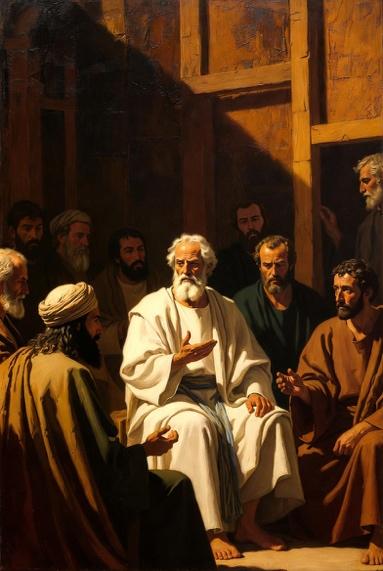
This teaching conflicted with Paul and Barnabas’ teachings to Gentiles and led to an important decision by the early Messianic Jewish leadership group, which later became known as the Jerusalem Counsel (see the commentary on Acts, to see link click Bs – The Council at Jerusalem). After hearing debate from both sides, James, Yeshua’s half-brother and the leader of the Messianic Community in Jerusalem, said: Therefore, my opinion is that we should not put obstacles in the way of the Gentiles who are turning to God. Instead, we should write them a letter telling them to abstain from things polluted by idols, from fornication, from what is strangled and from blood (Acts 15:19-20). James’ ruling about eliminating obstacles such as circumcision and substituting less stringent practices resulted in the council’s unanimous ruling, which then sent a letter to be read to all the Gentile churches declaring that they didn’t need to convert to Judaism nor undergo male circumcision before becoming full members of the Messianic Community and disciples of Messiah.
This ruling supported two important truths that can be missed by modern scholars – be they Christian or Jewish. First, the fact that the Judaizers (see the commentary on Galatians Ag – Who are the Judaizers?) taught that Gentiles had to become Jews before they could believe in Messiah, as the Hebrew Roots Movement today demands (see the commentary on Galatians Ak – The Hebrew Roots Movement: A Different Gospel) is not true. This ruling ended the legalistic burden of observing all 613 mitzvot for all followers of Yeshua, both Messianic Jews and Gentiles. If the Messianic Jews themselves had decided to abandon that legalistic observance, it seems pointless, and even cruel, to require the Gentiles to do so.
Therefore, for both Messianic Jews and Gentiles, the Torah reveals the heart of God in three ways. First, the Torah is still a moral guide by revealing sin (Romans 7:7). Secondly, we know that all Scripture is God-breathed and is useful for teaching, rebuking, correcting and training in righteousness (2 Timothy 3:16). Therefore, the Torah can be used as a teaching tool to show ADONAI’s standard of righteousness, so that we can know Him better and love Him more. And thirdly, it can also be used to point others to Yeshua. ADONAI had told Abram that all the peoples on the earth would be blessed through his spiritual descendants (Genesis 12:3b; also see Galatians 3:24-25 and Mt 28:19). Therefore, you could say the Torah is God’s blueprint for living. The closer we follow the Torah, the smoother our life will be. This is true for unbelievers as well. If they unwittingly follow Torah, their lives will go much smoother. But for those who violate the teachings of the Torah, your life will collapse into chaos, this is true for both believers and unbelievers.
Secondly, the Jerusalem Council asserted that Gentiles coming to Yeshua could, and should, come to Him as Gentiles. This is the mystery of the Gospel that through Yeshua, the way was open for the Gentiles to be grafted into the Righteous of the TaNaKh, but remain Gentiles (see the commentary on Dani’el Dx – The Mystery of the Olive Tree). No longer would Gentiles need to convert to Judaism. Instead, Gentiles could become part of the people of God, the Jewish people, as Gentiles. The only requirement was faith alone in the crucified and risen Yeshua. Together, they followed the God of Abraham, Isaac, and Jacob, and opened up the message of ADONAI to the whole world.6
Leave A Comment