





Blessed be Ja’el
5: 24-31
Blessed be Ja’el DIG: What is admirable in Ja’el? Why is the description of Sisera’s mother so pathetic? Why does Deborah go into such detail in her song? Why is the Bible’s characterization of Deborah so encouraging for women? How are Deborah’s last words in this hymn both a prayer to YHVH and a call to Isra’el?
REFLECT: Ja’el made the decision to support Isra’el no matter the cost. How would you rate your support for Isra’el? Other than ADONAI, for whom would you likely compose a song of praise? What aspect of Deborah’s song has benefited you the most? Try composing a song about God’s victory in your life.
While the Israelite city of Meroz failed to do its duty, the Gentile Ja’el did not fail.
As Deborah’s victory song continues (to see link click At – Deborah’s Victory Song), Deborah’s blessing on Ja’el reminds us of Gabriel’s words to Mary (see the commentary on The Life of Christ Al – The Birth of Jesus Foretold to Mary). Because of Barak’s hesitation, Deborah announced that a woman would get the credit for killing the general of the Canaanite army (4:8-9). The phrase crushing his head doesn’t mean that she decapitated him. With one stroke the tent peg went through his temple.125
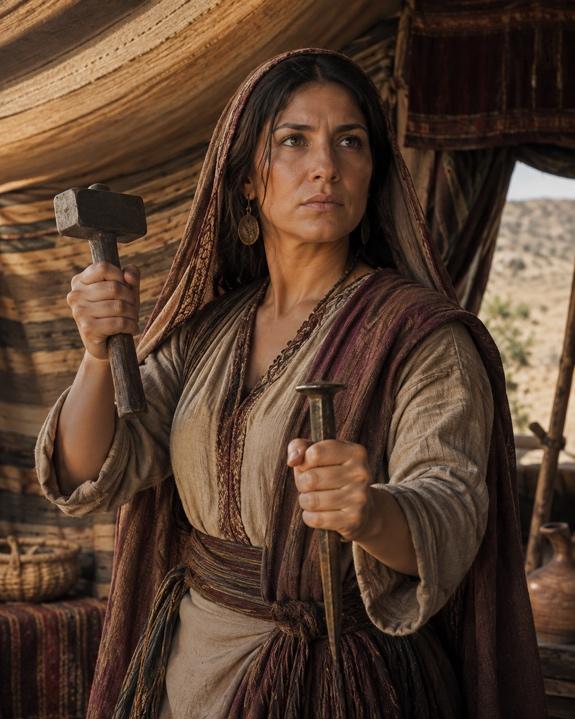
The Seventh Stanza: The Praise of Ja’el (5:24-27): Most blessed among women is Ja’el, the wife of Heber the Kenite. May she be blessed above all women who live in tents (5:24 NLT). While the Israelite city of Meroz took the side of the Canaanites, the Gentile Ja’el took the side of Isra’el, even going against her husband. It should be noted that there is no condemnation of Ja’el’s actions whatsoever, only praise. There are many people that condemn her for her actions of deception; totally ignoring that during wartime, deception of the enemy is part of the rules of war. However, there are no words of condemnation of her actions in the text. The Bible only praises her, and one should not let his or her own subjective misjudgment color their thinking about certain biblical characters. He asked for water, and she gave him milk; in a bowl fit for nobles she brought him cheese. She was treating him like royalty. Then with her left hand she reached for a tent peg, and with her right hand for the workman’s hammer. The Hebrew text uses different, but similar-sounding words for striking. She struck (Hebrew: chalmah) Sisera with the hammer, crushing (Hebrew: machakah) his head. With a shattering blow (Hebrew: machatzah), she pierced (Hebrew: chalphah) his temple.126 At her feet he sank, he fell, and lay still at her feet. And where he sank, there he died (5:25-27 NLT). The description of Sisera’s death in this verse gives the impression that he was standing in the tent when Ja’el struck him and then fell dead at her feet. But he was lying down asleep when he was slain (4:18). We may have here some Hebrew poetic license, but it’s also possible that in the agony of his death, Sisera raised himself up from the tent floor and then sank at her feet and died.
The Eighth Stanza: The Mother of Sisera (5:28-30): The singer moves from describing Sisera’s death to portraying Sisera’s mother watching for her son’s return. From the window, Sisera’s mother looked out. Through the window she watched for his return, saying, “Why is his chariot so long in coming? Why don’t we hear the sound of chariot wheels (5:28 NLT). What a pathetic picture of hope where there is no hope! How many people today are looking out the window of false assumptions and expecting something to happen that will never happen. Sisera was dead; he would never come home to his mother’s love again.127 The wise women of the Canaanite court answered her, even though she kept trying to convince herself that he would be coming soon. His mother and her attendants kept telling themselves that everything was going to be fine (but it wasn’t). She thought out loud: Of course! They must be dividing the captured plunder – with a woman or two for every man. The Hebrew literally reads: A womb, a pair of wombs for each man. These are sexual expressions. They reflect the realities of war for the victorious soldiers. The women of conquered foes were used primarily for sexual gratification – for rape or to become sex slaves. This woman’s loyalty to her son and her people blinded her loyalty to other women.128 Another treasured prize of war was expensive clothing. A plunder of colorfully embroidered garments, two embroidered scarves for every soldier’s neck (5:29-30 CJB). The demise of Sisera and the portrayal of his mother are clear indications of God’s determination to judge the wicked. The mother’s thoughts about plundering and raping helpless, innocent women reveal what Sisera had undoubtedly done countless times before. But this time he would not humiliate a single woman; instead, a single woman – a Kenite woman – would humiliate him and turn him into plunder.
How can we apply the scene of Sisera’s mother? In one way, it’s a sad, tragic scene. But in the large scope of the poem as a whole and the fourth cycle in which it is found, it provides us with an important balance to the events that we have already seen, especially those in the tent of Ja’el. It prevents us from simply concluding that Sisera was an innocent victim. In different circumstances, Sisera wouldn’t have hesitated to victimize Ja’el any less than he would have hesitated to victimize Deborah or any other woman. His track record is graphically testified to by his own mother – who, in fact, was not only perfectly content with this but apparently had encouraged this behavior in her son. The poem’s presentation of her thought processes serves to show that her son’s life desires are like hers: plunder and self-gratification. Such wickedness at the expense of others will not go unjudged: Ha’Shem does not hesitate to punish and destroy those who reject Him (Deuteronomy 7:10). He lavishes steadfast love to a thousand generations. He forgives wickedness, rebellion and sin. Yet, He doesn’t acquit the guilty (Exodus 34:7a).129
The Ninth Stanza: The Closing Prayer (5:31a): May all your enemies perish like this, ADONAI. This assumes that those who fight against Isra’el also fight against ADONAI and is in keeping with the cursing aspect of the Abrahamic Covenant: I will curse anyone who curses you (Genesis 12:3b). But may those who love Him be like the sun going forth in glory (5:31a CJB)! This closing prayer contrasts the enemies of ADONAI, who like Sisera go out in darkness, with the people of God, who are like the noonday sun. The battle at Megiddo was more than just a conflict between two opposing armies. It was a conflict between the forces of darkness and the forces of light. We either love Messiah and walk in the light (see the commentary on The Life of Christ Df – You are the Salt of the Earth and the Light of the World), or we are His enemy, and perish in the darkness. Don’t you realize that friendship with the world makes you an enemy of God (James 4:4).130
The Rest (5:31b): What the events recalled in the story and the song did produce, however, was another intermission, so to speak, in Isra’el’s downward spiral. Then there was rest in the land for forty years. Only when the song is completed is the entire Deborah-Barak story closed with the now famous formula of rest for the land (5:31b NLT).
Judges portrays a degenerative society. Yet, Deborah is without a doubt the most honorable human figure in the book and one of the most remarkable people in the entire TaNaKh. As the prophet of God in a dark and dismal age, she represented a ray of light and hope. ADONAI is the true hero in the account, but her character and achievements should not be minimized. In an era of weak men, YHVH raised up a woman to serve as a lightning rod against His wrath. The priesthood’s silence in Chapter 5 is deafening. But just because they were in spiritual decline did not mean that the LORD had totally abandoned His people. He still had a representative. She didn’t sit at Bethel or Shiloh where the Tabernacle resided, but outside the town, received the pleas of the Israelites on God’s behalf. Her commissioning of Barak represents divine authority. In fact, as His representative, she went the second mile and accompanied him into battle, as a recognized representative and spokesperson for the Commander in Chief.
That was her role; no more, no less. In doing so she was granted full authority to take her place among the continuous line of God’s servants and prophets. While they served as agents of God’s grace in every age, in none was it more welcome than in the dark days of the judges. To borrow a note from an anonymous first century author, “In Deborah the grace of God has been awakened; through her, the works of YHVH have been seen.” That people in our day, especially women, should find inspiration in Deborah is not surprising. She didn’t displace men in officially established positions of leadership, but her gender did not disqualify her from significant service to the LORD (see the commentary on Genesis Lv – Women and Spiritual Gifts). And so it is at any age. God’s call to service often catches His people by surprise, but when He calls, we must respond to His command, even when it appears to run counter to conventional thinking.131
Dear heavenly Father, praise You that You love and desire to use all who believe in You, Jews and Gentiles alike, including Ja’el the Kenite (4:17), to bring honor to Your holy Name. There were several other Gentiles that were used by God in the TaNaKh: Melchizedek, king of Salem and priest of God Most High blessed Abraham, and served as an early picture of Messiah’s priesthood (Genesis 14:18-20); Rahab, a Canaanite woman from Jericho hid Israelite spies because of her faith in the God of Isra’el, was woven into the genealogy of Yeshua (Joshua 2:1-21; Matthew 1:5); Ruth, a Moabite widow left her homeland to follow Naomi and embrace the God of Isra’el, becoming the great-grandmother of King David (Ruth 1:16; Matthew 1:5); Naaman, a commander in the Syrian (Aramean) army whom ADONAI healed of leprosy through Elisha, leading him to worship the One True God (Second Kings 5;1-15); Cyrus the Great, the pagan king of Persia whom Ha’Shem called: His anointed, used him to conquer Babylon and allow the Jewish exiles to return and rebuilt the temple in Jerusalem (Isaiah 45:1); Balaam, a pagan diviner from Mesopotamia whom the LORD compelled to speak truthful blessings over Isra’el rather than curses (Numbers 22-24). In Messiah Yeshua’s holy Name and power of His resurrection. Amen
Leave A Comment