




Pursuing the Prize
3: 12-16
Pursuing the prize DIG: Using the imagery of a track race, where does Paul picture himself in his spiritual life? What prize is he after? How is it known when he has reached his goal? What is perfectionism? How is it dangerous? What is sanctification? When and where would Paul receive his prize? How are we perfect?
REFLECT: Comparing your spiritual life now to a race, are you sitting it out due to lack of practice, an injury, or no warm-up? Are you standing in the blocks? Going full speed? Ready to give up? Why? What hurdles seem especially high to jump over? Is the goal of a believer a comfortable experience on this earth?
Paul’s present: the athlete, “I pursue” showing maximum effort.
As John MacArthur relates in his commentary on Philippians, judging from the frequent use of athletic metaphors in his writings, the apostle Paul must have been a sports fan. Speaking of his desire to be effective in his godly life, Paul wrote: I box in such a way, as not beating the air (First Corinthians 9:26b). He described the life of a believer to the Ephesians as a struggle (Greek: pale, meaning a wrestling match or a fight) . . . not against flesh and blood, but against the rulers, against the powers, against the world forces of this darkness, against the spiritual forces of wickedness in the heavenly places (Ephesians 6:12). In what might be considered his epitaph, Paul triumphantly declared: I have fought the good fight (Second Timothy 4:7a). In a reference to the Isthmian Games (held in Corinth and second in importance only to the Olympic Games), he reminded the Corinthians, “Everyone who competes in the games’ exercises self-control in all things. They then do not receive a perishable wreath, but we receive an imperishable crown” (see the commentary on Second Corinthians, to see link click Bc – For We Must All Appear Before the Bema of Messiah).
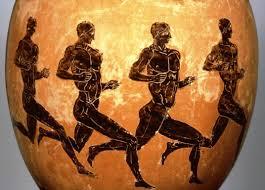
But Paul’s favorite athletic metaphor is that of a footrace. He declared to the Ephesian elders: I do not consider my life any account as dear to myself, so that I may finish my race and the ministry which I received from the Lord Yeshua, to testify solemnly of the Gospel of the grace of God (Acts 20:24). Reminding the Corinthians of the dedicated athlete who competed in the Isthmian games, the apostle wrote: Do you not know that those who run in a race all run, but only one receives the prize? Run in such a way that you may win (First Corinthians 9:24). At the close of his life, Paul could declare: I have finished the race, I have kept the faith (Second Timothy 4:7b).
The previous file (see Bh – Paul’s Response to His Opponents) described Paul’s transformation when he encountered the risen Messiah on the Damascus Road. Then the apostle recited his impressive credentials. However, he then declared that compared to the surpassing value of knowing the Master, those achievements were mere rubbish. Paul exchanged his useless human achievements for the knowledge, righteousness, power, fellowship, and glory of the Lord Yeshua Messiah.
But it seems that some of the believers in Philippi may have mistakenly assumed that, having gained those marvelous benefits, that Paul had reached spiritual perfection (see Perfectionism by B. B. Warfield, P&R Publishing, Phillipsburg, New Jersey, 1931). The Judaizers (see Galatians Ag – Who Were the Judaizers) may also have taught the Philippians that spiritual perfection was attainable through being circumcised and Torah observance. There were also heretics (forerunners of the second-century Gnostics) who taught that spiritual perfection awaited those who attained a certain level of knowledge. To counter such false ideas, Paul quickly added these verses, relating six necessary prerequisites for effective reaching for the heavenly prize of bodily resurrection and the full realization of God’s promises that come with it.143
1. Pursuing the prize requires a proper awareness: Not that I have already obtained this or am already perfect (3:12a CJB). The verb translated perfect (from teleioo) has the sense here of something that is brought to conclusion or fulfills its ultimate goal. The perfect tense of the verb stresses the state or condition of perfection or completion that the bodily resurrection will bring, while the passive voice indicates that it was not Paul who is doing the perfecting, but rather that he is being perfected by someone else (God).144 Now all believers are eternally secure (see the commentary on The Life of Christ Ms – The Eternal Security of the Believer). That spiritual reality cannot be improved upon, but our sanctification (see Ax – Sanctification) can, and must, be. Knowing that we are not now what we should be, and what we will someday be in glory, must not produce apathy, but a zeal for running the race toward the heavenly prize. That is the Ruach’s work in us (Second Corinthians 3:18) and the longing of every regenerated soul.145
So, Paul sprinted toward the prize to which ADONAI had called him in that confrontation on the Damascus Road (see the commentary on Acts Bc – Sha’ul Turns from Murder to the Messiah). Those who are maturing in Messiah will share Paul’s mind-set, not being complacent; but rather, striving to know the Lord more fully and to reflect Him more faithfully. The grace that we have already received invites us to the greater grace ahead. Paul rejects every version of perfection, ancient or modern, that promises relief from the race in exchange for any reward that falls short of the imperishable crown that we shall receive in heaven. Paul refuses to be sidelined short of that goal. Nor will he let his friends at Philippi drop out of the race. He urged them, as he urges us, to keep pace with him all the way to the finish line.146
2. Pursuing the prize requires a maximum effort: This verse is the heart of the passage. In contrast to thinking he had arrived or had been made perfect, Paul said he was pursuing the prize (Greek: dioko, meaning to run or follow after aggressively). The verb translated pursue is the same one he used in 3:6 to recall his persecution of the Messianic Community before he was saved. The result is a subtle wordplay that is impossible to bring into English. In effect, Paul says that he was determined to devote the same sort of intense energy and maximum effort that was once directed towards persecuting believers, to pursuing being made into the likeness of Messiah. Because his ultimate goal was the state of perfection at the resurrection, he continually pursued it in the present to make that final perfection [his] own. In other words, the apostle pictures himself as a runner pursuing a goal placed before him – the state of perfection that will be realized at his resurrection (see the commentary on Revelation Ff – Blessed and Holy are Those Who Have Part in the First Resurrection). However, Paul was only able to pursue this state of perfection because Messiah Yeshua had made him His own (3:12b Greek). The only reason that Paul was able to make perfection his own is that Messiah had first made Paul His own.147
Paul was a prisoner of war, and glad of it. Messiah confronted Rabbi Sha’ul on the Damascus Road (see the commentary on Galatians Ao – God Set Me Apart and Called Me through His Grace) and laid sovereign claim to His enemies’ allegiance. Because Messiah had laid hold of Paul and would never let go, Paul would one day lay hold of the perfection awaiting him at the finish line in heaven, and never let go.148 The picture is that of Messiah pursuing and overtaking the sinner who is running away from Him, making him His own, and then leading him in a new direction to pursue the final goal of perfection.
3. Pursuing the prize requires a focused concentration: Maximum effort without focused concentration is useless. Every athlete knows that runners in a race must fix their eyes ahead of them; those who watch the crowd or their own feet are likely to trip and fall. To make a maximum effort in any athletic endeavor requires the participants to concentrate on a point straight ahead. Paul addresses the Philippians with the gentle, intimate, affectionate brothers and sisters to move their hearts away from the Judaizers and toward him. For the third time Paul adds the disclaimer: For my part, I don’t think of myself as being perfected. Here, the apostle directed his argument at those who were teaching error, and he wanted to make the truth abundantly clear. Despite the claims of the false teachers to the contrary, spiritual perfection is not possible in this life! However, Paul had a laser-focused concentration on the life-long process of sanctification. But how would he accomplish that goal? He responded: This one thing I do: forgetting things which are behind me.149 Paul didn’t keep thinking about the past; he didn’t constantly remind himself of all his past achievements (see Bh – Paul’s Response to His Opponents: Religious credits that do not impress God). He strained forward toward what was ahead of him (3:13 Greek). Straining forward perfectly captures the picture of a runner, with every muscle engaged, drawing on every ounce of energy, in the final all-out sprint to the finish line.
The way Paul runs his race poses heart-searching questions for you and me. If your thought life, daily routine, spending practices, and interpersonal interactions were translated into Paul’s athletic imagery, what would it look like? Are you “running aimlessly?” Is your pace hindered by backward glances toward previous days, or sideways glances at other runners? Since Messiah has captured you in His amazing grace, can you rest on your laurels. Can you direct your aim, imagination, time, energy, and money toward the precious prize that Paul pursues? Then rivet your gaze on the goal, on the prize that he found irresistibly attractive, and run with all the strength and stamina that Messiah can give you!150
4. Pursuing the prize requires a proper motivation: It is a metaphor of a believer’s life that declares: I pursue the goal and receive the heavenly prize for which God, through Messiah Yeshua, is calling us (3:14 Greek). As noted earlier, this idea is the heart of the passage. The present tense I pursue expresses Paul’s continuous effort to attain his prize of being ushered into God’s glorious presence in heaven. As noted above, perfection is not attainable in this life. The finish line is in heaven, where the rewards will be handed out (Matthew 5:12; Luke 6:23; First Corinthians 3:12-15). Like a runner triumphantly pumping his fist in the air as he approaches the finish line, Paul declared at the end of his life: I have fought the good fight, I have finished the race, I have kept the faith; in the future that is laid up for me the crown of righteousness, which the Lord, the righteous Judge, will award to me on that day (Second Timothy 4:7-8). Only in the future would Paul receive the crown of righteousness (Messiah’s righteousness transferred to him); only then, would he receive the prize which he so diligently pursued.151
The goal of the life of a believer is not the most comfortable existence here on this earth. By calling us to Himself in Messiah Yeshua, ADONAI has given us a higher calling, one that aims for nothing less than the fullness in this present evil age will necessarily involve suffering, but such sufferings are not worth comparing with the glory that is to be revealed to us (Romans 8:18). It is our shame that we too often settle for what the world offers to us as satisfying when far greater treasures are ours in Messiah, both in this world and the world to come. When we, as believers, set as our goal the fullest experience of all that YHVH has for us in Messiah, we are truly the richest people on earth.152
5. Pursuing the prize requires a proper recognition: Paul was not in the spiritual race alone; it includes all believers, described here by the phrase: as many of us are perfect (3:15a Greek). The apostle is not speaking of heavenly perfection; that would contradict what he said earlier in 3:12a. That perfection does not come until believers are glorified (see Ax – Sanctification: Ultimate sanctification). Rather, in a play on words, he describes believers as those who are positionally perfect (or justified) in Messiah (see Ax – Sanctification: Positional sanctification). Since Paul is arguing against those who taught that perfection is attainable in this life, his use of the word perfect may be a bit double-edged, with a twinge of sarcasm. Those false teachers were not perfect in either practice or position.
Every true believer must have this same attitude that Paul had (3:15b Greek). Like the apostle, believers must be totally focused on making the maximum effort to pursue the prize of glorification. We know how Messiah thinks because the Bible gives us His mind; therefore, we have the mind of Messiah (First Corinthians 2:16b). When we think biblical, divine thoughts, viewing all of life from the Lord’s perspective, those thoughts will mold our behavior so that we become more like Him.
But Paul was an experienced pastor and knew that not all believers would share his relentlessness focus on pursuing the prize. To them, Paul said: If you have a different attitude in anything, God will also reveal this to you (3:15c Greek). Those who refuse to heed Paul’s message will hear that same message from ADONAI. He will correct them through His Word, His Spirit, or through His discipline (see Hebrews Cz – God Disciplines His Children). God will do whatever it takes to make sure that believers recognize their need to pursue the prize of being conformed to the image of His Son (Romans 8:29a). He will also provide the resources we need to do that very thing: By His divine power, God has given us everything we need for a godly life through our knowledge of Him who called us by His own glory and goodness (Second Peter 1:3).
6. Pursuing the prize requires a proper consistency: One more thing, having developed a proper awareness, effort, concentration, motivation, and recognition, believers must consistently live by the same standard to which we have attained (3:16 NASB). In other words, believers must stay on the same spiritual path that they had been following. To use the metaphor of a race, they needed to keep running in their lane. Four divinely provided resources help us consistently pursue the prize as we sprint to the finish line of life. First is the Word of God. Peter wrote: Like newborn babies, long for the pure milk of the Word, so that by it you may grow with respect to salvation (First Peter 2:2). Second is prayer. Paul prayed that the Corinthians would be made complete (Second Corinthians 13:9). Third is following a godly example. Paul encouraged the Corinthians: Be imitators of me (First Corinthians 4:16; cf. First Corinthians 11:1; Philippians 3:17; First Thessalonians 1:6; Second Thessalonians 3:7 and 9; First Timothy 4:12; Hebrews 13:7; First Peter 5:3). Finally, ADONAI uses trials to mold us into the image of Yeshua Messiah: After you have suffered for a little while, the God of all grace, who called you to His eternal glory in Messiah, will Himself perfect, confirm, strengthen, and establish you (First Peter 5:10; cf. James 1:2-4).153 Salvation is by grace alone, through faith alone, in Messiah alone, so that ADONAI alone receives all the glory.
Dear heavenly Father, praise You for Your Word and Your wisdom to discern that I am far from perfect in this life. Lord, help me run the race of sanctification, keeping my eyes on the prize of glorification when I am finally with You in heaven. Help me be consistent in my pursuit of holiness. Then, and only then, will I be perfect as You are, minus your deity. In Messiah Yeshua’s holy Name and power of His resurrection. Amen
Leave A Comment