





The Conspiracy of Ga’al
9: 26-41
The conspiracy of Ga’al DIG: Why did Ga’al want to fight Abimelech? Where did Abimelech live? Where did Ga’al live? Why did Ga’al emphasize Abimelech’s paternal heritage rather than his maternal heritage? What was Zebul’s plan to defeat the rebellion of Ga’al? Why didn’t Ga’al stand a chance in the battle?
REFLECT: When presented with a problem, do you wait around until action is unavoidable or are you proactive? How do you show your loyalty to YHVH? Because today’s culture doesn’t encourage loyalty to either family or to the Lord, how can you protect yourself against the wiles of the devil?
God gave the Israelites the king they deserved, and He gave Abimelech the people he deserved.
ADONAI created a rift between Abimelech and the citizens of Shechem (to see link click Bk – The Destruction of Shechem), so much so that the Shechemites began to work against the king. They began to rob the caravans that passed by the city on the nearby trade routes. Abimelech was living at Arumah (9:41), and the activities of those bandits were robbing him of both money and reputation. Foreign merchants would hear about the danger and take a different trade route. But even more, the word would get out that the king couldn’t even control his subjects or protect his kingdom. Into this situation stepped a newcomer, Ga’al, a man who knew a good opportunity when he saw it.238
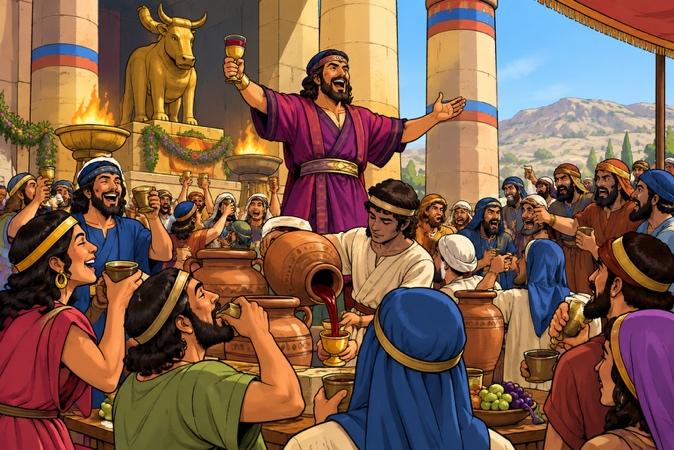
Day one: The Conspiracy of Ga’al (9:26-29): Abimelech appears to have taken no action against the marauding bands which were terrorizing the countryside. It was not until there was a direct challenge to his authority that he was stirred to action. Now Ga’al, (Hebrew: meaning to vomit) son of Ebed, moved his relatives into Shechem, and its citizens put their trust in him (9:26 NIV). He appears out of nowhere, but soon will claim to be a descendant of Hamor, the founder of Shechem (Genesis 33:19 and 34:2). The return with Ga’al’s relatives was ominous because they are bound to him by blood. Nothing is known of Ga’al apart from the information given in this chapter. The citizens of Shechem were apparently easily swayed and Ga’al gained their confidence by his guile, just as Abimelech had previously done (see Bi – The Conspiracy of Abimelech).239
At the time of the grape harvest (June-July) the Shechemites held a pagan religious festival comparable to, but earlier than, the Israelite festival of Sukkot (see the commentary on Leviticus Eg – Hag Sukkot) which was in September-October (Deuteronomy 16:13-15). Under the Canaanite influence, the pagan festival had replaced Sukkot as the great summer festival until the reformations of Hezekiah and Josiah (Second Kings 23:21ff and Second Chronicles 30:1ff and 35:1ff). This gave Ga’al and the rulers of Shechem the opportunity to meet and plan their next move under the guise of holding a religious festival. The people went out into the fields, harvested their grapes, and held the annual festival at Shechem that was held in the temple of the local god, Ba’al-Berith (9:27a Hebrew).240 Grapes were gathered and trodden out in the winepresses to produce wine during this season, which became a time of merry-making, over-indulgence, and immorality, hardly compatible with a holy feast. The scene of Shechem taken over by a mob of drunkards contrasted sharply with the picture of well-being Abimelech had promised the city (9:26).241
And everyone began cursing Abimelech. At the height of the celebration Ga’al took the opportunity to address the crowd. “Who is Abimelech?” Ga’al boasted. “He’s not a true son of Shechem, so why should we be his servants? Then he slyly traced Abimelech’s genealogy through his father, not his Shechemite mother, saying: he’s merely the son of Gideon, and this Zebul is merely his henchman. Next, he appealed to them to serve the true sons of Hamor, the founder of Shechem (see Genesis Ib – The Rape of Dinah). Why should we serve this half-breed Abimelech (9:27b-28 NLT)? Finally, having undermined their confidence in Abimelech and having made his emotional appeal, he hinted how different things would be if he were made their leader.242 Ga’al was living in Shechem while Abimelech was living in Arumah. The people could tell Ga’al their problems, and he would give them what they needed, so why would they go to Arumah for help? He said: If I were in charge here, I would get rid of Abimelech. I would say to him, “Get some soldiers, and come out and fight” (9:29 NLT). He was confident that the people would follow him and he could get rid of Abimelech. So with empty bravado he tossed out his challenge to the absent king. The tone and the methods of Ga’al were similar to those of Absalom (see the Life of David Do – Absalom’s Conspiracy).243
The report to Abimelech (9:30-33): Abimelech’s local lackey in Shechem was Zebul, the governor of the city, who wasted no time getting the information about Ga’al to the king. When Zebul heard what Ga’al said, he was furious. He sent messengers to Abimelech in Arumah, telling him, “Ga’al son of Ebed and his brothers have come to live in Shechem, and now they are inciting the city against you.” This suggests that not everyone was a part of the drunken mob and Abimelech continued to have a measure of support. But the drift toward a civil war was brewing. Not only did Zebul inform Abimelech about the rebellion, but he also gave the king a strategy for dealing with the boastful intruder. Come by night with an army and hide out in the fields. In the morning, as soon as it is daylight, attack the city. No doubt reasoning that it would be better to take the initiative rather than to allow Ga’al time to consolidate his position.244 When Ga’al and those who are with him come out against you, you can do with them as you wish (9:30-33 NLT). Zebul would be working for the king within Shechem, and the king would gather his troops outside the city.
Day Two: The defeat of Ga’al (9:34-41): Abimelech’s response was quick. He and all his men went by night and split into four companies, stationing themselves around Shechem. By about 3:00am, I imagine, Abimelech had his four companies of troops waiting in position around Shechem. Zebul played his role with considerable skill. Now Ga’al was standing at the city gate just as Abimelech and his army came out of hiding (9:34-35 NLT). When Ga’al saw them, he said to Zebul, “Look, there are people coming down from the hilltops!” But Zebul made a disarming comment trying to avoid the obvious: It’s just the shadows on the hills that look like men. In a little while, Ga’al squinted and exclaimed: No, those are men coming down from the hills. And another group is coming down the road past the Diviners’ Oak. Then Zebul, with his trump card ready, turned to him and taunted: Where is your big mouth now? He must have practiced that line all night. Wasn’t that what you said, “Who is Abimelech, and why should we be his servants?” The men you mocked are right outside the city, leaving Ga’al no alternative but to fight or lose face!245 So Ga’al led the men of Shechem out to fight Abimelech, but they were woefully unprepared. Abimelech chased Ga’al, and the big mouth fled the battlefield. And many fell wounded, up to the entrance of the city gate (9:36-40 NLT).
Abimelech settled (Hebrew: vaiyseshev) in Arumah, and Zebul drove out Ga’al and his relatives, so that they couldn’t live in Shechem (9:41 Hebrew). Very few details are given about the battle itself, but the very brevity of the account is telling. It was really no contest at all. Ga’al realized all too late that he had been outmaneuvered and beat a hasty retreat, only to lose most of his men in the process. Ga’al himself and his relatives – the instigators of the rebellion in the first place – made it back to Shechem, but were unable to remain there or to cause any further trouble. They left there for parts unknown. Zebul, now in full control of the city, drove them out, reversing their arrival there back in 9:26 and bringing closure, apparently, to the whole Ga’al episode. We never hear from Ga’al again.
However, the statement that Abimelech settled in Arumah rather than Shechem itself is puzzling, and prevents the closure of the story from being total. Arumah was only five miles from Shechem. Abimelech had already left Shechem before the final clash with Ga’al, and may have even been in Arumah. But Shechem was by far the most significant city in the area, and the place where Abimelech had first made his bid for power and made king. To withdraw from it temporarily for tactical reasons is understandable, but to settle elsewhere is odd, to say the least. It suggests that something still remained to be resolved between Abimelech and the people of Shechem. This tension sets us up for the sequel to the Ga’al episode that follows (see Bm – Abimelech Destroys Shechem).246
After the death of Gideon, the Israelites didn’t show covenant loyalty or faithfulness to ADONAI (8:33). They demonstrated disregard for God’s covenant and for Gideon and his descendants whom Ha’Shem raised up on their behalf. Humanity’s tendency is to quickly forget all the good that others (human and divine) may do for them. When the Israelites made Ba’al-Berith (9:46) their god, breaking their covenant with YHVH to enter into a covenant with a Canaanite deity, they became spiritually Canaanite. In such a situation, with the enemy being internal rather than external, ADONAI withdrew His gracious favor. God gave the Israelites the king they deserved, and He gave Abimelech the people he deserved. What characterized the Israelites in general characterized their leader, Abimelech, who showed no regard for their loyalty and certainly none for YHVH. Certainly the culture that we live today doesn’t encourage loyalty to either family or to the Lord.247
Dear Heavenly Father, praise You: For nothing will be impossible with God (Luke 1:37). Ga’al’s followers, proud in heart, were brought low. Soon proud Abimelech and his proud followers would be brought low by You. They had both demonstrated disregard for Your covenant and for Gideon and his descendants whom You raised up. When men are proud and show no regard for You and Your covenant, they had better watch out for You do see and at the right time You will step into destroy them. You are a Mighty God showing love, mercy, righteousness and justice. Then Adonai passed before him, and proclaimed, “Adonai, Adonai, the compassionate and gracious God, slow to anger, and abundant in lovingkindness and truth, showing mercy to a thousand generations, forgiving iniquity and transgression and sin, yet by no means leaving the guilty unpunished, but bringing the iniquity of the fathers upon the children, and upon the children’s children, to the third and fourth generation (Exodus 34:6-7). Father, You have almighty power, including to take out the ruler of any city or country. We worship You. In Messiah Yeshua’s holy Name and power of His resurrection. Amen
Leave A Comment