

Co – The Great Banquet of Belshazzar and the Fall of Babylon 5: 1-31

The Great Banquet of Belshazzar and the Fall of Babylon
5: 1-31
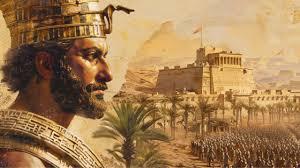
Dani’el is one of the most significant books in the Bible in terms of the chronology of future events because it contains essential information concerning the key figures and time sequences of the far eschatological future. It is difficult to understand prophetic chronology without consulting the book of Dani’el. There are visions in Dani’el that detail what YHVH would do beginning in the sixth century BC until the Messianic Kingdom. Thus, Dani’el can be seen as the foundation for the key themes of biblical prophecy. Dani’el did not attempt to write history when he wrote his book; rather, he was developing a theme.248 The banquet described in the introductory verses of Chapter 5 took place in 539 BC. Twenty-three years had passed since the events detailed in Dani’el 4 (to see link click BtThe Dream of the Great Tree). Dani’el’s first vision in Chapter 7 took place fourteen years earlier in 553 BC, and his vision of Chapter 8 took place in 551 BC. By the time of the great banquet, Dani’el had been in Babylon for at least sixty-six years, and had already experienced additional information regarding the times of the Gentiles (see AoThe Times of the Gentiles) and the transference of power from the Babylonian Empire to the Medo-Persian Empire. Therefore, the events of Chapter 5 would not have taken Dani’el by surprise. Here is an overview of Dani’el’s prophecies in chronological order:

602 BC prophecy of the Great Statue (2:1-45) when Dani’el was 18.

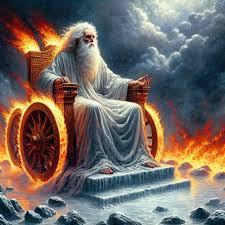
553 BC prophecy of the Four Beasts and the Ancient of Days (7:1-28) when Danie’l was 67.

551 BC prophecy of the Ram and Male Goat (8:1-27) when Dani’el was 69.

539 BC prophecy of the Fall of Babylon (5:1-31) when Dani’el was 81.

539 BC prophecy of the Seventy-Weeks (9:1-27) when Dani’el was 81.

536 BC prophecy of the Future Nations (11:2-45) when Dani’el was 84.

536 BC prophecy of the Future of Isra’el (12:1-13) when Dani’el was 84.

Dani’el 5 begins with the words King Belshazzar, and we are somewhat puzzled to find that the writer has suddenly dropped Belshazzar into our laps. We have just come from two chapters concerning Dani’el’s vision of four beasts (7:1-28), and his vision of the ram and male goat (8:1-17). Unexpectedly, we are staring Belshazzar in the face. Who is he? Where did he come from? We need to play some historical catch-up.

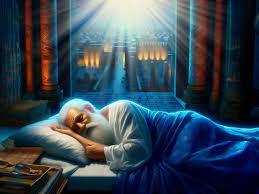
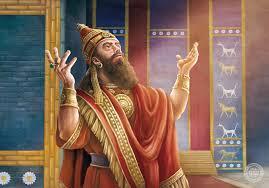
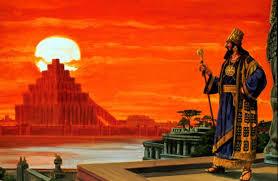
Nebuchadnezzar  died in 562 BC, after a reign of forty-three years. However, in less than another twenty-five years all was lost. Evil-Merodach (561-560 BC), Nebuchadnezzar’s son, followed his father on the throne. But he was apparently assassinated by his brother-in-law Neriglissar, who had a tenure of about four years and was succeeded by his son, Labashi-Marduk. Unfortunately for him, he was killed within a month and one of the conspirators, Nabonidus, became king (555-539 BC). It seems that Nabonidus didn’t have designs on the throne himself, but may have been placed there as a “compromise candidate” by the conspirators. Some think that Belshazzar, Nabonidus’ son, was the real mover behind the conspirators. In any case, as far as the Babylonians were concerned, Nabonidus had a religious “problem.” He was a passionate disciple of the moon god Sin, to such a degree that he alarmed the Babylonian clergy, for he seemed intent on replacing the god Marduk from his supremacy among the Babylonian pantheon. This may have led to a “relocation program” for Nabonidus, because he spent the next ten years at Tayma, an oasis in the North Arabian desert, five-hundred miles from Babylon. His son, Belshazzar, acted as co regent with his father delegating control of the royal affairs to him, and being very pro-Marduk, kept the Babylonian clergy from revolting. Which is why we are suddenly staring Belshazzar in the face at Dani’el 5:1.249 He ruled until Babylon fell to Cyrus the Great in 539 BC. Because he was the city’s de facto king, he is considered the last ruler of Babylon.

This status fulfills a prophecy made by Jeremiah. Now I will give your countries to King Nebuchadnezzar of Babylon, who is my servant. I have put everything, even the wild animals, under his control. All the nations will serve him, his son, and his grandson until his time is up. Then many nations and great kings will conquer and rule over Babylon (Jeremiah 27:6-7). Jeremiah prophesied that Nebuchadnezzar’s family line would end with his grandson. Belshazzar was that grandson. His name means Bel Protect the King. It is very close to Dani’el’s Babylonian name, Belteshazzar, which means May Bel Protect His Life.250

It is not easy to reconstruct the events surrounding the fall of Babylon. The so-called Nabonidus Chronicle (preserved on a single clay tablet now kept at the British Museum in London) is incomplete, but it tells of the return of Nabonidus to Babylon to perform a new year festival. The date is missing, but “seventeenth year” is assumed, for the armies of Darius, were closing in. Darius was made king (9:1-2), called king (6:8), and exercised the authority of a king (6:9). He is called king twenty-eight times in Chapter 6. So the evidence suggests that Darius the Mede was none other than Cyrus king of Persia (see AgDarius and Cyrus).

The month Tashritu (the seventh month) is named in connection with the attack of Darius on the Babylonian army at Opis on the Tigris River and the revolt of the city and its massacre. “The fifteenth day Sippar was seized without a fight. Nabonidus fled, (but was captured by Darius). On the sixteenth day, the army of Darius entered Babylon without battle.” Presumably this was the event referred to in Dani’el 5:30, though it was during the next month that Darius entered the city in person on November 2, 539 BC. Thus, when the banquet began, Babylon was under siege.

In the light of this background, Belshazzar’s banquet was sheer chutzpah, the last fling of a terrified ruler unsuccessfully trying to drown his fears in alcohol. Little wonder that panic seized him and made a fool of him as soon as he realized his dangerous position. The fact that his father abandoned the capital and left him to face the fierce enemy alone arouses a certain amount of sympathy for this weak and blasphemous “king.”251

This chapter, verses 1 through 31 can be broken down in chiastic fashion, resulting in a mirror effect as the ideas are “reflected” back in the passage: A to A, B to B, C to C, with D being the turning point of the chiasm where the queen mother reintroduces Dani’el, since he was apparently a forgotten figure in the royal court.

A. Belshazzar’s Great Banquet – 5:1-4 (Cp)

B. The Handwriting on the Wall – 5:5-9 (Cq)

C. The Advice of the Queen Mother – 5:10-12 (Cr)

B. Dani’el Interpreted the Handwriting on the Wall – 5:13-29 (Cs)

A. Belshazzar was Killed – 5:30-31 (Ct)

2025-07-30T22:14:23+00:000 Comments

Cn – The Significance of Dani’el Chapter 8 to the Times of the Gentiles

The Significance of Dani’el Chapter 8
to the Times of the Gentiles

Luke describes this period of time when he wrote: They will fall by the sword and will be taken as prisoners to all the nations. Jerusalem will be trampled on by the Gentiles until the times of the Gentiles are fulfilled (to see link click Ao The Times of the Gentiles). This can best be defined as that long period of time from the Babylonian Captivity (see  Jeremiah GuSeventy Years of Imperial Babylonian Rule) to the Second Coming of Messiah, during which time the Gentiles have complete dominance over Jerusalem. This does not rule out temporary Jewish control of the City until the Second Coming. Such temporary control was exercised during the Maccabbean Period (164-163 BC), the First Jewish Revolt against Rome in 66 AD, and the Second Jewish Revolt (the Bar Kochba Revolt) against Rome (132-135 AD), and since 1967 as a result of the Six Day War. This, too, was temporary, since Gentiles will trample down the holy City for at least another 1,260 days (see the commentary on Revelation BxThe Tribulation Temple). Therefore, any Jewish takeover of the City of Jerusalem before the Second Coming must be viewed as temporary and does not mean that the times of the Gentiles have ended. The Times of the Gentiles can only end when the Gentiles no longer trample down the City of Jerusalem.246

Chapter 8 makes an important contribution to the main theme of the book, the times of the Gentiles, in that it focuses on the aspect of Jewish persecution. In Chapters 2-7, Dani’el dealt extensively with the Gentile empires that would rise and fall during the times of the Gentiles. Because he didn’t focus on how the Jews would fare during this period, he kept the text in Aramaic (see AcIntroduction of Dani’el from a Messianic Jewish Perspective: Languages). But as soon as he began discussing how that period of time would affect the Jews, he switched back to Hebrew. Chapter 8 and the remainder of the book show that the times of the Gentiles will continue to be a period of persecution for the Jews.247

2025-07-11T13:05:30+00:000 Comments

Cm – How to Wait for God 8: 27

How to Wait for God
8: 27

Dani’el’s vision had a profound impact on him, saying: I was worn out and lay sick for several days. Then I got up and went about the king’s business; but I was overwhelmed by the vision and still couldn’t understand it.

Dani’el 8 is a vision about waiting. It is a vision of an end that is not imminent, at least not for Dani’el and not for many generations of readers since then. But the very act of waiting is given meaning by the certainty that at the right time, the time of God’s choosing, Messiah will come on the clouds to bring history to its conclusion (to see link click Ao The Times of the Gentiles). Gentile believers have a variety of expectations of when that return will take place. Some teach that we will have to go through the Great Tribulation, some say Yeshua will come back in the middle of the Great Tribulation, while others think it won’t be until after the time of Jacob’s trouble. But when we approach the Scriptures from a Messianic perspective, and look at God’s appointed times, it becomes clear to us.

Each of the festivals of ADONAI point to Yeshua Messiah. The first four festivals point to His First Coming. The Passover points to Messiah’s death (see the commentary on Leviticus DyPesach); Unleavened Bread points to the sinlessness of His sacrifice (see Leviticus DzHag ha’Matzot); the feast of Firstfruits points to His resurrection (see Leviticus EaRasheet); and Pentecost points to the birth of His Church (see Leviticus EcHag Shavu’ot). Then there is a four-month interval in Leviticus 23:22 that pictures a time of labor in the fields in preparation for the final harvest of the summer and before the fall harvest. This verse is not related to any feast, but pictures the Dispensation of Grace that we now live (see my commentary on Hebrews BpThe Dispensation of Grace).

The last three festivals in the second cycle of festivals also come close together, even closer than those of the first cycle of feasts. In fact, they all come within two weeks of each other. The last three feasts of the second cycle are to be fulfilled by the program of the Second Coming. As Jesus says Himself at the end of the Bible: Yes, I am coming quickly (Revelation 22:20). Amen. Come, Lord Yeshua. The festival of Trumpets points to the Rapture (see Leviticus EeRosh ha’Shanah); then, after the Rapture, come the Day of Atonement (see Leviticus EfYom Kippur), which points to the Great Tribulation; then, after the last three days of the Great Tribulation, the Lord returns (Hosea 6:1-3); finally, we celebrate the festival of Booths (see Leviticus Eg – Sukkot). Therefore, because Rosh ha’Shanah comes BEFORE Yom Kippur, we can be confident that we will not have to endure the wrath of the Great Tribulation. We will be in heaven with the Lord when that happens.

Dani’el tells us that he could not understand the vision, that he was overpowered and devastated by the vision, and that at the end of a period of sickness for several days he got up and went about the king’s business. Each of these three aspects of Dani’el’s response to his vision should help us shape our waiting for the times of Gentiles to end.

Living with partial understanding: Dani’el tells us that he could not understand the vision. This statement might not seem very surprising. After all, the historical events described in the dream were many years in the future in Dani’el’s day, and interpreters still struggle to comprehend the intricacies of what he saw. Certainly a lack of comprehension is what most readers experience when they first encounter these visions.

However, when we think more deeply about it, it should strike us as noteworthy that Dani’el is unable to comprehend the meaning of his own vision. This is the same Dani’el who alone was able to interpret Nebuchadnezzar’s dreams in Dani’el 2 and 4, of whom Nebuchadnezzar said: I know that the spirit of the gods [or God] is in you, and no mystery is too difficult for you (4:9a). In Chapter 5, when no one else could read the handwriting on the wall, the queen mother said confidently of Dani’el, “He was found to have a keen mind and knowledge and understanding, and also the ability to interpret dreams, explain riddles and solve difficult problems. Call for Dani’el, and he will tell you what the writing means (5:12). Dani’el read and interpreted without difficulty the mysterious writing that had troubled Belshazzar and his nobles. If anyone could understand those apocalyptic visions, surely it would have been Dani’el!

Yet, in these latter chapters of Dani’el, we are told twice that he was unable to understand the visions (8:27 and 12:8). This is especially remarkable since the visions and their interpretations were explicitly given to Dani’el to understand (7:16-17, 8:15, 9:22, and 10:4). Indeed, we are told that what distinguishes the wicked from the wise is precisely the fact that none of the wicked will understand, but those who are wise will understand (12:10). Since Dani’el is the wisest of the wise, how could he not have understood them?

So which is it? Did Dani’el understand the visions or did he not understand them? I think the answer is “both.” Clearly, there were aspects of the visions that he understood; yet at the same time, no matter how hard he tried, there were also aspects of the visions that he didn’t understand. As Peter put it: The prophets, who prophesied about this gift of deliverance that was meant for you, pondered and inquired diligently about it. They were trying to find out the time and circumstances to which the Spirit of the Messiah in them was referring in predicting the Messiah’s sufferings and the glorious things to follow. It was revealed to them that their service when they spoke about these things was not for their own benefit, but for yours. And these same things have now been proclaimed to you by those who communicated the Good News to you through the Ruach Ha’Kodesh sent from heaven. Even angels long to look into these things” (1 Peter 1:10-12)! As Peter suggests, some of those things that were mysterious to Dani’el are now clearer to us. However, at the same time, there are aspects of his visions that we should expect to remain mysterious to us still. If, as Peter says, some of these things are mysterious even to angels, then perhaps it should not be surprising if they never become clear to ordinary mortals like us.

This balance between what may confidently be understood and what must remain for now somewhat hazy is important to maintain. There are some things that ADONAI has revealed clearly in His Word, and other things that remain concealed from us. Things which are hidden belong to ADONAI our God. But the things that have been revealed belong to us and our children forever, so that we observe all of His Word (Deuteronomy 29:29). We should take comfort in God’s sure and certain control of each day of history, all the way to His return. Yet, we should be properly humble in our ability to predict when that will happen.

Overwhelmed by the coming judgment: Next, Dani’el said that he was overwhelmed by the vision for several days. This is similar to his response to the other visions he received (7:15 and 28, 10:16). Why did he feel so overwhelmed by the visions he received? It wasn’t simply by their breathtaking scope and dizzying scale; rather, it was their message of coming judgment and destruction on God’s own people by Antiochus Epiphanes in the near historical future and by the antichrist in the far eschatological future. The prophet identified with his people as well as with ADONAI, and even though the judgment that Dani’el saw lay many years in the future, he could not simply pronounce it upon them from a comfortable distance. On the contrary, he physically identified with his people in their future suffering so much so, that it actually made him sick.

The prophet’s identification with those for whom his message was intended is an important model for us as we wait for the Messiah’s return. In view of our expectation of the Second Coming, it can be easy for us to become isolated from the society around us. In fact, the more convinced we are of the imminence of our Lord’s return, the more isolated we become. Our friends become a “holy huddle,” excluding the lost. But Dani’el calls us not merely to condemn the lost world around us, but to be personally devastated by the prospect that they may spend all eternity in hell. Compassion for lost souls demands nothing less from us. If we have Dani’el’s heart for his people, we can never be content with our own salvation. Instead, we need to have a passion that our unsaved family members, our neighbors, our friends, the prodigals and the wanderers, and indeed the whole world should come to know and worship the God of Abraham, Isaac, and Jacob, the King of kings and the Lord of lords.

Busy about the King’s business: Finally, Dani’el wasn’t simply devastated at the prospect of the coming judgment of his people. At the end of his time of sickness, he got up and went about the king’s business. This is a remarkable statement, given the fact that the king at the time was Belshazzar. In spite of the wickedness of the civil authorities of the day, Dani’el did not isolate himself from the culture around him, but continued faithfully in his service to the pagan Babylonian society. His vision that the future belonged to the Kingdom of God (see CfThe Kingdom of Messiah) did not send him off to hide in a corner, but continued to drive him out in the service of his community.

Dani’el’s quiet commitment to do the work of the king, even in a pagan culture, shows the value of the work that we must do for our King, while we wait (Matthew 25:14-30). Here on earth we find ourselves perpetually in exile. This is not our ultimate home (Hebrews 13:14-16); nonetheless, this is the culture in which God has placed us, so that we can be light and salt in a rotting, dark world (Matthew 5:13-16). Perhaps we should recognize that even as Dani’el served his earthly master, King Belshazzar, he understood that at the same time he was about the business of his heavenly Master, ADONAI Himself. It is no coincidence that having warned His apostles that the day and hour of His return were unknown, Yeshua went on to tell a parable about the master who went away for a long time and then returned unexpectedly, only to find his servants slack in their duties (Matthew 24:45-51). We need to be busy about the King’s business, which means serving our culture with all the gifts and abilities that God has given us.245

Dear heavenly Father, praise you that you are so infinitinally wise and that your timing for events is always perfect! Waiting for humans often causes frustration and impatience; but that is not how you feel. You see the end from the beginning, you see things that are still future to humans, as if they have already happened. Becoming mature and growing in faith is very important in the life of a believer. Waiting is a tool you use (Romans 5:4) to perfect me to become more mature in You. These trials are so that the true metal of your faith (far more valuable than gold, which perishes though refined by fire) may come to light in praise and glory and honor at the revelation of Messiah Yeshua (1 Peter 1:7). What comfort it is to know that waiting is not because of Your inability, for You are always totally capable and always sovereign; waiting is due to Your wisdom to better prepare me for the circumstances that You have for me in the future.

You know the future and You give me many choices, including learning to rely closely on You while waiting. Then I will be fully equipped and able to handle whatever lies ahead of me. You use Your Word to teach and to train me. So that the person belonging to God may be capable, fully equipped for every good deed (Second Timothy 3:17). Help me to wait patiently for Your perfect timing and grow in maturity. Now may the God of shalom . . . make you complete in every good thing to do His will, accomplishing in us what is pleasing in His sight, through Messiah Yeshua. To Him be the glory forever and ever (Hebrews 13:20a-21). In Messiah Yeshua’s holy Name and power of His resurrection. Amen

2025-07-11T12:56:01+00:000 Comments

Cl – Living in the Valley of Darkness 8: 15-26

Living in the Valley of Darkness
8: 15-26

Living in the valley of darkness DIG: How was Antiochus a type of the antichrist? In what ways is Gabri’el an important angel? Who was the two-horned ram? Who was the male goat? What does the ram and the goat have to do with each other? Why will the Tribulation be like living in the valley of darkness for unbelievers?

REFLECT: If Dani’el’s response to the threats at the end of the world was grim, what do you think our response should be? All of us have at one time or another suffered under the attack of the evil one. How do you handle living in the valley of darkness? Where do you find comfort? How do you get the devil to flee from you (James 4:7)?

Even though I walk through the valley of darkness, I will fear no evil (Psalm 23:4a adapted).

Since Dani’el did not understand the vision of the ram, the male goat, and the small horn (to see link click CkThe Ram and the Male Goat), he received the interpretation from the angel Gabri’el. Dani’el now reports his second vision, and once more animals are employed to symbolize empires. In Chapter 7 ADONAI had given a preview of world history with an emphasis on the end times, especially the evil deeds of the antichrist. But God’s people needed to be warned of another crisis that would come in less than four hundred years after Dani’el’s death, the persecutions of a madman named Antiochus IV Epiphanes (175-165 BC). His reign would be one of the most horrible periods in history for the Jews. It would only last for a few years, but God knew that for those extremely dark days, His people would need a supernatural revelation to encourage them as they encountered the face of evil.237

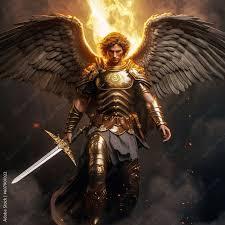
The Appearance of Gabriel (8:15-18): If Dani’el returned to a state of consciousness at all, he was soon sent back in a visionary state, and saw before him a man-like figure who spoke with a human voice. While Dani’el was watching the vision and trying to understand it, there before him stood one who appeared to be a man (8:15). There are several good reasons to believe that this unknown creature standing over the Ulai Canal was actually the Archangel Micha’el. First, Angels in the Bible always appear as young men. Second, Micha’el and Gabri’el are associated together later in the book (10:13, 21, and 12:1). Third, as the archangel, Micha’el has authority to give orders to other angels. And I heard Micha’el say to Gabri’el, tell this man the meaning of the vision (8:16). Gabri’el is an important angel. In the B’rit Chadashah he was chosen to announce to Zacharias that he would be the father of John the Baptist (see The Life of Christ AkThe Birth of John the Baptist Foretold) and to Mary that she would bear the Messiah (see The Life of Christ AlThe Birth of Jesus Foretold to Mary). As Gabri’el approached Dani’el, the aged prophet was so overwhelmed by the spiritual power that stood before him, he fell on his face as Ezeki’el had done in his visions (Ezeki’el 1:28, 3:23, and 44:4). As Gabri’el came near the place where Dani’el was standing, he was terrified and fell down prostrate, stunned with awe and dread (8:17a).238

Then Gabri’el spoke to him, saying: Son of man, understand that the vision concerns the time of the end. Yet, if this vision describes Antiochus IV Epiphanes, how can it speak of “the end?” This is a general prophetic expression that means “the end of a specific prophecy.” In the present case, the end means the end of Antiochus.239 While he was speaking to me, I fainted and fell on my face. Abraham experienced something similar in Genesis 15:12. When Dani’el was laying on the ground, knocked out by fear, Gabri’el touched him and helped him stand up straight. Then Gabri’el touched Dani’el and raised him to his feet (8:17b-19).

The interpretation of the ram (8:20): The two-horned ram that you saw represents the kings of Media and Persia. The two horns represent the Medes and the Persians. Yet they belonged to the same animal. This fact emphasizes the unity of the Medo-Persian Empire: one bear, two sides (see CcThe Kingdoms of This World: The second beast), one ram, two horns, one empire composed of two kingdoms.

The interpretation of the male goat (8:21-22): The shaggy goat is the king of Greece, and the large horn between its eyes is the first king. The four horns that replaced the one that was broken off represent four kingdoms that will emerge from his nation but will not have the same power. Dani’el describes a king who would conquer the Medo-Persian Empire. This was an historical event that took place several centuries after Dani’el lived. The small horn of Chapter 8 springs from the division of the Greek Empire of Alexander the Great. We know him as Antiochus Epiphanes. He was the ruler who sought to show his contempt for the Jews by going to the Temple and slaughtering a pig, putting its blood on the altar.

The interpretation of time (8:19): Gabri’el said: I am going to tell you what will happen later in the time of wrath, because the vision concerns the end of the appointed time of wrath. His oppression of the Jews was directly predicted in 8:9-14. An angel had asked: How long will it take for the vision to be fulfilled – the vision concerning the daily sacrifice, the rebellion that causes desolation, the surrender of the Sanctuary and the trampling underfoot of ADONAI’s people?” And the answer was: It will take 2,300 evenings and mornings; then the Sanctuary will be properly restored (8:13-14). Therefore, the duration of that time of wrath was prophetically allotted to Antiochus Epiphanes it was 2,300 whole days.

Antiochus Epiphanes (8:23-25): These verses are the heart of the vision and the reason for the revelation to Dani’el. ADONAI disclosed this historical summary to the prophet to prepare the Jewish people for the coming crisis – Antiochus’ persecution. Jewish worship and lifestyle stood in the way of his policy of Hellenization. It was in the latter part of their reign when Antiochus would rise to power. This refers to the period near the end of Greek rule when the four kings who succeeded Alexander the Great carved up his empire into four kingdoms. Additionally, his rise to power was because of rebellion (8:12), when rebels had become completely wicked (8:23a). This may allude to the sins of the Jewish people themselves, when reaching its climax, brought about divine judgment in the form of Antiochus’ persecutions. The books of 1 and 2 Maccabees record many in Isra’el who were not faithful to ADONAI and even adopted the idolatrous Greek religion (1 Maccabees 1:11-15 and 43). Those sins would have brought about the discipline of Ha’Shem in order to purify the nation.240

Antiochus is described as a fierce-looking king and a master of intrigue, who would deal harshly with those who oppose him (8:23b). One of his first acts was to drive out the high priest Onias and replace him with Jason, a supporter of the Greeks. Jason was replaced by Menelaus, who bought the high priesthood. Believing a rumor that Antiochus had died, Jason attacked the holy City only to learn that Antiochus was very much alive. The angry king attacked Jerusalem.241 Raging like a wild animal, he sent an army of twenty thousand men under Apollonius to level Tziyon. He ordered his soldiers to cut down without mercy those whom they met, and to slay those who took refuge in their houses. They entered the City on the Sabbath and there was a massacre of young and old, a killing of women and children, a slaughter of virgins and infants. In the space of three days, eighty-thousand were lost, forty thousand meeting a violent death, and the same number being sold into slavery (2 Maccabees 5:11-14). For the Jews, it was like living in the valley of darkness.

Antiochus began to rule a rather weak kingdom in 175 BC, but attained great power through military conquests. He will become very strong; but not by his own power, but only by the power of Satan, the prince of darkness. Through his numerous wars with Egypt and other nations, and his persecution of the Jews, Antiochus will cause astounding devastation and will succeed in whatever he does. He will destroy the mighty men, military and political of other countries who were killed by Antiochus, and the righteous of the TaNaKh who would not follow the command to accept his Greek gods (8:24). Consequently, for 2,300 days Antiochus appeared to be invincible.242

Through his shrewdness he will cause deceit to succeed and will consider himself superior. He will rise to power by promising false security and will destroy many, and take his stand against the Prince of princes, that is against God Himself. But such arrogance can only lead to one end, he will be destroyed, but not by human power (8:25). The ultimate power behind the Maccabean freedom fighters was Ha’Shem Himself, who allowed them to restore the Temple to its former function as the center for worship of the true and living God. His House was more than a building; it was a symbol of His presence with His people, hence a source of life and hope. Its desecration at the hands of Antiochus was an assault against ADONAI and a cause for despair among the righteous of the TaNaKh. But the restoration of the Temple meant new life, the offering of the sacrifices, and the possibility of fellowship with God once again.243 But it did not end well for Antiochus Epiphanes, for in the same year that he desecrated the Temple, he died from a divinely-inflicted disease!

In the final analysis, it may be concluded that there is a dual reference in this striking prophecy. It is not only speaking of Antiochus in his desolation and desecration of the Temple; it is also looking forward to the great desolator who would come, the one who is called the little horn (7:23-25). What Antiochus did in history, the antichrist will do in the far eschatological future; in addition, God’s destruction of Antiochus will be a foretaste of His final destruction of the antichrist. But they both had one thing in common. The hatred of the Jews by Antiochus in the past, foreshadowed the hatred of the Jews by the antichrist in the future.

The affirmation (8:26): The vision of the evenings and mornings that has been given you is true, but seal up the vision, in the sense of concluding it, not in the sense of keeping it secret, for it concerns the distant future. He kept the vision in his mind and later preserved it in writing when he wrote it down under the inspiration of the Ruach Ha’Kodesh.

Hope in the blackest night: As Ian Duguid explains in his commentary on Daniel, we need to see clearly how Dani’el Chapter 8 gives us hope in the blackest of nights, in the face of the worst of our own failures and the worst assaults of the devil against us. Like the apostle Paul, we often find ourselves under stress to the point that we may be tempted to despair of the future (Second Corinthians 1:8-9). We have our own personal failures in the ongoing struggle against sin. We may be tempted to ask how can God’s purposes to save and sanctify stand in the face of mankind’s continual rebellion and the Tempter’s constant assaults?

The answer to that question comes as we see how Dani’el 8 affirms ADONAI’s victory, even in the face of the coming darkness of the days of Antiochus Epiphanes. If God’s purpose were not thwarted by that period of rebellion and defilement, then they will certainly never be thwarted by our personal experience of unfaithfulness or persecution.

Even though Antiochus desecrated the Temple, he couldn’t lay a hand on YHVH Himself. But nearly two hundred years later, in the person of Yeshua Messiah, the dwelling place of God was once again desecrated because of our sin and rebellion. The LORD’s own people rejected the Messiah that He had sent. As John’s Gospel declares: He came to His own people, and even they rejected Him (John 1:11 NLT). Instead, the leaders of God’s chosen people actually allied themselves with the forces of evil against the Son of God and handed him over to the Romans, and to death, crying out: Crucify him (Matthew 27:22)! What worse abomination or act of betrayal could there ever be than crucifying YHVH? No wonder it was dark on that day (see The Life of Christ LvJesus’ Second Three Hours on the Cross: The Wrath of God: Darkness That Covers the Entire World). It seemed that darkness had completely triumphed and God’s, “Let there be light,” had been swallowed up by night.

The cross is surely the ultimate expression of the rebellion of God’s people and the hatred of the kingdoms of this world against Him. Nor should we think that, as believers, we are any better than those first-century Jews. We too were once the enemies of Ha’Shem because of our fallen nature (Romans 3:23), all of us are rebels against God. We too loved darkness rather than light because our deeds were evil (John 3:19). Our own hearts testify to the profound truth of that judgment. By our comfortable coexistence with our cherished sins, we bear witness daily to the darkness that still remains in our hearts.

Yet, even such abominable rebellion and hatred could not thwart God’s purposes. At the cross, the Adversary did his worst to Yeshua, and as a result, simply brought about what ADONAI had planned from the beginning of time. The light shines in the darkness, and the darkness has not overcome it (John 1:5). The cross is therefore the guarantee that God’s plan will always prevail in the face of our weakness, rebellion, and sin, and in spite of the relentless attacks of the Serpent and all of his demons. Because of the victory won on the cross, the gates of hell can never prevail against Messiah’s flock (see The Life of Christ MsThe Eternal Security of the Believer). To be sure, evil remains awful and powerful in this world. Sin still has devastating effects, whether it comes from inside or outside the Church, and it will not simply pass away as our world matures. Our path to heaven often takes us through the valley of darkness. The horrible realities in the here and now may be the fruits of our own sin, or of the sin of others, or the hate of powerful spiritual forces.

But God remains in control. Despite the best efforts of the enemy, He will bring all things to their proper end at the proper time (see AoThe Times of the Gentiles). In the meantime, we are called to be faithful and obedient, trusting in Messiah alone and giving thanks daily for the cross, the place of triumph over our sin. How long will it take for the vision to be fulfilled (8:13)? How long will it be until the darkness will finally be over and the daylight will come? How long until the Son of righteousness will rise, and His children will shine with Him forever? How long until we are sanctified and cleansed of all our remaining sin? How long, O Lord? Come quickly, Lord Yeshua, and bring Your great work to its completion in us.244

Dear heavenly Father, praise You that when I am living in dark trials, You are always there with me. You never leave me alone. For God Himself has said, “I will never leave you or forsake you . . . the Lord is my helper; I will not fear (Hebrews 13:5b and 6b). When I keep my focus on You and not my circumstances, it gives me strength and courage. Thank You that no time is so dark that Your light cannot penetrate it. Yeshua spoke to them again, saying, “I am the light of the world. The one who follows Me will no longer walk in darkness, but will have the light of life” (John 8:12). Thank You for walking with me (John 14:23), lighting up dark times with Your steadfast love (Psalms 63:3) and your almighty power (Rev 19-20). In Messiah holy Name and power of His resurrection. Amen

2025-07-11T11:55:35+00:000 Comments

Ck – The Ram and the Male Goat 8: 1-14

The Ram and the Male Goat
8: 1-14

The ram and the male goat DIG: Dani’el 7:8 refers to a “little horn,” and here in Dani’el 8:9 it refers to a “small horn.” Are these the same or different? Who would you say are the top five people, including Alexander the Great, who have shaped the world as you know it? Who is the ram? Who is the male goat?

REFLECT: Why did God speak so often in visions in Dani’el’s time, but not today? Who are the people that you know who speak with the same authority as Dani’el? Can you name anyone in politics who has been used by God even though they were unaware of it? What reason does Dani’el give you to trust God?

No matter how brutally the Gentile nations may treat the people of Isra’el, ADONAI uses the nations to accomplish His ordained purposes. His plans for Isra’el will be fulfilled no matter how much the nations may oppose His chosen people. There has always been a believing remnant. 

For the first time since 2:38 Dani’el interprets his symbols. The ram with two horns represents the Medo-Persian Empire (8:20); the male goat is the king of Greece (8:21). This vision goes no further than the Greek empire. No mention is made of the setting up of the Messianic Kingdom as in 2:44 and 7:27. But, Dani’el emphasizes one specific despotic ruler who rises from one part of the divided Medo-Persian Empire. This focus will become even more detailed in Chapter 11 (to see link click DwAntiochus Epiphanes).218

The vision (8:1-2): In the third year of King Belshazzar’s reign, I, Dani’el, had a vision, after the ones that had already appeared to me (see CbDani’el’s Visions). In my vision I saw myself in the palace of Susa in the province of Elam beside the Ulai Canal (one of the Persian royal cities, more than 200 miles east of Babylon). A century later the Persian king Ahasuerus built a magnificent palace there, which was where the events recorded in the book of Esther took place (see the commentary on Esther AkThe King Gave a Grand Banquet in Susa, and Displayed the Vast Wealth of His Kingdom), and where Nehemiah was the cupbearer for king Artakhshasta (see the commentary on Ezra-Nehemiah BuNehemiah Intercedes for Jerusalem).219 It is unlikely that Dani’el left Babylon and traveled to Susa to receive his vision. It’s more likely that ADONAI transported him to Susa just as He transported Ezeki’el to Jerusalem (Ezeki’el 8:3), and the apostle John to the wilderness (Revelation 17:3) and to a high mountain (Revelation 21:10). Since Dani’el was about to describe the victory of the Medes and the Persians over the Babylonians, God put him into the future capital of the Persian Empire.220 However, at the time of Dani’el’s vision, Susa was simply a small, unassuming town. The future palace of Susa had not even been built yet.

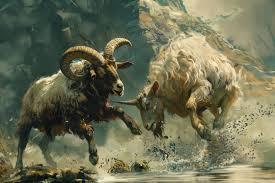
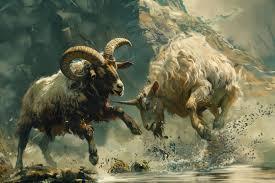
The ram (8:3-4): When he looked up, he saw a ram with two horns, standing beside the canal, and the horns were long (8:3a). There are four reasons to interpret the ram with the two horns as a symbol of the Medo-Persian Empire. First, the Bible itself identifies it as such: The two-horned ram that you saw represents the kings of Media and Persia (8:20). Second, in a Persian religious book known as the Bundahishn, the guardian spirit of Medo-Persia is portrayed in the form of a ram with pointed horns.221 Third, the Persian king bore the golden figure of a ram’s head when he stood before his army.222 And fourth, different nations in the Ancient Near East were represented by zodiac signs, and the sign for Persia was Aries, the ram.223 Additionally, the vision of the ram also develops previous revelations concerning the second Gentile empire. It is a further elaboration of the chest and arms of silver (see AzThe Second Empire: Chest and Arms of Silver), and the lopsided bear (see CcThe Kingdoms of This World: The second beast).224

One of the horns was longer than the other but grew up later (8:3b). Rams normally have two horns, but these horns were unique. One horn grew up later yet grew longer than the other. These horns symbolize the two divisions of the empire. Persia would begin with less strength, but would eventually become much more powerful than Media due to the rise of Cyrus the Great. Centuries before he appeared on the scene, Isaiah called him by name, and even called him “God’s shepherd” (see the commentary on Isaiah IbCyrus is My Shepherd and Will Accomplish All). It was Cyrus whom ADONAI chose to defeat the Babylonians and permit the Jews to return to the Land.

I watched the ram as it charged toward the west and the north and the south. No animal could stand against it, and none could rescue it from its power. The rapid progress of Cyrus during the ten years of 549 to 539 BC suggested a ram goring every beast that got in his way. By thrusting westward and northward into Asia Minor, he bypassed Babylon, only to capture it later and take the lands to the southwest and southeast. It did as it pleased and became great (8:4). Nearly two hundred years of history and national expansion, such as the world had never seen before, are summed up in this one verse.225 Why did YHVH call Cyrus? For the sake of Jacob My servant, of Isra’el my chosen (Isaiah 45:4a). No matter how brutally the Gentile nations may treat the people of Isra’el, ADONAI uses the nations to accomplish His ordained purposes. His plans for Isra’el will be fulfilled no matter how much they may oppose His chosen people.226

The male goat (8:5-8): According to Dani’el Chapters 2 and 7, ADONAI allots each Gentile empire a certain amount of time before terminating its dominion and transferring its power to another. This would also be the case with the Medo-Persians, as verses 5-14 prophecy. Again it must be remembered that from Dani’el’s perspective, none of what he saw in his vision had happened yet. At the point of his writing in 551 BC, the Babylonian Empire was still the most dominant monarchy in the world.227

As I was thinking about the ram, suddenly a goat with a prominent horn between its eyes came from the west. In Nebuchadnezzar’s statue, Greece was depicted as a belly and thighs of bronze (see BaThe Third Empire: Belly and Thighs of Bronze), and a swift leopard (see CcThe Kingdoms of This World: The third beast). Now, Dani’el sees Greece angrily crossing the whole earth without touching the ground, and like a leopard, Alexander was known of the speed in which his armies moved (8:5). The large prominent horn represents Alexander the Great. There are three reasons to interpret the goat as a prophetic symbol of the Greek Empire. First, the Bible itself identifies it as such: The shaggy goat is the king of Greece, and the large horn between its eyes is the first king, Alexander the Great (8:21). When he came to conquer Persia, he did so from Macedonia and Greece, which are both located west of Persia. Therefore, Dani’el stated that he saw the male goat coming from the west. Second, the zodiac sign for Greece was Capricorn, the one-horned goat. Third, the national emblem of Macedonia was a goat.228

Alexander was one of the great military strategists of history. He led the armies of Greece from victory to victory and extended his empire even beyond that of Cyrus had done with the Persian army. He was born in 356 BC, the son of a great conqueror in his own right, Philip of Macedon. Philip had united Greece with Macedonia and was planning to attack Persia when he was assassinated. Alexander, educated under the famed Aristotle, was only twenty in 336 BC when he succeeded his father as king. A year-and-a-half later (334 BC), he had launched his attack against the Persians. This focus will become even more detailed in Chapter 11 (see DvAlexander the Great).

The destruction of the ram (8:6-7): The goat charging the ram in a fit of great rage rightly describes Alexander’s assault on the Medo-Persian Empire. The male goat came toward the two-horned ram I had seen standing beside the canal and charged at it in great rage (8:6). Hatred for the Persians had grown steadily since the time of Cyrus due to constant quarreling and fighting between Persia and Greece, and the Greeks were especially bitter over the invasions of Darius 1 (490 BC) and his son Xerxes (480 BC). Alexander was determined to avenge those assaults on his homeland. In his vision, Dani’el saw the goat attack the ram furiously, striking the ram and shattering its two horns. The ram was powerless to stand against it; the goat knocked it to the ground and trampled on it, and none could rescue the ram from its power (8:7). In that same year Alexander won the Battle of Granicus in Asia Minor, thereby bringing to an end the dominance of the Medo-Persian Empire. With his subsequent victories at Issus (333 BC) and Arbela (331 BC), the conquest of Medo-Persia was complete. Incredibly, after three years, Alexander had conquered the entire Near East. The details of this prophecy are so historically accurate that literary critics have attacked the book, saying that it must have been written after these events took place. But we worship an omniscient God who is outside of time. He can predict the past and the future. In fact, He causes the future to happen.

The division of the four horns (8:8): This verse prophetically describes what would happen to the Greek Empire after Alexander’s death. He carved out an empire of 1.5 million square miles, but at the height of his career, having conquered much of the known world, Alexander was taken ill with a severe fever (possibly malaria) and on June 13, 323 died at the age of 32. The goat became very great, but at the height of its power the large horn was broken off (8:8a). Alexander spread the Greek language and culture all over the world, an act that prepared the world for the Gospel by giving it a common language, Koine Greek, the language of the B’rit Chadashah.229

When Alexander died, he left two sons, Alexander IV and Herakles, both of whom were murdered. Historically, this prophecy was fulfilled by Alexander’s four generals. It took twenty years of infighting and struggle before the empire was successfully divided among four prominent horns. They grew up toward the four winds of heaven (8:8b). Cassander took Macedonia and Greece in the west; Lysimachus took Thrace and Bithynia in the north; Ptolemy took Egypt, Isra’el, and Arabia Petrea in the south; and Seleucus took Syria, Babylonia, and the territory in India in the east.230

The small horn (8:9-14): In contrast to the little horn (the antichrist) described in Chapter 7 (see CdThe Kingdom of Satan), a small horn (Antiochus Epiphanes) emerges in Chapter 8. The little horn of Chapter 7 springs from the Empire of Imperialism (see BbThe Fourth Empire: Imperialism). However, the small horn of Chapter 8 springs from the division of the Greek Empire of Alexander the Great. But they both had one thing in common. The hatred of the Jews by Antiochus in the past, foreshadowed the hatred of the Jews by the antichrist in the future.

The activities of the small horn (8:9-12): Dani’el begins by describing how the small horn rose to power. Out of one of them came another horn, which started small but grew in power to the south and to the east and toward the Beautiful Land (8:9). As we have already seen, after the death of Alexander the Great, his empire was divided into four parts with four of his generals taking control (8:8). Out of one of those horns, a small horn appeared who became the infamous Antiochus Epiphanes, the ruler of Syria from 175 to 163 BC, and known as one of the cruelest tyrants in history.

Antiochus gave himself the name Epiphanes, which means illustrious manifestation, for he claimed to be a revelation (epiphany) of the gods. He even had the word god (theos) put on the coins minted with his picture on it to look like the Greek god Zeus. In addition, he set up a statue of himself in the Most Holy Place in the Temple. And he had a passionate desire to turn the Jews into good Greeks. One of his first acts was to drive out the high priest Onias and replace him with Jason, a supporter of the Greeks. Jason was replaced by Menelaus, who actually bought the high priesthood. Believing a rumor that Antiochus had died, Jason attacked Jerusalem only to learn that Antiochus was very much alive (Oops). The angry king attacked Jerusalem and plundered the Temple. In 168 he sent an army of twenty thousand men under Apollonius to level Jerusalem. They entered the City on the Sabbath, murdered most of the men, and took women and children as their slaves. The remaining men fled to the army of Judas Maccabeus.231

The small horn grew until it reached the host of the heavens (Isra’el), and it threw some of the starry host (the army of Antiochus) down to the earth and trampled on them (8:10). In other words, Dani’el accurately prophesied that Antiochus would attack the Jewish people. The historical fulfillment of verse 10 is recorded in 1 Maccabees 1:29-32: Two years later the king sent to the cities of Judah a chief collector of tribute, and he came to Jerusalem with a large force. Deceitfully, he spoke peaceable words to them, and they believed him; but he suddenly fell upon the City and dealt it a severe blow and destroyed many people of Isra’el. He plundered the City, burned it with fire, and tore down its houses and its surrounding walls. And they took captive women and children, and seized the cattle (also see 1 Maccabees 1:37-38, 41-42, 48-50, 60-61, and 64). This quotation shows that while the Maccabean books are not inspired Scripture, they record the fulfillment of many of Dani’el’s prophecies and are important historical documents and are of the same value as the records of Josephus.232

But the king wasn’t satisfied, so he issued an edict to abolish the Jewish religion. Antiochus set himself up to be as great as the commander of the army of ADONAI, or the high priest; and took away the daily sacrifice from YHVH Himself, and God’s Sanctuary was thrown down, or desecrated. In addition, because of rebellion, the LORD’s people and the daily sacrifice were given over to Antiochus. He prospered in everything he did, and God’s truth (the Torah) was thrown to the ground or disregarded (8:11-12). He prohibited the Jews from honoring the Sabbath, practicing circumcision, obeying Jewish dietary mitzvot, and offering sacrifices. Any Jew found possessing a copy of the Torah was put to death. And he climaxed his campaign of terror on December 14, 168 BC, by replacing the Jewish bronze altar (see the commentary on Exodus Fa Build Altar of Acacia Wood Overlaid with Bronze) with an altar to Zeus . . . and sacrificed a pig on it! What Antiochus did was a foreshadowing of what the antichrist will do when he puts his image in the Tribulation Temple and commands the world to worship him (see the commentary on Revelation DrThe Abomination That Causes Desolation).233

The 2,300 evenings and mornings (8:13-14): Dani’el overheard two angels speaking, and from their conversation God’s prophetic timetable was revealed to him. Then I heard an angel speaking, and a second angel asking him, “How long will it take for the vision to be fulfilled – the vision concerning the daily sacrifice, the rebellion that causes desolation, the surrender of the Sanctuary and the trampling underfoot of the Lord’s people?” The question was asked for Dani’el’s sake, since the answer was given to him rather than the second angel. The first angel said to me, “It will take 2,300 evenings and mornings; then the Sanctuary will be properly restored (8:13-14).” In the Hebrew text, the conjunction “and” is missing. Instead of evenings and mornings, the Hebrew reads erev boker, or evening-morning. This expression refers to two parts of one day and the korban tamid, meaning a perpetual offering, since it was offered twice daily, once in the morning and once in the afternoon. Therefore, the duration that was prophetically allotted to Antiochus Epiphanes was 2,300 whole days.

To enforce his laws and ensure that the Jewish people engaged in idol worship, Antiochus sent his soldiers to villages throughout Judea. When the Syrians reached Modi’in, a town located about twelve miles northwest of Jerusalem, they demanded a local Levite leader, Mattathias, be an example to his people by sacrificing a pig on a pagan altar. The priest refused and he not only killed a Jew who stepped forward to do the Syrian’s bidding, but he also killed the king’s representative. Then Mattathias tore down the pagan altar. Antiochus responded swiftly by attacking the Jewish people of Modi’in and killing their men, women, children, and animals. One thousand people are said to have died on that day (1 Maccabees 2:38). That event triggered a major revolt, their October 7th you might say. In 167 BC, Mattathias and his five sons were joined in their fight for the liberation of their country by a group of devout and patriotic Jews (1 Maccabees 2:42). The priest’s family, which belonged to the Hasmonean dynasty, became known as the Maccabees. The name Maccabee means the hammar. It was applied to Judah, the leader of the five brothers, who kept hammering away against the Syrians until they were defeated three years later. After the victory, the Maccabees cleansed the Temple and initiated the Festival of Lights. As the Bible shows, Hanukkah was observed in the first century AD (see the commentary on the Life of Christ HjThen Came Hanukkah at Jerusalem, and It Was Winter), and it is still commemorated by the Jewish people today.234

The fulfillment of the prophecies of Dani’el 8:14 is recorded in 1 Maccabees 4:36-59, 2 Maccabees 10:1-9, and by Josephus in his Jewish Antiquities. The following quotation reflects 2 Maccabee 10:1-9, “Now Maccabeus and his followers, ADONAI leading them on, recovered the Temple and the City; and they tore down the pagan altars which had been built in the public square by the foreigners (the Syrians), and also destroyed the sacred grounds. They purified the Sanctuary of the Temple and made another bronze altar of sacrifice; then, striking fire out of flint, they offered sacrifices, and burned incense and lighted lamps and set out the bread of the Presence. And when they had done this, they fell prostrate and begged ADONAI that they might never again fall into such trials, but that, if they should ever sin, they might be disciplined by ADONAI Himself and not to be handed over to blasphemous and barbarous Gentile nations. It happened on the same day on which the Sanctuary had been profaned by the foreigners, the purification of the Sanctuary took place, that is, on the twenty-fifth of Kislev (November-December of the Jewish calendar) 164 BC. And as they celebrated for eight days with rejoicing, like Sukkot.

Since the dedication of the First Temple was such a joyous occasion, Solomon decided that the festivities should reflect the joyous seven-day festival of Sukkot (see the commentary on Numbers FgThe Hag Sukkot Offering), followed by the eighth day assembly (see the commentary on Numbers FhThe Eighth Day Assembly). Therefore, the dedication of the First Temple was observed for eight days with the lighting of lampstands. Three-hundred-and-fifty-two years later, the Maccabees decided to duplicate those same celebrations. This is why Hanukkah is celebrated for eight days. It is also the reason that lights became associated with the Feast of Dedication. The Temple was purified, the daily tamid offering was restored and Jewish worship began once again. Much later, the rabbis invented the legend of the miracle of Hanukkah: a small jar of oil kept the candles burning in the rededicated Temple for eight full days. However, this legend did not appear in any Jewish texts until 600 years after the first Hanukkah, and there is no historical record of any such miracle taking place.235 Thus, the real miracle of Hanukkah was in the Maccabean victory over Antiochus Epiphanes on December 14, 165 BC, and their Persian oppressors.

Therefore, bearing beautiful branches, and also palm fronds, they sang psalms of thanksgiving to ADONAI who had given success in cleansing His own Holy Place. They decreed by public ordinance and voted that the whole nation should observe those eight days every year. And this was the end of Antiochus Epiphanes, who died that same year from a divinely-inflicted disease!236

Dear heavenly Father, praise Your almighty power and omniscient wisdom! Your plans for Isra’el will be fulfilled no matter how much the nations may oppose His chosen people. You are always sovereign and totally in control. No matter who the monarch is, only You give Your permission to rule (Revelation 13:5). Just as You rescued Isra’el from the hands of the cruel Antiochus Epiphanes, so you will again rescue Isra’el during the Tribulation from a tyrant acting in a similar proud manner. It will be a terrible time. Death and martyrdom are to be preferred over following the beast. But what a joy for those experiencing trials to focus on the wonderful future that you promise to all who believe in You, an eternal home in heaven with You where there will be no crying, dying, mourning nor pain! I also heard a loud voice from the throne, saying, “Behold, the dwelling of God is among men, and He shall tabernacle among them. They shall be His people, and God Himself shall be among them and be their God” (Revelation 21:3).

Thank You that when politics and problems in the world seem insurmountable: No matter how brutally the Gentile nations may treat Isra’el, You use them to accomplish Your ordained purposes! How wonderful all the many great deeds you have done for Your people. You so graciously and mercifully conquered sin (Second Corinthians 5:21), You have promised to live within those who love You (John 14:23) and Messiah is making an eternal home in heaven for Your children. I am filled with hope when I remember how wonderfully You have worked to rescue Isra’el throughout history, and how you will rescue them on the last three days of the Tribulation when they come to recognize you as their Messiah (Zechariah 12:10). In Messiah’s holy Name and power of His resurrection. Amen

2025-08-03T23:45:25+00:000 Comments

Cj – Dani’el’s Vision of the Ram and Male Goat 8: 1-27

Dani’el’s Vision of the Ram and Male Goat
8: 1-27

In Dani’el 8:1, the language reverts back to Hebrew (to see link click AcDani’el from a Messianic Jewish Perspective: Languages), and remains that way to the end of the book. The sages teach that because these are Dani’el’s personal visions, the text is exclusively Hebrew. The message of Chapters 2 and 7 regarding the far eschatological significance of the four Gentile kingdoms is not repeated in Chapter 8. Instead, Chapter 8 is a vision report. It focuses on events that occurred during the second (see BcThe United Stage: Rome) and third (see BdThe Divided Kingdom Stage: East and West Balance of Power) kingdoms and, thus, primarily deals with the period between the sixth and second centuries BC. Dani’el did not attempt to write history when he wrote his book; rather, he was developing a theme.183

Here is an overview of Dani’el’s prophecies in chronological order:

602 BC prophecy of the Great Statue (2:1-45) when Dani’el was 18.

553 BC prophecy of the Four Beasts and the Ancient of Days (7:1-28) when Danie’l was 67.

551 BC prophecy of the Ram and Male Goat (8:1-27) when Dani’el was 69.

539 BC prophecy of the Fall of Babylon (5:1-31) when Dani’el was 81.

539 BC prophecy of the Seventy-Weeks (9:1-27) when Dani’el was 81.

536 BC prophecy of the Future of the Nations (11:2-45) when Dani’el was 84.

536 BC prophecy of the Future of Isra’el (12:1-13) when Dani’el was 84.

In Chapter 8, Dani’el had a vision of two animals. As in the previous chapters, these animals represent earthly kingdoms. The vision focuses on Alexander the Great (see DvAlexander the Great) and the ascent of Antiochus IV Epiphanes (see DwAntiochus Epiphanes), who was the most detestable Seleucid monarch. During his reign, he persecuted the Jewish people mercilessly and tried to do away with any worship of ADONAI. The fulfillment of Dani’el’s prophetic vision in Chapter 8 is described in detail in the Maccabean books. These apocryphal texts date back to the second century BC. They will be quoted extensively in the discussion of Chapter 8 because they demonstrate the accuracy of Dani’el’s prophetic vision. The accuracy of the Maccabean books has led some to believe that the book of Dani’el must have been written in the second century BC. However, I Maccabees lends credence to the traditional view that the book was written in the sixth century BC. In his final words, Mattathias, who helped to ignite the Maccabean Revolt against the Seleucid Empire, exhorted his sons to remain faithful to YHVH by citing the examples of three Jews in the blazing furnace and Dani’el in the lion’s den, “Hananiah, Azariah, and Mishael believed and were saved from the flame. Dani’el, because of his innocence, was delivered from the mouth of the lions” (I Maccabees 2:59-60). Mattathias passed away around 166 BC. So, there is no reason to dispute the reliability of his speech. Hence, the events of the book of Dani’el were widely known in the second century BC and, as a result, could not have been written after that time.217

2025-08-03T23:43:49+00:000 Comments

Ci – The Significance of Dani’el Chapter 7 to the Times of the Gentiles

The Significance of Dani’el Chapter 7
to the Times of the Gentiles

Luke describes this period of time when he wrote: They will fall by the sword and will be taken as prisoners to all the nations. Jerusalem will be trampled on by the Gentiles until the times of the Gentiles are fulfilled (to see link click Ao The Times of the Gentiles). This can best be defined as that long period of time from the Babylonian Captivity (see the commentary on Jeremiah Gu – Seventy Years of Imperial Babylonian Rule) to the Second Coming of Messiah, during which time the Gentiles have complete dominance over Jerusalem. This does not rule out temporary Jewish control of the City until the Second Coming. Such temporary control was exercised during the Maccabbean Period (164-163 BC), the First Jewish Revolt against Rome in 66 AD, and the Second Jewish Revolt (the Bar Cochba Revolt) against Rome (132-135 AD), and since 1967 as a result of the Six Day War.

The Four Empires that King Nebuchadnezzar saw in Dani’el 2 were the same Four Kingdoms that Dani’el saw in Chapter 7 represented by four beasts (see BzDani’el’s Vision of Four Beasts), which goes through several stages, with an emphasis on the last one. Both Chapters make it clear that the Fourth Gentile Empire began with the end of the Third Empire and will continue until Yeshua Messiah comes to set up His Kingdom (see BgThe Fifth Empire: The Kingdom of God). This Fourth Gentile Empire is imperialistic and will go through five successive stages (see BbThe Fourth Empire: Imperialism). At some point, a one-world government will be established. According to Dani’el 2:42 and 7:24, the global government will collapse and break into ten kingdoms. During this stage, the antichrist will begin to rise to power. By the middle of the Great Tribulation, he will be strong enough to kill three of the ten kings, and the other seven will simply submit to his authority. Once this happens, the fifth and final stage of the Fourth Empire will begin (see CdThe Kingdom of Satan). It will last for three-and-a-half years until the end of the Great Tribulation (Hosea 6:1-3). At that time, the final ruler of the times of the Gentiles, the antichrist, will by killed by Messiah.216

2025-07-09T12:01:19+00:000 Comments

Ch – The Interpretation of Dani’el’s Visions 7: 15-28

The Interpretation of Dani’el’s Visions
7: 15-28

The interpretation of Dani’el’s visions DIG: In what way were the four empires that the king saw in Dani’el 2 connected to the four beasts in Dani’el 7? Who are the kedoshim and what will they do? Why was a second interpretation needed? Who are the ten horns and the ten kings? What will happen to the antichrist?

REFLECT: What do you look forward to? What do you imagine the Kingdom of God will be like? What do you see yourself doing during His Messianic Kingdom? Who will you see there? Dani’el was deeply troubled by his vision. How do you feel about it? Does it cause you to fear the future, or does it give you comfort? 

These verses record Dani’el’s reaction to the remarkable visions he had received and provide their interpretation. Dani’el made two separate requests to obtain all the desired information. The first request is given in verses 15-16 and leads to the summary interpretation in verses 17-18. The second request for further detail on the Fourth Empire is covered in verses 19-22 and leads to the detailed interpretation in verses 23-27.212

A summary interpretation (7:15-16): Like Nebuchadnezzar in Chapter 2, Dani’el was greatly troubled in spirit, by the visions that passed through his mind. Dani’el had previously seen ten thousand times ten thousand angels standing before the Ancient of Days (7:10). Presumably, Dani’el approached one of those angels standing there and asked him the meaning of his dream. The prophet Zechariah received similar aid from an unnamed angelic interpreter (Zechariah 1:9 and 2:3). Later, Dani’el will receive help from the angel Gabriel in the interpretation of two other visions (8:16 and 9:21). Consequently, we may speculate with good reason that it’s Gabriel seen here speaking to Dani’el. Thus, the angelic messenger told Dani’el a summary interpretation of the entire vision.213

The kingdom of man (7:17): The four great beasts are four kings that will rise from the earth. The Gabri’el’s summary statement establishes a connection between Dani’el’s vision (see BzDani’el’s Vision of Four Beasts) and Nebuchadnezzar’s dream (see AqNebuchadnezzar’s First Dream). The Four Empires that King Nebuchadnezzar saw in Dani’el 2 were the same Four Kingdoms that Dani’el saw in Chapter 7, represented by four beasts. Earlier, I pointed out that the four beasts emerged out of the sea (7:2-3). Here, Gabri’el declares that they arose out of the earth. Both statements are true. The fact that the beasts, or, better the kingdoms, emerged out of the sea highlights their Gentile identity. The fact that they will rise from the earth highlights their humanity. The prophecy refers to human, not divine, kingdoms ruled by Gentiles.

The Kingdom of God (7:18): Then Gabri’el provided a summary of the Fifth Empire that Dani’el saw in his dream (see BgThe Fifth Empire: The Kingdom of God). But the kedoshim, meaning the holy ones of the Most High will receive the Kingdom and will possess it forever – yes, for ever and ever. In 7:14, it was revealed that at His Second Coming, the Son of Man would be given authority, honor, power and sovereignty over all nations of the world. Yet, here Gabri’el states that the people of the Most High will receive that kingdom and possess it forever. Again, both statements are true.

There are numerous verses in the TaNaKh where kadosh (holy) is used to refer to the people of Isra’el. For example, in Exodus 19:6, Isra’el is called a holy nation. Isra’el is referred to as a holy people in Deuteronomy 7:6; Psalm 26:19 and Psalm 16:3. The Israelites were to be holy (for example, Leviticus 11:44-45, 19:2, 20:26, 21:8). The amillennial and postmillennial interpretation of Dani’el 7:18 see the holy ones of the Most High as Christians, and “the kingdom” as a spiritual kingdom. However, the Church did not come into existence until Acts 2. Proponents of replacement theology tend to take passages that refer to Isra’el’s blessings allegorically, applying them to the Church. But, a literal interpretation requires that all verses be explained using the same method. Thus, the kedoshim, the holy ones of 7:18 and 21, are the Jewish people (Revelation 2:26-27). They will be co-heirs of the Kingdom that, according to 7:14, ADONAI will give to the Son of Man. The Jews will possess this Kingdom together with Messiah forever.214

A detailed interpretation (7:19-22): As related by Arnold Fruchtenbaum in his commentary on Dani’el, the summary interpretation did not satisfy Dani’el’s questions about the fourth beast. In particular, the little horn gave him the most trouble in his vision in 7:8 and 8:9. In verse 19, Dani’el focused on the beast himself. Then I wanted to know the meaning of the fourth beast, which was different from all the others and most terrifying, with its iron teeth and bronze claws – the beast that crushed and devoured its victims and trampled underfoot whatever was left (7:19). Dani’el wanted to know all about the fourth beast, again emphasizing that it was very different. He repeated that it was most terrifying, had iron teeth, and destroyed anything in its way. The one new element of the description was that it had bronze claws.

In addition, Dani’el also wanted to know more about the ten horns on the head of the beast. He noticed that when the little horn that came up, three of the original ten fell (Revelation 17:12-13 and 17) – the horn that looked more imposing than the others and that had the eyes of a man and a mouth that spoke boastfully. As Dani’el watched, this little horn was waging war against the Jewish people (see the commentary on The Life of Christ JyThe Sheep and the Goats), until the Ancient of Days came and pronounced judgment in favor of the believing remnant, and the time came when they possessed His Kingdom (7:20-22). ADONAI alone has the authority to give the earth to whomever He chooses.

The Fourth Empire (7:23-26): These verses reflect Gabri’el’s detailed interpretation of Dani’el’s visions. He gave me this explanation. In verse 23a the Fourth Empire is seen in its united stage (see BcThe United Stage). When Rome conquered the Greek Empire, it did so as a united force. Later, the empire would be split into a western and eastern power (see BdThe Divided Kingdom Stage), but in this stage, the Fourth Empire was united. What made it different from all preceding empires was its policy of imperialism. When Babylon conquered other nations, it did not install Babylonians as their rulers. Instead, the empire selected leaders from among the subjugated populations and placed them under its control. This historical fact is demonstrated by the conquest of Judah. When Nebuchadnezzar destroyed Jerusalem, he chose Gedaliah, a Jew, to rule over the Province of Judah rather than a Babylonian (Jeremiah 41:2-3 and 52:30).

The Medo-Persians followed the same strategy. When they conquered a nation, they didn’t appoint Medes or Persians to rule its subjects, but rather chose leaders from the defeated country. Zerubbabel is an example of this policy. He was appointed as Isra’el’s governor by the Medes and the Persians (see the commentary on Ezra-Nehemiah AgThe First Return). Nehemiah is another example (see Ezra-Nehemiah BtThe Third Return). Although they were Jews, Zerubbabel and Nehemiah ruled under Medo-Persian authority. The Greeks utilized the same method. Under their rule in Isra’el, the Jewish high priest became the ruler of Judea. All of this, however, changed when the Romans conquered the known world. As soon as a nation was conquered, the empire would install a Roman native as the country’s new ruler. Consequently, the B’rit Chadashah frequently mentions Roman procurators like Pilate (Matthew 27:11-19 and Luke 23:13-14); Felix, (Acts 23:23-24), and Festus (for example in Acts 25:1-12).

At this point, the vision departs from the chronology established in Dani’el 2 (see BbThe Fourth Empire: Imperialism). In that chapter, the next stage was the Divided Kingdom Stage (see Bd). Yet, rather than elaborating on, or at least mentioning this stage, verse 23b describes the third stage of the Fourth Empire (see BeThe One World Government Stage). It will be different from all the other kingdoms and will devour the whole earth, trampling it down and crushing it. Because Rome never conquered the whole earth, this prophecy has never been fulfilled. It is a far eschatological prophecy in which the antichrist will trample the entire world.

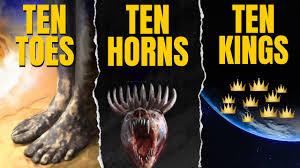
Verse 24a shows that there will be ten horns in that One World Government, which represent ten kings and the ten toes of 2:42. There are those today who say that the ten horns are the European Economic Community (EEC), or even the European Union (EU). But the ECC has been absorbed into the EU, which currently has twenty-seven member states. Therefore, this is a simple rule to follow regarding prophecy. One must not interpret biblical prophecy by current events, but interpret current events by biblical prophecy. There is one additional principle to keep in mind: Bible prophecy is never fulfilled approximately; it is always fulfilled precisely and as written. Much of what is presented as fulfillment is sensationalized prophecy books and based on a single similarity. However, one similarity does not fulfill biblical prophecy. There is no fulfillment until there is total fulfillment.

After the ten horns/kings, another king will arise, different from the earlier ones; he will subdue three kings (7:24b). This other king will be the antichrist. Once the three kings are killed, the other seven submit to his authority. The ten horns you saw are the ten kings who have not yet received a kingdom, but who for one hour will receive authority as kings along with the beast, or the antichrist. They have one purpose and will give their power and authority to the beast (17:12-13). The same point is made in verse 17. For God has put it into their hearts to accomplish his purpose by agreeing to give the beast their power to rule, until God’s words are fulfilled (17:17). The seven other kings will all agree to relinquish their power to the antichrist. With that decision, he will succeed in taking over the political control of the whole world, with the exception of Bozrah in Jordan where the majority of the Jews will take refuge (see Isaiah KgThe Second Coming of Jesus Christ to Bozrah). The next goal of the beast will be to gain control of the world’s religious system. He will need to remove all opposition. This will include religious Babylon (see Revelation DlThe Destruction of Religious Babylon), the two witnesses (see Revelation DcI Will Give Power to My Two Witnesses to Prophesy), believers born again during the Great Tribulation and, of course, those pesky Jews.

Then Gabri’el provided some new information regarding the little horn. He will speak against the Most High and oppress his holy people and try to change the set times (Aramaic term zimmin), which included the festivals (see the commentary on Leviticus DwGod’s Appointed Times). In Esther 9:27, the Hebrew equivalent, zeman, refers to God’s Appointed Times. Thus, the little horn will attempt to alter the biblical feasts as Jeroboam did (see the commentary on the Life of Solomon DdGolden Calves at Dan and Bethel). Additionally, the antichrist will try to change “the law. The Aramaic term for law, dat, can refer to a royal decree (as in Dani’el 2:13 and 15; Ezra 7:26), or the Torah (Dani’el 6:5 and Ezra 7:12). In the context of Dani’el 7:25, it could refer to religious law enacted by the government or, more likely, to the Torah (7:25a).

The antichrist will conquer three of the ten kingdoms during the first half of the Great Tribulation. During that time, Isra’el will be protected from war by a covenant it signed with the antichrist (9:27). Midway through the Great Tribulation, however, the antichrist will invade Jerusalem (Revelation 11:2), desecrate the Tribulation Temple (see Revelation BxThe Tribulation Temple) and change feasts and the Torah. Gabri’el goes on to say that God’s holy people will be delivered into the hands of the little horn for three-and-a-half-years, forty-two months, or 1,260 days (7:25b). He will blaspheme YHVH (Revelation 13:5-6) and persecute the Jews (Matthew 24:16-22; Mark 13:14-20; Revelation 13:7-10). However, as we will see in verse 27, this dispensation will culminate in the Second Coming of Yeshua Messiah to Bozrah.

When Messiah returns at the end of that seven-year period. Among the very first casualties of Armageddon will be the antichrist himself (see Revelation ExThe Eight Stage Campaign of Armageddon). The ease with which Messiah will kill the antichrist is described by Paul. And then the lawless one will be revealed, whom the Lord will slay with the breath of His mouth and destroy with the brightness of His coming (Second Thessalonians 2:8). Earlier, Dani’el revealed that he continued to watch the heavenly court because of the boastful words the little horn was speaking. He kept looking until the beast (the antichrist) was slain and his body destroyed and thrown into the blazing fire (7:11). Habakkuk 3:13 speaks in even more graphic terms: You went out to rescue Your chosen people, to save your anointed ones. You crushed the leader of the house of the wicked and laid him open from thigh to neck. And finally, Isaiah tells us: All the other kings of the nations, all of them, lie in glory, each in his own tomb. But you are discarded, unburied, like a rejected branch. You are covered with the slain in a mass grave, with those pierced by the sword, then fall like stones inside a pit, like a trampled corpse (Isaiah 14:18-19). Therefore, after the antichrist is killed, his resurrected body is thrown alive into the lake of fire that burns with sulfur (Revelation 19:20b). Then Dani’el summarizes his discussion of the Kingdom of Satan, by saying: the Ancient of Days will sit in His heavenly court, and the power of the antichrist will be taken away and completely destroyed forever (7:26).

The Kingdom of God (7:27): Finally, the angel Gabri’el provided the interpretation regarding the last kingdom of Dani’el’s vision. When the Kosher King returns, He will rule with His holy ones. Then the sovereignty, power and greatness of all the kingdoms under heaven will be handed over to the holy people of the Most High. His Kingdom will be an everlasting Kingdom, and all rulers will worship and obey Him (see Revelation FiThe Government of the Messianic Kingdom). In summary, the Fifth Empire refers to the Messianic Kingdom, or the Kingdom of God. Isra’el, the Jewish people, will be serving under Him as the head of the Gentiles (Deuteronomy 28:1 and 13; Isaiah 14:1-2, 49:22-23, and 61:6-7, etc.).

Conclusion (7:28): In the last verse of the chapter, Dani’el commented on the impact the visions had on him. At this point the revelation ended. As for me, Dani’el, my thoughts were deeply troubling, and my face turned pale, but I kept the matter to myself, meaning that he documented his experiences, but did not share them with anyone.215

2025-07-08T12:48:19+00:000 Comments

Cg – The Second Exodus: Genesis and Revelation

The Second Exodus: Genesis and Revelation

As we read Exodus and Revelation we can see that Isra’el will experience a Second Exodus. This can be seen in four areas: the Plagues, the Lamb, the Exodus, and the Song. What happened in the First Exodus was a foreshadowing of the Second Exodus. Once again God will rescue His people from Egypt (the world) and bring them home to the Land.

It is clear that when John read the story of the Exodus, he was not merely reading for had been, but also what would be in the future. Because Yeshua is the prophet like Moses (see the commentary on Deuteronomy, to see link click DkA Prophet Like Moses), there will be a Second Exodus. Revelation shows that the B’rit Chadashah authors have the same expectation as the authors of the TaNaKh. Therefore, Isra’el has the hope of a Second Exodus in the far eschatological future. It is clear from reading Revelation, that the Second Exodus will be even greater than the first Exodus. First, we see the Second Exodus in the plagues:

First, was the plague of the festering, painful boils. We read that Moses took soot from a furnace and stood before Pharaoh. He tossed it into the air, and festering boils broke out on men and animals (see the commentary on Exodus BpMoses Tossed Soot in the Air, Festering Boils Broke Out). Then, in the far eschatological future, one of the seven angels begins to pour out the seven bowls of wrath, resulting in ugly and painful sores that broke out on those who live on the earth (see  Revelation EbThe First Angel poured His Bowl and Ugly and Painful Sores Broke Out). Therefore, just as ADONAI sent festering boils to hasten the First Exodus, He sent ugly and painful sores during the Great Tribulation to hasten the Second Exodus and once again rescue His people (see CfThe Kingdom of Messiah).

Secondly, was the plague of blood. ADONAI said to Moses, “Tell your brother Aaron, ‘Take your staff and stretch out your hand over the waters of Egypt – over the streams and canals, over the ponds and all the reservoirs’ – and they will turn into blood” (see Exodus BkStrike the Water of the Nile and It Will Be Turned into Blood). Then, in the far eschatological future, the second angel poured out his bowl on the sea, and it turned into blood like that of a dead man and every living thing in the sea died (see Revelation EcThe Second Angel Poured Sea Turned into Blood). Therefore, just as ADONAI caused the water in Egypt to turn to blood and hasten the First Exodus, He caused the sea to turn into blood during the Great Tribulation to hasten the Second Exodus and once again rescue His people.

Thirdly, was the plague of darkness. So Moses stretched out his hand toward the sky, and total darkness covered all Egypt. No one could see anyone else or leave his place for three days (see Exodus BsTotal Darkness Covered All Egypt for Three Days). Then, in the far eschatological future, the fifth angel poured out his bowl of wrath, this time spilling its contents on the throne of the beast himself, and his kingdom was plunged into darkness. Joel 2:1-2 tells us that it will be a day of darkness and gloom, a day of clouds and thick fog; a great and mighty horde is spreading like blackness over the mountains. There has never been anything like it, nor will there ever be again, not even after the years of many generations. The sun will be turned into darkness and the moon into blood before the great and terrible Day of the ADONAI (see Revelation Ef The Fifth Angel Poured Out His Bowl Plunging His Kingdom into Darkness). Therefore, just as ADONAI caused darkness to cover all of Egypt to hasten the First Exodus, He will cause the sun to turn into darkness during the Great Tribulation to hasten the Second Exodus and once again rescue His people.

Fourthly, was the plague of frogs. Like the former plagues in Egypt, this one was directed by Ha’Shem against the idolatry of Egypt. The Nile River was sacred in their eyes; therefore, God turned its waters into blood. ADONAI said to Moses, “You are to tell Aaron, ‘Stretch out your hand with your staff over the streams and canals and ponds, and make frogs come up on the land of Egypt.” All natural water sources were struck by the plague. So Aaron stretched out his hand over the waters of Egypt, and the frogs came up and covered the land (see Exodus BlStretch Out Your Hand and Make Frogs Come Up on the Land of Egypt). Then, in the far eschatological future, the sixth angel will pour out his bowl on the great river Euphrates. Then they saw three evil spirits, the dragon, the beast and the false prophet, that looked like frogs. Frogs were unclean animals (Leviticus 11:10 and 41), but these were not literal frogs as in the plague in Egypt. They came out of the mouth of the dragon, out of the mouth of the beast and out of the mouth of the false prophet (see Revelation Eg I Saw Three Evil Spirits That Looked Like Frogs). So, just as God caused Egypt to be overrun by frogs to hasten the First Exodus, He caused what looked like frogs to come out of the mouth of the dragon, the beast, and the false prophet during the Great Tribulation to hasten the Second Exodus and once again rescue His people.

Fifthly, was the plague of hail. Because Pharaoh would not let the Israelites go, Moses continued as God’s mouthpiece, saying: At this time tomorrow I will send the worst hailstorm that has ever fallen on Egypt, from the day it was founded till now. Throughout Egypt hail struck down and killed everything in the fields – both men and animals; it beat down everything growing in the fields and stripped away most every tree (Exodus 9:18 and 25). The psalmist Asaph described the scene this way: He destroyed their vines with hail and their sycamore-figs with sleet. He gave over their cattle to the hail, their livestock to blots of lightning (Psalm 78:47-48). Then, in the far eschatological future, from the sky, huge hailstones of about a hundred pounds each fell upon mankind. And they cursed God on account of the plague of hail, because the plague was so terrible (Revelation 16:21). Therefore, just as ADONAI sent the worst hailstorm to ever hit Egypt to hasten the First Exodus, He will send huge hailstones of about a hundred pounds each to fall on man kind during the Great Tribulation to hasten the Second Exodus and once again rescue His people.

Sixthly, was flashes of fire and lightning. When Moses stretched out his staff toward the sky, ADONAI sent thunder and hail, and lightning flashed down to the ground. So God rained hail on the land of Egypt; hail fell and lightning flashed back and forth. The appearance of lightning and thunder in the TaNaKh, often pointed to the presence of God (Exodus 19:16 and 20:18). It was the worst storm in all the land of Egypt since it had become a nation, spanning eighteen centuries (see Exodus BqSo the LORD Rained Down Hail on the Land of Egypt). Then, in the far eschatological future, as the kingdoms of the world close in around the believing remnant in Bozrah (see my commentary on Isaiah KgThe Second Coming of Jesus Christ to Bozrah), the seventh angel will toss the contents of his final bowl into the air. Immediately a loud voice from the throne room out of the heavenly Temple says: It is done! And John heard flashes of lightning, rumblings, peals of thunder (see Revelation EhThe Seventh Angel Poured Out His Bowl and God said: It is Done!). Therefore, just as ADONAI sent thunder and lightning to Egypt and hastened the First Exodus, He will send thunder and lightning during the Great Tribulation to hasten the Second Exodus and once again rescue His people.

Second, we see the Second Exodus in the Lamb: In the Egyptian Passover the Hebrews were to take some of the blood from a lamb and put it on the sides and top of the doorframes of their houses (12:7). ADONAI told Moshe that on that same night He will pass through Egypt and strike down every firstborn – both men and animals – and thus bring judgment on all the false gods of Egypt. The blood will be a sign for you on the houses where you are; and when I see the blood, I will pass over you. Therefore, the blood of the lamb would save the firstborn (both Hebrew and Egyptian) of those who had enough faith to put it on the sides and top of their door frames. Then, in the far eschatological future, we see a great multitude that no one could count, from every nation, tribe, people and language, standing before the throne and in front of the Lamb. And they cried out in a loud voice, shouting: Salvation belongs to God, who sits on the throne, and to the Lamb (Revelation 7:9-10 and 17)! For the Lamb at the center of the throne will be their great Shepherd; He will have already led them on a Second Exodus, resulting in a thousand years of peace and safety in the Messianic Kingdom. Therefore, just as the lamb can be seen rescuing the Israelites on the night before the First Exodus, the Lamb can be seen in heaven ready to rescue His people again during the Second Exodus.

Third, we see the Second Exodus in leaving Babylon: At midnight, ADONAI fulfilled what He had promised and struck down all the firstborn of Egypt. Pharaoh and all his officials and all the Egyptians got up during the night, and there was loud wailing in Egypt, for there was not a house without someone dead. During the night Pharaoh summoned Moses and Aaron. “Get Out!” he ordered. Leave my people and take the rest of the Israelites with you (Ex 12:31)! This would lead to the First Exodus (see Exodus CaAt the End of the 430 Years, to the Very Day). Then, in the far eschatological future, from the middle of the Great Tribulation forward, Ha’Shem will increase the pressure on mankind to repent. Once the antichrist is revealed (2 Thess 2:3) and a mighty angel declares: There will be no more delay (Revelation 10:6), all restraint will be removed. ADONAI purposed to destroy Babylon (see Revelation ElThe Fall of Commercial and Political Babylon), so just as Lot was warned to leave Sodom, a mighty angel will warn the Jews, “Come out of her, My people,” quoting from Jeremiah 51:45. This would lead to the Second Exodus, where the Jews would assemble at Bozrah (see Revelation EvThe Basis of the Second Coming of Jesus Christ), which will lead to the salvation of the believing remnant (Romans 11:26). Therefore, just as leaving Egypt would result in the First Exodus, leaving Babylon will ultimately result in the Second Exodus during the Great Tribulation.

And fourth, we see the Second Exodus in the Song: After seeing the bodies of the Egyptians lying dead on the shore of the Red Sea (Exodus 14:30), Moses and the Israelites spontaneously sang a song to God. Before the Israelites joined in with Moses to sing their song of redemption, they were singing the blues, the desert blues. Before crossing the Red Sea, they sang the blues long and hard, and they would return to the desert blues again because it will be their theme song as they travel throughout the desert for forty years. But for a time, however, they would sing this song of redemption (see Exodus CkThen Moses and the Israelites Sang This Song).210 Then, in the far eschatological future, we see a great multitude standing on a sea of glass before God’s throne in heaven. And they sang the song of the Lamb, who is their eternal Redeemer. Like the song of Moses, the song of the Lamb represents God’s faithfulness to His children and judgment of His enemies. The song of Moses was sung at the Sea of Reeds, the song of the Lamb will be sung at the crystal sea; the song of Moses was a song of triumph over Egypt, the song of the Lamb will be a song of triumph over Babylon; the song of Moses told how ADONAI brought His children out of Egypt, the song of the Lamb tells how Jesus will bring His people into the Promised Land; the song of Moses was the first song in Scripture, the song of the Lamb is the last; the song of Moses commemorated the execution of an enemy, the expectation of the redeemed and the exaltation of the Lord, the song of the Lamb deals with the same three themes (see Revelation DzThe Seven Angels with Seven Last Plagues).211 Therefore, just as the song of Moses told how ADONAI brought His children out of Egypt, the song of the Lamb will tell how Yeshua Messiah will bring His people into the Promised Land.

2025-07-07T11:07:15+00:000 Comments

Cf – The Kingdom of Messiah 7: 13-14

The Kingdom of Messiah
7: 13-14

The Kingdom of Messiah DIG: What is the sequence of Dani’el’s four visions? How is this the climax of Dani’el’s vision? Where does the term the Son of Man come from? How many times does the Son of Man appear in the B’rit Chadashah? How long is the Kingdom? How did Yeshua use the term Son of Man?

REFLECT: When Kingdom is established, what are the things about our present world that you most look forward to being changed? What do you think “peace in the world” will feel like? Dani’el’s response to this prophecy was one of solemnity and sudden fright. What does Dani’el’s response tell you about him?

Yeshua is son of man and as Son of Man, very man and Very God.

The scene shifts again, this time from the courtroom and the judgment of the beasts (to see link click CeA Vision of the Heavenly Court) to the description of Messiah’s Second Coming (see the commentary on Isaiah KgThe Second Coming of Messiah to Bozrah). These verses describe the setting up of the Kingdom of Messiah following the destruction of the Fourth Empire (CdThe Kingdom of Satan). The sequence is that of the Second Coming; a seventy-five-day interval (see the commentary on Revelation EyThe Seventy-Five Day Interval); followed by the establishment of the thousand-year reign of Messiah.

The Second Coming: Dani’el starts: As my vision continued at night, I looked (7:13a). The introductory formula here echoes the formula introducing his vision, “In my vision at night I looked” (7:2a), and forms book-ends for the literary unit (7:2-14). This construction serves to underscore the importance of the final scene as the climax of Dani’el’s vision.205 He saw a human figure described as one like a son of man (7:13b). The Aramaic phrase (see AcIntroduction of Dani’el from a Messianic Jewish Perspective: Languages) for son of man is bar enash. The Hebrew equivalent is ben adam. It appears many times in the TaNaKh in reference to human beings. For instance, in Jeremiah 49:18, ADONAI declared that no ben adam, no human being, would ever again live in Sodom and Gomorrah. Another example is the prophet Ezeki’el, who used the phrase ben adam numerous times (for example in Ezeki’el 2:1). The Messianic reference of this title, however, does not come from Jeremiah or Ezaki’el, but from Dani’el. In the B’rit Chadashah, Yeshua is called the Son of Man eighty-eight times. In fact, this is one of Yeshua’s favorite titles for Himself (Matthew 8:20, 9:6, 11:19, 20:18; Mark 8:38; Luke 18:8; John 1:51).206

Yeshua had no qualms about confessing His own identity from Dani’el 7:13. When the high priest Caiaphas illegally placed Yeshua under oath and demanded that He declare if He was the Messiah, the Son of God (Matthew 26:63b; Mark 14:61b). But refusing to answer this question would be equivalent to a denial of His deity. Therefore, Yeshua answered the startled Sadducee: The words are your own (Matthew 26:64a CJB). The Lord always says the right things at the right time and here He called attention to the words of His accuser, not His. This accusation was inadmissible because rule number 14 said that a person could not be condemned on the basis of his own words (see The Life of Christ Lh The Laws of the Great Sanhedrin Regarding Trials). It was as if Yeshua was really saying, “Caiaphas, whatever your concept of the Messiah is – I am(Mark 14:62a). And as such, He had a unique relationship with ADONAI as His Son (Psalm 2).

But just to be sure there was no misunderstanding, the Lord added more detail: I tell you that one day you will see the Son of Man sitting at the right hand of the Powerful One (or HaG’vurah, a common substitute for the actual name of God) and coming on the clouds of heaven (Mathew 26:64b; Mark 14:62b; Psalm 68:4; Isaiah 19:1). To those educated rabbis and priests, the messianic phrase Son of Man would arouse a clear image of the appearance of the Messiah. In Psalm 110:1, the Messiah is invited to sit at the place of honor. Dani’el spoke of his vision of the coming Messiah on the clouds of heaven (7:13c). Those standing in judgment of Yeshua knew those verses all too well. So it was quite obvious that the maverick Rabbi from Nazareth was claiming to be much more than merely a good rabbi or even a prophet. No, He claimed to be the unique Messiah sent from the God of Isra’el.207 Just before Messiah leaves heaven to come to the earth, He will approach the Ancient of Days (7:9), with the angels leading Him to the throne of God the Father (7:13d). This verse makes it very clear that the Son of Man and the Ancient of Days are distinct beings. This points to a plurality in the Godhead. The Son of Man is submissive to the Father, yet He is given eternal authority over all the nations of the world and is worshiped by them.

The Messianic Kingdom: He was given authority, honor, power and sovereignty over all nations of the world, so that people of every race, nation and language would worship Him. His rule is eternal – it will never end, and His Kingdom will never be destroyed (7:14). How did Dani’el respond to this great revelation? He was deeply troubled and his face turned pale, but he kept the matter to himself (7:28). Again, it is important to keep the sequence of Dani’el’s visions in mind. In the first vision, he saw three beasts surfacing from the great sea (see CcThe Kingdoms of This World). In the second vision, he saw the fourth beast rise to power. This beast had ten horns, and a little horn emerged (see CdThe Kingdom of Satan). In the third vision, the Ancient of Days held court in heaven, and the fourth beast was destroyed (see CeA Vision of the Heavenly Court). The fourth vision deals with the Second Coming of Messiah. Then the times of the Gentiles will end (see AoThe Times of the Gentiles) His Kingdom will be eternal and not be destroyed like Babylon, Medo-Persia, Greece or Rome. In the last stage of the Fourth Empire, all kingdoms will be replaced by the Kingdom of God.208

As Iain Duguid asks in his commentary on Daniel, so what are we to make of Dani’els vision of a God-man – one who shares our humanity, yet at the same time provides him with the fullness of the Deity in bodily form? It is far easier for us to understand it than it was for Dani’el, for we have the benefit of the hindsight of the prophecy’s fulfillment. The son of man was the perfect title for Yeshua to bear on His work, His strange work, and perform His task, His alien task (Isaiah 28:21), precisely because it combined in itself the strange ideas of “mere humanity” with the unparalleled glory of God Himself. In His earthly ministry, it was the “human” aspect of the son of man that was most prominent. We see him at dinner with a prostitute, stopping off for lunch with a tax-collector, blessing children, healing the poor, and ignoring the influential Pharisees and wealthy Sadducees. Ultimately, He hung pierced and bleeding on a cross; He died and was buried in a tomb, surely the most ungodly of acts. But His majesty, even though veiled while on the earth, was still present. He taught as one with unparalleled authority (Matthew 7:29), He forgave people their sins (Luke 5:24), and He spoke of possessing a Kingdom (John 18:36). Both divine and human aspects are present because Yeshua is son of man and as Son of Man, very man and Very God.

For the first disciples, the lesson that Yeshua was the son of man focused upon his humanity. They had to learn that salvation does not come through the arrival of a triumphal heavenly figure bearing a sword, and blasting his opponents with fire from heaven. Rather, it came through the arrival of a baby in a manger, who grew up to bear a crown of thorns and carry a cross. The Son of Man did not come to be served (as one might have expected), but to serve – and to give His life as a ransom for many (Mark 10:45). However, for the readers of the book of Revelation, the lesson of the Son of Man was reversed. They were in the situation of Dani’el’s hearers, suffering intense persecution for their faith, and so needed to be reminded of the central lesson of Dani’el 7. The Second Coming of our Lord will not be the same as His First Coming. Messiah is not eternally suffering upon the cross, but when the time is right, He will return as the Son of Man in glory on the clouds (Revelation 1:7), bearing a sharp sickle to bring final judgment on His enemies (Rev 14:14-20).209

2025-07-06T12:40:04+00:000 Comments

Ce – A Vision of the Heavenly Court 7: 9-12

A Vision of the Heavenly Court
7: 9-12

A vision of the heavenly court DIG: What picture does the “Ancient of Days” bring to mind: Wisdom of senility? Venerability or sovereignty? Sentimental softy or moral purity? What do you think is implied by “the books were opened?” Who is the fourth beast? What happens to him and the other three beasts?

REFLECT: What does the phrase “the Ancient of Days” mean to you? When you look at the picture below, does it strengthen your faith, or seem weird? Why is that? Seeing this courtroom scene and the judgement coming from God the Father, what feelings do you have for those who are being judged?

Dani’el 2 gives us the perspective of the times of the Gentiles from a human viewpoint
as something majestic, but Dani’el 7 gives us the perspective from God’s viewpoint
as something dreadful.

In his third vision (to see link click BzDani’el’s Vision of Four Beasts), Dani’el was no longer on the earth (see CdThe Kingdom of Satan), but in heaven. He saw an angelic court preparing to begin proceedings in a heavenly courtroom, and a sentence of judgment was about to be carried out. There is a startling contrast here. In 7:7-8 the antichrist is seen blaspheming the God of heaven, but in 7:9-10 the sovereign LORD is shown sitting upon His throne, calmly preparing for the day of judgment. A greater contrast between two connecting verses can hardly be imagined.199 In addition, the language and style of this account shifts from prose to short phrases presented in poetic parallelism. Three scenes followed in rapid succession, as one part of the vision faded into another.

The Ancient of Days (7:9-10): As I looked, thrones were set in place, and the Ancient of Days took His seat. God the Father is never taken by surprise, never undecided, never in a panic about His world. He reigns. In the face of the horrible havoc that humans are able to cause, Dani’el is reminded that ultimate authority does not reside in Babylon, Persia, Greece, or Rome. It is in the hands of God. His clothing was as white as snow; the hair of his head was white like wool, reflecting His purity. The description of YHVH must not be taken literally, because He doesn’t have a body, wear clothes, or grow white hair. These things are symbolic of His nature and character: He is eternal, holy, and sovereign. In Revelation 1:12-20, these same characteristics are applied to Yeshua Messiah, thus proving that He is the eternal Son of God.200 His throne was flaming with fire, and its wheels were all ablaze (7:9). Dani’el’s description of the glory surrounding the One seated on the flaming throne with wheels recalls what Ezeki’el saw (see Ezeki’el Ak – The Vision of the Chariot).

A river of fire was flowing, coming out from before Him. The fire speaks of His holiness and judgment against sin. Our God is a consuming fire (Deuteronomy 4:24; Hebrews 12:29; Psalm 97:1-4). But this is nothing new. From the burning bush (Exodus 3:3) to Malachi’s judgment by fire (Malachi 4:1), fire often depicts God’s presence, or is pictured as going before Him to prepare for His coming (Psalm 50:3 and 97:3). The river of fire coming out from the chariot describes God’s judgment as being poured out upon the wicked, particularly upon the Kingdom of Satan and the antichrist when Messiah returns (see the commentary on Isaiah KgThe Second Coming of Jesus Christ to Bozrah). It is fitting that thousands upon thousands attended Him; ten thousand times ten thousand stood before him. Dani’el tries to write something like infinity in order to express the countless number of angels that stood before the throne ready to carry out the judgments of Ha’Shem.200 The description builds up to the climax: judgment was about to begin, the court was seated, and evidence was produced as the books were opened (Exodus 32:32; Psalm 56:8; Malachi 3:16), and God the Father prepared to judge the evil on the earth (7:10).202 No matter what Satan or the antichrist do on the earth, God is still on the throne.

The destruction of the fourth beast (7:11): With the description of heaven finished, Dani’el returns to the beasts of Chapter 2. The fourth beast represents the Fourth Empire (see BbThe Fourth Empire: Imperialism). Dani’el foresaw that this Empire would undergo several stages. It began with the rise of the Roman Empire (see BcThe United Stage), followed by the Medo-Persian Empire (see BdThe Divided Kingdom Stage), and lastly by the appearance of the antichrist during the Great Tribulation (see BeThe One World Government Stage). Then Dani’el continued to watch because of the boastful words the little horn was speaking (see CdThe Kingdom of Satan: The little horn). He kept looking until the beast (the antichrist) was slain and his body destroyed and thrown into the blazing fire. The fire mentioned here is the same fire of judgment seen in 7:9-10. Revelation 19:20 spells out the fulfillment of this prophecy: And the beast was captured, and with him the false prophet who did mighty miracles on behalf of the beast – miracles that deceived all who had accepted the mark of the beast and who worshiped his statue. Both the beast and his false prophet were thrown alive into the fiery lake of burning sulfur. The Kingdom of Satan will utterly be destroyed, which will end the Times of the Gentiles (see AoThe Times of the Gentiles). This dramatic turn of events will prove beyond any doubt that ADONAI is sovereign over the whole world.

The first three beasts (7:12): The other beasts (see CcThe Kingdoms of This World), which were lion-like (7:4), bear-like (7:5), and leopard-like (7:6), had been stripped of their authority, but were allowed to exist for a period of time. But how could those beasts lose their authority and still exist? As the Babylonians (see AyThe First Empire: A Head of Gold), the Medo-Persians (see AzThe Second Empire: Chest and Arms of Silver), and the Greeks (see BaThe Third Empire: Belly and Thighs of Bronze) were defeated one after another, their authority ended, but they continued to exist because they were absorbed into the next empire. For example, Greece was conquered by Rome (see BcThe United Stage); and although Greek dominance ceased, the Greeks continued to exist because they were absorbed into the Roman Empire.

In Revelation 13:1-2, John saw the same Fourth Beast that Dani’el saw in his vision, but he provided a much more detailed description. Then I saw a beast rising up out of the sea. It had seven heads and ten horns, with ten crowns on its horns. And written on each head were names that blasphemed God. This beast looked like a leopard, but it had the feet of a bear and the mouth of a lion! And the dragon (Satan) gave the beast (the antichrist) his own power and throne and great authority. John’s description of the Fourth Beast is strikingly similar to Dani’el’s description of the first three beasts. The body of John’s beast resembled that of a leopard, its feet were bear-like, and its mouth looked as if it belonged to a lion. In Dani’el’s vision, the leopard represented the Greek Empire; the bear represented the Medo-Persian Empire, and the lion represented the Babylonian Empire. The similarities between John’s beast and Dani’el’s other three beasts suggest that those empires left their mark on the Fourth Empire.203 The continued existence of the defeated kingdoms is parallel to Chapter 2 where Nebuchadnezzar’s statue did not collapse until its feet of iron and clay (representing the final phase of the of the Fourth Empire), was struck by the Rock, Yeshua Messiah.204 Therefore, the Kingdom of Satan will be completely destroyed and replaced by a new world order (see CfThe Kingdom of God).

Dear heavenly Father, praise You for being so wonderful and perfect in character. You are totally holy and perfect in love! Your omniscient wisdom works together with Your holiness and love to ensure perfect justice that is never too harsh, never too lenient and always happens at the perfect timing. When evil seems to rear its ugly head, Your children do not need to fear for they have a sure hope that the Kingdom of Satan will utterly be destroyed. That gives Your children confidence that earthly trials will soon be over and heaven’s joys will be eternal! For I consider the sufferings of this present time not worthy to be compared with the coming glory to be revealed to us (Romans 8:18). You will use the time of Tribulation both to purify conquerors for Your Kingdom and to weed out hardened evil doers who refuse to repent. People were scorched with fierce heat, and they cursed the name of God – the One who has power over these plagues. But they did not repent, to give Him glory. Then the fifth angel poured out his bowl on the throne of the beast, and his kingdom was plunged into darkness. People gnawed their tongues in pain and cursed the God of heaven because of their pains and their boils. But they did not repent of their deeds (Revelation 16:9-11). And if anyone was not found written in the Book of Life, he was thrown into the lake of fire (Revelation 21:15). In the Name of the One who sits at Your right hand. Amen

2025-08-05T10:12:38+00:000 Comments

Cd – The Kingdom of Satan 7: 7-8

The Kingdom of Satan
7: 7-8

The Kingdom of Satan DIG: How is the fourth beast different from the other three that preceded it? Here Dani’el 7:8 refers to a “little horn,” but Dani’el 8:9 refers to a “small horn.” Are these the same or different? List the traits of our current world climate that would enable a global leader like the antichrist?

REFLECT: What kinds of things do you see around you that remind you that the Kingdom of Satan is still alive and well? When you think about the end times that Dani’el’s vision describes with the antichrist, what gives you hope? How can we be sure that believers will not suffer the wrath of the Great Tribulation?

The ten toes of Dani’el 2 are the ten horns and ten kings of Dani’el 7:7-8 and 24, which will come from a future imperialistic one world government. Dani’el 2 gives us the perspective of the times of the Gentiles from a human viewpoint as something majestic, but Dani’el 7 gives us the perspective from God’s viewpoint as something dreadful. Therefore, Chapter 7 elaborates on the prophecies that were made in Chapter 2.

The fourth beast (7:7): As frightening as the first three beasts were (to see link click Cc The Kingdoms of This World), the most hideous creature was yet to come. After that, in my vision at night (inspiring great fear) I looked, and there before me was a fourth beast – terrifying and frightening and very powerful. It was different from all the former beasts, and it had ten horns with which to gore its victims (7:7). The fourth beast could not even be described in terms of earthly animals. It was frightening, dreadful, and incredibly strong, with large iron teeth it crushed and devoured its victims and trampled underfoot.195 Trampling with the feet emphasizes vengeance. One example of the method of conquest in history is the war of Rome with Carthage in 146 BC. Located on the eastern shore of Lake Tunis in what is now Tunisia, Carthage was one of the most prosperous cities in the classical world and one of the most important commercial centers in the ancient Mediterranean area. After a nearly three-year siege, Rome annihilated the city, never to be rebuilt. The Roman armies swept across the ancient world defeating one nation after another until the empire extended from the Atlantic Ocean in the east to the Caspian Sea and from North Africa to the Rhine and Danube Rivers, Canaan and Syria were also under Roman domination.196 In the same manner, the fourth empire would crush civilizations, which the other three empires did not do.

The fourth beast’s ten horns correspond to the ten toes of Nebuchadnezzar’s statue (2:31-33). In the teaching of Dani’el 2, it was noted that those parts of the statue represented an empire that could best be described as “Imperialism” (see BbThe Fourth Empire: Imperialism). This fourth empire was shown to undergo multiple stages described in Chapter 2: The United Stage (Bc), the Divided Kingdom Stage (Bd), and the One World Government Stage (Be). It was pointed out that the United Stage was fulfilled by the Roman Empire. It was one of the most successful imperial states in world history in terms of its geographical reach, longevity, and subsequent influence. Yet, it was only the first of several stages. Dani’el’s vision in Chapter 7, then, adds to the information that has been given so far about the Fourth Kingdom.197

The little horn (7:8): Then Dani’el described the appearance of an eleventh horn on the head of the fourth beast. While I was thinking about the ten horns, there before me was another horn, a little one (the same one that is seen in 8:9), that came up among them, and three of the first horns were uprooted before it. This horn was much smaller than the other ones. Yet, it had strength, for in the process of emerging, it uprooted three of the original ten horns. Furthermore, this horn was distinct in that it had human characteristics. This horn had eyes like the eyes of a human being and a mouth that spoke arrogantly.198

This little horn is the antichrist (see DzThe Antichrist), the beast of Revelation (see the commentary on Revelation DnAll the Inhabitants of the Earth Worship the Beast). This man of lawlessness will exalt himself and defy everything that people call god and every object of worship. He will even sit in the Tribulation temple (see Revelation BxThe Tribulation Temple), claiming to be God Himself (see Revelation DrThe Abomination That Causes Desolation) (Second Thessalonians 2:3b-4 NLT). Dani’el prophesied that in the last days a powerful kingdom made up of a confederation of nations will rise out of the ashes of the old Roman Empire. It will be the Kingdom of Satan, and it will have incredible power, for by its sheer force the counterfeit trinity, Satan, the antichrist, and the false prophet, will rule the whole world. That period in human history is called the Great Tribulation (see Revelation ChThe Beginning of the Great Tribulation). It will be a time when the wrath of Ha’Shem will be poured out on the earth.

How can we be sure that believers will not suffer the wrath of the Great Tribulation? Approaching the Scriptures from a Jewish perspective can be helpful in many ways, but when dealing with events of the end times, it is especially beneficial. The key to understanding the sequence of end time events can be clearly seen when studying Feasts of Isra’el (see Leviticus DwGod’s Appointed Times). The first four feasts were fulfilled by the program of the First Coming of Yeshua. The feast of Passover was fulfilled by the death of Messiah (see Leviticus DyPesach), Unleavened Bread was fulfilled by the sinlessness of His sacrifice (see Leviticus DzHag ha’Matzot), Firstfruits was fulfilled by His resurrection (see Leviticus EaRasheet), and Pentecost was fulfilled by the birth of His Church in Jerusalem (see Leviticus Ec Hag Shavu’ot).

Between the first four feasts and the last three feasts, there is a four-month interval mentioned in passing. When you reap the harvest of your land, do not reap to the very edges of your field or gather the gleanings of your harvest. Leave them for the poor and for the foreigner residing among you. I am ADONAI Your God (Leviticus 23:22). During the pause between the two sets of festivals, life is to continue as normal. This interval is pictured as a summertime of labor in the fields in preparation for the final harvest of the summer and before the fall harvest. This verse is not related to any feast. Unless one understands what is really happening, it almost seems like an unnecessary interruption. However, it is the pause between the festivals that fulfilled the program of the First Coming as opposed to the festivals to be fulfilled by the program of the Second Coming. This internal of four months does have a Messianic implication.

The Messianic implication is the insertion of the Dispensation of Grace (see my commentary on Hebrews BpThe Dispensation of Grace), interrupting the program of the feasts of Isra’el. Indeed, the gleanings for the poor and the foreigner residing among you is a very good picture of the mission of the Church itself in Gospel evangelism. For example, Yeshua stated: Look to the fields! They are ripe for harvest (John 4:35)! Thus, it becomes a fitting symbol of the obligation of the Church to proclaim the Good News. Therefore, Leviticus 23:22, being a parenthetical verse interrupting the discussion of the feasts of Isra’el, is significant in that it symbolizes the present age in which we now live and in which the program of the feasts of Israel has been temporarily interrupted. The last three festivals in the second cycle of festivals also come close together, even closer than those of the first cycle of feasts. In fact, they all come within two weeks of each other. The last three feasts of the second cycle are to be fulfilled by the program of the Second Coming.

So, back to my original question, will believers suffer the wrath of God during the Great Tribulation? In a word, no! How can I be so sure? The last three feasts will be fulfilled by the program of the Second Coming of Yeshua. The feast of trumpets will be fulfilled by the Rapture of the Church (see Leviticus EeRosh ha’Shanah), which comes before the Day of Atonement (see Leviticus EfYom Kippur), and that will be fulfilled by the Great Tribulation. As far as the Rapture is concerned, the Lord Himself will come down from heaven, with a loud command, with the voice of the archangel and with the trumpet call of God, and the dead in Messiah will rise first. After that, we who are still alive and are left will be caught up together in the air. And so we will be with the Messiah forever. And because we will not go through the Great Tribulation, Paul can say: Therefore, comfort each other with these words (1 Thessalonians 4:16-17). The English word Rapture comes from the Latin translation of the Bible called the Latin Vulgate. There, the word caught up is translated rapturo, and this is where we get the English word Rapture. The events described here and First Corinthians 15:50-53, differ considerably from those that will accompany Yeshua’s return to the earth to set up His earthly Kingdom (Rev 19:11-21). This is the distinction between the Rapture and the Second Coming.

From the Greek translation of the Bible, the phrase caught up comes from the word harpazo. It has four meanings, all of which tell us a great deal about the Rapture. First, it can mean to carry off by force. Satan and his demons, whose kingdom runs through the lower atmosphere of the earth, will offer opposition to the believers going through their territory on their way to heaven. Paul speaks of the Adversary in Ephesians 2:2 as the ruler of the kingdom of the air, and the word for air there means the lower, denser, atmosphere. That is why it will be necessary for the Lord to come down and carry us off by supernatural force against the opposition of the dragon of old and his demons.

Secondly, it can mean to snatch out of the way of danger. The Bible teaches that God did not appoint us to suffer wrath but to receive salvation through our Lord Yeshua Messiah (First Thessalonians 5:9), and one of the purposes of the Great Tribulation is to bring wrath upon an unbelieving world. The prophet Isaiah tells us: See, the Day of the Lord is coming – a cruel day, with wrath and fierce anger – to make the land desolate and destroy the sinners within it (Isaiah 13:9). Thus, according to God’s timing, the wrath of the Great Tribulation will be visited upon the earth. And because the Church is made up of His children, our Lord will come and snatch us out of the way of danger.

Thus, since Rosh ha’Shanah comes before Yom Kippur, the Rapture comes before the Great Tribulation. We are not appointed to suffer wrath, and wrath is exactly what the Great Tribulation is all about. But on the last three days of the Great Tribulation, the leadership of the remaining Jews will recognize that Yeshua really is the Messiah and cry out for Him to return (Hosea 6:1-3). Only after the Great Tribulation do we celebrate Sukkot which will be fulfilled by the Messianic Kingdom (see CfThe Kingdom of Messiah).

Dear heavenly Father, praise You for being the very best father that ever could be! Your steadfast love always wraps around all that You do. Thank you for being such a wise and wonderful heavenly Father who in love and kindness seeks to use whatever it takes, even trials and Tribulation, to draw people back to loving you as their God, so you can have mercy on them and bring them home to heaven to live in great joy and shalom with You forever! In Messiah Yeshua’s holy Name and power of His resurrection. Amen

2025-08-05T10:32:24+00:000 Comments

Cc – The Kingdoms of This World First Samuel 7: 1-6

The Kingdoms of This World
First Samuel 7: 1-6

The kingdoms of this world DIG: Who are these strange beasts? When you think of a kingdom, what kind of images come to mind? In Dani’el’s vision, empires are described as beasts. Describe the nations that are in the headlines today and the beasts that they most remind you of. Which beast was Dani’el living under?

REFLECT: How do you react to these dreadful “beastly” forces within our world? Within your life? Do you look at your life right now with God as something majestic, or is your life in the world something dreadful? What reason does ADONAI give you to trust Him and believe that He has the whole world in His hands?

Dani’el 2 gives us the perspective of the times of the Gentiles from a human viewpoint as something majestic, but Dani’el 7 gives us the perspective from God’s viewpoint as something dreadful. Thus, Chapter 7 elaborates on the prophecies that were made in Chapter 2.

Verse 1 introduces Dani’el’s dream visions by providing a date. In the first year of Belshazzar, grandson of Nebuchadnezzar, king of Babylon, Dani’el had a disturbing dream, and visions passed through his mind as he was lying in bed. The first year of Belshazzar corresponds to 553 BC, and he would rule for only fourteen years before his death (to see link click CtBelshazzar was Killed). In Aramaic (see Ac – Dani’el from a Messianic Jewish Perspective: Languages), the method of revelation is referred to both as dreams and visions. Dani’el was asleep when he received his visions, but as soon as he woke up he wrote down the substance of his dream while it was still fresh in his mind (7:1).190 By recording his vision, Dani’el invites the reader to be a spectator and observe the action as it unfolds before him. The shift to the first-person distinguishes the visions portion of the book from the court stories and gives one the impression that Dani’el is sharing excerpts from his personal journal. He stands before the Mediterranean with a storm brewing.191

The Great Sea (7:2-3): Dani’el said: In my vision at night I looked (Aramaic chazah, pointing to continuous action). Thus, he was continually gazing at his vision that night. What he saw was a great sea that was churning up, or being agitated. It’s not uncommon for an ocean to be stirred by storm fronts, but there was something peculiar about the disturbance of the great sea. It was moved by the four winds of heaven (7:2). The fact that the winds originated in heaven indicates that they represent something other than the natural movement of air. They symbolized the heavenly powers and forces by which Ha’Shem sets the nations of the world in motion. Hence, the winds point to God’s sovereignty. Whenever the word sea is used symbolically in Scripture, it always refers to the Gentile nations (Isa 17:12-13; Mt 13:47-50; Rev 13:1, 17:1; Eze 26:3). So these four great kingdoms would be Gentile kingdoms, and each kingdom would be distinct from the others. God, in His sovereign will, was allowing this to happen for His own purposes and glory.

So, the four great beasts came up out of the sea (7:3). The number four is significant because all the beasts came out of the Gentile nations. But who were these beasts? The Aramaic word cheivan, simply refers to wild animals. However, in 7:17 it is interpreted as referring to the kingdoms of this world. Hence, the four beasts represent four Gentile kingdoms, each one different from the others. Because Chapter 7 elaborates on the prophecies that were made in Chapter 2, the four kingdoms of King Nebuchadnezzar’s dream referred to the Babylonian, Medo-Persian, Greek, and Roman empires.

The first beast (7:4): The first beast, like the head of gold of Nebuchadnezzar’s statue, represented the Babylonian Empire (see AyThe First Empire: A Head of Gold). So, the first Gentile kingdom was like a lion. The lion is the king of the beasts and it was used as a symbol of Babylon (Jeremiah 4:7, 49:19, 50:17 and 44). What makes this lion different from other lions was that it had the wings of an eagle. The eagle is the king of the birds and it was also used as a symbol of Babylon (Jeremiah 48:40, 49:22; Ezeki’el 17:3). Thus, the lion and the eagle were both used by Jeremiah to describe Nebuchadnezzar. Dani’el said: I watched until its wings were torn off and it was lifted from the ground so that it stood on two feet like a man, and the heart of a man was given to it. This is a description of the proud and self-sufficient King Nebuchadnezzar being reduced to a field animal to realize his dependence on God (see Bx – Humiliation: The King’s Discipline). But it also represents both Nebuchadnezzar and his empire, for as near as a man could become a beast, he became one. And as much as a beast can become a man, Babylon lost its beast-like nature and its animalistic characteristics and became more humane. This summarizes the experience of Babylon changing from the lust of conquest to the building of her culture.192

The second beast (7:5): The second beast, like the chest and arms of silver of Nebuchadnezzar’s statue, represented the Medo-Persian Empire (see AzThe Second Empire: Chest and Arms of Silver). So, the second Gentile kingdom looked like a bear. It was raised up on one of its sides because the Persians were stronger than the Medes. The bear is less majestic than the lion. Its bulky body appears less graceful and agile. Nevertheless, in the Bible it is frequently associated with great fierceness (First Samuel 17:34-36; Second Samuel 17:8; Proverbs 28:15; Hosea 13:8; and Amos 5:19). Indeed, the Medo-Persian Empire was fierce (Isaiah 13:15-18). Yet, it lacked the cohesive strength that made Babylon so formidable. In addition, just as a bear moves more slowly than a lion, so did the Medo-Persian Empire move more slowly in its military campaigns. The loss of speed was a result of its enormous size. They were conquered by sheer force of numbers. Finally, the bear had three ribs in its mouth between its teeth, indicating that it had already dismembered some prey. Most likely, the ribs represent three of the three historical conquests of the Medo-Persian Empire: Lydia in 546 BC, Babylon in 539 BC, and Egypt in 525 BC. At the end of the verse, the bear is encouraged to “get up and eat even more until you have your fill of flesh!” In other words, the Medo-Persian Empire was given the authority to conquer other nations.193

The third beast (7:6): After that, I looked, and there before me was another composite animal, part leopard, part bird, this third beast looked like a leopard. That third beast, like the belly and thighs of bronze, represented the Greek Empire (see BaThe Third Empire: Belly and Thighs of Bronze), and the leopard was used as a motif for the Greek Empire (Jeremiah 5:6; Hosea 13:7). It is less majestic than the lion and less grand than the bear, but it is swifter and faster than both. With leopard-like swiftness Alexander the Great conquered the Medo-Persian Empire, including Egypt, Syria, and Isra’el. Within six more years, he covered more than 11,000 miles of territory, from Greece in the west to the borders of India in the east, which greatly extended Greek culture and influence. What made this leopard-like creature different from the rest was that it had four wings like those of a bird on its back. This made it twice as swift as the other two-winged lion and surely faster than the lumbering bear. Alexander’s empire had four divisions like the four wings: the first wing was Thrace, the second wing was Greece, the third wing was Egypt, and the fourth wing was Mesopotamia. Nearly two hundred years before Alexander was born, Dani’el received this prophecy that predicted the Greek Empire would be divided between four others. So, this beast also had four heads. Alexander’s untimely death in 323 BC left him without a successor after his two sons were murdered, and his empire was divided among his four generals: Lysimachus, Cassander, Ptolemy, and Seleucus. Ptolemy and Seleucus ruled the two kingdoms that had a direct impact on Isra’el’s history: Egypt and Syria. And the Greek Empire was given authority to rule (7:6b). This beast was the third of four Gentile empires to dominate Zion.

Summary of the first Three Beasts: The times of the Gentiles (see AoThe Times of the Gentiles) began with the Babylonian Empire, which was represented by the golden head of Nebuchadnezzar’s dream statue, and the lion-like creature Dani’el saw in his vision. The second empire was the Medo-Persian Empire, symbolized by the silver arms and chest and the bear-like creature. Various aspects of this empire are described in 2:39a, 5:31 to 6:28, 7:5, 8:1-7 and 10:1 to 11:2. The brass belly and the leopard-like creature symbolized the Greek Empire. It began as a single empire under Alexander the Great, but it split into four separate empires upon his death. Extensive revelation regarding his empire can be found in 2:39a, 7:6, 8:7 to 27, and 11:3-35.194 So in his first vision, Dani’el saw the first three Gentile kingdoms, like animals that he was familiar with, a lion, a bear and a leopard. However, in the second vision (7:7-8), it changed drastically.

Dear heavenly Father, praise You that You are the Almighty Sovereign Ruler of the Universe! You are greater than any power, no matter how big or how strong they are. Sometimes it seems that life seems to be run by “beastly” forces, such as the government or our boss at work; yet it is such a comfort that You are sovereign over every government and every situation. Praise you that when those who love You come to live with You in heaven, there will be no crying, dying, mourning nor pain (Revelation 21:4); but for now, while still living on earth, Your children will face beastly trials of many kinds. You purify your children by trials so that they grow stronger in godly character.  We also boast in suffering – knowing that suffering produces perseverance; and perseverance, character; and character, hope.  And hope does not disappoint, because God’s love has been poured into our hearts through the Ruach Ha’Kodesh who was given to us (Romans 5:3b-5). Hope in trials is like an anchor of rescue. David so trusted in You that when he was in the wilderness in the midst of severe trials, he still looked to You, saying: Since Your lovingkindness is better than life, my lips will praise You. So I will bless You as long as I live. In Your name I lift up my hands. My soul is satisfied as with fat and oil, so my mouth praises You with joyful lips (Psalms 63:3-5). Your steadfast love is always right there with me in every moment of every trial. Thank you for your awesome love and care! In Messiah Yeshua’s holy Name and power of His resurrection. Amen

2025-07-15T11:36:45+00:000 Comments

Cb – Dani’el’s Visions 7: 1-14

Dani’el’s Visions
7: 1-14 

Dani’el 2 gives us the perspective of the times of the Gentiles from a human viewpoint as something majestic, but Dani’el 7 gives us the perspective from God’s viewpoint as something dreadful.

The first fourteen verses of Chapter 7 describe a dream that was given to Dani’el in 553 BC. Technically, all of what Dani’el saw may have been part of a single dream. However, as verse 1 will show, Dani’el himself spoke of a dream and visions, indicating that the dream consisted of multiple components. To reflect Dani’el’s attempt at organizing what he saw in his dream, he speaks of visions at night. There were at least four such dream-visions. First, the vision of the four beasts (see CcThe Kingdoms of This World). The second vision in his dream relates to the fourth beast and the little horn (see CdThe Kingdom of Satan). The third vision deals with the Ancient of Days (see CeA Vision of the Heavenly Court). And the fourth vision concerns the Second Coming of Messiah and the establishment of His Kingdom (see CfThe Kingdom of Messiah).189

2025-07-06T12:43:56+00:000 Comments

Ca – Understanding Apocalyptic Literature 7:1 to 12:13

Understanding Apocalyptic Literature
7:1 to 12:13

Apocalyptic literature proclaims a theology of hope, and reminds us that ADONAI is presently on the throne and that He will ultimately triumph.

As Iain Duguid relates in his commentary on Daniel, the end of the world is a remarkably popular subject these days. Netflix and other streaming services, always a useful cultural barometer, are a clear witness to this fact. Over recent years we have seen the release of movies in which the future life on our planet is threatened by aliens, asteroids, floods, frost, killer viruses, lethal machines, mutant creatures, and nuclear holocaust, just to name a few. This interest may stem from the existential angst that comes from the threat of a terrorist attack, or a growing awareness of humanity’s ability to make our planet uninhabitable, or from some quite different root cause. Wherever it comes from, however, it is undeniable that there is more interest in the end of the world these days than there has been for a while. This phenomenon should make this a good time to study the apocalyptic portions of the Bible, for those sections are also interested in the end of the world. If people want to know how the world will end, what better place to turn than to the Word of the sovereign God who controls all of history? Dani’el Chapters 7 to 12, which contains just such apocalyptic literature, should therefore be extremely relevant for all of us.

Yet, for many believers the apocalyptic sections of the Bible make them nervous because they don’t think they will be able to understand what they find there. It doesn’t help that some preachers who do tackle these portions of Scripture explain in vivid terms the way in which the current alignment of European or Middle Eastern countries conforms to their end-times scenario. This scenario, which is made up of a cocktail of two parts Dani’el, three parts Revelation, and a dash of Ezeki’el, resembles one of the composite beasts of Dani’el 7. It’s part lion, part bear, part man, but not exactly any of these. These complicated end-times scenarios tend to combine disparate elements of the biblical text into a single piece, ignoring the fact that the end result cannot be harmonized with the plain reading of any one of the individual parts. It leaves one wondering, “Is there another way to understand these biblical passages, a way that through sane and sensible interpretation uncovers the message of these passages for believers in all times and in all places?”186

All too often teachers of the Bible have had one set of rules for the interpretation of non-prophetic passages, but have been unable, or unwilling to apply the same set of rules to apocalyptic literature. In this way, apocalyptic literature has often suffered at the hands of its enemies. But it has also suffered at the hands of its friends. Even when the same set of rules is applied to it as to other passages, there has often been an inconsistency in the application of rules, giving way to a tendency to spiritualize and/or sensationalize parts of a passage. Thus, apocalyptic literature has also suffered at the hands of its friends, which, in turn, has given it a bad name in its witness to the world.

There are four basic rules of interpretation that are keys to understanding apocalyptic literature. The first is called The Golden Rule of Interpretation. When the plain sense of Scripture makes common sense, seek no other sense; therefore, take every word as its primary, ordinary, usual, literal meaning, unless the facts of the immediate context, studied in the light of related passages and self-evident truths, clearly indicate otherwise. In other words, this law states that all biblical passages are to be taken exactly as they read unless there is something in the text indicating that it should be taken some way other than literally. If the words of the Bible do not mean what they say, then no one can say what they mean. If the Golden Rule of Interpretation is applied consistently, much of the “newspaper prophecy” can be avoided, as well as other errors such as Amillennialism. So when the plain sense of Scripture makes sense, no other sense needs to be sought. As in any language, literal or normal interpretation does not rule out figures of speech, but even these have a literal background. We should not approach the Bible with the idea that it is filled with symbols that are hard to understand. It is not. We should approach the Bible with the assumption that it can be understood just like any other book that is taken literally. While recognizing the existence of the symbols, there will be no resorting to guesswork. Rather, we will study Dani’el Chapters 7 to 12 on the premise that all the symbols in it are explained elsewhere, either in a different part of Dani’el itself, or somewhere else in the Bible. In other words, we will let Scripture interpret Scripture. Their meanings will not be determined by speculation. The Golden Rule of Interpretation is the first of four basic rules of interpretation and is by far the most important because it lays the foundation for the other three.187

The second law is called The Law of Double Reference. This law observes the fact that often a passage of a block of Scripture is speaking of two different persons or two different events that are separated by a long period of time. In the passage itself they are blended into one picture, and the time gap between the two persons or two events is not presented by the text itself. The fact that a gap of time exists at all is known because of other Scriptures. But in that particular text itself the gap of time is not seen. A good example of this law is some of the prophecies of the TaNaKh regarding the First and Second Coming of Messiah. Often these two events are blended into one picture with no indication that there is a gap at all. Zechariah 9:9-10 is a good example of The Law of Double Reference. Verse 9 is speaking of the First Coming, but verse 10 is speaking of the Second Coming. These two comings are blended into one picture with no indication that there is a separation of time between them. Another example is Isaiah 11:1-5. Verses 1-2 speak of the First Coming, while verses 3-5 speak of the Second Coming. Again, the two are blended into one picture with no indication of a gap of time between the two. Because many apocalyptic passages follow this principle of The Law of Double Reference, this is an important law to know.

The third law is The Law of Recurrence. This law describes the fact that in some passages of Scripture there exists the recording of an event followed by a second recording of the same event giving more details to the first. Hence, it often involves two blocks of Scripture. The first block presents a description of an event as it transpires in chronological sequence. This is followed by a second block of Scripture dealing with the same event and the same period of time, but giving further details. An example of The Law of Recurrence in a prophetic passage is Ezeki’el 38:1 to 39:16. Ezeki’el 38:1-23 gives a complete account of the invasion of Isra’el from the north and the subsequent destruction of the invading army. This is followed by a second block of Scripture, Ezeki’el 39:1-16, which repeats some of the account given in the first block and gives some added details regarding the destruction of the invading army. A similar example is found in the first two chapters of Genesis. From Genesis 1:1 to 2:3, we are given an outline of the seven days of creation. Genesis 2:3 concludes with the seventh day. But following that in Genesis 2:4 through the end of Chapter 2, we have the story of the creation of Adam and Eve. It is obvious that this second block is going back and giving us the details of exactly how Adam and Eve were created.

The fourth law is The Law of Context, which states: A text apart from its context is a pretext. A verse can only mean what it means in its context and must not be taken out of its context. When it is taken out of its context, it is often presented as meaning something that it cannot mean within the context. A good example of this is Zechariah 13:6, which states: If someone asks him, “What are these wounds on your body?” he will answer, “The wounds I was given at the house of my friends.” This verse is often used as a prophecy of the Messiah. Pulled out of context, it does indeed sound like it refers to Yeshua. But the context of Zechariah 13:2-6 is speaking of false prophets. This is the danger of studying a verse by itself rather than in its context. The old saying that you can prove anything by using the Bible is only true when you pull verses out of their context. Therefore, these are the four basic rules of interpretation, which, if followed, will help in the study of the Bible in general, and of apocalyptic prophecy in particular.188

2025-06-30T12:54:15+00:000 Comments

Bz – Dani’el’s Vision of Four Beasts 7: 1-28

Dani’el’s Vision of Four Beasts
7: 1-28

Dani’el 2 gives us the perspective of the times of the Gentiles from a human viewpoint as something majestic, but Dani’el 7 gives us the perspective from God’s viewpoint as something dreadful.

Dani’el is one of the most significant books in the Bible in terms of the chronology of future events because it contains essential information concerning the key figures and time sequences of the far eschatological future. It is difficult to understand prophetic chronology without consulting the book of Dani’el. There are visions in Dani’el that detail what YHVH would do beginning in the sixth century BC until the Messianic Kingdom. Thus, Dani’el can be seen as the foundation for the key themes of biblical prophecy. Dani’el did not attempt to write history when he wrote his book; rather, he was developing a theme.183 Here is an overview of Dani’el’s prophecies in chronological order:

602 BC prophecy of the Great Statue (2:1-45) when Dani’el was 18.

553 BC prophecy of the Four Beasts and the Ancient of Days (7:1-28) when Danie’l was 67.

551 BC prophecy of the Ram and Male Goat (8:1-27) when Dani’el was 69.

539 BC prophecy of the Fall of Babylon (5:1-31) when Dani’el was 81.

539 BC prophecy of the Seventy-Weeks (9:1-27) when Dani’el was 81.

536 BC prophecy of the Future Nations (11:2-45) when Dani’el was 84.

536 BC prophecy of the Future of Isra’el (12:1-13) when Dani’el was 84.

This far eschatological prophecy provides the interpretation of Nebuchadnezzar’s vision. In order to understand the Times of the Gentiles (to see link click AoThe Times of the Gentiles), Chapters Two (see AqNebuchadnezzar’s First Dream) and Seven must be viewed together. An angel told Dani’el that the four beasts represented four empires, the same sequence of empires that Nebuchadnezzar had seen in his dream in Chapter Two. However, there, the king saw a great and impressive statue made of valuable metals, while here, Dani’el saw dangerous beasts that ruthlessly devoured peoples and nations. To the human eye, the nations of the world are like Nebuchadnezzar’s great statue, impressive and important; but from ADONAI’s viewpoint, the nations are merely ferocious beasts that attack and seek to devour one another.184 We can compare these chapters in three ways. First, they are visionary. In Chapter 2 the visionary was a pagan king, Nebuchadnezzar, but in Chapter 7 the visionary was Dani’el himself. Secondly, we can compare the interpreters. Dani’el was the interpreter in Chapter 2, but an angel was the interpreter in Chapter 7. Thirdly, we can compare the two perspectives.

In Chapter 7 four empires are pictured as four beasts. They describe four temporary Gentile Empires, with an emphasis on the fourth, which goes through several stages. Finally, the Fourth Empire will be destroyed by the Fifth Empire, the Kingdom of Messiah, which will last for a thousand years (see Revelation FhThe Dispensation of the Messianic Kingdom), before the onset of the Eternal State (see the commentary on Revelation FqThe Eternal State).185The different stages would be viewed as follows:

Dani’el’s Visions – 7:1-14 (Cb)

The Kingdoms of This World – 7:1-6 (Cc)

The Kingdom of Satan – 7:7-8 (Cd)

A Vision of the Heavenly Court – 7:9-12 (Ce)

The Kingdom of Messiah – 7:13-14 (Cf)

2025-07-30T22:13:10+00:000 Comments

By – Redemption: The King’s Deliverance 4: 34-37 and 1-3

Redemption: The King’s Deliverance
4: 34-37 and 1-3

Redemption: The King’s Deliverance DIG: What position regarding “all the world” and “the Most High God” is Nebuchadnezzar assuming? If people do “prosper greatly,” who would like to take the credit? What does that say about this king? Was king Nebuchadnezzar part of the Righteous of the TaNaKh of his day? Why? Why not?

REFLECT: Think of a time when you were given a second chance at something. How do you suppose Nebuchadnezzar approached his kingship and kingdom differently after receiving his second chance? How does sanity begin with a realistic self-appraisal before God? Why should God exalt the humble? How can you raise your eyes to Yeshua?

ADONAI is the God of second chances.

The king’s restoration (4:34-35): At the end of the king’s humiliation (to see link click BxHumiliation: The King’s Disciple), restored to his right mind, Nebuchadnezzar took over the narrative again, reverting to the first person, with the simple explanation: I, Nebuchadnezzar, raised my eyes toward heaven. For all that time he behaved like an ox. His eyes were focused on the ground, where he could look for grass. However, the day came when Nebuchadnezzar lifted his eyes skyward, and that was the turning point in his madness. The ability to recognize ADONAI is a fundamental difference between man and beast. As Nebuchadnezzar raised his eyes toward heaven, his sanity returned. Then I praised the Most High; I honored and glorified Him who lives forever (4:34a).

Just as Dani’el 4:3 contained noteworthy biblical terminology (see below), Nebuchadnezzar’s words in this verse also include scriptures that are well known from other parts of the TaNaKh. His dominion is an eternal dominion; His kingdom endures from generation to generation (4:34b). David said: Your Kingdom is an everlasting Kingdom, and Your dominion endures throughout all generations (Psalm 145:13a). Thus, he acknowledged God’s sovereign authority, and because He is sovereign, He can do as He pleases, and nobody can hinder Him or call Him to account (Romans 9:14-23). The heart of sinful mankind rebels at the very idea of a sovereign God, for the human heart wants to be “free” of all outside control. Sinners think they are “free” and don’t realize how much they are in bondage to their fallen nature and to the forces of Satan and the world. We are free because ADONAI is sovereign.

All the peoples of the earth are regarded as nothing (4:35a). Isaiah said: All the nations who do not know Him are as nothing; they are regarded by Him as worthless and less than nothing (formless or confusion) (Isaiah 40:17a). There are three Hebrew words that are used beautifully here. The first word means nothing, the second word means nothingness, and the third word means confusion. This word confusion is the same word that is used in Genesis 1:2, where we read that the earth was formless and empty, or the earth was formless and confused. The nations are nothing, nothingness, and mere confusion. Therefore, there is no comparison between the greatness of God and the triviality, insufficiency and confusion of the nations. This bold appraisal does not mean the LORD doesn’t value the Gentile nations. He doesn’t think they are worthless and the many statements in the TaNaKh make this clear. It is merely that by comparison with ADONAI (in the sense of His presence), Assyria and its gods, Babylonia and its gods, Persia and its gods, fade into insignificance.

He does as he pleases with the powers of heaven and the peoples of the earth. No one can hold back His hand or say to Him: “What have you done” (4:35b)? Isaiah also said: Woe to those who argue with their Creator. Does the clay pot argue with its maker? Does the clay say to the potter, “What are you making?” Does your work say, “How clumsy can you be” (Isaiah 45:9)? Also the king confessed that mankind is answerable to YHVH and no one has the right to question Him (Job 33:12b-13; Isaiah 29:16; Romans 9:19-20).

The king’s return (4:36): Submitting to God’s sovereign will didn’t make Nebuchadnezzar any less of a man; in fact, his commitment transformed him from living like a beast to living like a man.175 At the very moment that Nebuchadnezzar acknowledged the Most High as God, the king was returned to his throne. At the same time that my sanity was restored, my honor and splendor were returned to me for the glory of my kingdom. My advisers and nobles sought me out, and I was restored to my throne. Remarkably, he regained his position as king with even greater honor than before when he walked in pride. Where sin increased, grace increased even more (Romans 5:20b). This return was the fulfillment of the band of iron and bronze mentioned in 4:15. Just as the band kept the stump and the roots of the tree in the ground, so did it symbolically secure the king’s power.176 ADONAI is the God of second chances (see the commentary on Jonah Ax – The Ninevites Believed God).

This is an important point for us to recognize in our own lives. On the one hand, discontent and disaster, or at least profound physical discomfort, are very often necessary for spiritual growth and change. As long as we are comfortable and at ease in this world, we are not normally ready to examine our hearts and undertake deep changes. On the other hand, when our Lord disturbs the calm waters of our lives we begin to be ready to seek different paths to pursue. It is often when our career hopes are dashed, or our marriage relationship is in shreds, or the doctor announces that we have only a few more months to live that we are finally persuaded to become serious about spiritual things. If that is true, however, it suggests that we should approach these troubled times of our lives with a far more positive outlook than we normally do. These shattering experiences should prompt within us the expectation and hope that ADONAI is going to do something important in our lives. It is precisely through the storms of life that God will show us who we really are, and, even more importantly, who He really is.177

The king’s testimony (4:1-3): King Nebuchadnezzar, To the nations and peoples of every language, who live in all the earth: May you prosper greatly (4:1)! It is my pleasure to tell you about the miraculous signs and wonders that the Most High God has performed for me. How great are His signs, how mighty His wonders, namely, the interpretation of his dream by Dani’el and the deliverance of the three Hebrews in the fiery furnace!178 His Kingdom is an eternal Kingdom; His dominion endures from generation to generation. In his testimony, the king declared a number of things about the nature of God: (1) He lives forever, (2) He has an eternal Kingdom, (3) all the peoples of the earth are regarded as nothing before Him, (4) He is ADONAI-Tzva’ot, the LORD of heaven’s angelic armies (see Joshua 5:13-15; Second Kings 19:31; Psalm 24:10; Second Corinthians 6:18), (5) He does as He pleases with the peoples of the earth, (6) No one can resist His will, and (7) No one can object to His will.179 What an expression of worship.

The king’s redemption (4:37): Now I, Nebuchadnezzar, praise and exalt and glorify the King of heaven, because everything He does is right and all His ways are just (4:37a). These verbs indicate continued action, suggesting that Nebuchadnezzar did these things consistently. These verbs embody the ideas of reverence, respect, honor, admiration, and worship. Since Nebuchadnezzar said that these attributes characterized his life, we may conclude that he joined the righteous of the TaNaKh of his time, and was united with Abraham in sh’ol (see the commentary on Hebrews CpThe Faith of Abraham). Nebuchadnezzar confessed that what Ha’Shem had done to him was right and just. This is certainly not acknowledged by someone who continues in rebellion against God. The king also admitted that he had walked in pride (5:20), but had been humbled by his experience. This too would testify to a transformation in his character through a newfound trust in the God of Abraham, Isaac, and Jacob.180

Peter tells us that between Yeshua’s death on the cross and His resurrection, our Lord was put to death in the body but made alive by the Spirit. He was spiritually alive but physically dead. Sometime during those three days He went and preached to the spirits in prison (First Peter 3:18-19). With Messiah dead on the cross the demons must have been celebrating their seeming victory only to have the living Messiah show up and make a triumphant announcement that He had conquered death. Rabbi Sha’ul mentions the same thing when Messiah descended into the low, earthly regions of sh’ol (Ephesians 4:9). The TaNaKh refers to the place of the dead as sh’ol (see the commentary on Proverbs Af – Sh’ol).

One part of sh’ol was a place of torment and agony, occupied by the unrighteous dead and by the demons who disobeyed long ago when God waited patiently in the days of Noah while the ark was being built (First Peter 3:20a). However, another part of sh’ol was a place of contentment and rest, inhabited by the righteous dead who had put their faith in ADONAI. Abraham’s side (Luke 16:22) was a common name for that side of sh’ol at the time of the Messiah. They resided there until Yeshua had paid for their sins on the cross. Then, after declaring victory over those very demons, the Lord of Life liberated the godly captives and led them to heaven when He ascended on high (Ephesians 4:8). Among those who went with Him were Adam, Eve, Abel, Seth, Enoch, Methuselah, Lamech, Noah, Nebuchadnezzar and all the righteous of the TaNaKh before the cross, including those mentioned in the hall of faith in the book of Hebrews (see my commentary on Hebrews Cl – The Hall of Faith).

And those who walk in pride, He is able to humble (4:37b). There seems to be a prophetic application in this incident, as well as in the one in Chapter 3 (see BsThe Significance of Dani’el Chapter 3 to Times of the Gentiles). Even though ADONAI has appointed Gentiles to a place of prominence during the Times of the Gentiles, most nations and people continue to rebel against Him. The Psalter asks: Why are the nations so angry? Why do they waste their time with futile plans? The kings of the earth prepare for battle; the rulers plot together against ADONAI and against His Messiah. “Let us break their chains,” they cry, “and free ourselves from slavery to God” (Psalm 2:1-3 NLT). Therefore, one purpose of the Great Tribulation, which will precede Messiah’s Second Coming (see the commentary on Isaiah KgThe Second Coming of Jesus Christ to Bozrah), will be to humble the nations and have them submit themselves to Messiah’s authority (Philippians 2:10-11).

At the conclusion of God’s judgment, described in Revelation Chapters 6-18, Yeshua Messiah, the victorious Rider on the white horse, will descend from heaven and annihilate the nations (see the commentary on Revelation ExThe Eight Stage Campaign of Armageddon). Then an angel will announce that the kingdom of the world has become the Kingdom of God and of His Messiah, and He will reign forever and ever (Revelation 11:15). Ha’Shem’s judgment on Nebuchadnezzar, designed to humble him to God’s authority, seems to prefigure Ha’Shem’s judgment on the nations and subject them to the authority of the One who has given them the right to rule (see Bz – Dani’el’s Vision of Four Beasts).181 As always, our Lord has the last word: For those who exalt themselves will be humbled, and those who humble themselves will be exalted (Matthew 23:12).

Suffering and redemption: As Iain Duguid relates in his commentary on Daniel, how is it possible for the humble to be restored through trials? Is there something inherently redemptive about Nebuchadnezzar’s suffering and ours that earns God’s favor? Is restoration achieved through a kind of penance, a work suffered that we must learn how to atone for our pride and thus get to heaven? If we think that, we haven’t understood humanity at all. Remember, Nebuchadnezzar’s restoration did not come when he looked at himself, but rather when he raised his eyes toward heaven. He simply looked to ADONAI’s grace to restore him, not based on anything he had done – not even his newfound humbleness. His hope was simply in God’s mercy.

Yet, that still begs the question, “Why should ADONAI exalt the humble?” We may certainly see why God should humble the proud and show them that they are not as great and important as they think they are. The arrogant of this world need to be taken down a peg or ten. Wicked kings like Nebuchadnezzar deserve their punishment. But why should the LORD exalt the humble? Why do they receive His favor?

The answer to that question takes us to the consideration of another King who was brought down from the heights to the depths. This King could truly have looked out over all creation and said, “Is this not the world I have created for My royal residence, by My mighty power and for the glory of My majesty?” He didn’t simply create one of the wonders of the ancient world; He created the whole world out of nothing! Yet, instead of exalting Himself, this King voluntarily humbled Himself. Even though He was in very nature God, this King humbled Himself and became a man. He left the comforts and glories of heaven and came to dwell on the earth among sinful humanity (John 1:14), a step downwards at least as significant as when Nebuchadnezzar went to dwell among the beasts of the field and the birds of the air. Yet, He took His humbling even further than that. This King took upon Himself the form of a servant (Mark 10:45): He healed the sick and preached to the poor, and even washed the feet of His disciples. He carried His servanthood all the way to a criminal’s death on the cross, even though He had done nothing wrong (Philippians 2:6-8). What greater humbling experience could there possibly be than for the living God to die? Yet, this King’s humbling was not forced upon Him because of His pride. On the contrary, it was a voluntary choice on His part so that He might redeem our pride.

This humble King is named Yeshua. However, His time of humiliation is over and now He is once again exalted in glory. Now that He has accomplished our salvation, He is seated at the right hand of the Father (Hebrews 10:12-13). Now this Yeshua is the one who our worship is directed, the One in heaven to whom our eyes are raised. This is why the humble are exalted: not because our humility has been earned, but because of our faith/trust/belief in the Lord, who was once humbled and is now glorified, instead of looking at ourselves. We are united with Him (John 6:56, 17:20-23; Romans 7:4, 12:5; Ephesians 4:25, 5:30), so that His glorification is our glorification also, minus His deity.

So we need to take our eyes off of ourselves and our accomplishments. We even need to take our eyes off of our failures and disasters. We need to stop comparing ourselves with others. Instead, we need to raise our eyes heavenward and look to Messiah, the humbled, exalted King. His death and resurrection are the means by which we are restored to our senses and made welcome in the most exalted company, heaven itself. We need to put away the pride of our successes, be humbled by all of our sins and failures, and rejoice in the extraordinary riches of God’s mercy and grace. We need to raise our eyes to heaven and praise ADONAI that though He humbles the proud, He also redeems and exalts the humble. Through His grace, He makes us fit to stand in His presence forever.182

Dear heavenly Father, praise You for Your great steadfast love that both protects me and seeks to humble the proud, bringing them into Your sheepfold. Yeshua declared: I am the Good Shepherd. The Good Shepherd lays down His life for the sheep . . . I have other sheep that are not from this fold; those also I must lead, and they will listen to My voice. So there shall be one flock, one Shepherd (John 10:11, 16). How gracious You are to desire a relationship with those who have turned from selfish pride to faith in You as their Lord and Savior. Your sacrificial death and resurrection paid the way for those who trust in You to become part of your family.  But whoever did receive Him, those trusting in His name, to these He gave the right to become children of God (John 1:12). Thank You for using trials to both humble my pride and to refine me to grow closer to You. Truly you are worthy of all love, praise and worship! In Mesiah Yeshua’s holy Name and power of His resurrection. Amen

2025-06-25T09:37:10+00:000 Comments

Bx – Humiliation: The King’s Discipline 4: 28-33

Humiliation: The King’s Discipline
4: 28-33

Humiliation: the king’s discipline DIG: How long suffering had Ha’Shem been with King Nebuchadnezzar? Why didn’t he respond? What happened to Nebuchadnezzar when he began eating grass? Why did that happen to him? How long did it last? What extra-biblical evidence of Nebuchadnezzar’s madness is there?

REFLECT: How has ADONAI been long suffering with you? How long did He give you? How did you respond? When has your pride affected your life? Have you recovered from that episode? What did you learn? What is the very nature of pride look like? How can you help others avoid the mistakes of pride?

Pride comes before a fall.

The use of the third person in these verses is to be understood as a literary device to show that the king himself was unable to give an account of what happened while he was out of his mind. Up to this point Nebuchadnezzar seems to be the one in control, seemingly the master of his own fate. But after Dani’el’s interpretation (to see link click BvInterpretation: The King’s Danger), it is obvious that the Most High God is in control of both the world and the king’s fate.167 These verses were probably written by Dani’el and inserted in the official royal document, but Nebuchadnezzar picks up the narrative in verse 34. Luke followed a similar approach in Acts 23:25-30. Neither the Babylonian king nor the Roman officer was inspired by the Ruach Ha’Kodesh when they spoke, but Dani’el and Luke were led by the Spirit to include their writings in what we know as the Bible.168

Sadly, the warning of the dream (see BwExhortation: The King’s Decision) was ignored by Nebuchadnezzar. A whole year went by, during which the king had plenty of time to repent and live his life differently. Instead, he mistook the merciful delay of God’s judgment as a sign that the warning could safely be ignored. Yet, all the events foretold in the dream did happen to King Nebuchadnezzar because God’s Word never fails to fulfill its purposes (4:28).169 ADONAI graciously gave Babylonian Monarch an entire year in which to obey His warning and repent of his sins, but the king refused to yield. Pride had so gripped his heart that he would not submit to the Most High God. Solomon tells us that when a crime is not punished quickly, people feel it is safe to do evil (Ecclesiastes 8:11). YHVH waited patiently in the days of Noah and gave mankind one-hundred-and-twenty years to turn from their sins, but they refused (First Peter 3:20 and Genesis 6:3). He gave Jerusalem almost forty years of grace after the religious leaders turned Yeshua over to the Romans to be crucified, but then they came and destroyed the Temple and the City. Just think how long suffering He has been with this present evil world (Second Peter 3:9).

Twelve months later, as the king was walking on the roof of the royal palace of Babylon, he thought: Isn’t this the great Babylon I have built as my royal residence, by my mighty power and for the glory of my majesty (4:29-30)? Baylon was one of the preeminent cities in history during Nebuchadnezzar’s reign and was undoubtedly the most magnificent and probably the largest city on earth. Herodotus, the ancient Greek historian, visited Babylon about one hundred years after Nebuchadnezzar’s death and was overwhelmed by its grandeur. Eight gates provided access to the city, the most celebrated of which was the Ishtar Gate on the north side. This was a massive double tower rising to a height of forty feet and decorated with dragons of Marduk and bulls of Hadad. A bridge four hundred feet long spanned the Euphrates River and connected the east and west parts of the city. And not to be forgotten, Babylon also boasted of the famous “hanging gardens,” which the ancient Greeks considered one of the seven wonders of the world.170

When the king gazed out upon all of that grandeur, his heart was filled with pride, and pride is one of the sins that God hates (Proverbs 6:12-19). Pride leads to disgrace, but with humility comes wisdom (Proverbs 11:2 CJB). God opposes the proud but shows favor to the humble (Dani’el 4:6b; Proverbs 3:34; First Peter 5:5). It was pride that transformed the angel Lucifer into the Adversary (Isaiah 14:12-15), and it was pride that brought about the downfall of King Uzziah (Second Chronicles 26:16-21).

Even as the words were on his lips, a solemn Voice came from heaven interrupting the king’s egotistical boastings and announced that his time of probation had ended: This message is for you, King Nebuchadnezzar, your royal authority has been taken from you (4:31). We never know when ADONAI’s voice will speak or His hand will touch our lives. Whether it’s the call of Moses in Midian (Exodus 3), the drafting of Gideon to lead the Israelite army (Judges 6), the opportunity of David to kill a giant (First Samuel 17), the summons to the four fishermen to leave all and follow Messiah (Matthew 4:18-22), or the warning that life has come to an end (Luke 12:16-21), the LORD has every right to break into our lives and speak to us. What the king had learned from Dani’el’s interpretation of the dream (see BvInterpretation: The King’s Danger), he now heard from heaven! No one knows when their hour will come (Ecclesiastes 9:12a).171

You will be driven away from people and will live with the wild animals; you will eat grass like the ox. Nebuchadnezzar appears to have suffered from a case of zoanthropy, the delusion that one has become an animal. This mental condition came upon him as divine judgment for his pride.172 Since Nebuchadnezzar had a beastly heart, God allowed his brutish nature to be revealed openly. It’s likely that Dani’el and the other officials managed the affairs of the kingdom until the king returned to the throne. That in itself was a strong witness to Nebuchadnezzar of God’s grace and Dani’el’s faithfulness.

Seven years (see the commentary on Genesis Ae The Number Seven) will pass by for you until you acknowledge that the Most High is sovereign over all kingdoms on earth and gives them to anyone he wishes. Immediately what had been said about Nebuchadnezzar was fulfilled. He was driven away from people and ate grass like an ox. His body was drenched with the dew of heaven until his hair became matted and coarse from lack of care and came to look like the feathers of an eagle, and his uncut nails grew to look like the claws of a bird (4:32-33). Critics of the Bible contend that there is no external or historical evidence to support the biblical account of Nebuchadnezzar’s madness, which is not true. The following five examples of extra-biblical evidence are not exhaustive.

The first example concerns the archives of Nebuchadnezzar. There are no records of the king’s actions or decrees 582 and 575 BC. This is unusual in that the rest of his reign is well documented. Asserting that the ancient writers make no mention of this sickness in regard to Nebuchadnezzar, liberal critics of the Bible hold that the record cannot be historical. To this it may be replied, for one thing, that such an omission in official records is only to be expected. Kings only wrote matters that put them in a favorable light. They omitted events that put them in an unfavorable light. Another example of this is when the Assyrian king Sennacherib omitted his defeat after one hundred and eighty-five thousand of his troops were killed by the Angel of ADONAI outside Jerusalem. He never mentioned it in his annals.

A second example comes from the third century BC. Berossus, a Babylonian priest and astronomer of that era, recorded that after forty-three years in power, Nebuchadnezzar suddenly fell ill. Berossus’ text was preserved by Josephus, who quoted it at length in Against Apion (1:20). The reference to the illness that preceded Nebuchadnezzar’s death is unusual because sickness was typically omitted in ancient records. The fact that Berossus mentioned it may be a reference to the uniqueness of Nebuchadnezzar’s illness.

A third example came roughly a century later by the Greek historian Abydenus. Three statements from him are relevant to the discussion of Nebuchadnezzar’s madness. First, he wrote that Nebuchadnezzar was “possessed by some god or another.” This phrase was used in ancient times to indicate that someone was mentally ill. Second, he stated that Nebuchadnezzar suddenly vanished for a period of time, which parallels Dani’el’s statement that the king lived in the fields like an animal. And third, that the events described in Dani’el 4 and this quotation happened near the end of Nebuchadnezzar’s reign.

A fourth example is found in the British Museum, which houses a clay tablet with the designation BM34113. Several lines of this tablet describe Nebuchadnezzar’s erratic behavior, including that “his life appeared to be of no value to him.” It has also been suggested that an Aramaic fragment excavated from Qumran Cave 4 in 1952 and attributed to Babylon’s last king Nabonidus is actually recounting Nebuchadnezzar’s madness.

And the last example comes from Nebuchadnezzar’s son-in-law, Nabonidus. In a prayer attributed to him, Nabonidus appears to describe what happened to the king rather than to himself. Either directed at himself rather than the king as a polite gesture or to save his head. “I was smitten [with a malignant disease] for a period of seven years, and became unlike men. [But when I confessed my sins] and faults, God gave me a magician. He was a Jew from [those exiled in Babylon]. The king gave an explanation [of his absence], and wrote an order that honor and [great glory] should be given to the Name of the [Most High God].”173

As Iain Duguid relates in his commentary on Dani’el, it is worth noticing where Nebuchadnezzar’s eyes were directed at the beginning of his time of judgment. At the beginning of the episode he was on his lofty perch, walking on the roof of the royal palace, from where his eyes could roam sideways and downward, comparing his glory to that of other men and glorifying himself. He thought of himself as the center of the universe, the tree from which everything else received its nourishment (see BuAgitation: The King’s Dream). This is exactly what pride does: it locates the self at the center of the universe, glorying in its own accomplishments, and putting everyone else down. Its eyes are always directed sideways or downwards, comparing oneself with others, and endlessly trying to outdo them. In its very nature, pride has to be cleverer than someone else, or more attractive than other people, or a better cook, or a faster runner, or a more skilled gardener, or whatever. Pride is never satisfied in what has been accomplished because it lives to defeat others, regardless of the contest. Thus, the eyes of pride are always fixed on oneself and one’s’ performance, in a way that leaves no room for looking upwards to God.174

Dear heavenly Father, praise You for being the perfect loving and wonderful heavenly Father of all who believe and follow You. Children love to take pride in their fathers and You are absolutely the best father that ever could be! But having a holy fear of You is so wise. The fear of ADONAI is the beginning of knowledge, but fools despise wisdom and discipline (Proverbs 1:7). When someone’s haughty pride makes them full of themselves, it’s like a cancer growing that will destroy them. Humility, thinking of oneself in a humble way that puts God first is what blesses a person (Proverbs 22:4). Do not be wise in your own eyes; fear Adonai and turn away from evil. It will heal your body and refresh your bones (Proverbs 3:7-8). Delighting in obeying You and humbly following your Torah is what makes a person sure-footed so as not to slip nor stumble. From ADONAI a man’s steps are made firm, when he delights in His way (Psalm 37:23). Thank You for being such a wise and wonderful heavenly Father who delights in helping and guiding me. In Messiah Yeshua’s holy Name and power of His resurrection. Amen

2025-06-24T09:18:44+00:000 Comments

Bw – Exhortation: The King’s Decision 4: 27

Exhortation: The King’s Decision
4: 27

Exhortation: The King’s decision DIG: Did Nebuchadnezzar think he was invincible? Are God’s plans set in concrete or are they somewhat contingent upon our actions? Do we have free will in God’s universe? What are the implications of verse 27 in this regard?

REFLECT: Can we say “No!” to God and make it stick? Since we are saved, does this affect our eternal security? Can we gain our salvation through works? Can we lose our salvation through works? What decision have you made? Who can you pray for this week?

The decree the king had dreamed about could be delayed or even cancelled,
but only if he made the right decision.

The horrifying fate described for Nebuchadnezzar in his dream (to see link click BvInterpretation: The King’s Danger: The meaning of the decree), was not inevitable, though. The purpose of the dream was to provide the king with a warning, so that he might repent of his pride. He could demonstrate that repentance by doing what was right and showing concern for the oppressed. Therefore, Dani’el pleaded with him, “Your Majesty, please accept my advice: Stop sinning and do what is right, repent from your wicked past and be merciful to the poor. Perhaps then your tranquility (Hebrew: shelevah, meaning prosperity, tranquility, or security) will continue” (4:27 NLT). If Nebuchadnezzar humbled himself, then ADONAI wouldn’t have to humble him. If he did not repent, however, then the Babylonian monarch would find out who was really in control of the universe.163

Dani’el’s advice for Nebuchadnezzar consisted of two points: First, the king was to repent of his sins by righteousness. In both the TaNaKh and the B’rit Chadashah, the terminology of this advice points to justification by faith through the putting on of righteousness. In discussing the return of Yeshua just before the start of the Messianic Kingdom, Isaiah says that Messiah will put on righteousness as His breastplate, and the helmet of salvation on his head; He put on the garments of vengeance and wrapped himself in zeal as in a cloak (59:17). This pictures Yeshua getting ready to intervene. Paul would later take this verse and use it when describing the full armor of God (see Ephesians CbThe Armor of God). Because many people are more familiar with the B’rit Chadashah than the TaNaKh they believe that Paul was describing a Roman soldier. But Isaiah had written this long before there were any Roman soldiers. The full armor of God in Ephesians 6 is either a direct quote or paraphrase from the TaNaKh. His point is that we should resist Satan as Messiah did in the wilderness, with Scripture (Matthew 4:1-11; Mark 1:12-13, and Luke 4:1-13).164

Second, Nebuchadnezzar was to repent of his wickedness by being merciful to the poor. Following justification by faith, he should do good works that follow salvation (James 2:17-26). Justification by faith and its consequences would lead to the continuation of the king’s tranquility. Of course, Dani’el’s counsel to the king was not a “plan of salvation,” for neither Nebuchadnezzar nor anyone else can be saved by works. Salvation involves a personal experience with the living God with right living naturally flowing out of a changed life. In this instance, Dani’el was pleading for the king to follow what Isaiah had said centuries before: Learn to do right; seek justice. Defend the oppressed. Take up the cause of the fatherless; plead the case of the widow (Isaiah 1:17).165 This was the dilemma that Nebuchadnezzar faced. The decree the king had dreamed about could be delayed or even cancelled if he made the right decision.

In ancient times, an Eastern monarch exercised supreme authority and was master of life and death. Dani’el knew that Nebuchadnezzar had a violent temper (2:12 and 3:19), and he was taking a dangerous path as he confronted the king with his sins; and yet the faithful prophet must proclaim the Word and leave the consequences with the LORD. Moses learned that in the court of Pharaoh, and so did Nathan in the court of David when he boldly told the king, “You are the man” (Second Samuel 17:7). Elijah boldly confronted wicked King Ahab and Queen Jezebel (First Kings 18:17ff), and John the Baptist told King Herod to break off his evil relationship with Herodias (Mark 6:14-29).

Unlike the Jewish rulers, who were supposed to be accessible to their people and serve them as shepherds, Eastern kings lived in splendid isolation and heard only the good news. Being a high official in Babylon, Dani’el knew that Nebuchadnezzar had not been concerned about the poor or shown mercy to those in need. Dani’el also knew how many times that the Torah of Ha’Shem spoke of Himself as the protector and defender of the poor, the aliens, and the oppressed. Perhaps Nebuchadnezzar had exploited the people in pursuing his extensive building operations, and wealth that should have helped the poor had been used to gratify the selfish appetites of the proud king.

Dani’el was calling for repentance. He wanted the king to change his mind, acknowledge his sins, turn from them, and put his faith in the true and living God, the Most High God of the Hebrews. Nebuchadnezzar knew enough about Dani’el’s God to know that Dani’el spoke the truth,166 but what decision would Nebuchadnezzar make? What decision will you make?

In 1960, sensing that believers needed a resource to help them navigate the ever-changing world, Billy Graham launched Decision magazine. At the end of every crusade, Billy would have an altar call for people who had made a decision for Christ. Over the years, the publication has continued to proclaim the Good News of Jesus Christ. King Nebuchadnezzar needed to make a decision, and today the entire world needs to make a decision about Yeshua Messiah. If you have not made that decision yet, indeed, now is the “right time.” Today is the day of salvation (Second Corinthians 6:2b)! The Bible says that Messiah died for our sins according to the Scriptures, that He was buried, that He was raised on the third day according to the Scriptures (First Corinthians 15:3b-4). If you believe that and have never asked Yeshua to be your Lord and Savior would you pray this simple prayer right now: God, I admit that I have sinned. I believe that Yeshua Messiah died for my sins, and I want to trust Him to save me right now. Finally, why should God let you into His heaven? That’s right, because Yeshua has died to pay for your sins. Now you need to find a good messianic synagogue or church that teaches the Word of God faithfully so you can grow in your faith, exercise your spiritual gift(s), and have fellowship with other believers.

2025-06-23T12:08:51+00:000 Comments

Bv – Interpretation: The King’s Danger 4: 19-26

Interpretation: The King’s Danger
4: 19-26

Interpretation: The King’s danger DIG: List the risks you think Dani’el may have faced in telling the king the bad news of the dream. Nebuchadnezzar was warned of God’s coming judgment and yet did nothing about it. Why? What keeps the king (and us) from repenting even when we are confronted with our wrongdoing? Whom do you credit for your prosperity? What “tree” of yours has been cut down to size?

REFLECT: How does Dani’el’s courage in speaking God’s truth to the king relate to our responsibility to speak God’s Word in your world? What kind of burden do you think it would be to know the future and all the hard times that you were going to have to face over the next seven years? If you knew what hardships you were going to face, how do you think you would approach God differently?

When we refuse to submit ourselves to God as creatures made in His image,
we are in grave danger of descending to the level of animals.

Dani’el’s reluctance (4:19): After hearing the description of Nebuchadnezzar’s dream (to see link click BuAgitation: The King’s Dream), Dani’el (also called Belteshazzar), visibly shaken, was speechless for a moment and his thoughts terrified him. When Dani’el received God’s interpretation he was terrified because he saw what lay ahead for the Babylonian monarch. So the king, recognizing Dani’el’s agitated state, said: Belteshazzar, do not let the dream or its meaning alarm you, essentially mitigates Dani’el’s responsibility for the contents of the interpretation. Only at the insistence of Nebuchadnezzar did Dani’el finally open up. Tactfully trying to prepare the king for the bad news, Dani’el answered: My lord, if only the dream applied to your enemies and its meaning to your adversaries (4:19)! This was a typical Jewish curse. We get the impression that Dani’el had a great personal concern for Nebuchadnezzar, and as they had worked together in the affairs of Babylon, he had sought to introduce the king to the One True God.

The meaning of the tree (4:20-22): The tree you saw, which grew large and strong, with its top touching the sky, visible to the whole earth, with beautiful leaves and abundant fruit, providing food for all, giving shelter to the wild animals, and having nesting places in its branches for the birds. The description of the tree reaching to the heavens (4:11) reminds us once again of the attempt by the rebels of the Tower of Babel to build a tower that reached to the heavens (Genesis 11:4a). And years before, Dani’el announced to Nebuchadnezzar, “You are this head of gold” (see Ay The First Empire: A Head of Gold), and now he announced: Your Majesty, you are that tree! As the center of the Babylonian world empire, the king provided protection and sustenance to the people who lived in Babylon’s vast boundaries. So far, it was good news, for Nebuchadnezzar would have been quite happy to see himself in the role of the cosmic tree (Ezeki’el 31), the center and pivotal point of the entire universe. You have become great and strong; your greatness has grown until it reaches the sky, and your dominion extends to distant parts of the earth. ADONAI had given Nebuchadnezzar authority over the entire known world as a divine grant; however, a grant that the Babylonian king never chose to exercise.

The meaning of the decree (4:23-26): Then came the bad news. As a result of Nebuchadnezzar taking credit for all these achievements, he was in great danger because his heart had become proud. The king should have learned from his first dream that the Most High God ruled the kingdoms of men and no earthly throne was secure. The Babylonian Kingdom would end one day and Ha’Shem would raise up another kingdom to take its place. (AzThe Second Empire: Chest and Arms of Silver). In the episode of the fiery furnace, Nebuchadnezzar witnessed the miracle of the three faithful Jewish men, and he had decreed that no one speak against their great God (3:29). But now Nebuchadnezzar was about to meet that Most High God and receive severe discipline from His hand.160

Your Majesty saw a holy one, an angelic messenger, coming down from heaven and saying: Cut down the tree and destroy it, but leave the stump, bound with iron and bronze, in the grass of the field, while its roots remain in the ground (4:23a). While much of what was said up to this point was a repetition of Nebuchadnezzar’s own words (4:13-15a), Dani’el then presented the king with a startling bit of new information. Dani’el reveals the reference of the tree symbol. It is Nebuchadnezzar himself; and he was also the subject of coming judgment. As the tree will be desolated, so he will be desolated. The Divine Lumberjack would bring the tree crashing to the ground, removing it from its place of influence and glory.161

But there was even worse news for Nebuchadnezzar. Dani’el continued: This is the interpretation, Your Majesty, and this is the decree the Most High has issued against my lord the king: Just as the subject of the dream will be reduced to an animal-like state, so you would be reduced from his humanity and become beast-like. You will be driven away from people and will live with the wild animals; you will eat grass like the ox. At night you will not come inside like a man, but remain in the open field. Thus, in the mornings you will be drenched with the dew of heaven (see BxHumiliation: The King’s Discipline). Years later, Dani’el would tell Nebuchadnezzar’s grandson Belshazzar that his grandfather lived with the wild donkeys (5:21). Seven years will pass by for you until you repent, and acknowledge that the Most High is sovereign over all kingdoms on earth and gives them to anyone he wishes. The command to leave the stump of the tree with its roots means that your kingdom will be restored to you when you acknowledge that Heaven rules (4:23b-26).

As Warren Wiersbe relates in his commentary on Daniel, the grand lesson ADONAI wanted the king to learn – and the lesson we must learn today – is that YHVH alone is sovereign and will not permit mortals to usurp His throne or take credit for His works. We are but creatures, and God is the Creator; we are only His subjects, but He is the King of kings. When men and women refuse to submit themselves to God as creatures made in His image, they are in grave danger of descending to the level of animals. It’s worth noting that the LORD used animals when He wanted to describe the great empires of history (see Bz Dani’el’s Vision of Four Beasts), and that the last great world dictator is called the beast (see the commentary on Revelation DnAll the Inhabitants of the Earth Worship the Beast).

Men and women are made in the image of ADONAI, but when we leave God out of our lives and resist His will, we can descend to the level of animals. Don’t be like the horse or the mule, warned King David, who was guilty of acting like both (Psalm 32:9). Like the impressive stallion, he rushed into sin when he committed adultery with Bathsheba (see the commentary on the Life of David DcDavid and Bathsheba), and then like a stubborn mule, he delayed confessing his sins and repenting (see the Life of David DdNathan Rebukes David). When Messiah confronted Sha’ul of Tarsus on the Damascus Road, He compared the pious rabbi to a stubborn ox when He said: It’s hard for you to kick against the goads (Acts 9:5 and 26:14).162

Dear heavenly Father, praise Your love and wisdom that graciously lives within all who believe in You. Yeshua answered and said to him: If anyone loves Me, he will keep My word. My Father will love him, and We will come to him and make Our dwelling with him (John 14:23). Because You desire to bless, You warn using trials and problems. Both King Sha’ul and Sha’ul of Tarsus had trials; but only Sha’ul of Tarsus obeyed you.

Like clay hardening in the sun, so King Sha’ul’s heart remained proud and did not follow Your clear commands spoken by the prophet Samuel. On the one hand, King Sha’ul’s actions were prideful and showed that he thought more about himself than about wanting to please You. Sha’ul’s heart could have softened by the warmth of Your love, but he chose pride. On the other hand, Sha’ul of Tarsus’ heart melted like wax before You. He had been a blasphemer, and a persecutor of Your people (Acts 8:1-3). But after You struck him with blindness, his heart softened to obedience. His change of heart meant that You could use him as a choice instrument to carry Your Name before nations and kings and Bnei-Yisrael (Acts 9:15b).

You are always gracious, calling people to come back to You in repentance. The Lord is not slow in keeping His promise, as some consider slowness. Rather, He is being patient toward you – not wanting anyone to perish, but for all to come to repentance (Second Peter 3:9). May we wisely seek You when trials and problems come upon us and remember that life on this earth will soon be over with its trials. For I consider the sufferings of this present time not worthy to be compared with the coming glory to be revealed to us (Romans 8:18). In Messiah Yeshua’s holy Name and power of His resurrection. Amen

2025-06-26T12:10:46+00:000 Comments
Go to Top