

Bu – Agitation: The King’s Dream 4: 4-18

Agitation: The King’s Dream
4: 4-18

Agitation: the king’s dream DIG: How does the king’s handling of this dream differ from his handling of the earlier one? Who is Belteshazzar? How does the tree seem to represent the king? What did the iron and the bronze stand for? What hope is conveyed by letting the stump of the tree remain? Who is the messenger, and how does he fit into the dream of the tree?

REFLECT: Describe a lesson that you or someone you know learned the hard way. In what ways have you seen pride function as a destructive force? How can you appreciate your accomplishments without bragging or putting yourself or others down? How is discomfort and disaster, or at least profound personal discomfort, often the necessary precursors of spiritual growth and change.

ADONAI saw the pride in Nebuchadnezzar’s heart and was prepared to deal with it.

Some students believe that twenty or thirty years may have elapsed between the episode of the fiery furnace described in Chapter 3 and the events described in this chapter. Nebuchadnezzar was now enjoying a time of peace and security. After defeating all his enemies and completing several impressive building projects, he was able at last to rest at home and delight in what had been accomplished. Nebuchadnezzar thought that he was the builder of “Babylon the great” and the architect of its peace and prosperity, but he would soon learn that all these things had been permitted by the will of the Most High God. Once again ADONAI, in His grace, used a dream to communicate an important message to Nebuchadnezzar. In his first dream (to see link click AwThe King’ Dream), the king saw a great metallic statue of which he was the head of gold, but in this dream he saw a huge flourishing tree that fed and sheltered a multitude of animals and birds. After the first dream, the king was troubled (2:3), but after the second dream, he was terrified (4:5).153

I, Nebuchadnezzar, was at home in my palace, contented and prosperous. This reminds us of David walking around on the roof of his place in Jerusalem (see the commentary on the Life of David DcDavid and Bathsheba). The king was quite literally, the lord of all that his eyes could see. Yet that situation of contentedness and prosperity was an obstacle to the very work of God in his life that had to be addressed before his heart was changed.

As Iain Duguid relates in his commentary on Daniel, this is an important point for us to recognize in our own experience. Discomfort and disaster, or at least profound personal discomfort, are very often the necessary precursors of spiritual growth and change. As long as we are comfortable and at ease in the world, we are not normally ready to examine our hearts and make deep changes. On the other hand, when ADONAI disturbs the calm waters of our lives, we begin to be ready to seek different paths to pursue. It is often when our career hopes are dashed, or our marriage relationship is in shreds, or the doctor announces the we have cancer that we are finally persuaded to become serious about spiritual things. Since that is true, however, it suggests that we should approach these troubled times of our lives with a far more positive outlook than we normally do. These shattering experiences should prompt within us the expectation and hope that God is going to do something important in our lives. It is precisely through the storms of life that the Lord will show us who we really are, and even more importantly, who He really is.154
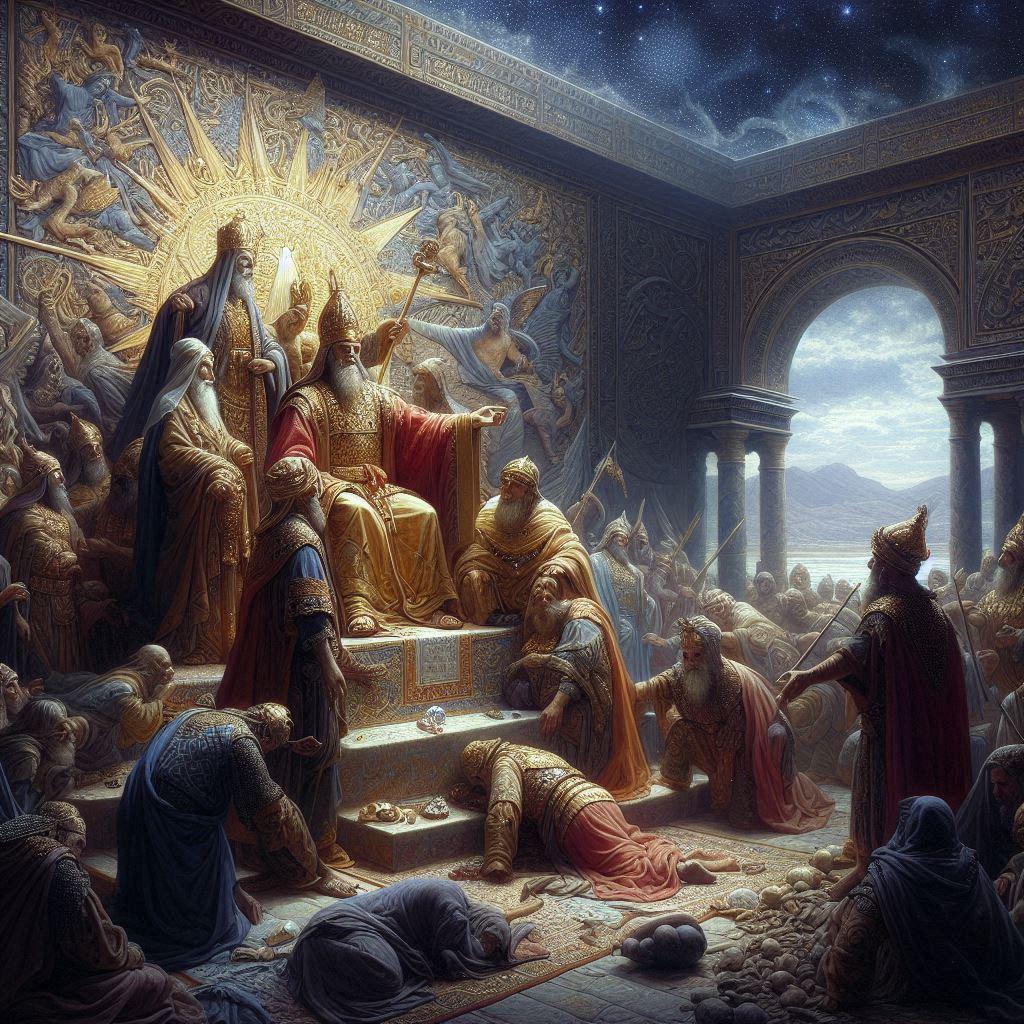
Suddenly the king’s carefree life was suddenly shattered by a strange dream. I had another dream that made me afraid. As I was lying in bed, the images and visions that passed through my mind terrified me. So I commanded that all the wise men of Babylon be brought before me to interpret the dream for me (4:4-6). The summons was more than just a friendly invitation. It was a command, which emphasized the seriousness of the situation. The king issued a command for the wise men to gather. Unlike the first time, Nebuchadnezzar only wanted the interpretation of his dream. He did not bother demanding that the wise men reveal the content as well.155 However, when the magi (Hebrew: chartom, refers to a magician or wise man, often associated with the practice of interpreting dreams, or performing magic)enchanters (Hebrew: ashshaph, refers to a class or wise men who were often consulted for their ability to interpret dreams, signs, and omens, and as such, were key figures in the king’s advisory team), sorcerers (Hebrew: kashaph, refers to the use of drugs, potions, or spells and is associated with “sorcery” or “witchcraft”) and diviners (Hebrew: gezar, primarily means to cut or divide. The term conveys a sense of separation or determination, often implying authority or finality in a decision being made. They were important in a religious society that was shaped by divine and royal decrees) came to see the king, he told them about the dream, but he was frustrated because they could not interpret it for him (4:7).

As he did in Chapter 2 (see AxDani’el Interprets the King’s Dream), Dani’el came to the rescue. Finally, Dani’el came into my presence and I told him the dream. After the experience of the first dream, when the wise men failed so miserably (see AsThe Challenge to the Magi), you would think Nebuchadnezzar would have bypassed his advisers and called Dani’el immediately. But it seems in the record of both dreams, Dani’el was kept apart from the wise men, even though he was chief of the magi. This title was not meant to be a compliment. It was appropriate because that had been Dani’el’s position since 2:48, when he became the head of the Babylonian school of astrology. In practice, however, Dani’el never performed astrology or any other form of sorcery.

He is called Belteshazzar (meaning Bel protect life), after the name of my god (Bel). When Nebuchadnezzar acknowledged that the spirit of the gods was with Dani’el, he was simply addressing him as a master astrologer. At this point, Nebuchadnezzar was obviously polytheistic although he had acknowledged YHVH’s sovereignty years before (2:27 and 3:28-29).156 I said, “Belteshazzar, chief of the magi, I know that the spirit of the gods [or God] is in you, and no mystery is too difficult for you. Here is my dream; interpret it for me (4:8-9). These are the visions I saw while lying in bed: I looked, and there before me stood a tree in the middle of the land.
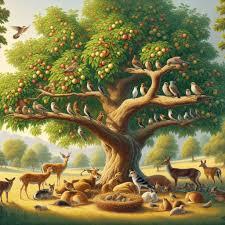
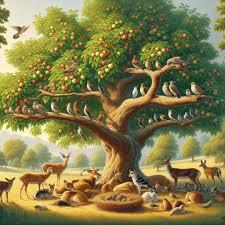
The first part of the dream (4:10-12): Nebuchadnezzar remembered the dream vividly. This time, it was not an image of an enormous statue, but of an enormous tree. The height of the tree was enormous. The tree grew large and strong and its top reached the heavens; it was visible to the ends of the earth. Its leaves were beautiful, its fruit abundant, and on it was food for all. Under it the wild animals found shelter, and the birds lived in its branches; from it every creature was fed. It was truly unique. Previously, Nebuchadnezzar had traveled to Lebanon to watch the felling of the great cedars to provide timber for his construction projects in Babylon. The tree he saw in his dream was significant because of its size and beauty. The tree bore so much fruit that there was enough for all living creatures. The animals of the earth rested in its shadows and the birds nested in its branches. It was an ideal setting.

The second part of the dream (4:13-15a): The first part of the king’s dream probably would have caused Nebuchadnezzar no concern. In fact, it may have produced pride as he recognized himself as the tree who provided bountifully for the subjects of his reign. But the second part of the dream, that the tree was to be cut down, turned into a troublesome nightmare.157 After the description of the tree, the king narrated the plot. It begins with the appearance of a “messenger.” In the visions I saw while lying in bed, I looked, and there before me was a holy one, an angelic messenger, coming down from heaven. He made sure that the commands of Ha’Shem were carried out. With a shout, the angel gave the order that the great tree was to be cut down and its branches trimmed. Not only that, but its leaves were to be stripped off and its fruit scattered. The animals were to flee from under it and the birds from its branches. But he commanded that the stump and its roots, bound with iron and bronze, remain in the ground, in the grass of the field. The stump indicates that even though the tree is to be devastated, the tree’s stump was to be preserved, yet bound with iron and bronze. As we will see later, 4:23 and 26 demonstrate that this metal band is symbolic of the preservation of Nebuchadnezzar’s life and kingdom.158

The third part of the dream (4:15b-16): In the third part of Nebuchadnezzar’s dream, the tree had abruptly morphed into a person. This must have been even more terrifying as the king realized that he would live like an animal for seven years. Let him be drenched with the dew of heaven, and let him live with the animals among the plants of the earth. Let his mind be changed from that of a man and let him be given the mind of an animal, till seven years pass by for him (see BxHumiliation: The King’s Discipline).

The purpose (4:17-18): This dream was designed to be a part of God’s revelation of Himself and His authority over Nebuchadnezzar who in pride had exalted himself above YHVH. The decision is announced by messengers, the holy ones declare the verdict, so that the living may know that the Most High is sovereign over all kingdoms on earth and gives them to anyone he wishes and sets over them the lowliest of people (4:17). ADONAI saw the pride in Nebuchadnezzar’s heart and was prepared to deal with it. The king could issue his decrees, but it was the decrees from the throne in heaven that rules the events on earth (4:17 and 24, 9:24-27). ADONAI has made the heavens His throne; from there He rules over everything (Psalm 103:19 NLT).159 This is the dream that I, King Nebuchadnezzar, had. Now, Belteshazzar, tell me what it means, for none of the wise men in my kingdom can interpret it for me. But you can, because the spirit of the gods is with you (4:18). With his account of the dream concluded, Nebuchadnezzar turns with confidence to Dani’el in order to hear his interpretation (see BvInterpretation: The King’s Danger).

Dear heavenly Father, praise You that as the Almighty Sovereign Ruler of the universe You have amazing love that seeks to bless by guiding and warning so they bend the knee before You worshiping and acknowledging you as the King of heaven, so You can pour Your love on them. You can see into the heart and You desire a heart that loves You back and repents/turns from wrong to following You. The Lord is not slow in keeping His promise, as some consider slowness. Rather, He is being patient toward you – not wanting anyone to perish, but for all to come to repentance (Second Peter 3:9). You are sovereign over the realms of men and women. The same sun that hardens clay, melts wax. Lord, let my heart melt like wax in love and obedience to You. To the One who sits at Your right hand. Amen.

2025-06-24T09:48:29+00:000 Comments

Bt – The Dream of the Great Tree 4: 1-37

The Dream of the Great Tree
4: 1-37

The Fall and Rise of Nebuchadnezzar.

Chapter 4 is the last of the cycle of events in which God is dealing with Nebuchadnezzar. It is similar to Chapter 2 in the sense that it has a dream as its centerpiece, but it stands in contrast to both Chapters 2 and 3 because there is no hint that Dani’el or his friends are in personal danger. This chapter deals with God’s sovereignty and Nebuchadnezzar’s pride. As in Chapter 2, a dream forms the center of the action in Chapter 4. King Nebuchadnezzar is again the recipient of a dream he cannot interpret and, for a second time, he calls on the services of Dani’el. This chapter is written predominantly in the first person, though verses 19 through 33 revert to the third person. The story is a tale of court drama in a subdued way, since it quietly shows Dani’el succeeding where the Babylonian wise men fail.150

As far as God’s sovereignty is concerned, Dani’el 4 will show, there are several principles that were already spelled out centuries earlier in the book of Job, where we read: For God speaks one, even twice, though people do not listen. He speaks in dreams, in visions of the night, when deep sleep falls upon people as they lie in their beds. He whispers in their ears and terrifies them with warnings. He makes them turn from doing wrong; He keeps them from pride. He protects them from the grave, from crossing over into sh’ol (Job 33:14-18). According to verse 14, even when God speaks once or twice, people do not listen. Now God has spoken to Nebuchadnezzar twice thus far in Dani’el: in Chapters 2 and 3. According to Job 33:15, God speaks through dreams and visions, which corresponds with the description of Nebuchadnezzar’s dream in Dani’el 2 (to see link click AwThe King’s Dream). According to Job 33:16, ADONAI instructs mankind. According to verse 17, He opposes pride. The reason for His intervention is given in verse 18: He must act against a person’s pride in order to help the sinner preserve their soul. The events described in Dani’el Chapter 4 illustrate in practice the principles outlined in Job.151

As far as Nebuchadnezzar’s pride is concerned, Chapter 4 recounts his extraordinary transformation to an animal-like creature, roaming in the fields, before being restored to his former splendor. His insanity was a mental disorder known as lycanthropy, a rare psychiatric syndrome that involves a delusion that the affected person has transformed into a non-human animal. It was well known in pre-scientific times, but is not referred to today under that name. This is a unique chapter in the Bible because it’s an official autobiographical document (except for verses 28-33), prepared by the king of Babylon and distributed throughout his kingdom. That Nebuchadnezzar should openly admit his pride, his temporary insanity, and his beastly behavior, and then give glory to the God of Isra’el for his recovery, is indeed a remarkable thing. He learned an important lesson the hard way just as people are learning it the hard way today: Pride goes before destruction, a haughty spirit before a fall (see Proverbs Co – Pride Goes Before a Fall).152

There are five “acts” in this extraordinary drama. This chapter, verses 1 through 37 can be broken down in chiastic fashion, resulting in a mirror effect as the ideas are “reflected” back and forth in the passage: A to A, B to B, with C being the climax of the chiasm.

A. Agitation: The King’s Dream – 4:4-18 (Bu)

B. Interpretation: The King’s Danger – 4:19-26 (Bv)

C. Exhortation: The King’s Decision – 4:27 (Bw)

B. Humiliation: The King’s Discipline – 4:28-33 (Bx)

A. Redemption: The King’s Deliverance – 4:34-37 and 1-3 (By)

2025-06-25T09:09:27+00:000 Comments

Bs – The Significance of Dani’el Chapter 3 to the Times of the Gentiles

The Significance of Dani’el Chapter 3
to the Times of the Gentiles

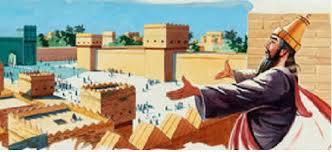
Luke describes this period of time when he wrote: They will fall by the sword and will be taken as prisoners to all the nations. Jerusalem will be trampled on by the Gentiles until the times of the Gentiles are fulfilled (to see link click Ao The Times of the Gentiles). This can best be defined as that long period of time from the Babylonian Captivity (see the commentary on Jeremiah GuSeventy Years of Imperial Babylonian Rule) to the Second Coming of Messiah, during which time the Gentiles have complete dominance over Jerusalem. This does not rule out temporary Jewish control of the City until the Second Coming. Such temporary control was exercised during the Maccabbean Period (164-163 BC), the First Jewish Revolt against Rome in 66 AD, and the Second Jewish Revolt (the Bar Kochba Revolt) against Rome (132-135 AD), and since 1967 as a result of the Six Day War. This, too, was temporary, since Gentiles will trample down the holy City for at least another 1,260 days (see the commentary on Revelation BxThe Tribulation Temple). Therefore, any Jewish takeover of the City of Jerusalem before the Second Coming must be viewed as temporary and does not mean that the Times of the Gentiles have ended. The Times of the Gentiles can only end when the Gentiles no longer trample down the City of Jerusalem.149
2025-06-19T12:00:20+00:000 Comments

Br – Nebuchadnezzar’s Decree Honoring the Jews and Their God 3: 28-30

Nebuchadnezzar’s Decree Honoring the Jews and Their God
3: 28-30

Nebuchadnezzar’s decree honoring the Jews and their God DIG: Why did the king reward Shadrach, Meshach and Abednego even though they defied him? What was the fate of all those who opposed them? Do you think this experience made him a believer? Why? Why not? What other reason might the king have had to reward them? Why did ADONAI include this story in the TaNaKh?

REFLECT: When did you know that the LORD was with you in the fiery furnace? When was the last time you “went along with the crowd” and regretted it? Are you willing to give up your life rather than serve or worship any god except ADONAI? How is this story of the Hebrews in the fiery furnace an encouragement to you today? Where is it the most difficult to maintain your identity as a believer? 

This story is an encouragement in Dani’el’s day, our day, and in the future.

Nebuchadnezzar and his officers had just been presented with irrefutable proof that the God of Isra’el was superior to all other gods. They had witnessed a miracle. Because they were present throughout the entire event, they were unable to claim that some trickery had been used. They had no choice but to accept the reality that the God of Hananiah, Mishael, and Azariah had accomplished something that the gods of Babylonia could never do.146

Then Nebuchadnezzar declared: Praise be to the God of Shadrach, Meshach and Abednego, who has sent the Angel of ADONAI (to see link click BqThe Vindication of the Jews) and rescued His servants! They trusted in Him and defied the king’s command and were willing to give up their lives rather than serve or worship any god except their own God (3:28). The pagan king expressed his administration for those young men because of their willingness to defy the king’s command and suffer a horrible death in order to remain true to their God. Although angered by their actions, he respected their commitment. Even in today’s world, unbelievers may not understand or appreciate our convictions, but usually they respect those who are willing to take a stand for ADONAI.

Therefore, I decree that the people of any nation or language who say anything against the God of Shadrach, Meshach and Abednego be cut into pieces and their houses be turned into piles of rubble, for no other god can save in this way. Such a command coming from the king is astounding, but one must consider the circumstances – Nebuchadnezzar had just witnessed a miracle. This decree may also have been an attempt to appease the God of Isra’el, for the king had mistreated God’s followers and actually challenged His power. Thus, Nebuchadnezzar may have realized that he was in danger of divine retaliation. Shadrach, Meshach and Abednego were not only honored by the king but they were rewarded. Then the king caused them to prosper in the province of Babylon (3:29-30). Probably material rewards and respect among the people were involved as well as a job promotion. As a result, faithfulness in a horrible trial resulted in a great blessing for the young Jewish men.147

Why did ADONAI include this story in the TaNaKh? For the same reason He included the stories about faith experiences of Abraham, Moses, Joshua, David, and the prophets: to encourage God’s people in our battle against the world, the flesh, and the devil (First John 1:15-16 and James 1:27). For everything that was written in the past was written to teach us. And the Scriptures give us hope and encouragement as we wait patiently for God’s promises to be fulfilled (Romans 15:4).

Encouragement in Dani’el’s day: Things looked very bleak for the Jewish people during the Babylon Captivity (see the commentary on Jeremiah GuSeventy Years of Imperial Babylonian Rule). Their homeland was devastated, the Temple and Jerusalem were in ruins, and the people were either scattered among the Gentile nations or in bondage in Babylon. The situation looked hopeless. The prophets foresaw the day when the Jews would return to their Land and rebuild the Temple and the City; but first, they had to endure the shame and suffering of the captivity.

The experience of Hananiah, Mishael, and Azariah must have greatly encouraged the faithful Jews and brought conviction to the Jews who were living with the pagan Babylonians. Those three men sent a strong message to their people: ADONAI Elohim was still on the throne. He hasn’t abandoned us, and He will fulfill all the promises He has made to His people. YHVH promised to be with them in their furnace affliction if they would trust and obey Him. Later, when the believing remnant returned to the Land (see the commentary on Ezra-Nehemiah AkNumbering the Exiles Who Returned Under Zerubbabel), the account of the fiery furnace must have helped to sustain them in those years of difficulty and delay.

Encouragement in our day: Life may be fairly safe and comfortable where you and I live, but in many parts of the world, God’s people are paying a high price to maintain their testimony and their separation from the world. Day after day, they hear the herald shouting, “Fall down before the golden statue! Everybody is doing it!” In his first letter, Peter warned that the “fiery trial” was about to begin, and surely they remembered what happened to the three Hebrew men in the days of Nebuchadnezzar. We are told that there were more martyrs for Messiah during the twentieth century than during all the preceding centuries (for more information on that topic, see Foxe’s Book of Martyrs). Not all believers have been spared death in the furnace, but they haven’t spared compromising their witness of Messiah, taking the easy way out.

As we move toward the end of the Dispensation of Grace (see the commentary on Hebrews BpThe Dispensation of Grace), the furnace of opposition will be heated seven times hotter, and the pressure to conform will become stronger and stronger. It will take a great deal of grace, prayer, courage, and faith for God’s people to stand tall for Messiah while others are bowing down to the gods of this world. The book of Dani’el is a great source of encouragement, because it reminds us that ADONAI cares for His people and honors them when they are true to Him. Those who honor Me, I will honor (First Samuel 2:30a).

Encouragement for the future: The events in Dani’el Chapter 3 remind us of the prophecies found in the book of Revelation, especially Chapters 13 and 14. Those who were left behind at the Rapture (see the commentary on Revelation ByThe Rapture of the Church) will still have the opportunity to be saved, but they will have to spend some time in the furnace. As believers, we know that we are not appointed to suffer wrath (First Thessalonians 5:9a), and will be in heaven with the Lord during the Great Tribulation because Rosh Ha’Shanah (see the commentary on Numbers FeThe Rosh ha’Shanah Offering) comes before Yom Kippur (see Numbers FfThe Yom-Kippur Offering).

However, for those left behind, one day there will arise a world leader like Nebuchadnezzar (see Revelation DnAll the Inhabitants of the Earth Worship the Beast). The people who obey will be given a special mark on their forehead or their hand, and this mark will be the passport for staying alive and doing business (see Revelation DpThe Mark is the Name of the Beast). Those who refuse to obey will be persecuted and many will be martyred (see Revelation CpThe Fifth Seal: I Saw Under the Altar Those Who Had Been Slain). But the Lord will seal to Himself 144,000 Jews whom the Beast will not be able to touch (see Revelation DtAnd They Sang a New Song Before the Throne), and those who believe will come through the Great Tribulation to reign in Messiah’s Kingdom.148

2025-06-19T11:46:53+00:000 Comments

Bq – The Vindication of the Jews 3: 24-27

The Vindication of the Jews
3: 24-27

The vindication of the Jews DIG: What is ironic about the Babylonian soldiers dying and the three Hebrew men living? Who was the fourth figure in the furnace? Where is the Angel of ADONAI found in the TaNaKh? What was Nebuchadnezzar’s response to the miracle? How did it fulfill the prophecy by Isaiah?

REFLECT: Has there ever been a period in your life when you knew there was someone with you in the furnace? If you were to write about your adventures in faith, what would the title be? What is the most difficult place for you to maintain your identity as a believer? Who can you pray for this week?

Every time the Angel of ADONAI is mentioned in the TaNaKh,
it is always a preincarnate appearance of the Messiah.

Nebuchadnezzar was prepared to watch Shadrach, Meshach and Abednego disintegrate into flames, but he was not prepared for what he saw. When the king saw that the three men were unharmed by the raging flames, his rage quickly turned to bewilderment. Then King Nebuchadnezzar leaped to his feet in amazement and asked his advisers, “Weren’t there three men that we tied up and threw into the fire?” They replied, “Certainly, Your Majesty” (3:24).

Was there a God who could rescue Shadrach, Meshach and Abednego from the hands of such a powerful ruler? Nebuchadnezzar himself gives us the answer. He said, “Look! I see four men walking around in the fire, unbound and unharmed, with their ropes evidently burned away. The description reveals that the three men were in no hurry to escape from the flames, but were walking around unharmed (3:25a). The majority of Jewish scholars have identified this fourth person as an angel. For example, Slotki remarks, “The Talmud asserts that it was the archangel Gabriel (Pes. 118a-b). The majority of rabbis believe that Nebuchadnezzar was permitted to see the angel even though he did not deserve it on his own merit. Seeing “the fourth man” in the fiery furnace did not mean that Nebuchadnezzar attained any insight into prophecy as Dani’el did. He was simply permitted to see “the fourth man” because it served God’s purposes.

But this was no ordinary angel because “the fourth man” looked like the Son of God (3:25b). Only Yeshua can save. Even a powerful angel like Gabriel, who makes announcements (Dani’el 8:16, 9:21, and Luke 1:19), or like Michael, the great prince who fights with the Adversary (Dani’el 10:13, 12:1, Jude 1:9 and Revelation 12:7) never saved anyone. From a Messianic perspective, every time the Angel of ADONAI is mentioned in the TaNaKh, it is always a preincarnate appearance of Yeshua Messiah. Therefore, “the fourth man” in the fiery furnace was the Second Person of the Trinity. It is certainly true that when believers go through fiery trials, Messiah is with us. God did not simply rescue His servants from the fire, He sent His Son to pass through the fire with them, a Presence that takes richer dimensions in the B’rit Chadashah when YHVH comes to dwell physically with us as Immanuel (Matthew 1:23).

The Angel of ADONAI is seen in many places in the TaNaKh, and each time points to the preincarnate Messiah. Here are seven examples. The first example of the Angel of ADONAI in the TaNaKh was with Hagar near a spring in the Negev desert. The Angel of ADONAI told her to go back to Sarah: You are now with child and you will have a son. You shall name him Ishmael (see the commentary on Genesis EjHagar and the Angel of the LORD).

The second example of the Angel of ADONAI was with Abraham, and was told by God, “Take your son, your only son, Isaac, whom you love and sacrifice him there as a burnt offering on one of the mountains I will tell you about. Abraham was obedient, and just as he raised the knife to sacrifice his son, the Angel of ADONAI called out to him from heaven, saying: Abraham, Abraham! Do not lay a hand on your son. Now I know that you fear God, because you have not withheld your son, your only son from Me (see Genesis FoAbraham Called that place The LORD Will Provide).

Thirdly, when Moses was tending the flock of Jethro, his father-in-law, the priest of Midian, he suddenly found himself confronted by a burning acacia bush. But there was something different about it; Moshe saw that though the bush was on fire it did not burn up. There, within the burning bush, the Angel of ADONAI appeared to him and said: Do not come any closer. Take off your sandals, for the place where you are standing is holy ground (see the commentary on Exodus AqFlames of Fire from within a Burning Bush).

The fourth example of the Angel of ADONAI was with Balaam. Going to meet the rulers of Mo’ab, Balaam saddled his donkey. But God was very angry with him because the LORD knew full well that despite his superficial piety, Balaam fully intended to curse Isra’el. Therefore, the Angel of ADONAI blocked Balaam’s path three times. Finally, on the third attempt, God opened Balaam’s eyes, so that he could see the Angel of ADONAI standing in the way with His drawn sword in His hand. Then Balaam bowed his head and fell on his face (see the commentary on Numbers DrBalaam and the Donkey).

Fifthly, God raised up Deborah to be the fourth judge in Isra’el’s cycle of judgment and deliverance. The Canaanite kings came into Isra’el looking for the spoils of battle, but they left empty handed, trusting in their chariots, which proved inadequate to save them. While retreating, the Israelite city of Meroz failed to do its duty. They sided with the Canaanites and let those fleeing through Meroz escape when they should have blocked their path and put them to death. “Curse Meroz!” said the Angel of ADONAI, “Curse the people living there with a bitter punishment for not coming to help ADONAI, to help ADONAI against the mighty warriors.” Their sin wasn’t simply failing to assist Isra’el; they failed to help ADONAI (see Judges Bb – The Defeat of the Canaanites).

The sixth example of the Angel of ADONAI came after the Israelite victory over the Canaanites. But the passing years blurred the memory of the great deliverance and the next generation reverted to an easy-going syncretistic religion that once again threatened to obliterate Isra’el’s distinctive worship of YHVH. After being enslaved by the Midianites, the people cried out to God, and He raised up Gideon as a new judge. The Angel of ADONAI came and sat down under the oak in Ophrah that belonged to Joash the Abiezrite, where his son Gideon was threshing wheat in a winepress to keep it from the Midianites. When the Angel of the ADONAI appeared to Gideon, He said, “You courageous hero! ADONAI is with you (see Judges Bf – The Call of Gideon).

The seventh example of the Angel of ADONAI came on the heels of the Assyrian invasion in the fourteenth year of Hezekiah’s reign, when Sennacherib king of Assyria attacked all the fortified cities of Judah and captured them (Isaiah 36:1). But then he went one step beyond where God permitted by sending a letter to Hezekiah saying that ADONAI could not help the Jews. When Hezekiah received the letter from Sennacherib he went up to the Temple of LORD, and spread it out before ADONAI as a symbolic act, displaying the Assyrian’s blasphemies in the presence of God. And Hezekiah prayed: ADONAI-Tzva’ot, God of Isra’el . . . listen to all the words Sennacherib has sent to insult the living God (37:14b-15). Then, that night the Angel of ADONAI went out and put to death a hundred and eighty-five thousand men in the Assyrian camp. When the people in Jerusalem got up the next morning, there were all the dead bodies in front of them (see the commentary on Isaiah GwThen the Angel of the LORD Put to Death a Hundred and Eighty-Five Thousand Men in the Assyrian Camp).

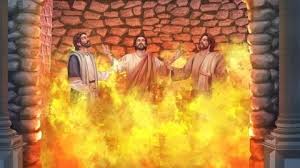
Continuing with the story, then Nebuchadnezzar approached the opening of the blazing furnace and shouted, “Shadrach, Meshach and Abednego, servants of the Most High God, come out! Come here!” So Shadrach, Meshach and Abednego came out of the fire, and the satraps, prefects, governors and royal advisers crowded around them. The young men were not merely unharmed, their clothing did not even smell of smoke. They saw that the fire had not harmed their bodies, nor was a hair of their heads singed; their robes were not scorched, and there was no smell of fire on them (3:26-27). A powerful testimony to the extent of their salvation by the Angel of ADONAI.

This was the fulfillment of the words the LORD had spoken to His people through Isaiah the prophet two centuries later: When you pass by the waters, I will be with you; when you pass through the rivers, they will not overwhelm you; when you walk through the fire, you will not be scorched . . . the flames will not burn you” (Isaiah 43:2). Notice that God didn’t promise to take his people around the rivers or to keep the fire from them. On the contrary, trials and hardships are the anticipated path for the people of God, then and now. After preaching the Good News, Paul and Barnabas returned to Pisidian Antioch strengthening the disciples and encouraging them to remain true to the faith, saying: We must go through many hardships to enter the Kingdom of God (Acts 14:21-22).

Trials provide the context in which our faith shines with unmatched clarity before the eyes of a world. Rejoice in this, even though for a little while you may have to experience grief of various trials. Even as gold is tested for genuineness by fire. The purpose of these trials is so that the genuineness of your trust, which is far more valuable than perishable gold, will be judged worthy of praise, glory and honor at the revealing of Yeshua Messiah (First Peter 1:6-7). It is precisely in the furnace that the reality of our faith is displayed most clearly. Yet, in the midst of those trials and difficulties, our Lord promises that we can count on His Presence to be with us, ensuring that our trials would not utterly overwhelm us. ADONAI doesn’t stand far off from us when we need His help; He has promised to be God with us, Immanuel. As a result, nothing in all of creation can separate us from God’ love (see the commentary on Romans CmThe Certainty of Redemption).145

2025-06-17T11:37:07+00:000 Comments

Bp – Dani’el’s Friends Punished 3: 19-23

Dani’el’s Friends Punished
3: 19-23

Dani’el’s friends are punished DIG: Why was Nebuchadnezzar so overwhelmed with rage? Why were Shadrach, Meshach and Abednego thrown into the fiery furnace wearing their robes, trousers, turbans and other clothes? What happened to the soldiers who threw them into the furnace? Why was that ironic?

REFLECT: When have you been so angry that you couldn’t think straight? Haste makes waste. What did Yeshua mean when He said, “whoever wants to save his life will lose it, but whoever loses his life for me will find it?” Why would ADONAI be with Shadrach, Meshach, and Abednego, but not with His own Son?

Like Shadrach, Meshach, and Abednego,
Yeshua’s obedience was tested and found faithful until death.

The three Jews confession of faith in the God of Abraham, Isaac, and Jacob (to see link click BoThe Jews Confess Their Faith), courageous to us, exasperated Nebuchadnezzar. He was furious with Shadrach, Meshach and Abednego for refusing to serve his gods or worship the statue of gold that he had set up. He was so overwhelmed with rage that he couldn’t think straight anymore and his facial expression changed toward them. The king’s pride was severely wounded, so he ordered a furnace, evidently burning in the background of the scene, heated seven times hotter than usual (3:19). This picture is not to be understood literally, perhaps reflecting the heat of his own anger. The writer is using a proverbial expression meaning as hot as possible (Proverbs 24:16 and 26:16).138 This decision showed a lack of thinking because if this was supposed to be torture, the hotter the fire, the shorter the period of suffering during the execution.

And the king also commanded some of the strongest soldiers in his army to tie up Shadrach, Meshach and Abednego and throw them into the blazing furnace. But this didn’t make any sense either. It was not as though the three Jews could have escaped those powerful soldiers. The king was so anxious to carry out the death sentence that the executioners were not even permitted time to strip the prisoners of their clothes. Again, it seems that Nebuchadnezzar just wasn’t thinking logically. So these men, wearing their robes, trousers, turbans and other clothes, were bound and thrown into the blazing furnace (3:20-21). This detailed reference to their clothing serves to heighten the extraordinary nature of their eventual deliverance, since even their clothes would not even smell like smoke (3:28). As government officials, Shadrach, Meshach and Abednego were clothed in upper-class garments that were befitting the occasion. Yet, Nebuchadnezzar didn’t bother to have them removed. The whole scene gives us a sense of haste; a hurry to carry out the king’s decree. Having bound the three Jews, the soldiers carried them to the furnace and threw them in.139

The king’s command was so urgent and the furnace so hot that the flames of the fire killed the soldiers who took up Shadrach, Meshach and Abednego, and these three men, firmly tied, fell into the blazing furnace (3:22-23). The furnace was used for smelting ore. It had a large opening at the top through which fuel and vessels full of ore could be placed into the fire and there was a door at the bottom through which the metal was taken out. An opening in the wall enabled the smelters to check on the progress of their work, and through the holes in the wall they could use bellows to make the fire blaze even more. It was large enough for at least four people to walk around in. It was into this furnace that Nebuchadnezzar cast the three faithful Jews, fully clothed and bound.140

When the soldiers approached the furnace from the edge of the cliff or ascending slope, they were able to get close enough to its opening to throw their prisoners inside. Evidently, because of the extreme heat or a shift in the wind, the soldiers were consumed by the flames.141 There is a great irony here, to be sure. The ones who obeyed Nebuchadnezzar’s commands died, while those whom he condemned to death emerged alive! What a vivid demonstration of Yeshua’s statement that whoever wants to save his life will lose it, but whoever loses his life for me will find it (Matthew 16:25). The issue was not whether Isra’el’s God could keep His servants alive, but whether Nebuchadnezzar could! In a similar way, our own idols often turn out to be liars, unable to deliver either the rewards that they promise or the judgments they threaten.142 But what about those who refuse obedience when it comes to a choice between faithless Nebuchadnezzar and to ADONAI Himself? Was there a God who could rescue them from the hands of such a powerful ruler?143 Nebuchadnezzar himself gives us the answer (see BqThe Vindication of the Jews).

Like Shadrach, Meshach, and Abednego, Yeshua’s obedience was tested and found faithful until death. He went through His own personal furnace experience completely alone. ADONAI was with the three Jewish men in the fire, and we have the promise of the Lord’s sustaining presence with us in our trials, but on the cross Yeshua felt the utter loneliness of total abandonment by YHVH. When the fire of God’s wrath burned Him to the core and blazed unchecked over Him, He was entirely alone. There was no companion to share His burden, no angel was sent to relieve His agony, no saving hand from God stretched down to preserve His faithful Servant in His moment of greatest need. For Yeshua, there was no deliverance from experiencing the power of the final enemy, death itself.

Now why would ADONAI be with Shadrach, Meshach, and Abednego, but not with His own Son? Why would He be faithful to His promise to be with Isra’el, sinners as they were (Isaiah 64:5), and then abandon Yeshua, His perfect chosen One? You would expect it to be the other way around.

The answer to that question is that on the cross, Yeshua was taking into Himself the fiery pains that we deserve for our compromise to idolatry. Unlike Dani’el’s three friends, we are no heroes of the faith. Every time we bow down to the idols of our own hearts, we deserve the judgment curse of Ha’Shem. We choose to escape the fiery threat of our idols, but only at the cost of earning the fiery judgment of God for our unfaithfulness. Nebuchadnezzar is not the only one who condemns to the fire those who will not bow the knee to Him (Revelation 20:14). ADONAI rightfully demands the wholehearted worship of those whom He has created. Yet, in the case of His people, the LORD took all of our fiery judgment curse and laid it on His own Son. Yeshua personally paid the price of our hell during those six hours on the cross so that we might pass through the threatening fire unburned and emerge safely out on the other side. What is more, all of Messiah’s perfect righteousness was transferred to our spiritual bank accounts at the moment of faith. Therefore, a faithfulness that far exceeds that of Shadrach, Meshach, and Abednego is now ours as a free gift. And we are welcomed into the presence of God for Messiah’s sake.144

Dear heavenly Father, praise You that nothing is impossible for You (Luke 1:37)! Your Steadfast Love, Infinite Wisdom and Almighty Power work together so you are totally able to rescue me from any spiritual problem or trial. Thank You that You were willing to put on human flesh and come down from Your heavenly home and be there with Dani’el’s three friends. But King Nebuchadnezzar answered saying: Look! I see four men walking about unbound and unharmed in the middle of the fire, and the fourth has the appearance like the Son of God (Dani’el 3:25)!

You appeared to Abraham at Mamre when he saw “three men”. Then ADONAI appeared to him at Mamre’s large trees while he was sitting in the entrance of his tent during the heat of the day. When he lifted up his eyes to see, suddenly, three men were standing right by him. When he saw them, he ran from the entrance of his tent to meet them and bowed down to the ground (Genesis 18:1-2) . . .Then He said, “I will most surely return to you in about a year’s time, surprisingly, Sarah your wife will have a son.” (Genesis 18:10 also 16-22). Your children worship and exalt Your holy Name and we love to live our lives trusting You with a heart full of love and joy to put You first at all times- even in circumstances when death is possible. In Messiah Yeshua’s holy Name and power of His resurrection. Amen

2025-06-17T11:38:43+00:000 Comments

Bo – The Jews Confess Their Faith 3: 16-18

The Jews Confess Their Faith
3: 16-18

The Jews confess their faith DIG: What were the three Hebrews concerned with? How did they challenge king Nebuchadnezzar? Why are believers who fast and pray not healed? As we get closer to the Second Coming of Messiah, what kinds of compromises do you think we will face as a people of faith?

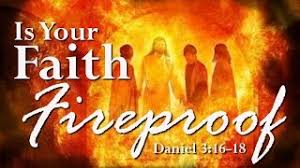
REFLECT: Is your faith fireproof? How do you think it would feel to make a choice of faith that you knew could very easily result in your own death? How would you define the kind of faith that gives you the strength not to conform? When has ADONAI carried you through tough times because of your obedience?

True faith doesn’t look for loopholes; it simply obeys God.

After being threatened with death by the Babylonian king (to see link click BnDani’el’s Friends Questioned) Shadrach, Meshach and Abednego replied to him, “King Nebuchadnezzar, we do not need to defend ourselves before you in this matter (3:16). There was nothing the three could say in their own defense. They were technically guilty, but they had also been misrepresented. They could make excuses, but true faith doesn’t look for loopholes; it simply obeys God and knows that He will do what is best. Faith rests on commands and promises, not arguments and explanations. Times of adversity are usually times of opportunity, especially when ADONAI’s people are being persecuted for their faith. Yeshua says: You will be handed over to the local councils and beaten in the synagogues. You will stand trial before governors and kings because you are My followers. But this will be your opportunity to tell them about Me (Mark 13:9 NLT). The three courageous Jews weren’t concerned about themselves, nor were they afraid of the fury of the king. Their only concern was obeying YHVH and giving a faithful witness to all who were watching and listening. Their attitude was respectful and their words were few and carefully chosen.133

Then the Jews responded with a challenge of their own, saying: If we are thrown into the blazing furnace, the God we serve is able to deliver us from it, and he will deliver us from Your Majesty’s hand. Shadrach, Meshach, and Abednego did not presume to predict what the outcome would be in their case. If God were our servant, our assistant, He would be predictable: He would always do our bidding. However, those young men understood that since God is Sovereign, it was His choice whether He opted to be glorified in their deaths or through their dramatic deliverance. Either way, they would not compromise their commitment to the LORD. Live or die, they would be faithful to their God.134

Shadrach, Meshach, and Abednego had witnessed ADONAI’s power over the false gods of Babylon in that matter of the king’s dream (see AwThe King’s Dream), and they had studied the TaNaKh. This included the accounts of the great wonders YHVH had performed for Isra’el, miracles that those young men would have heard and believed. There was no question in their minds that the God who divided the Sea of Reeds and performed the other miracles in delivering Isra’el from Egypt, could do the same for them . . . if that was His will. This explains the confidence they exhibited when they declared: But even if he does not, we want you to know, Your Majesty, that we will not serve your gods or worship the statue of gold you have set up (3:17-18). Even if they had to suffer a horrible, painful death in a burning oven, they refused to abandon their God and worship idols.

This is an important lesson for believers today. The Lord may allow trials to come into our lives to build character or for a number of other reasons (Romans 5). The purpose for our trials may not be understood, but God simply asks that we trust/believe/have faith in Him – even when it’s not easy. As Job, who endured incredible suffering, exclaimed: Though He slay me, yet will I hope in Him (Job 13:15a). Although God does not guarantee us that we will never suffer or experience death, He does promise always to be with us. In times of trial our attitude should be that of these young men. As Messiah told His apostles: Do not be afraid of the One who can destroy both but cannot kill the soul. Rather, be afraid of the One who can destroy both the soul and the body in hell (Matthew 10:28). This explains the confidence exhibited by Shadrach, Meshach, and Abednego as they declared: But even if he does not save us, we want you to know, Your Majesty, that we will not serve your gods or worship the image of gold you have set up (3:17-18). Similar words have been uttered countless times throughout the centuries as believers have suffered martyrdom for the Lord. Certainly, those Hebrews were convinced that even if they perished in the flames, there was a better life beyond with father Abraham and the righteous of the TaNaKh.135

This was the finest hour of these three confessors. Their faith did not hold fast simply by accident or by the decision of the moment. It had grown strong because in previous tests they had grown strong in faith as they had given glory to God (Romans 4:20). As they looked back on the crisis of the fiery trial, they must have seen the previous tests in a new light. Their significance was to prepare them for this monumental crisis so that through their faithfulness to ADONAI would echo down throughout the ages.136

Hebrews 11 lists the names and deeds of great men and women of faith, including these three Jewish men (Hebrews 11:34a), but in Hebrews 11:36, the writer says: “And others, and then lists people who seem to be failures in spite of their faith (see the commentary on Hebrews CvFaith Through Trials). The Greek word for “others” means others of a different kind. That is, others who had faith but didn’t see Ha’Shem do the miracles He did for those listed in Hebrews 11:1-35. The LORD always rewards faith, but He doesn’t always step in and perform special miracles. Not everyone who prays is healed, but God always gives strength to bear the pain and the grace to face death without fear. The three young men believed that God could deliver them, but they would trust Him even if He didn’t. That is how faith is supposed to operate in our lives.137

Even though the fig trees have no blossoms, and there are no grapes on the vines; even though the olive crop fails, and the fields lie empty and barren; even though the flocks die in the fields, and the cattle barns are empty, yet I will rejoice in ADONAI! I will be joyful in God my Savior. ELOHIM Adonai is my strength; He makes my feet swift and sure-footed as a dear, He enables me to stand on high places (Habakkuk 3:17-19).

Dear heavenly Father, praise You for Your great and painful sacrifice that You willingly paid to redeem me (Hebrews 12:2, Second Corinthians 5:21). How blessed I am that Your love does not stop at redeeming me, but You continue to work in mt life to mold and purify me to be more like Messiah. In this you rejoice, though now for a little while, if necessary, you have been grieved by various trials, so that the tested genuineness of your faith – more precious than gold that perishes though it is tested by fire – may be found to result in praise and glory and honor at the revelation of Yeshua Messiah (First Peter 1:6-7). Thank You for turning painful trials on their head, and for using them to help me to grow more like You, ADONAI, in my character. It is so wonderful that Your wisdom and love work together to make something beautiful out of trials by shaping my inner being to produce endurance, character and hope. We rejoice in hope of the glory of God. Not only that, but we rejoice in our sufferings, knowing that suffering produces endurance, and endurance produces character, and character produces hope, and hope does not put us to shame, because God’s love has been poured into our hearts through the Holy Spirit who has been given to us (Romans 5:2b-5). In Messiah Yeshua’s holy Name and power of His resurrection. Amen

2025-06-15T13:02:51+00:000 Comments

Bn – Dani’el’s Friends Questioned 3: 13-15

Dani’el’s Friends Questioned
3: 13-15

Dani’el’s friends questioned DIG: What are the ways that God claims to be unique? What titles and descriptions does God use of Himself? What does each mean? In what ways is He different from the idols in Isaiah 44:12-20? For what reason is idolatry mocked in these verses? In what ways do those who worship idols end up like the idols themselves? List some of the ways we are asked to compromise within our culture if we are going to fit in with the general public. What kind of concerns distract us from being concerned with what ADONAI wants from us? What are the empty vessels today?

REFLECT: What idols have people in our culture created for themselves? Why are people attracted to these false gods? With which ones do you struggle? How have you seen these false gods end up oppressing those who make them? Karl Marx said that “religion is the opiate of the people” to drug them into ignoring reality. How might the prophet agree with him? How do the modern forms of idolatry do that? How might worshiping God end up being an idol itself? How is true worship of the LORD different? In what way have you experienced that following these modern idols merely ends in futility?

The three Israelites knew that all idols are merely empty vessels.

A case could be made as early as Chapter 2 that Nebuchadnezzar reveals a sense of insecurity. This sounds surprising for the most powerful human being on the face of the earth, but with power and wealth come those who want to take it away for themselves, even if it means murder. Nebuchadnezzar’s insecurity is apparent in his treatment of the magi earlier (to see link click AsThe Challenge to the Magi), as well as his happiness after learning that he was the head of gold (see AyThe First Empire: A Head of Gold).128

Furious with rage that Shadrach, Meshach, and Abednego would not bow down before his statue (see BmThe Accusation Against the Jews) Nebuchadnezzar summoned them. Justice demanded that the three men should not be condemned on hearsay alone and therefore, despite his furious rage, Nebuchadnezzar gave them the opportunity to recant. Perhaps he had grown fond of them, or perhaps he had made a large investment of time and money on them. Whatever the reason, it was vital that the great king should not lose face before the magnificent gathering of international delegates.129

So these men were brought before the king. Almost in disbelief, Nebuchadnezzar said to them, “Is it true, Shadrach, Meshach and Abednego, that you do not serve my gods or worship the image of gold I have set up (3:13-14)? It is clear that the king regarded their disobedience as a personal affront. One could argue that they not only made the king feel that he owed them nothing, but that they owed him their allegiance! After all, it was Dani’el alone who had revealed the dream to the king (see AwThe King’s Dream). Nebuchadnezzar had only appointed the three to positions of authority at Dani’el’s request.130

Now when you hear the sound of the horn, flute, zither, lyre, harp, pipe and all kinds of music, if you are ready to fall down and worship the image I made, very good. But if you do not worship it, you will be thrown immediately into a blazing furnace. Then Nebuchadnezzar climaxes his threat with a statement that gets at the heart of the chapter: Then what god will be able to rescue you from my hand (3:15)? In light of the king’s experiences with the God of the Jewish people, this statement was one of defiance and showed surprising arrogance. Nebuchadnezzar’s tone had been quite different earlier when the king said to Dani’el, “Surely your God is the God of gods and the Lord of kings,” the ruler over the kings of the earth, and a Revealer of mysteries because ADONAI was the only God who was able to reveal this mystery (2:47). What had changed? Nebuchadnezzar had set up the golden statue after he had conquered Jerusalem (see Jeremiah GbThe Destruction of Solomon’s Temple on Tisha B’Av in 586 BC). That victory made him believe that he was supreme in his power and could defy the God whose City and Temple he had destroyed.131 However, later, he would change his tune (see Bx – Nebuchadnezzar’s Humiliation).

The Babylonian king could threaten the Jews all he wanted, but Shadrach (Hananiah), Meshach (Mishael) and Abednego (Azariah) knew something that Nebuchadnezzar didn’t. They had studied the TaNaKh and knew that all idols are merely empty vessels (see the commentary on Isaiah HtWorship the LORD, Not Idols). The Achilles’ heel of all paganism is idol making. And the line of reasoning used by Isaiah to reveal it is detailed and devastating. In Isaiah 40:18-20 and 41:5-7, idols were exposed by contrasting them to the holiness of ADONAI. But in Isaiah 44:6-20 that argument is reversed, the glory of God is seen in contrast to the absurdity and uselessness of idols. Instead of logical rejection of idol worship, Isaiah appeals to our imagination to drive home the final nail of persuasion. Thus, when he finished his sarcastic illustration, it is simply unthinkable to compare those chunks of wood and stone to the Holy One of Isra’el (Is 43:3). The three Jews knew that the golden statue was merely an empty vessel, and therefore would not bow down to it.

In mid-1938 Adolf Hitler paid a visit to Italy, hoping to cement an alliance. The Italian dictator Mussolini entertained him royally, subjecting him to various displays of Italian military “might.” But the crowds had a sort of sullen apathy toward the German leader. Hitler spent four hours in Florence, but must have been dismayed when it became clear that the cheers that he heard were all fake; they were crowd effects from some Italian movie and were played by a bunch of amplifiers from open windows. It was a sign that something was wrong, that there can’t be great power and real emptiness side-by-side.

This is what Dani’el wants us to see. Once you see the farce, the emptiness behind the façade of power, then you will be less likely to be intimidated by the pagan pressure. The matter Shadrach (Hananiah), Meshach (Mishael) and Abednego (Azariah) faced was deadly serious. But in the manner in which the story is told is subtly humorous, and the humor is intended to help you stand up against the idols of today, especially if you see the real weakness behind the veneer of power.132

Dear heavenly Father, praise Your wonderful steadfast love (Your steadfast love, O Lord, extends to the heavens, your faithfulness to the clouds (Psalms 36:5) and Your almighty power (Genesis 17:1). And the four living creatures, each of them with six wings, are full of eyes all around and within, and day and night they never cease to say, “Holy, holy, holy, is the Lord God Almighty, who was and is and is to come” (Revelation 1:8, 4:8, 19:11-21)!

Your Almighty power has complete victory over death and over all the kings of the whole earth (Revelation 19:17-21). Your Almighty power also conquered the enemy death! You only needed to speak a word and you were able to bring back to life: male (widow of Nain’s son in his casket raised-in Luke 7:11-16), female (Jairus’ young daughter raised-in Matthew 9:18-25, Luke 8:40-56), and Lazurus buried for three days (John 11:17-44).

What a joy it is to know that when I die, You have made a fantastic eternal home for me. Do not let your heart be troubled. Trust in God; trust also in Me.  In My Father’s house there are many dwelling places. If it were not so, would I have told you that I am going to prepare a place for you? If I go and prepare a place for you, I will come again and take you to Myself, so that where I am you may also be (John 14:1-3). Thank You for Your painful sacrifice (John 1:29, Second Corinthians 5:21) to conquer death (Matthew 28, Mark 16, Luke 24, John 20) so those who love You (John 1:12, 14:23, Romans 10:9-11) become Your children and spend forever praising and exalting You in heaven! In Messiah Yeshua’s holy Name and power of His resurrection. Amen

2025-06-15T13:01:31+00:000 Comments

Bm – The Accusation Against the Jews 3: 8-12

The Accusation Against the Jews
3: 8-12

The accusation against the Jews DIG: Who accused Shadrach, Meshach and Abednego? What was the motive of the accusers? How were their accusations anti-Semitic? Why would Satan want to attack and destroy these three Jews, and all Jews everywhere? What were the three accusations against them?

REFLECT: Have you ever stood up for “the Jews” in any way? In your community? At your place of work? At church? Have you ever stood up for God in the same places? Why? Why not? How are Gentiles saved to make Jews jealous (Romans 11:11)? Is your conscience held captive to the Word of God? Why not? How so?

Standing up for God will often be a lonely activity.

After the command to worship the golden statue (to see link click BlNebuchadnezzar’s Decree to Worship the Statue), there were three men in that great crowd who stood tall when everybody else bowed low. Their faith was in the God of Abraham, Isaac, and Jacob and in His TaNaKh that He had spoken to His people. Knowing Jewish history, Shadrach (Hananiah), Meshach (Mishael) and Abednego (Azariah) were confident that ADONAI was in control and they had nothing to fear. The prophet Isaiah had written: But now, this is what ADONAI says, He who created you, Jacob, He who formed you, Isra’el, “Don’t be afraid, for I have redeemed you; I am calling you by your name, you are Mine. When you pass by the waters, I will be with you; when you pass through the rivers, they will not overwhelm you; when you walk through the fire, you will not be scorched . . . the flames will not burn you” (Isaiah 43:1-2). Faith means obeying God regardless of the feelings within us, the circumstances around us, or the consequences before us.122

Apparently, the crowd was so vast that Nebuchadnezzar could not see Shadrach, Meshach and Abednego standing. But the writer of Dani’el reveals the identity of the accusers. At that time some Chaldeans, in other words, some Babylonian nationalists, came forward and brought an accusation against the Jews (3:8). These were not other magi, because they owed their lives to a Jew (Dani’el 2). Since there appears to have been no reason to point out their nationality, the designation seems to reflect a resentment specifically toward the Jewish people, and their religious practices that caused them to act so very differently than the rest of the world.123 The original Aramaic term (see AcDani’el from a Messianic Jewish Perspective: Languages), brought an accusation, keratz, is rather graphic, it means to slander or to backbite. It refers to malicious accusations that devour the accused piece by piece. Hence, more literally, the idiom means that the Chaldeans ate their pieces and tried to turn Shadrach, Meshach and Abednego into chopped liver, to use a Jewish synonym.124 The Adversary knew that the Messiah of Isra’el and the Savior of all mankind would come through God’s divinely chosen people. They are the people of Isra’el, chosen to be God’s adopted children. So God revealed His Sh’khinah glory to them. He made covenants with them and gave them His Torah. He gave them the privilege of worshiping Him and receiving His wonderful promises. Abraham, Isaac, and Jacob are their ancestors, and Messiah Himself was an Israelite as far as His human nature is concerned. And He is ADONAI, the One who rules over everything and is worthy of eternal praise (Romans 9:4-5 NLT)!
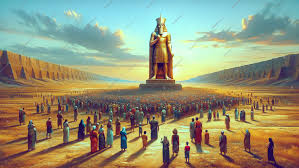
The Chaldeans reminded King Nebuchadnezzar of his decree as if he had forgotten his own words. Their approach was to be polite at first: May the king live forever! Your Majesty has issued a decree that everyone who hears the sound of the horn, flute, zither, lyre, harp, pipe and all kinds of music must fall down and worship the image of gold, and that whoever does not fall down and worship will be thrown into a blazing furnace (3:9-11). Getting to their main point, they finally spelled out their accusation? But there are some Jews (they keep making the point that they were Jews) whom you have set over the affairs of the province of Babylon – Shadrach, Meshach and Abednego – who pay no attention to you, Your Majesty. The accusation against the Jewish captives implied a subtle accusation against the king himself. After all, Nebuchadnezzar himself had appointed them to top positions of authority within the Province of Babylon (2:49). The anti-Semitic overtone was hard to miss.

Hananiah, Mishael and Azariah were identified as the guilty parties and accused of three things: First, these men . . . have no regard for you (3:12a). This accusation implies that the Jewish men had no respect for the one who had so graciously appointed them to positions of authority. Secondly, they do not serve your gods (3:12b). This information was not new to the king. He knew from his previous encounter with Dani’el that the Jews only worshiped YHVH. And thirdly, [They did not] worship the image of gold you have set up (3:12c). This accusation described a clear act of disobedience to Nebuchadnezzar’s decree.125 With this approach, Nebuchadnezzar’s reaction was predictable (see BnDani’el’s Friends Questioned).

True faith isn’t frightened by threats, impressed by crowds, or swayed by superstitious ceremonies. True faith obeys the Lord and trusts Him to work out the consequences. These three Jewish men knew the law of GodYou shall have no other gods before Me . . . You shall not bow down to them nor serve them (Exodus 20:3 and 5). Once ADONAI has spoken on a matter, it is settled and there’s no room for discussion or need for compromise. To bow down before the statue even once, no matter what excuse they might give, would have destroyed their witness and broken their fellowship with God. The tense of the Greek verb in Matthew 4:9 indicates that Satan asked Yeshua to worship him only one time, and the Savior refused. Hananiah, Mishael and Azariah would not bow down to the golden statue even once because it would lead to serving Nebuchadnezzar’s false gods for the rest of their lives.126

It is worth noticing that there were only three men in the whole vast crowd who refused to bow down to Nebuchadnezzar’s statue. This highlights the fact that standing up for God will often be a lonely activity. There are times when choosing to do what is right means that we cannot simply hide in the crowd. We have to stand more or less alone. Sometimes it will seem that the whole world is watching, as when Martin Luther stood before Catholic authorities in Worms, Germany 1521. Called upon to abandon his commitment to justification by faith alone, Luther boldly declared, “Unless I am convicted by Scripture and plain reason . . . my conscience is captive to the Word of God. I cannot and will not recant anything, for to go against conscience is neither right nor safe. God help me.” Luther’s example shows us that at times we may even have to stand alone for what’s right, even within the Church itself.127

Dear heavenly Father, praise You for Your steadfast love for Isra’el. Thus says ADONAI: “Only if heaven above can be measured and the foundations of the earth searched out beneath, then also I will cast off the offspring of Isra’el (Jeremiah 31:37a). Those who love You must also love Your Jewish children, for it is from the root of Jesse (Isaiah 11:1) that the promised Messiah would come (Matthew 1:1, 2 Samuel 7:12-16, Jeremiah 23:5-6). But until then, Jews and Gentiles are united into one Body, which is a picture of an olive tree with branches of both Jew and Gentile (Romans 11:17-24)? Thank You for loving and opening the door to heaven to all who believe in You as their Lord and SaviorJew and Gentile, male and female, rich and poor (Galatians 3: 25-26, 28). Thank You for being such a wonderful Father, always loving on Your me and seeking to draw me to be united in Messiah (Ephesians 1:9-10). To the One who sits at Your right hand. Amen

2025-06-01T10:41:28+00:000 Comments

Bl – Nebuchadnezzar’s Decree to Worship the Statue 3: 1-7

Nebuchadnezzar’s Decree to Worship the Statue
3: 1-7

Nebuchadnezzar’s decree to worship the statue DIG: Why was Dani’el absent during this time? Where was the statue built, why was that important? What two goals did king Nebuchadnezzar have in mind when he built his statue of gold? In a similar way, how do the dictators of today use the same tactics? The king used music to get the people to worship the statue. How is it used today to build our allegiances to someone?

REFLECT: What might be a golden statue in your life? How does today’s culture place the same kind of pressure on each one of us to put ADONAI in second place? Is there an area of your life where you are putting God in second place? What do you think made the difference between the Jews who fell down and worshipped the statue and those who didn’t? How do you use music to worship the Lord?

Nebuchadnezzar’s statue of gold was designed to establish a lasting testimony to his glory,
and to provide a unifying focus for his kingdom.

After conquering Jerusalem (see the commentary on Jeremiah, to see link click GbThe Destruction of Solomon’s Temple on Tisha B’Av in 586 BC), Nebuchadnezzar had set up a golden statue on the plain of Dura. That victory made him believe that he was supreme in his power and could defy the God whose City and Temple he had destroyed. We don’t know how much time elapsed between the night Nebuchadnezzar dreamt about the metallic statue in Chapter 2, and the day he commanded the people to fall down before the golden statue that he had made. But it seems logical that the statue was constructed as a test of loyalty to Nebuchadnezzar some time at the beginning of his reign.

Dani’el was absent on this occasion, but it seems his absence is explained in 2:49, which states: Moreover, at Dani’el’s request, the king appointed Shadrach, Meshach and Abednego to serve under Dani’el in the province of Babylon, while Dani’el himself remained at the royal court (2:49). With the king and other important officials absent, someone was needed to govern in the city. His absence may also have been due to other factors, but it is certain that Dani’el would never have bowed down to the statue.116

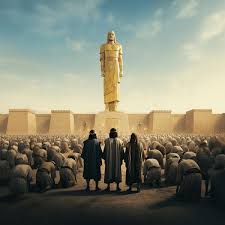
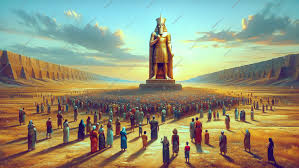
The heart of the king (3:1-3): King Nebuchadnezzar made an image of gold representing himself, sixty cubits high and six cubits wide (that is, about 90 feet high and 9 feet wide or about 27 meters high and 2.7 meters wide), and set it up on the plain of Dura in the province of Babylon (3:1). The location of the statue was significant, for the Babylonian plain was also the location for building the Tower of Babel (see the commentary on Genesis DmLet Us Build a City and Make a Name for Ourselves). The Tower of Babel had a twofold function in the mind of its builders: it was a defiant attempt to make a name for the people who built it as a lasting legacy to their glory, and also to prevent the people from being scattered throughout the earth, as God had declared (Gen 11:4). The king’s statue had the same two goals in mind: it was designed to establish a lasting testimony to his glory and to provide a unifying focus for his kingdom. This is why he summoned not merely the local dignitaries, but all the leading officials from throughout the empire – the satraps, prefects, governors, advisers, treasurers, judges, magistrates and all the other provincial officials to stand before the statue for its dedication (3:2-3).117

The hearts of the people (3:4-7): Then a herald loudly proclaimed, “Nations and peoples of every language, this is what you are commanded to do: As soon as you hear the sound of the horn, flute, zither, lyre, harp, pipe and all kinds of music, you must fall down and worship the image of gold that Nebuchadnezzar has set up” (3:4-5). All this was based upon the pagan model of that day: the right of the state was also the law of the state. Thus, to worship the law of the state was to submit one’s self to that state. But if they were a conquered people, they were admitting that the conquering god was more powerful than their own national god. And by worshiping the conquering god, they were pledging allegiance to the state of that god. Now if you were polytheistic, as most of the conquered peoples were, this would not violate your conscience. You wouldn’t be rejecting your national god; it was merely a statement of loyalty, nothing more.

Centuries later we have a modern example of this pagan concept in the Nazi Germany. On July 29, 1936, the head of the Hitler Youth, Baldur von Schirach, made a speech in which he said. “One cannot be a good German and, at the same time, deny God. But a declaration of faith in eternal Germany is, at the same time, a declaration of faith in the eternal God.” In other words, “If we act as true Germans, we act according to the laws of God. Whoever serves Adolph Hitler serves Germany, and whoever serves Germany serves God.”118

Later, Paul Schneider stood lined up with the other prisoners at Buchenwald concentration camp in Germany. It was April 20, 1938, Hitler’s forty-ninth birthday and, in tribute, the prisoners were ordered to remove their berets and honor the Nazi swastika flag. At once all whipped off their headgear. But the guards observed one man who would not “bow” to the swastika . . . Paul Schneider. They beat him with twenty-five lashes with an ox-hide whip. But that was only the first time he was beaten because he refused to worship the idol.119

When we put it in those terms, it becomes evident that our culture places the same pressure on each one of us to put our God in second place, although in more subtle ways. We too find ourselves constantly pressed to keep our beliefs private, and therefore secondary. We are told that the public sphere must be kept untainted by any religion, for any other opinion threatens the false unifying dogma of the separation of church and state. We can believe what we want, no problem. However, we are strongly discouraged from talking about it, or trying to influence the beliefs of others. In our public schools, any hypothesis may be taught in a science class, except the idea that the universe shows the evidence of intelligent design. Similarly, students are told that they can read any book they want in study hall, so long as it’s not the Bible. Thankfully, in our society, we are not likely to get shot or thrown into a fiery furnace for being the odd one out, and we still have a remarkable amount of freedom, but we still feel other kinds of pressures to conform and put ADONAI in second place.120

The herald continued: Whoever does not fall down and worship the idol will immediately be thrown into a blazing furnace (Dani’el 3:6). It was used for smelting ore, with a vertical shaft and an opening at the bottom for extracting the metal. It was usually built by a cliff so you approached the top from the cliff, or there would be an incline leading up to the top. The Persians are said to have had similar ovens for the execution of criminals. Such cruel punishment was common in Babylonia and Assyria (Jeremiah 29:22). Dani’el’s three friends had a choice, fall down before the image or fall down into the blazing furnace. The rabbis teach that this was a deliberate attempt to lead the Jews astray, and so cause them to forfeit God’s favor and their right to the promises of YHVH.

But this was more than a political rally, it was a religious service complete with music, and it called for total commitment on the part of the worshippers. Therefore, as soon as they heard the sound of the horn, flute, zither, lyre, harp and all kinds of music, all the nations and peoples of every language fell down and worshiped the image of gold that King Nebuchadnezzar had set up (3:7). Notice that the word worship is used ten times in this chapter. Nebuchadnezzar used instrumental music because it could stir the people’s emotions and make it easier for him to manipulate them and win their submission and obedience. Throughout history, music and song have played an important role in strengthening nationalism, motivating conquest, and inspiring people to act. Music has the power to grip human thoughts and emotions that people can be transformed from being free agents into becoming mere puppets. Therefore, music can be a wonderful tool and treasure from the Lord, or it can be a destructive weapon from Satan.121 When the music began, a sea of government officials fell to the ground and worshiped the statue of gold just as they had been commanded. However, three men stood alone (see Bm – The Accusation Against the Jews).

Dear Heavenly Father, praise You that Your almighty power extends over life and death.  Yeshua said to her: I am the resurrection and the life! Whoever believes in Me, even if he dies, shall live (John 11:25). Dani’el’s three friends were convinced that You had the power to save them; but if not, it was more important for them to please You than to save their own lives. If it is so, our God whom we serve is able to save us from the furnace of blazing fire and He will deliver us out of your hand, O king. Yet even if He does not, let it be known to you, O king, that we will not serve your gods, nor worship the golden image that you set up (3:17-18). ADONAI, help me to love You as much as they did. Thank You for being such a wonderful, wise and loving Father that I can entrust my life to You. In Messiah Yeshua’s holy Name and power of His resurrection. Amen

2025-05-28T11:12:38+00:000 Comments

Bk – Nebuchadnezzar’s Statue of Gold and the Fiery Furnace 3: 1-30

Nebuchadnezzar’s Statue of Gold and the Fiery Furnace
3: 1-30

After conquering Jerusalem (see  Jeremiah, to see link click GbThe Destruction of Solomon’s Temple on Tisha B’Av in 586 BC), Nebuchadnezzar had set up a golden statue. That victory made him believe that he was supreme in his power and could defy the God whose City and Temple he had destroyed. The setting of the conflict with Shadrach (Hananiah), Meshach (Mishael) and Abednego (Azariah) is the plain of Dura, located a few miles south of the city of Babylon. King Nebuchadnezzar made a statue of gold and set it up. These words echo through the first half of the chapter in verses 1-18. The statue was intended to be worshipped, but the writer does not call it a god. The fact that all peoples, nations, and languages were to fall down and worship it suggests that Nebuchadnezzar intended to unite his kingdom under one religion. The statue probably represented himself. Having been told that he was the head of gold (see the commentary on AyThe First Empire: A Head of Gold), what more natural than to capitalize on the fact and to make the whole statue gold?

The size and shape of the statue are both remarkable. It was as high as the date-palms that still grow in the plains of Iraq, and it was a slender nine feet in diameter. It must have been more like an obelisk than a statue, and made out to resemble a man. The writer, however, is not interested in such details, but rather in the ideology it stood for and to which he could not condone. The incident represents the conflict between the worship of the true God and the humanistic use of religion to boost the power of the rulers of this world. It is typical of idolatry that the idol is used by the worshipper to achieve his ends. Nebuchadnezzar couldn’t see any reason but defiance for refusal to worship himself as requested, and therefore did not hesitate to demand the brutal punishment of the fiery furnace.

Death by burning at the hands of Nebuchadnezzar is recorded in Jeremiah 29:22, and a directive of the ruler Rim Sin (1750 BC) of Larsa, “Because they threw a young slave into an oven, you throw a slave into a furnace,” proves that the idea did not originate with the Babylonian king. Therefore, there is nothing improbable about the story until it comes to the miraculous intervention by which the lives of the three men were saved and a fourth accompanied them in the furnace.115

Some commentators regard this chapter as a kind of allegory rather than as a historical event. However, if that were true, then the corresponding biblical account of the bravery of the three Jewish men in the fiery furnace, joined by the Son of Man, would also be allegorical. Then where does it stop? Is the preincarnate Messiah in the fiery furnace really allegorical? Critics of the Bible have been discounting the miracles in God’s Word forever, allegorizing its literal history out of existence; hence, attacking the miraculous God that we worship. No, what we have before us in chapter 3 verses 1-30 is historical fact, just as all the other miracles in the Bible are literal events. Faith comes by hearing, that is, hearing the Good News about Yeshua Messiah (Romans 10:17).

This chapter, verses 1 through 30 can be broken down in chiastic fashion, resulting in a mirror effect as the ideas are “reflected” back in the passage: A to A, B to B, C to C, with D being the climax of the chiasm.

A. Nebuchadnezzar’s Decree to Worship the Statue – 3:1-7 (Bl)

B. The Accusation Against the Jews – 3:8-12 (Bm)

C. Dani’el’s Friends Questioned – 3:13-15 (Bn)

D. The Jews Confess Their Faith – 3:16-18 (Bo)

C. Dani’el’s Friends Punished – 3:19-23 (Bp)

B. The Vindication of the Jews – 3:24-27 (Bq)

A. Nebuchadnezzar’s Decree Honoring the Jews and Their God – 3:28-30 (Br)

2025-06-19T12:03:19+00:000 Comments

Bj – The Significance of Dani’el Chapter 2 to the Times of the Gentiles

The Significance of Dani’el Chapter 2
to the Times of the Gentiles

Luke describes this period of time when he wrote: They will fall by the sword and will be taken as prisoners to all the nations. Jerusalem will be trampled on by the Gentiles until the times of the Gentiles are fulfilled (to see link click Ao The Times of the Gentiles). This can best be defined as that long period of time from the Babylonian Captivity (see the commentary on Jeremiah GuSeventy Years of Imperial Babylonian Rule) to the Second Coming of Messiah, during which time the Gentiles have complete dominance over Jerusalem. This does not rule out temporary Jewish control of the City until the Second Coming. Such temporary control was exercised during the Maccabbean Period (164-163 BC), the First Jewish Revolt against Rome in 66 AD, and the Second Jewish Revolt (the Bar Cochba Revolt) against Rome (132-135 AD), and since 1967 as a result of the Six Day War. This, too, was temporary, since Gentiles will trample down the holy City for at least another 1,260 days (see the commentary on Revelation BxThe Tribulation Temple). Therefore, any Jewish takeover of the City of Jerusalem before the Second Coming must be viewed as temporary and does not mean that the Times of the Gentiles have ended. The Times of the Gentiles can only end when the Gentiles no longer trample down the City of Jerusalem.114
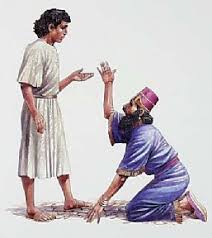
2025-05-26T10:33:41+00:000 Comments

Bi – Nebuchadnezzar Promotes Dani’el 2: 46-49

Nebuchadnezzar Promotes Dani’el
2: 46-49

Nebuchadnezzar promotes Dani’el DIG: Why did king fall down before Dani’el? Was the king a believer at this point? Who are the people today who have the opportunity to influence our world’s leadership the way Dani’el influenced the king? How can we best pray for those people to be a positive influence?

REFLECT: The king did not forget his dream. And you must not forget it either; don’t forget what the God of heaven reveals to you through this dream, for this is a dream that will come true. How do you handle the compromise of your godly values? What primary theological truths are emphasized in this chapter?

The king had concluded that Dani’el was the man in touch with the God of heaven,
and as such, was to be honored and feared.

With the successful explanation and interpretation of Nebuchadnezzar’s dream (to see link click AwThe King’s Dream), the king was overwhelmed. He knew Dani’el had spoken the truth and fell down before Dani’el and paid him honor, ordering that an offering and incense be presented to him (2:46). Although aware that Dani’el was not divine, as evidenced by the fact that the king immediately gave glory to Dani’el’s God and not to Dani’el (see below), the Babylonian ruler ordered an offering be given to Dani’el as ADONAI’s representative. Regardless of Nebuchadnezzar’s intent, Dani’el would have never accepted worship of himself and would have been appalled at the suggestion. The king’s actions are perfectly understandable in light of the circumstances. He had just witnessed a miracle. Had not Nebuchadnezzar’s own magi declared to him that such knowledge could only come from the gods themselves (2:10-11)? The king had concluded that Dani’el was the man in touch with the God of heaven; and as such, was to be honored and feared.107

The king said to Dani’el, “Surely your God is the God of gods and the Lord of kings,” the ruler over the kings of the earth, and a Revealer of mysteries because ADONAI was the only God who was able to reveal this mystery (2:47), that is the dream and its interpretation. At this point, then, we cannot conclude that Nebuchadnezzar had become a believer. While he had given YHVH a position of superiority, he still only added Him to the Babylonian pantheon.108 Many people are like Nebuchadnezzar today. They know about the true God – many even believe in His miraculous powers – but they never step over the line from knowledge to faith (see Hebrews AlHow Shall We Escape If We Ignore So Great a Salvation).

Nebuchadnezzar had declared that anyone who revealed and interpreted his dream would receive gifts and rewards and great honor (2:6a). Therefore, the king kept his word and promoted Dani’el with great honors, just as Pharaoh had honored and promoted Joseph in Egypt (Genesis 41:39-43).109 Then the king placed Dani’el in a high position and lavished many gifts on him. He made him ruler over the entire province of Babylon and placed him in charge of all its wise men (2:48). Apparently, Nebuchadnezzar saw Dani’el as a superior astrologer. This conclusion illustrates the king’s lack of spiritual insight. Dani’el would never practice astrology. He would never ask the stars to tell him about the future. Instead, he would always go to the Creator of the stars, and that was the God of Abraham, Isaac, and Jacob. A rabbinic commentary points to this truth. “There was no disloyalty from the religious point of view in Dani’el accepting this position. What was forbidden by the Torah was not the knowledge, but the practice, of the Babylonian superstitious arts (Sloki, Dani’el, Ezra, Nehemiah, page 20).110

Babylon was divided into many provinces, each one under the leader of a satrap (3:2a). Dani’el was made a satrap over the province in which the royal court was located. From the king’s perspective, this promotion would be the logical reward for his success as an interpreter of dreams; from Dani’el’s perspective, there would be many opportunities for Dani’el to compromise, but Dani’el’s faith in ADONAI was strong and he would choose to always trust and serve God. Also, not to mention jealousy of the royal administrators who would cause Dani’el no little amount of trouble (see DmThe Conspiracy of the Royal Administrators).111

This passage raises a number of questions, such as how did these Gentile astrologers from Babylon know that a Jewish King had been born? And, even if they knew about it, why would they choose to come and worship Him? There had been astrologers in Babylonia at least from the time of Nebuchadnezzar. Yet, there is no record of one wise man from Babylon going to Jerusalem to worship a Jewish king – until the birth of Yeshua (see the commentary on The Life of Christ AvThe Visit of the Magi). The answers to these questions go back to Dani’el and his position as the head of the Babylonian school of astrology.112

Moreover, Dani’el did not forget his friends, but asked that they be promoted too. So the king appointed Shadrach (Hananiah), Meshach (Mishael) and Abednego (Azariah) administrators to serve under Dani’el in the province of Babylon, while Dani’el himself remained at the royal court, as an advisor to Nebuchadnezzar (2:49). The references to Shadrach, Meshach, and Abednego set the stage for the next court story in Dani’el . . . the account of the statue of gold and the fiery furnace (see BkNebuchadnezzar’s Statue of Gold and the Fiery Furnace).

Three primary theological truths are emphasized in this chapter. First, God is sovereign over kings and the affairs of this earth. If the Lord does not control our lives, from the actions of rulers and other positions of power to the most minute circumstance, then everything in life is uncertain. We are victims of circumstance, and whatever happens will happen. Que sera, sera! But since ADONAI is sovereign, as the Bible declares Him to be, and since He is our God – since the promises He makes and the actions He takes are certain to be fulfilled – then we can be confident of the future and know that we will be able to live our lives in a way that pleases YHVH. Second, Ha’Shem is omniscient. He knows all things, including the future, and at times chooses to reveal the future to human beings. And third, empires will rise and fall until Messiah comes back, but the glorious Kingdom of God will surely come and all wickedness of earthly regimes will cease (see BgThe Fifth Empire: The Kingdom of God).113

Dear heavenly Father, praise You that You are so wise, loving and holy! The greatest joy is living a life close to You, praising You for Your wonderful character that never changes! Faith is the key for those who seek YHVH. Now without faith it is impossible to please God. For the one who comes to God must believe that He exists and that He is a rewarder of those who seek Him (Hebrews 11:6). Though Nebuchadnezzar fell down before Dani’el, acknowledging with words that You are the God of gods and the Lord of kings; he did not have faith, for his heart did not worship You as his Lord and King. He would soon have a statue made for his own glory and would require all to worship the golden statue. Faith trusts You – no matter what the circumstances are. Daniel’s faith caused him to trust in You even when his life was on the line and he knew that he would be thrown into the lion’s den because he chose to publicly pray to You, and You protected him (Dani’el 6). Like those who lived out their faith, even in the midst of hard trials, so I love You and want to live by faith. You are so wonderful and so worthy of all love and worship. In Messiah Yeshua’s holy Name and power of His resurrection. Amen

2025-07-24T11:56:26+00:000 Comments

Bh – The Dispensational View of the Kingdom of God

The Dispensational View of the Kingdom of God

The only possible conclusion is that ADONAI will establish the Fifth Empire,
His own Messianic Kingdom, after the four Gentile empires have run their course.

As Arnold Fruchtenbaum relates in his commentary on Dani’el, all forms of replacement theology, such as covenant theology, amillennialism, and postmillennialism (also see the commentary on Galatians, to see link click AkThe Hebrew Roots Movement: A Different Gospel), identify the Fifth Kingdom as the Church, and not Isra’el. They wrongly assert that this Kingdom was established at the time of Messiah’s First Coming. Augustine of Hippo (354 AD to 430 AD) was one of the most influential early theologians who emphasized this idea. In his book The City of God, he wrote, “Therefore, the Church even now is the Kingdom of Christ, and the Kingdom of heaven. Accordingly, even now His saints reign with Him.”105 Augustine’s teaching on this subject was foundational in the development of replacement theology. It was the basis upon which later authors constructed the medieval theory of the state church.

A variant of Augustine’s teaching is seen in the writings of Joseph Mede (1586-1638 AD), a biblical scholar and specialist in Hebrew studies from England. He interpreted Dani’el’s kingdoms as Babylon, Medo-Persia, Greece, and Rome. However, when he came to the Fifth Empire (see Bg – The Fifth Empire: The Kingdom of God), he made a distinction between the stone and the mountain in Dani’el 2. Mede tried to go around the obvious by identifying two stages of the Fifth Empire. His work became a classic in the field of prophetic interpretation. But to arrive at the conclusion that the Church is the Kingdom of God, one must read one’s own theology into Dani’el 2:36-45.

There are several excellent biblical reasons to take this Dispensationalist viewpoint. First, the establishment of the Kingdom of God parallels the establishment of the other four empires in that it will also be set up on the earth. In replacement theology, the Kingdom is usually viewed as being in heaven.

Second, the Kingdom of God will be established in the days of the ten kings (2:44), meaning in the days of the Great Tribulation (see Be The One World Government Stage). According to Acts 2, the Church began in the first century. At that time, the Fourth Empire was in its first, not its fourth stage. The Roman Empire ruled the entire known world (see BcThe United Stage). Yet, Dani’el declared the time when ADONAI would set up His Kingdom as being in the days of the ten kings. Therefore, the Fifth Empire, the Kingdom of God, would come only after the Fourth Empire had run its course, not at the time of the Roman Empire.

Third, Dani’el stated clearly that the Kingdom of God would bring a decisive end to all of the Gentile Empires. The Church does not fit this description. At His First Coming, Yeshua did not smash the Roman Empire into pieces. On the contrary, He was executed under Roman law. After the resurrection and ascension, Rome remained in control of Isra’el, and the times of the Gentiles (see AoThe Times of the Gentiles) continued on through Acts 2 to the present day.

Fourth, the Fifth Kingdom is described as conquering the entire world quickly and decisively. The Church has not and will not perform this action.

Fifth, the Kingdom of God is further described as subduing the entire planet. It is described as a theocracy. The invisible Church (composed of only believers) has never been a political organization. However, the visible church (composed of only believers and unbelievers), even in its outward form, is required by Scripture to be subject to Caesar. The verse: Give back to Caesar what is Caesar’s, and to God what is God’s (Matthew 22:21) summarizes the relationship between the visible church, secular government, and society. Dani’el’s description of the Kingdom of God is vastly different. Unlike the visible church, God’s Kingdom will remove all other empires and become the absolute authority on the earth.

Sixth, if the invisible Church had ever attempted to seize political control of the entire world, it would have had to do so gradually due to its reliance on its own growth. In the first century, the number of believers increased, but not exponentially. Even as the invisible Church was gradually replaced in number by the visible church, the events of the last seventeen centuries simply cannot be compared to Dani’el’s description of the Fifth Kingdom. Dani’el 2:44-45 says this Kingdom will overthrow its predecessor suddenly and decisively.

Seventh, amillennialism and other forms of replacement theology have to teach that it is the Church that will overcome the Gentile Kingdoms. Yet, the Church did not do so in the first century, and it is losing ground in the twenty-first century.

Eighth, in verses 2:34-35, Dani’el explained that the Rock would strike the statue on its feet of iron and clay, smashing them to pieces, and becoming a huge mountain, growing continuously until it filled the whole earth (2:34-35b). But spreading the Gospel by force is inconsistent with the ethics of the B’rit Chadashah. Believers proclaim the Gospel, but do not beat people over the head with it. ADONAI wants us to choose Him because we want to, not because we have to. He gives every person the free will to reject or accept Him.

In summary, the invisible Church made up of believers, cannot be the Kingdom of God as described in Dani’el 2. Contextually, exegetically, and otherwise, it is impossible. Hence, to assert that the Fifth Empire, the Kingdom of God, is the invisible Church of today is to impose one’s own theology on the text.106

2025-05-23T10:51:24+00:000 Comments

Bg – The Fifth Empire: The Kingdom of God 2: 44-45

The Fifth Empire: The Kingdom of God
2: 44-45

The fifth empire, the Kingdom of God DIG: What will distinguish this Kingdom from the other four? Whenever the word rock is used symbolically in the Bible, how is it used? How is the term huge mountain used symbolically in the Bible? In what ways will this Kingdom be different from the Gentile kingdoms?

REFLECT: What signs of the end times does this passage encourage you to look for? How does the knowledge of the end times encourage your walk today? How does it make you feel that the Kingdom of God will last forever? Is that a hard concept for you to grasp? How so? How is Yeshua Messiah your Rock?

The destruction of the statue represented the coming of Yeshua Messiah.

Dani’el now reaches the climax of his dream interpretation. Once the first Four Gentile Empires run their course, a Fifth Kingdom will be set up. As verses 44-45 show, this Kingdom will be very different from all the other empires that preceded it because ADONAI Himself will set it up. In the last three days of the Great Tribulation (Hosea 6:1-3), the God of heaven will set up a Kingdom that will never be destroyed, nor will it be left to another people. It will crush all those kingdoms and bring them to an end (2:44a). The chronology is important here. God will allow the one world government to exercise authority for the Great Tribulation (to see link click CvDani’el’s Vision of the Seventy Sevens). Its feet mixed with iron and clay will come after the Dispensation of Grace (see Hebrews BpThe Dispensation of Grace), when Ha’Shem will resume His dealing with the nation of Isra’el. Therefore, just as the one world government led by the antichrist is still in the future, so is the Kingdom that will be set up by God Himself.97

It is also significant that all the empires comprising the different parts of the statue surveyed thus far are literal empires that existed for a literal time, occupied specific lands with identifiable borders, and had a capital city. This begs the question, why wouldn’t the last kingdom, represented by the Rock not cut human hands, also not be a literal Kingdom that will reign for a literal time (Revelation 20:1-10), and that will occupy a specific land with identifiable borders (Genesis 15:18-21), and have a capital (Isaiah 2:2-3)? Such a viewpoint represents a premillennial view of history. The expression “millennial” simply means a thousand years. Premillennialism is the belief that the thousand-year Kingdom will not come into existence until Yeshua Messiah comes back first (or “pre”) and then sets up His earthly Kingdom (see the commentary on Revelation FlWhen the Thousand Years Are Over).98

In summary of what has been stated so far, God Himself will set up His Messianic Kingdom after the last three days of the Great Tribulation (Hosea 6:1-3). Because He will be the Ruler, the Fifth Kingdom will be a theocracy. Daniel explained that His Kingdom will never be destroyed. God’s domain will continue beyond any human empire. Furthermore, the sovereignty of His Kingdom will not be left to another people. This is very important to understand. It means that the Fifth Kingdom will not belong to the Gentiles, but to Isra’el (see the commentary on Jeremiah EoI Will Make a New Covenant with the People of Isra’el). Dani’el concluded the verse by stating that the Fifth Kingdom will itself endure forever (2:44b). The Aramaic term for forever, alam, means perpetuity or antiquity. It corresponds to the Hebrew term olam. While olam can refer to the indefinite future, it can also refer to a duration of an age. This meaning is applicable in verse 44b; as a result, the Kingdom of God will never end.

Then, Dani’el connected the Kingdom of God with the Rock of Nebuchadnezzar’s dream (2:45a). The Bible uses many symbols, but it is consistent in its usage. In almost every instance, any specific symbol will mean the same thing throughout the TaNaKh and the B’rit Chadashah. When the word Rock is used symbolically, it always refers to the Messiah. Thus, its usage can be seen in passages such as Psalm 118:22; Isaiah 8:14 and 28:16; Zechariah 3:9; Matthew 21:44; Acts 4:11; First Corinthians 10:4; and First Peter 2:4-8.

According to Dani’el, the Rock was cut out of the mountain without (human) hands (2:45b). This description shows the divine origin of the Rock. In verse 34, Dani’el only mentioned that this Rock was cut out without human hands; here, he adds that it was cut out of the mountain. This can only be Mount Zion, where the God of heaven has founded His Kingdom, which shall spread all over the earth and destroy all of the world-empires. It’s not only important to note that the Rock is part of this mountain, but that it was cut without hands. The focus is on the divine origin. In 2:35, Dani’el explained that the Rock itself would become a great mountain and fill the whole earth. When the term mountain is used symbolically, it always refers to the king, kingdom, or throne. This points to the fact that the Kingdom of God will start with the Messianic Kingdom for a thousand years, and then transition into the Eternal State (see Revelation FqThe Eternal State).

The fact that it will crush the iron, the bronze, the clay, the silver, and the gold (2:45c), indicates that His Kingdom will bring the Times of the Gentiles (see AoThe Times of the Gentiles) to an end. There are three distinctions to be made between the Kingdom of God and the Four Gentile Empires. As to origin, the Four Gentile Empires are human, but the Kingdom of God is divine. As to duration, the Four Gentile Empires are temporary, but the Kingdom of God is eternal. As to power, the Four Gentile Empires are each overcome by successive empires, but the Kingdom of God cannot be conquered.99

Rabbinic theology agrees with most of this interpretation. Rashi noted, “The Kingdom of the Holy One, blessed be He, which will never be destroyed, is the Kingdom of the Messiah.100 Rabbi Bahya ben Asher (1255 to 1340), known as Rabbeinu Bahya, stated, “The whole message is that once the Messiah arrives, the kingship will not depart anymore from Judah forever.101 The Kabbalistic Zohar observes, “Some have prevailed in this world, and all will prevail at the advent of King Messiah, when Isra’el will be one nation in the Land (Ezeki’el 37:22), one nation before the Holy One, blessed be He. This is the meaning of the verse, and I will make them one nation in the Land, and they will reign above and below, as it is written: and there before me was one like a son of man, coming with the clouds of heaven (Dani’el 7:13). This is King Messiah, as it is written: In in the times of those (ten) kings, the God of heaven will set up a Kingdom that will never be destroyed, nor will it be left to another people (Dani’el 2:44a).102

Dani’el’s interpretation of Nebuchadnezzar’s dream concludes in 2:45d with the statement that everything will happen exactly as he prophesied: The great God has shown the king what will take place in the future. The dream is true and its interpretation is dependable. ADONAI provided the interpretation of the dream. So both the dream and its interpretation are trustworthy. Nothing could stop their fulfillment.103

As Warren Wiersbe relates in his commentary on Dani’el, the destruction of the statue (see BeThe One World Government Stage) represented the coming of Yeshua Messiah, who would judge His enemies and establish His universal Kingdom. As simple as this seems to be, it carries with it four important messages. First, it reveals that ADONAI is in control of history. He knows the future because He plans the future. This doesn’t mean God is to blame for the evil things that leaders and nations do, but that He can overrule even their wickedness to accomplish His divine purposes. The God of heaven gave Nebuchadnezzar his throne and enabled him to defeat his enemies and expand his empire (2:37-38). But the God who gave him this authority could also take it away, and He did (see the commentary on Jeremiah EzA Message Against Babylon). The king didn’t know how long his empire would last, but he knew it would end someday. In fact, Babylon was conquered by what Dani’el called an “inferior” kingdom (2:39).

Second, the dream reveals that human plans decline as time goes on. The massive and awesome statue not only changed in value from head to foot – from gold to clay – but is also changed in strength, finally ending in feet of iron mixed with clay. Actually, the statue was top-heavy, for the atomic weight of gold is ten times that of clay, and silver is five times heavier than clay. Therefore, from age to age, nations and kingdoms might appear strong and durable, but they’re in constant danger of falling over and crashing. The statue Nebuchadnezzar saw dazzled him with the brilliance of the gold, silver and bronze, but it was standing on feet composed of iron and clay.

Third, it will be difficult to hold things together at the end of the age. The feet of the statue were composed of iron and clay. Iron is strong and durable, but clay is weak and prone to crumble. The iron gives the appearance of strength and endurance, but the clay announces just the opposite. In fact, clay robs the iron of its ability to hold things together, for whenever the iron touches the clay, in produces weakness at those points. Society today is held together by treaties that can be broken, promises that can be ignored, traditions that can be forgotten, organizations that can be disbanded, and money-making businesses that can fail – all of it iron mixed with clay. At his best, man is clay, for YHVH made him out of the dust of the earth. Though man and woman are both made in the image of God (Genesis 1:26), sin has robbed us of the dominion He gave us. We are both creators and destroyers, and we seem bent on destroying another and the world the LORD has graciously given us. The heart of every problem is the problem in the human heart – rebellion against God.

Fourth, Yeshua will return, destroy His enemies, and establish His Kingdom. The Rock that destroys the statue is a frequent image of God in Scripture, and especially of Messiah, the Son of God (Psalm 118:22; Isaiah 8:14 and 28:16; Matthew 21:44; Acts 4:11; First Corinthians 10:4; and First Peter 2:4-8). The phrase “without hands” is used in Scripture to mean not by human power and refers to something only God can do (Colossians 2:11; Hebrews 9:11 and 24). The world will be delivered from evil, not by a process, but by a crisis, the promised return of Messiah Yeshua. Whatever remains of the Four Gentile Empires, passed from one empire to the next, will be destroyed and become like chaff on a threshing floor (2:35a). Then Messiah will establish His Kingdom, which will fill the earth.

When we consider these truths, our response ought to be one of joyful confidence, knowing that the Lord has everything under control and will one day reign on earth. While God’s people should do everything they can to alleviate suffering and make this a safer and happier world, our hope is not in laws, political alliances, or moral crusades. Our hope is in the Lord. People’s hearts need to be changed by the grace of God, and that means God’s people must be witnesses to the ends of the earth. The only Kingdom that will stand forever is Messiah’s Kingdom (2:44), and the only people who will be citizens of that Kingdom are those who have trusted Him to be their Lord and Savior, being born again by the Spirit of God (John 3:1-1-18).

What would all of this have meant to King Nebuchadnezzar as he sat on his throne listening to Dani’el explain the mysteries of God. For one thing, the message of the statue should have humbled him. It was not Nebuchadnezzar who conquered nations and kingdoms; it was YHVH who enabled him to do it and who gave him his empire. Your majesty, you are the king of kings, said Dani’el. The God of heaven has given you dominion and power and might and glory (2:37). Sadly, the great king forgot this lesson and one day said: Is not this the great Babylon I have built as the royal residence, by my mighty power and for the glory of my majesty (4:30)? ADONAI had to humble the king and make him live like an animal (see BxHumiliation: The King’s Decline) until he learned that Ha’Shem does according to His will, and who alone deserves the glory (4:35). In giving the dream and enabling Dani’el to interpret it, YHVH displayed His wisdom and power. God has the wisdom to plan the ages and the power to execute it. King Nebuchadnezzar ruled from 605 BC to 562 BC, but Messiah Yeshua’s Kingdom will never end.104

Dear heavenly Father, praise You that as You reign in Your Millennial Kingdom (Revelation 20) no one can ever conquer. It is an everlasting Kingdom (Dani’el 7:26). Your marvelous heavenly Kingdom follows Your Millennial kingdom. You are always Almighty, All-Powerful with Steadfast Love! How gracious You are to have paid sin’s gruesome penalty of death thru Messiah’s death as the Lamb of God (John 1:29) and resurrection (1 Corinthians 15:3). How wonderful that You adopt me as Your child. But whoever did receive Him, those trusting in His name, to these He gave the right to become children of God (John 1:12).

It is so sad that people will have such proud hearts that though some will be able to do miracles in Your Name, they will love themselves more than You and so You will not allow them into heaven. Not everyone who says to Me, “Lord, Lord!” will enter the Kingdom of heaven, but he who does the will of My Father in heaven.  Many will say to Me on that day, “Lord, Lord, didn’t we prophesy in Your name, and drive out demons in Your name, and perform many miracles in Your name?”  Then I will declare to them, “I never knew you. Get away from Me, you workers of lawlessness” (Matthew 7:21-23)! But to Your children, you say: If anyone wants to follow Me, he must deny himself, take up his cross every day, and follow Me. For whoever wants to save his life will lose it, but whoever loses his life for My sake will save it (Luke 9:23-24).

What joy it will be to live with You in Your eternal heavenly Kingdom. Even if it costs Your follower His earthly life for loving You most- it will be worth it all! What a marvelous home of eternal peace and joy it will be, living with You in Your eternal heaven! Behold, the dwelling of God is among men, and He shall tabernacle among them. They shall be His people, and God Himself shall be among them and be their God. He shall wipe away every tear from their eyes, and death shall be no more. Nor shall there be mourning or crying or pain any longer, for the former things have passed away (Rev 21:3b-4). Praise You forever! In Messiah Yeshua’s holy Name and power of His resurrection. Amen

2025-07-15T15:16:08+00:000 Comments

Bf – Summary Statement about the Fourth Kingdom

Summary Statement about the Fourth Kingdom

In summary, 2:40-43 describes the Fourth Gentile Empire. This empire goes through several stages. First, there is the United Stage, strong as iron (to see link click BcThe United Stage). Second, there is the Divided Kingdom Stage, which still has the strength of iron (see BdThe Divided Kingdom Stage). However, the presence of clay shows that this stage is weaker than the previous one. Third, there is the One World Government Stage as is seen in the ten toes being composed of iron and clay (see Be – The One World Government Stage). Part of this stage will be strong and part will be weak and brittle. The lack of cohesiveness is especially evident in the toes. Unity is impossible, and ten different kingdoms occur because the different rulers cannot unite. The Fourth Gentile Empire differs greatly from the previous empires. It totally crushes and subdues all that came before it. It is this empire that is especially emphasized when dealing with the Times of the Gentiles (see AoThe Times of the Gentiles).96 We will discuss the Fourth Kingdom in more detail when we get to Chapter 7. Dani’el 2 gives us the perspective of the times of the Gentiles from a human viewpoint as something majestic, but Dani’el 7 gives us the perspective from God’s viewpoint as something dreadful, where four kingdoms are pictured as four beasts.

2025-05-21T13:23:25+00:000 Comments

Be – The One World Government Stage: Absolute Imperialism 2: 42-43

The One World Government Stage: Absolute Imperialism
2: 42-43

The one world government stage DIG: How is this one world government imperialistic? What unstable “iron and clay” unions do you see in our broken world? Who is the antichrist? Who is the Rock that destroys the one world government? What did the Rock become and filled the whole earth? What did it represent?

REFLECT: What do you feel like these days: iron or clay? Why? What is the clay in your relationships? Is your relationship with the Lord today like iron or clay? Satan is not very original. He always imitates ADONAI. How can you tell the difference between Godly wisdom and the schemes of the devil?

ADONAI begins to reveal to Dani’el the initial revelation regarding the Times of the Gentiles (see AoThe Times of the Gentiles). He provides an initial overview of the four empires that will govern this period. As the book progresses, God’s revelation becomes increasingly specific, reaching their climax in Chapter 12.

The One World Government Stage will cover the entire earth. As the toes were partly iron and partly clay, so this kingdom will be partly strong and partly brittle and weak (Dani’el 2:42). This stage is represented by the ten toes. Just like the feet, the toes are made of iron and clay. The empire that began as iron regressed to a state of clay mixed with iron. This mixture speaks of a progressive deterioration. It is possible that other metals mixed together form an alloy that might be stronger than either of the metals individually. But iron and clay cannot be mixed. If iron and clay are put into a crucible, heated to the melting point, and poured into a mold, when the pour has cooled, the iron and clay remain separate. The clay cannot be broken down, which leaves a weak casting.91

As far as the statue in Nebuchadnezzar’s dream is concerned, this lack of unity is especially seen in the toes. For some reason, not explicitly stated in the Bible, the one world government will divide into ten kingdoms that will cover the whole earth – not merely Europe. It will probably start sometime before the Great Tribulation and continue until the first three and a half years of the Great Tribulation have ended (see below). While Dani’el previously mentioned the toes of the statue (2:41), here, he explicitly states that the rulers of the Divided Kingdom (see BdThe Divided Kingdom Stage) could never unite the people.92 The iron in the statue gives the appearance of strength and endurance, but the presence of clay proves otherwise. In fact, the clay robs the iron of its ability to hold things together and produces weakness. This mixture of iron and clay also shows that these kingdoms will try to strengthen themselves by forming alliances with each other through intermarriage. But they will not hold together, just as iron and clay do not mix (Dani’el 2:43).

In the first three and half years of the Great Tribulation, the earth will be ruled by these ten Gentile nations with ten kings. In the middle of it, the antichrist will expand his political power. He will kill three kings and seven others will submit to his authority. In the middle of the Tribulation, the king of the South will engage the antichrist in battle, and the king of the North will storm out against him with chariots and cavalry and a great fleet of ships. In his vision, Dani’el describes as best he can what he sees. Chariots and cavalry are best taken as representative of their counterparts of modern warfare; however, modern weapons could not have been used in his day. But the antichrist will invade those countries and sweep through them like a flood. He will kill those kings and also invade Isra’el. Once invaded, she will be taken over by the Gentiles (Revelation 11:1-2). Many countries will fall, but Edom, Moab and Ammon, or modern-day Jordan, will be delivered from his hand so that there will be one place in the world to which the Jews can flee. Whenever one part of the world persecutes the Jews, God opens up a city of refuge for them (Matthew 24:15-22; Revelation 12:6, 13-14). The antichrist will extend his power over many countries. Egypt will not escape. He will gain control of the treasures of gold and silver and all the riches of Egypt, with Africa also in submission to him. But reports about the king of the East and the king of the North will alarm him, and he will set out in a great rage to destroy and annihilate them (Dani’el 11:40-44). He will pitch his royal tents between the Mediterranean Sea and the Dead Sea, at the beautiful holy mountain on the temple mount in Jerusalem. At that time he will sit in the Most Holy Place of the tribulation temple and declare himself to be God (see the commentary on Revelation DoThe Beast Out of the Earth: The False Prophet).

Yet he will come to his end in the middle of the Great Tribulation, or so it appears. At some point during his war against the ten kings the antichrist will appear to be killed (see Revelation DhThe Antichrist Appears to be Killed). So, the antichrist’s alleged death and resurrection will be a counterfeit of Messiah’s death and resurrection (see Revelation DjThe Antichrist Seems to be Resurrected). The people of the world will believe that the beast is their savior. Since the Great Tribulation will be a time where the world will experience death on a scale never seen before in human history, his seeming invincibility to death will win him even greater fame than before. As a result, the whole world will be astonished and follow the beast (13:3b).

He will seem bulletproof.

The antichrist will be the counterfeit son in every respect (see DzThe Antichrist). There has been a counterfeit virgin birth, a counterfeit god-man, and now a counterfeit death and resurrection. Not very original. A counterfeit Second Coming to rule will be seen as he moves to possess the nations and kingdoms of the world. Satan is playing the part of the counterfeit Father in this scenario. For just as the true Father gave His authority to the true Son; consequently the counterfeit father will give his authority to his counterfeit son.93 It is no wonder that the entire world will be swept off its feet by this articulate, persuasive figure. The world will cry out: Who is like the beast, and who is able to make war against him (13:4)? This will cause the other seven kings to submit to his authority until the return of Messiah at the end of the Great Tribulation (see Revelation DkThree Kings Killed and Seven Submit).94

The statue was not the only figure in Nebuchadnezzar’s dream. Dani’el relayed: While you were watching, a Rock was cut out. The Rock is a frequent image of ADONAI in Scripture and especially of Yeshua Messiah (Psalm 118;22; Isaiah 8:14 and 28:16; Matthew 21:44; Acts 4:11, First Corinthians 10:4; and First Peter 2:4-8). Thus, it was a Rock not made by human hands, implying divine origin. It came with the purpose of smashing the statue. But with two characters, the statue and the Rock, we now have a plot. It struck the statue on its feet of iron and clay, and smashed them to pieces (2:34). Here, Dani’el depicts spiritual weakness. Prophetically, the dream predicted that the smashing of the statue would occur only in the last stage (see Bb – The Fourth Empire: Imperialism). Then the iron, the clay, the bronze, the silver and the gold were all broken to pieces and became like chaff on a threshing floor in the summer. This recalls the prophecy of Isaiah in which the nations who oppressed Isra’el are reduced to chaff and blown away by the wind (Isaiah 41:15-16). In the king’s dream, the entire statue was destroyed, and the dust into which the statue had turned could not be found. The wind swept it away without leaving a trace (2:35a).

But rather than breaking into pieces itself, the Rock that struck the statue mysteriously grew and became a huge mountain, growing continuously until it filled the whole earth (2:35b). The motif of the mountain that fills the entire earth echoes the vision of Isaiah in which the mountain of ADONAI’s Temple in Jerusalem, it will be raised above the hills, and all nations of the world will stream to it (see the commentary on Isaiah ApThey Will Beat Their Swords into Plowshares).95

Dear heavenly Father, praise You that You are absolutely totally truthful! Yeshua said to him: I am the way, the truth, and the life! No one comes to the Father except through Me (John 14:6). There is nothing counterfeit in You; nor is there any deceit. What a comfort and joy that righteousness and justice are the foundation of Your throne. Lovingkindness and truth go before You (Psalms 89:14). Thank You that though You are almighty, all powerful with all wisdom, You use Your authority in a righteous and loving way. According to the riches of his grace, which he lavished upon us, in all wisdom and insight making known to us the mystery of his will, according to his purpose, which he set forth in Messiah. As a plan for the fullness of time, to unite all things in him, things in heaven and things on earth (Ephesians 1:7b-10).

How wonderful your promise to live within those who believe in You. Yeshua answered and said to him: If anyone loves Me, he will keep My word. My Father will love him, and We will come to him and make Our dwelling with him (John 14:23). What a great picture of being united “in Messiah”, in your description of the vine and the branches. You tell how important it is for the branch to remain in the vine as all true believers are ”in Messiah.” Abide in Me, and I will abide in you. The branch cannot itself produce fruit, unless it abides on the vine. Likewise, you cannot produce fruit unless you abide in Me. “I am the vine; you are the branches. The one who abides in Me, and I in him, bears much fruit; for apart from Me, you can do nothing (John 15:4-5). It is a joy to live for You with all our thoughts, deeds and desires. What a fantastic privilege to be united “in Messiah”. In Messiah Yeshua’s holy Name and power of His resurrection. Amen

2025-08-05T10:08:15+00:000 Comments

Bd – The Divided Kingdom Stage: East and West Balance of Power Dani’el 2: 41

The Divided Kingdom Stage: East and West Balance of Power
Dani’el 2: 41

The divided kingdom stage DIG: How and when was the Roman Empire divided? What were the two divisions? When the east-west balance of power stage eventually collapses, what will it give way to? Why is this stage called a divided kingdom?

REFLECT: Are you divided in any way? How so? Do you need to get away, or do you want to stay separated from that person, job, or philosophy? Do you fret over world politics? Do you think you can learn to control what you can control and let go?

ADONAI begins to reveal to Dani’el the initial revelation regarding the Times of the Gentiles (see AoThe Times of the Gentiles). He provides an initial overview of the four empires that will govern this period. As the book progresses, God’s revelation becomes increasingly specific, reaching their climax in Chapter 12.

Verse 41 describes the second stage of the Fourth Empire of Imperialism. Just as you saw that the feet and toes were partly of baked clay and partly of iron, so this will be a divided kingdom; yet it will have some of the strength of iron in it, even as you saw iron mixed with clay (Dani’el 2:41). When Dani’el described Nebuchadnezzar’s dream in 2:33 he spoke of its legs and feet, “its legs of iron, its feet partly of iron and partly of baked clay.” While he explained that the statue’s feet were made of both iron and clay, he said nothing about the composition of the toes. Here, in verse 41, he mentioned that the toes were also made of iron and clay. Then he drew a parallel: Just as the statue’s feet and toes were characterized by the composition of the two materials, the second stage of the Fourth Empire would be characterized by division. So, Dani’el called this stage a divided kingdom.89

The Roman Empire stage began in 63 BC and continued until AD 364, when Emperor Valentinian divided it into an east-west balance of power. The capital of the eastern Roman Empire was Constantinople until 1453. The Turks then destroyed it. But the political leaders, scribes and scholars of the eastern Roman Empire simply fled northward into Russia. They infiltrated the Russian government and Romanized it. The Russian kings then took on the new title of Czar, which is the Russian word for Cesar. After a while, Russia gave herself the official title of the Third Roman Empire.

The western balance of power shifted more frequently. It remained in Rome until AD 364, when, after being sacked, it shifted to the Franks under Charlemagne in AD 800. They officially called themselves the Holy Roman Empire under the Frankish nation. Later it shifted to Germany under Otto I, in AD 962. At that point the German kings changed their names to Kaiser, the German word for Cesar. They were officially known as the Holy Roman Empire of the German nation. Since then, especially after World War II, the western balance of power has been centered in the democratic nations of the west. The presence of iron and clay in the statue symbolizes a decline in strength. But even at the divided kingdom stage, it still possessed the strength of iron. Dani’el 2 gives us the perspective of the times of the Gentiles from a human viewpoint as something majestic, but when we get to Dani’el 7, it will give us the perspective from God’s viewpoint as something dreadful.

Eventually, this east-west balance of power will collapse and give way to the one world government stage. This will probably happen in Ezeki’el Chapters 38-39 because Russia will invade Isra’el and God will so deal with the Russians that they will cease being a political force in world affairs (see Revelation BhThe Northern Alliance and the Invasion of Isra’el). Ezeki’el says that not only will the Russian armies be destroyed in Isra’el, but Russia itself will be destroyed. I believe that this will happen before the Great Tribulation ever starts. That will lend itself to a One World Government.90 As a result, in 364 AD the east-west balance of power began and continues to the present day as is evidenced by the conflict between the United States with Russia and China. The centers of the balance of power may shift again, but it will remain essentially an east-west balance until it gives way to the third stage (see BeThe One World Government Stage).

Dear heavenly Father, praise You are an awesome God who never divides Your affections or actions. Your love for me is always a faithful and steadfast. Your love, ADONAI, is in the heavens, Your faithfulness up to the skies (Psalms 36:5). Your eyes are always watchful over me to give me the deepest joy and most abundant life. I have come that they might have life, and have it abundantly (John 10:10c)! Thank You for being such a wonderful King of kings. In Messiah Yeshua’s holy Name and power of His resurrection. Amen

2025-05-20T13:54:01+00:000 Comments

Bc – The United Stage: Rome Dani’el 2: 40

The United Stage: Rome
Dani’el 2: 40

The united stage: Rome DIG: What was different about this Fourth Empire than all the rest? How did they treat conquered peoples? Were they stronger or weaker than the Greek Empire? How long does this element of imperialism last? How did it end?

REFLECT: Are you contending with a bully right now? How so? What stage of life are you in? A united stage? A divided stage? A Kingdom of God stage? If you’re not in the Kingdom of God stage, how can you get free and get back to the Kingdom of God Stage?

ADONAI begins to reveal to Dani’el the initial revelation regarding the Times of the Gentiles (see AoThe Times of the Gentiles). He provides an initial overview of the four empires that will govern this period. As the book progresses, God’s revelation becomes increasingly specific, reaching their climax in Chapter 12.

Dani’el introduced the Fourth Empire with the following description: Finally, a Fourth Empire will appear on the earth, it shall be as strong as iron – for iron breaks and smashes everything – and as iron breaks things into pieces, so it will crush and shatter all the others (Dani’el 2:40). In the United Stage, the Fourth Empire embodied the Roman Empire. While no verse in Dani’el uses the word “Rome” as clearly as it uses the name “Persia” or “Greece,” Rome is clearly in view here since the historical record shows the Greece was eventually conquered by Rome. However, it would be incorrect to refer to the entire Fourth Empire as “the Roman Empire,” since, according to Dani’el, this empire would undergo five distinct stages. Only this initial phase should be called the Roman Empire.

This Empire was really unique, and what was really different about the Roman Empire, that was not true of the other three, was its policy of imperialism. When Babylonia conquered another nation, they did not send Babylonians in to rule the subjugated people. The Babylonians put leaders from the conquered country in charge, but they ruled under Babylonian authority. For example when Babylon destroyed Judah, they didn’t put a Babylonian in charge of the province of Judah, they put Gedaliah, a Jew, to rule under Babylonian authority. The Medo-Persians followed the same policy. When they conquered another nation, they did not send Medes or Persians to rule the subjugated people. They put leaders from the conquered country to rule over their own people. So under the Medes and the Persians, for example, people like Zerubbabel and Nehemiah, who were Jews, ruled Isra’el under Medo-Persian authority. When the Greeks conquered, they followed the same procedure, and the Jewish high priest became the ruler under Greek authority. But that changed with Rome. When Rome conquered a nation or a territory, they sent Romans in to rule. That is why in the New Covenant you read about Roman procurators such as Pilot, Felix and Festus. There was a new policy not followed by the previous three empires, the policy of imperialism, which makes it different from the others. This element of imperialism continues through all of its five stages.85

The Roman Empire dominated the world from the defeat of Carthage in 146 BC to the division of the Western and Eastern empires in 395 BC, approximately five hundred years. The last Roman emperor ruled in the West until 476 BC, and the Eastern Division of the empire continued until 1453 AD when the Ottoman soldiers armed with cannons, broke down the walls of Constantinople and occupied the capital city. It seems as though the two iron legs of the statue represent the Western and Eastern division of the Roman Empire.86

Dani’el pointed out that this first stage would be as strong as iron. Just as iron has the strength to break other metals such as gold (to see link click AyThe First Empire: A Head of Gold), silver (see AzThe Second Empire: Chest and Arms of Silver), and bronze (see BaThe Third Empire: Belly and Thighs of Bronze) into pieces, so would this stage crush the previous three empires. The Aramaic term (see AcDani’el from a Messianic Jewish Perspective: languages) for shatters, chashal, implies that it happens through a blow from a hammer. The term is used as a participle, which points to continuous action. Therefore, Rome ruled the nations that it conquered with an iron hand, and like a huge iron hammer, shattering all who resisted its will.

Nothing could better characterize the Roman power than this. Everything was crushed before it. Rome in its cruel conquest, swallowed up the lands and peoples that had been parts of the three previous empires and assimilated their lands and peoples into itself. The Roman empire beat down the establishment of all other kingdoms; abolishing their independence, and bringing them into the most extreme subjection; humbling the pride, subjecting the will, using the property, and trampling upon the power and dignity of other countries. It was by this cruel domination that Rome was distinguished from all the rest; for many centuries, the fruit of a thousand battles were fought in which millions of men were slain. Like a battering-ram, it made room for itself, by continual successive blows; and only stopped with no resistance was offered.87 So the distinctiveness of this first stage, namely its continual iron strength, would ultimately outweigh any other accomplishments.

Historians tell us that Paul’s description of the Roman world is no exaggeration (see the commentary on Romans AkThe Pagan Gentile). Notice, however, that none of these great empires takes center stage in Nebuchadnezzar’s dream. Thus, not only the king, but all the other emperors are regulated to the role of spectators (2:31). The centerpiece of the vision is the Kingdom that God establishes.88

Dear heavenly Father, praise You for being a wise and wonderful Sovereign Ruler over all the kings of the earth, overall in heaven and in earth. In one small sense You rule like the first three kingdoms of the statue, in that though You are the absolute sovereign ruler of the world, yet You allow others to rule territories of land on earth. In a more important way, You are like the Fourth Empire’s ruling in an imperialistic way, in that You desire to rule as the Lord and Master in each person’s heart! Ruling in someone’s heart is so much more important than ruling over kingdoms. Shepherd-King is how You rule. You have absolute authority and You are the King over all, yet You are also gentle, kind and wise as a Shepherd. Each of the rulers in the Four Empires of the statue ruled by conquering lands with military power and strength, by using force to subdue their enemies.

You do not use Your power in any way that could ever be called cruel. You are merciful, gracious and wise in how You use Your power and authority. Then ADONAI passed before him, and proclaimed, “ADONAI, ADONAI, the compassionate and gracious God, slow to anger, and abundant in lovingkindness and truth, showing mercy to a thousand generations, forgiving iniquity and transgression and sin, yet by no means leaving the guilty unpunished, but bringing the iniquity of the fathers upon the children, and upon the children’s children, to the third and fourth generation (Exodus 34:6-7).

As the Shepherd-King, You desire to rule in each person’s heart, to be their Lord and Savior. You are such a fantastic Shepherd- King. You guide Your sheep so tenderly, watching over each one with such care. ADONAI is my Shepherd, I shall not want. He makes me lie down in green pastures. He leads me beside still waters. He restores my soul. He guides me in paths of righteousness for His Name’s sake (Psalms 23:1-3).

Heaven is for family – God the Father, Messiah Yeshua, the Ruach Ha’Kodesh and all You adopted as children because of their trust in You. But whoever did receive Him, those trusting in His name, to these He gave the right to become children of God (John 1:12). You choose to include in Your family those who trust in You. Amen, amen I tell you, whoever hears My word and trusts the One who sent Me has eternal life. He does not come into judgment, but has passed over from death into life (John 5:24). You are such an amazing eternal Sovereign Ruler of the universe. All praise and glory and honor to our wonderful Shepherd-King who is also our wonderful heavenly Father. In Messiah Yeshua’s holy Name and power of His resurrection. Amen

2025-05-18T12:20:35+00:000 Comments

Bb – The Fourth Empire: Imperialism 2: 40-43

The Fourth Empire: Imperialism
2: 40-43

ADONAI begins to reveal to Dani’el the initial revelation regarding the Times of the Gentiles (see AoThe Times of the Gentiles). He provides an initial overview of the four empires that will govern this period. As the book progresses, God’s revelation becomes increasingly specific, reaching their climax in Chapter 12.

Finally, the rest of Nebuchadnezzar’s statue – namely, its legs and feet – represents the Fourth Gentile Empire, strong as iron – for iron breaks and smashes everything – and as iron breaks things to pieces, so it will crush and break all the other empires (2:40). The Fourth Empire is different from all the others. It goes through five different stages as seen below, with Rome being merely the first of these stages. What made this Empire different from all the others? The key difference was in the type of government initiated by Rome, which was a government of imperialism. When Rome conquered a land, Romans were sent to rule (for example, Pontius Pilate, Felix, and Festus). When the Babylonians conquered a land, they did not set up Babylonian rulers, but set up nationals to rule. In its conquest of Judah, Babylon first set up Zedekiah, and later Gedaliah was appointed to rule. Under Medo-Persia the same thing was done, and Jewish governors such as Zerubbabel and Nehemiah ruled. The Hellenists worked in the same way. Instead of sending Greeks to rule, they allowed the Jewish high priests to rule throughout the period of Greek domination.

The Times of the Gentiles describe four temporary Gentile Empires, with an emphasis on the fourth, which goes through five stages. Finally, the Fourth Empire will be destroyed by the Fifth Empire, the Messianic Kingdom, which will last for a thousand years (see Revelation FhThe Dispensation of the Messianic Kingdom), before the onset of the Eternal State (see Revelation FqThe Eternal State). Dani’el 2 gives us the perspective of the times of the Gentiles from a human viewpoint as something majestic, but when we get to Dani’el 7, it will give us the perspective from God’s viewpoint as something dreadful. Dani’el devoted more verses to the Fourth Empire than to the three preceding ones combined. The Five Empires are as follows:

The First Empire: The Babylonian Empire (Ay)

The Second Empire: The Medo-Persian Empire (Az)

The Third Empire: The Greek Empire (Ba)

The Fourth Empire: Imperialism 

a. The United State: Rome (Bc)

b. The Divided Kingdom Stage: East and West Balance of Power (Bd)

c. The One World Government Stage: Absolute Imperialism (Be)

d. Summary Statement about the Fourth Kingdom (Bf)

The Fifth Empire: The Kingdom of God (Bg)84

2025-05-26T13:47:07+00:000 Comments
Go to Top