




The Sayings of Agur
30: 1-33
As Jay Payleitner relates in his book The Prayer of Agur: Are you, like me, caught in the middle? Being pulled in two directions? Some days, we want more. More opportunities. More responsibilities. And, yes, more stuff. Other days, we want less. Fewer distractions. Fewer responsibilities. Less stuff to take care of and worry about. We’re either energized or exhausted. Confident or reluctant. Spiritually in tune or entertaining doubts. Allow me to introduce you to Agur. He’s the guy inspired by ADONAI to unscramble this exact mystery. Agur’s common sense approach to life and his strangely amusing chapter near the end of Proverbs reveal how to get in the center of God’s will. And that’s a wonderful place to be. Especially in today’s turbulent culture. Join me as we consider living in God’s sweet spot. Finding a balance between too much and too little. Inviting Him to simply love us where we are. And knowing we can trust Him to provide exactly what we need.
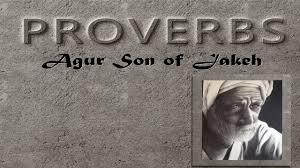
Allow me to introduce a man I am quite confident will be a new friend, colleague, and favorite author. His name is Agur. His identity is unknown. He’s smart, funny, and quite perceptive. He loves ADONAI. He’s streetwise in a good way, and he’s not afraid to speak his mind. Agur’s prayer is the only prayer in Proverbs. But Agur realizes there is much he doesn’t know. Yet he asks good questions. He will occasionally interrupt himself right in the middle of a stream of thoughtful teaching to deliver a seemingly random, but enlightening, truth we all need to hear. His sayings make for quite and wild ride.
Somehow, Agur’s sayings made their way into the book of Proverbs. You have to give him credit for that. Three millennia ago there were quite a few authors filling papyrus scrolls with inspired reflections. Being included in the TaNaKh alongside kings, prophets, and other spiritual giants is quite the accomplishment. Bible scholars agree that Solomon personally wrote or compiled Chapters 1 through 29 of Proverbs. But how and why the last two chapters were tacked on at the end is a bit of a mystery. No one disputes their relevance of authenticity, but very little is known about the authors.
We know that Lemu’el, the author of Chapter 31, was a king who received wise teaching from his mother. King Lemuel’s celebrated description in verses 10-31 of a wife of noble character has helped keep that last chapter of Proverbs in the limelight. Even less is known about Agur, author of Chapter 30. He was the son of Jakeh (30:1), another obscure reference, and he may have been from northern Arabia. That’s all the history we have. I suspect most of us have never thought much about him, his reputation, or his single puzzling appearance in the Bible. Actually, that’s not unusual. There are a few historical characters who show up for a single scene or have only the briefest mention in Scripture but still leave a memorable impression. So let’s look at three of them.
First, there’s Simeon, the aging prophet who met Mary and Joseph in the Court of the Women (see the commentary on The Life of Christ, to see link click Au – Jesus Presented in the Temple), soon after the fortieth day following His birth. The Ruach Ha’Kodesh had promised Simeon he would not die before seeing the Messiah. Taking the infant in his arms, the old man prophesied that Yeshua would be a light to the world, causing the fall and rise of many people. His memorable account takes up a mere eleven verses in Luke 2.
Secondly, the name Jochebed is mentioned only twice overtly – both times in long genealogies (Exodus 6:20 and Numbers 26:59), and once subtly in Exodus (see the commentary on Exodus Ak – A Man of the House of Levi Married a Levite Woman). But we could make the case that her actions launched biblical history. The mother of three heroes of faith – Moses, Aaron, and Miriam – Jochebed had the foresight and courage to send the three-month-old Moses floating down the Nile in a papyrus basket to rescue him from the Egyptian death squads. We may not remember her name, but she should be revered as a beacon of hope for anyone living under oppression and for mothers who love their children enough to let them go.
A third unforgettable biblical character mentioned ever so briefly is the repentant thief on the cross. On that history-making Friday in Golgotha (see the commentary on The Life of Christ Ls – Then They Brought Jesus to Golgotha, the Place of the Skull), one criminal hurled abusive taunts at Yeshua, but the other recognized the divinity of Messiah and confessed his own brokenness (see The Life of Christ Lu – Jesus’ First Three Hours on the Cross: The Wrath of Man: The Conversion of One of the Criminals). We don’t know his name, but that thief’s insight at the triple crucifixion brings hope to those who come to Messiah late in their life, even in their final moments. In addition, Yeshua’s promise to the thief: Truly, I tell you the truth, today you will be with Me in paradise (Luke 23:43), suggests there is no lag time between our time on earth and our entrance into heaven. That’s good to know.
It’s also good to know that modest lives like yours and mine can still make an impact. Can you identify with a guy who was moved to tears when he held a new baby, a mother who saw a great leader when she looked at her infant son, or someone whose eyes were opened upon meeting Yeshua for the first time? Like Agur, these were real people. Simeon, Jochebed, and the thief on the cross, were simply living their lives.
Therefore, I appreciate that Agur’s sayings, all thirty-three verses of Proverbs 30, made the cut. Since this chapter is included; then clearly, the Bible would be incomplete without it! Which means we have a responsibility to spend time reflecting on how Agur’s sayings apply to our lives. What’s more, his voice and his message desperately need to be heard today by anyone who longs for a friend and a dose of reality.
In this chapter, and especially in his prayer, Agur admits he doesn’t have all the answers and asks for help. He confesses that falsehoods occasionally flow from his mouth. He can’t always discern between the truth and lies he hears from others. He knows he needs a certain amount of money to live, but he doesn’t want too much or too little. In other words, he wanted to find God’s sweet spot in life (see Du – The Prayer of Agur).
The idea that a prophet and contributor to the Bible lives with a bit of angst and uncertainty should be a comfort. In this life, it’s okay if we don’t have all the answers. ADONAI welcomes our doubts and questions. Our Lord said: Whoever comes to Me I will never cast out (John 6:37), and: Come to Me, all you who are weary and burdened, and I will give you rest (Matthew 11:28). Like us, Agur has all kinds of questions and makes several quirky observations. That’s why Proverbs 30 is so engaging. Agur is the real deal, flaws and all. The Bible is filled with people who make mistakes, then turn to God and find answers, then still attempt to do life under their own power. Thankfully, God’s mercy, grace, and discipline override their failures and ours. So bring your doubts, questions, fears, and suspicions. God is big enough to handle them. You won’t hurt His feelings; He already knows them anyway.549
The difference of style, language and content in this chapter, as compared with the rest of Proverbs, is too striking to escape notice. That it is an addition is evident from the heading, but equally so from the author’s mode of thought and expression. The feeling created is that the reader is transported to a later age than Solomon’s, when the life of the nation had matured and inquiring minds were exercised with mysteries and problems of human existence. The questions in the prologue are reminiscent of passages in the book of Job.
Leave A Comment