




The Golden Ephod and the Golden Calf
8: 22-32
The golden ephod and the golden calf DIG: How did Gideon respond to the people’s request to be their king? How did Gideon go from a great military leader to someone who led his people into idolatry? What does it say about him, that he had about 140 children? How did his pride affect the people after his death?
REFLECT: What tends to be an ephod in your life? In what situations do believers struggle with pride? When using your spiritual gift(s) and producing good fruit, do you give God the glory? Is there anything in your life that an unbeliever might look at and say, “You’re a hypocrite?” Memorize Proverbs 16:18.
The book of Judges charts the progressive disintegration
of a people who will not serve the God who saves them.
The great question mark hanging over the book of Judges from its earliest chapters, like some dark thundercloud, concerns the matter of central and effective leadership. As the chapters unfold, we note how the tribes of Isra’el have slowly fallen away from their mission only to embrace Canaanite idolatry. They had abandoned the unity that the early stages of the conquest of the land required. Judges came and went, but none ever succeeded in rallying the tribes as one or in preserving their positive reforms for long. Also, no judge ever produced a child that could rule in his or her place. Inevitably, the demise of the judge spelled the end of the brief period of rest associated with their rule, to be ominously followed by the familiar refrain: Then the children of Isra’el did evil in the sight of ADONAI (2:11, 3:12, 4:1, 6:1, 10:6, 13:1). Now, for the first time, the Israelites raised the subject by intimating that Gideon might be a candidate for kingship.199
The rejection of the kingship (8:22-23): While Gideon was not received well in the Transjordan, it is clear that those in the Israelite heartland west of the Jordan considered him a conquering hero (to see link click Bf – The Final Defeat of the Midianites). The slayer of kings had achieved a kingly status in the eyes of his followers, who attributed their escape from the Midianite yoke directly to him, and made this the basis of their offer that he and his family rule Isra’el in perpetuity.200 The men of Isra’el came to Gideon and said: Rule over us, both you and your son and grandson because you have rescued us from the Midianites (8:22 NLT). The final chapter of Gideon’s life is a distinct anticlimax to his earlier heroic actions. The man who was a mighty warrior (6:12), now set such a deplorable example of self-indulgence that he led the whole nation into a downward spiral. Perhaps it is easier to honor God in some courageous action in the limelight of a time of national emergency than it is to honor Him consistently in ordinary, everyday life, which requires a different kind of courage. Gideon, who came though the test of adversity with flying colors, was not the first nor the last to fail in the test of victory.201
But Gideon told them, “I will not rule over you, nor will my son. ADONAI will rule over you” (8:23 NLT)! If the rationale of the offer was that the one who saves is entitled to rule, that honor belonged to ADONAI, not to Gideon, and even less to his son and grandson. Gideon knew that. However, he would begin to act like a king, especially in his dispensing of summary justice on those who resisted his authority. In crossing the Jordan he had already exceeded his mission and began to move toward the kind of rule offered to him.202
Gideon’s ephod (8:24-27): After Gideon refused to become king, he increasingly took on the trappings of royalty. After thinking about it, he said: I do have one request – that each of you give me an earring from your share of the plunder, for it was the custom of the Ishmaelites to wear gold earrings (8:24 NIV). The term Ishmaelites originally referred to another nomadic tribe descended from Hagar (Genesis 16:15), but the term apparently took on a broader usage so that it is applied here to the Midianites.203 This was a symbolic gesture of submission. By gladly giving their plunder to him, the Israelites were acknowledging that they were his vassals. They answered: We will be glad to give them. So they spread out a robe, and each threw a gold earring that they had gathered from the plunder. The weight of the gold earrings that he requested was 1,700 [shekels] or about 43 pounds of gold, beside the royal ornaments and pendants, the purple clothing worn by the kings of Midian, or the chains that were on their camels’ necks (8:25-26 NIV).
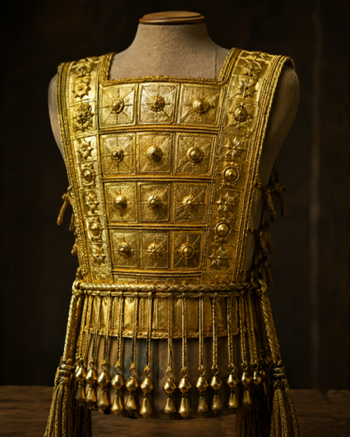
Then Gideon made an ephod from the gold (8:27a Hebrew). Gideon sought to commemorate his great victory over Midian with some tangible monument. Elsewhere in the TaNaKh, the ephod is mentioned as one of the more ornamented outer garments of the high priest that was also used in the ritual of enquiring of God and seeking His guidance (see the commentary on Exodus Gb – The Urim and Thummim: The Means of Making Decisions). But the fashioning of the image only spelled trouble, for it eventually became an object of worship in its own right, satisfying the people’s idolatrous desires. Gideon thus met the people’s request for a king with a request of his own, but while he admirably turned down their misplaced aspirations, he unwittingly provided them with a dangerous stumbling block.
In this connection, it is intriguing to note the similarities between this account and the narrative of the golden calf, cast by Aaron the priest when Moses lingered in his descent from Mount Sinai (see Exodus Gr – Aaron Made an Idol in the Shape of a Calf). In both cases, a leader figure gathered golden earrings from the people, and with the best of intentions, fashioned them into an object that quickly became an idol to be worshiped. Both well-intentioned, but both fundamentally flawed. But there is also a glaring contrast between the Golden Calf incident and the Judges passage: There, the people demanded a god figure in place of Moses, pressing a reluctant Aaron to proceed; here, it is Gideon, the leader of the people, who unleashed the tragic consequences to follow.204
The nature of the ephod is not clear. If the ephod was indeed a copy of the high priest’s garment (see the commentary on Exodus Fz – Make the Ephod of Gold, Blue and Purple Yarn), then Gideon was definitely out of God’s will in duplicating it and using it, because he wasn’t a priest. If it was a standing idol, then Gideon was disobeying God’s commandment (see Deuteronomy Bm – Do Not Make Idol’s), and corrupting the people as well. It was just a short step from worshipping the ephod to worshipping Ba’al (8:33).
Gideon missed a great opportunity to bring restoration, and perhaps revival to the Land. He had torn down his father’s altar to Ba’al (6:25-32), but there were many households in Isra’el that were still devoted to Ba’al, and those idols needed to be destroyed as well. The great victory over Midian gave Gideon good reason to call the nation back to ADONAI and obedience to His Torah. But instead of using the victory for God’s glory, he used it for his own profit, and the nation eventually lapsed back into sin once more.205
Furthermore, Gideon placed it in his hometown of Ophrah with two disastrous results (8:27b Hebrew). First, soon all Isra’el committed spiritual adultery by prostituting themselves by worshiping it there. Ophrah became the center of idolatrous worship. And second, it became a snare to Gideon. He took on himself the role of a priest, and he established a worship center away from the Tabernacle, which was in Shiloh. And it became a snare to his family, because it would ultimately result in the slaughter of all of his sons, but two, with one dying in battle later (8:27c Hebrew).206 Whatever Gideon’s intentions were, the people worshiped the ephod. So, for the first time in the book of Judges, it was a judge who began to promote idolatry. Thus, Gideon’s career ended by ushering in the very idolatrous worship that he had so vehemently fought at the beginning of his calling.207
Rest (8:28): In this way Midian was subdued before the Israelites, which never recovered. The Midianites would never again play a major role in the biblical record. During Gideon’s lifetime, the land had rest (Hebrew: shaqat) for forty years (8:28 NLT). This means the land had rest from war (see Joshua 11:23 and 14:15 where the same verb, shaqat, occurs). No enemy incursions, no invaders gathering the land of its produce, no pillaging of villages. But there is a reason to underline verse 28. It’s the last note of rest in Judges. After verse 28 the land no longer recovers its rest. This was a gift that Isra’el lost, an enjoyment she forfeited. Judges charts the progressive disintegration of a people who will not serve the God who saves them. People who persistently despise God’s gift will lose it.208
The Judgeship of Gideon (8:29-32): Jerub-Ba’al son of Joash went back home to live (8:29 NIV). Acting like king Solomon, Gideon established a large harem and fathered seventy sons for he had many wives (8:30 Hebrew). This was just his sons! Statistically, he could have had just as many daughters! That’s about one-hundred-and-forty children! This makes you wonder how he had the energy to fight the Midianites! In any case, such families were rare among private citizens. This must be interpreted as one more violation of the Torah, for kings were not to have many wives (see Deuteronomy Dh – The King). Jacob had two wives plus two concubines, who gave birth to twelve sons; David had eight wives plus concubines who gave birth to nineteen sons. Thus, it seems reasonable to assume that Gideon must have had at least twenty wives. But that wasn’t enough. He also had a concubine who was in Shechem, and also bore him a son. He named him Abimelech (8:31 Hebrew). While not explicitly stated in the text, it’s nevertheless a clear inference that she was a Canaanite. Abimelech’s own carefully worded argument of 9:2 will make this clear.
Gideon died when he was very old, and he was buried in the grave of his father, Joash, at Ophrah, where he was born, in the land of the clan of Abiezer (8:32 NLT). But the saga of Gideon is not over yet. In the next file, his son Abimelech will rise the issue of kingship one last time (see Bh – The Rise and Fall of Abimelech) before it’s finally buried for almost two centuries, until the end of prophet Samuel’s life and the ascent of Sha’ul to the throne.209 As Lawson Younger relates in his commentary on Judges, we can have our theology right and yet live as hypocrites. This is not to say that it’s okay to have wrong theology, but our lifestyle should match our words. There is perhaps nothing that causes people to turn away from God more than the hypocrisy of someone who professes faith in Messiah. People make enough excuses not to trust Yeshua without those in the Church giving them ammunition!
In not correcting the people as they gave him credit for the victory over the Midianites, Gideon took what didn’t belong to him . . . God’s glory. He causes others not to give God credit. What a contrast to the Song of Debrah (see Au – Sing Praises to ADONAI), in which YHVH receives the honor and praise that He is due and that is sung just before the Gideon account. When the Lord works through us, whether in a formal or informal way, we must give Him the honor and glory. The deep-rooted pride of achievement can blur our vision as to how we got to where we are. ADONAI has gifted us, and therefore, whatever we accomplish should ultimately be credited to Him. The athlete, the intellectual, the business man or woman, the pastor – all owe their achievements and accomplishments to the LORD. Gideon should have been grateful for being used to help accomplish the defeat of the Midianites. Instead he denied God and seized the praise of his countrymen.
The apostle Paul challenges us: So whether you eat or drink or whatever you do, do it all for the glory of God (First Corinthians 10:31). Whether it is a promotion, an achievement, a recognition, or a success, the Lord should be the first to receive the glory. To glorify ADONAI is our whole duty. Yeshua prayed: I have brought You glory on earth by finishing the work You gave Me to do. And now, Father, glorify Me in Your Presence with the glory I had with You before the world began (John 17:4-5). Gideon and his puny three hundred men did not win the battle . . . ADONAI did. As a result, all the boasting should have been in the LORD (Jeremiah 9:23-24; First Corinthians 1:31; Second Corinthians 10:17.210
Dear heavenly Father, praise You for helping me overcome myself and relying on Your strength to get me through tough times. Lord, keep me from the pride of thinking that I can accomplish anything on my own without You. Keep me from false pride. Gideon turned down the kingship only to act like a king. Lord help me not to profess Your name, but then continue on in self-sufficiency. Help me to rest in You. It is only thru Your wisdom, strength and power that I can win victories. To the One who sits at Your Right Hand. Amen
Leave A Comment