




The Final Defeat of the Midianites
8: 4-21
The final defeat of the Midianites DIG: Why did the leaders of Succoth and Peniel refuse to feed Gideon’s tired troops? What did it mean to tear their flesh with the thorns and briers of the wilderness? What change was seen in Gideon? Why was the capture and execution so important to Gideon?
REFLECT: How does pride affect those around us? How can we overcome pride (Proverbs 18:12; Matthew 11:28-30, 23:11-12; Philippians 2:3-4; Colossians 3:12). A gentile word (Proverbs 15:1) is always better than wrath. But sometimes a gentile word is impossible. Given that reality, what can you do instead?
The pursuit of the fleeing Midianites was temporarily interrupted by the parenthetical interlude of Gideon’s problem with Ephraim (to see link click Be – Gideon’s Problem with Ephraim). But, quite unexpectedly, Judges 8:4 will pick up where Judges 7:23 left off.
If the story had ended with 8:3, Gideon would be considered one of the heroic judges of ancient Isra’el, notwithstanding his problem with fear and lack of faith. However, as the narrative continues, the portrayal of Gideon becomes more and more bleak. The moment that he and his men cross over into the Transjordan, a whole new Gideon emerges. In contrast to the “first” Gideon, who was timid and who succeeded by the grace of God, this “second” Gideon is a forceful avenger, whose very success breeds even more failure.188
Restoration: ADONAI’s work of restoration involved more than defeating external enemies. Isra’el needed renewed faith, unity, and justice within the nation. Unfortunately, Gideon wasn’t the man for that job. Not only did he turn into a tyrant, but the disintegration of the nation would continue under his judgeship. And like King Sha’ul, he became a tragic figure.
The Mockery of Succoth (8:4-7): Gideon and his three-hundred men, exhausted, yet keeping up the pursuit, came to the Jordan River and crossed it into the Transjordan (8:4 NIV). They were tired from the battle (to see link click Bd – Gideon’s Victory Over the Midianites) and the pursuit, but they were still moving. The lack of an effective rearguard action by the Midianites allowed Gideon’s small force to forge ahead as fast as possible, while the hastily-assembled, allied supporting coalition made its way in pursuit of the widely-separated stragglers. When they reached Succoth, Gideon asked the leaders of the town, “Please give my warriors some food. They are very tired. I am chasing Zebah and Zalmunna, the kings of Midian (8:5 NLT). The army of Gideon had been equipped for a surprise attack, not a lengthy pursuit of a routed army, but he doubtless expected to obtain supplies from the Israelite tribes on the eastern part of the Jordan River.189
However, as far as the leaders of Sukkoth were concerned, this was a very dangerous request, even though Gideon’s men needed strength for the pursuit ahead. So the officials of Sukkoth replied: Catch Zebah and Zalmunna first! And then we’ll feed your army (8:6 NLT). The leaders of Sukkoth were skeptical of Gideon’s ability to defeat the fleeing Midianite army and capture the two kings. If Sukkoth helped Gideon and Gideon failed, then the Midianites would come back to Sukkoth and retaliate without mercy. It wasn’t like the men of Sukkoth didn’t think feeding their hungry brothers was an opportunity to show love, but it was a risk they didn’t want to take . . . and more to the point, they were rather disrespectful in the way they spoke to Gideon.190 This showed that the cohesiveness of the tribes west of the Jordan River and the tribes east of it found in the book of Joshua had broken down. They didn’t see themselves as one people anymore.
So instead of responding with a gentle word (8:2), Gideon’s timidity completely evaporated, and throwing diplomacy to the wind, he answered the leaders of Sukkoth with a threat. Glibly invoking the name of ADONAI, he threatened to take matters into his own hands. Gideon’s personal resourcefulness, which in his initial victory over the Midianites had been submitted to God’s will was now gone. Clearly, he cut YHVH out of the picture, and anything he accomplished was by his own strength and tactical skill.191 We can see Gideon’s transformation right before our very eyes when he said: If that’s your answer, then after ADONAI has given Zebah and Zalmunna into my hands, I will beat (Hebrew: thresh) your flesh with the thorns and briers of the wilderness (8:7 Hebrew), like a man beats grain on the threshing floor.192
The Mockery of Pen’el (8:8-9): Fuming at his rejection by the people of Sukkoth, Gideon moved up the Wadi Jabbok to Pen’el and again asked for food, but he got the same answer for the same reason (8:9 NLT). Pen’el (Hebrew: the face of God) was another town with deep roots in Isra’el’s past, for it was there that Jacob had a life-changing encounter with YHVH, and called in Pen’el because of the special significance it had for him (see the commentary on Genesis Hw – Jacob Wrestles with God). But now such an encounter happens in Gideon’s case. In fact, ADONAI no longer seemed to have any part of his actions. So he said to the people of Pen’el, “After I return safely (in Hebrew the root is shalom), I will tear down this strong-tower” (8:9 NLT). This is very ironic. The shalom (victory) in which Gideon expects to return will mean anything but shalom (safety) to the people of Penial. The strong-tower was supposed to form a refuge in times of danger for the people of an unwalled city. But it would not protect them from Gideon’s wrath. One can almost hear the disdain in his voice: this strong-tower he would tear down!193
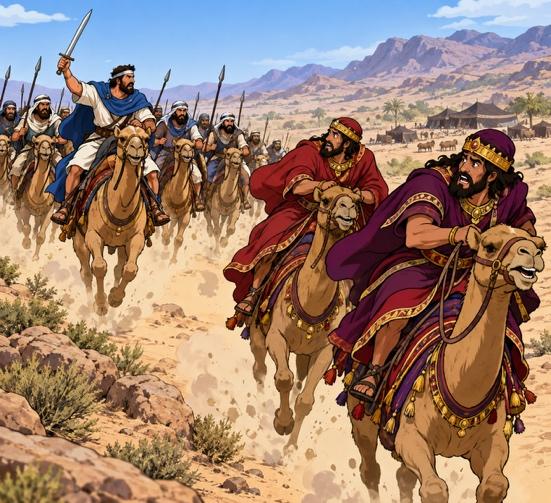
The Capture of Zebah and Zalmunna (8:10-12): But this time Zebah and Zalmunna were in Karkor, about one hundred miles east of the Dead Sea. The remnants of the once-mighty Midianite army must have considered themselves safe when they reached Karkor, but they didn’t count on the tenacity of Gideon and his men, who must have secured provisions along the way. The two Midianite kings only had about 15,000 men, that was all that remained of the allied armies of the east, for 120,000 had already been killed. Gideon circled around the caravan route east of Nobah and Jogbehah, and once again, they took the Midianite army by surprise because the Midianites didn’t expect Isra’el’s pursuit to extend so far south, so close to their home territory (8:10-11 NLT). Zebah and Zalmunna, the two Midianite kings, fled, but Gideon pursued after them and captured them, routing their entire army (8:12 NIV). All this inspired new panic among the enemy.194 The capture of the Midianite kings made it difficult for the surviving Midianites to regroup and reassert themselves; nevertheless, Gideon withdrew before his position became vulnerable. A great and decisive victory had been won by the dogged persistence of Gideon and his men, always outnumbered by their enemies.195 But the involvement of ADONAI remains silent.
The Punishment of Succoth and Pen’el (8:13-17): With the main objective achieved, it was time for Gideon to fulfill the threats he made to the leaders of Sukkoth and Pen’el, which he does with chilling ruthlessness and apparent relish. Then Gideon, son of Joash returned from the battle by way of the Heres Pass (8:13 CJB). He is probably referred to as Gideon son of Joash to remind us just how far this son of Joash had come, and compare what he did at the beginning (6:11-32). Gideon, who had once threshed wheat (6:11), now beat (Hebrew: threshed) the leaders of Succoth with the thorns and briers of the wilderness (8:7); and Gideon, who once had torn down the altar of Ba’al at Oprah (6:25), now tears down the tower of Pen’el (8:17). Only Abimelech will surpass Gideon’s brutality in punishing the Israelites who displease him. It was the beginning of a civil war theme that will widen as the narrative of the book continues to unfold from this point on.
Gideon is quite thorough and precise as he approaches his grim task. He captured a young man from Succoth and demanded that he write down the names of all the seventy-seven elders of the town. He wanted to make sure no one escaped his vengeance. With Zebah and Zalmunna in his hands, Gideon would have his pound of flesh; nothing more, but also nothing less. Then Gideon returned to Succoth and said to the elders, “Here are Zebah and Zalmunna. When we were before you, you taunted me, saying: Catch them first, and then we will feed your exhausted army.” So Gideon took the elders of the town and taught them a lesson, punishing them with thorns and briers from the wilderness. He also tore down the tower of Pen’el and killed all the men of the town (8:14-17 NLT).
The Execution of Zebah and Zalmunna (8:18-21): In this climactic section killing becomes the central motif, with reference to it in every verse. This is not killing that happens in the heat of battle, but the cold-blooded murder that happens after it (see the commentary on Deuteronomy Bq – Do Not Murder), when the man who cannot be challenged uses his power to settle old scores. Gideon had killed all the men of Pen’el, Now he turned his attention to Zebah and Zalmunna.196 He asked them, “The men you killed at Mount Tabor – what were they like?” This question shows that the Midianites didn’t only plunder Isra’el, they also murdered members of the Jewish population. The king’s answer would lead to their execution. “Like you,” they replied. “They all had the look of a king’s son” (8:18 NLT). Gideon’s response confirms the identity of the Mount Tabor victims. Those were my brothers, the sons of my own mother. His brothers’ blood was crying out from the grave. Therefore, Gideon must become the avenger of the blood (Numbers 35:19). As sure as ADONAI is alive, I swear that if you had spared them, I would not kill you (8:19 CJB). Gideon first offered the chance of revenge to his firstborn son Jether, since it would add to their humiliation to be killed by a youth, inexperienced in war. He said: Kill them! But Jether didn’t draw his sword, because he was only a boy and was afraid (8:20 NLT).197 It seems that Jether functions as a kind of foil for Gideon that reinforces some of the changes in him that we have been observing. Jether he was afraid, just as Gideon once was once afraid (see Bb – The Destruction of the Altar of Ba’al), and Jether saw himself as too young, just as Gideon had once protested that he was the youngest in his father’s house (6:15b). In Jether, we see Gideon as he used to be, in contrast to the Gideon we see now, in other words, Gideon has changed.
As sure as ADONAI is alive, I swear that if you had spared them, I would not kill you (8:19 CJB). The oath Gideon swore produces the first reference to ADONAI since He caused the Midianites, Amalekites, and Bedouin raiders throughout the camp to turn on each other with their swords (7:21). In contrast to then, ADONAI has not been portrayed as having any involvement in Gideon’s actions (commissioning him, commanding him, assuring him of victory, or giving his enemies into his hands). Even now, ADONAI doesn’t enter the story as an active participant, but only as Someone invoked by Gideon in an oath of self-justification in doing what he wanted to do all along, implying that the two kings brought it on themselves. But given Gideon’s recent actions at Succoth and Pen’el it’s difficult to see this oath as an expression of genuine holiness. Since crossing the Jordan River, Gideon has shown himself to be much more of a law-unto-himself than one who lives in dependence on ADONAI and does only as he is commanded to do.
Zebah and Zalmunna were defiant to the end, and took advantage of Gideon’s embarrassment at Jether’s hesitation, to taunt him one last time. They viewed Gideon’s delegation of their murder to Jether as a sign of weakness. They said to Gideon, “Be a man and kill us yourself!” If he was strong, like a real man, let him prove it by killing them himself. So Gideon obliged and killed them both, taking the royal ornaments from the necks of their camels as trophies of war (8:21 NLT). More detail about those ornaments is given in 8:26, where they take on a more sinister significance.198
Dear heavenly Father, praise You for always being a wonderful and loving Father. No one compares with you! You are the perfect balance of power, wisdom and justice in Your sovereign rule! Your arm is mighty, Your hand is strong, exalted is Your right hand. Righteousness and justice are the foundation of Your throne. Lovingkindness and truth go before You (Psalms 89:13-14). You do have great wrath (Ephesians 5:6, Colossians 3:6); a righteous wrath against sin and unholiness. As Gideon and the Israelites defeated the Midianites in the past, they continue to empower Isra’el to defeat her many enemies today. In Messiah Yeshua’s holy Name and power of His resurrection. Amen
Leave A Comment