




Sing Praises to ADONAI
5: 1-11
Sing Praises to ADONAI DIG: What is the purpose and occasion for the psalm of praise? Who is it for? What other songs in Scripture does this one bring to mind? As songwriters, what similarities do Debrah and Barak have with Moses and Miriam? What feelings come through about God in this song? What can we learn from this story about the kind of people God recruits into His service?
REFLECT: Debrah was a prophetess, a leader, and a song-writer. If you (or your family or spouse) had to describe you in three words, which three would you choose? What is the story behind those words? When has God shown His mercy and saved you from ruining your life more than once? What is one change you need to make in your life to be more usable for God’s service? Who can you serve this week?
The God of the Exodus came to rescue Isra’el . . . again.
As Deborah’s victory song continues (to see link click At – Deborah’s Victory Song), unlike the story of Chapter 4, the song is not concerned with how ADONAI took the honor of victory away from Barak and gave it to a woman. It pays tribute to those individuals and tribes who rose up to defend the God of Abraham, Isaac, and Jacob, and rebuke those who did not. But its chief burden is the righteous act of ADONAI Himself, who went forth as Isra’el’s champion and overwhelmed the enemy by unleashing the powers of heaven against them. The climax of the song is the battle itself (5:19-23), and the final verses show how completely the enemy was defeated (5:24-31a). Only when the song is completed is the entire Deborah-Barak story closed with the now famous formula of rest for the land (5:31b).
So, the Deborah-Barak story as we have it in Chapters 4 and 5 concludes with a victory song of praise to God and His loyal supporters, but especially YHVH Himself. The Gideon episode which follows immediately begins very differently – a striking example of the downward moral progression in each of the judges (see An – Cycles of Rebellion and Retribution). At the beginning of the Gideon episode, ADONAI will have to dispatch a prophet to remind the Israelites of their impending apostasy, and of His many interventions on their behalf (see Az – A Prophet Sent by ADONAI Confronts Isra’el).
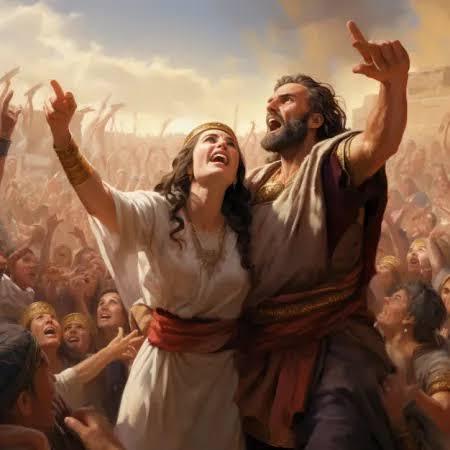
The Singers (5:1): This verse links the song to the preceding story. On that day God subdued Jabin the Canaanite king, before the Israelites. And the hand of the Israelites grew stronger and stronger against Jabin, the Canaanite king, until they destroyed him (see As – The Fourth Cycle: Debrah). And on that day Debrah and Barak, son of Abinoam, sang this song (5:1 NIV): This does not mean that they composed the song together, it only means that they sang it together. The song they sang was composed by Deborah, as verses 3, 7, and 12 as Chapter 5 clearly shows.100 The circumstances in which the song is sung and the way it is introduced both remind us of Exodus 15:1 – the song sung by Moses and the Israelites after being rescued by divine intervention from the vastly superior forces of Pharaoh with his six-hundred chariots.101 The phrase on that day links the song chronologically with the defeat of Jabin the Canaanite king, and suggests that it was a spontaneous response to the victory. The song itself has nine specific stanzas.
The First Stanza: Praising ADONAI (5:2-3): Verse 2 focuses on the role of the leaders and the people. When Isra’el’s leaders took charge, the people gladly followed. When Isra’el’s leaders were willing to lead, and the people were willing to follow their lead, then there was victory along with the resulting opportunity to praise ADONAI (5:2 NLT). Verse 3 issues a call to the Gentile kings and princes: Hear this, you kings! Listen, you princes! The content of what the Gentiles heard the Jews sing: I will sing praises to ADONAI, the God of Isra’el (5:3 Hebrew). Four things should be noted here. First, this is a call to Gentile kings and princes to hear what Deborah proclaims about the One true God. Second, these kings and princes were Gentiles because Isra’el had neither kings nor princes at this point in her history (21:25). Third, this verse is the response of Deborah, and thus is expressed in the first person. Fourth, this is a praise to ADONAI, and not anyone else.
The Second Stanza: ADONAI, the Commander in Chief (5:4-5): Verse 4a portrays God as a Divine Warrior, marching out from Mount Seir to aid His people. ADONAI, when You went out from Mount Seir, when You marched out from the land of Edom (5:4a CJB). It was the land of Esau, and comprised the mountain range stretching east from the southern end of the Dead Sea to the Gulf of Akabah. Verses 5:4b to 5 picture the results of God’s presence among His people. The result was that the earth quaked, and the sky shook; yes, the clouds poured down torrents of water (5:4 CJB). Keeping in mind that Ba’al was viewed as the storm god, here, the God of Isra’el was using what should have been Ba’al’s strongest weapons. The storm imagery emphasizes that ADONAI is God, not Ba’al. The following mention of Sinai and Edom recalls the beginning and end of the Wilderness Wanderings, both portrayed as witnesses to the mighty acts of YHVH. The mountains quaked at the presence of ADONAI, the God of Sinai, before ADONAI the God of Isra’el (5:5).102
This powerful poetry draws on the historical memory of the Exodus, when Ha’Shem, as the divine warrior, displayed His presence by making wind and water change their normal actions for the sake of His people; and at Sinai, where His Presence was demonstrated on the mountain in cloud and fire and earthquake. The same kind of language can be seen in the Psalms to recall God’s saving works in the past (Psalm 68:7-10), or His present majesty as ruler of the entire earth (Psalm 97:1-6). It will be taken up later by the prophets to speak of His Second Coming to judge the world (Amos 9:5-6; Isaiah 2:19; Zechariah 14:1-5). Here in Chapter 5 it gives a powerful poetic expression to the belief that the storm which broke over Sisera and his army (5:4) threw them into panic and retreat was no merely natural event, or amazing stroke of bad-luck. It was unleashed by YHVH, as He had divided the sea at the Exodus and shaken Mount Sinai. That same God had come to their rescue . . . again.103
The Third Stanza: The Emergence of Deborah (5:6-8): These verses describe the conditions under which Isra’el lived before Deborah arrived on the scene. In the days of Shamgar son of Anath (see Ar – The Third Cycle: Shamgar), and in the days of Ja’el (4:17-22). Here Shamgar and Ja’el are viewed as contemporaries, which further demonstrates that Shamgar’s judgeship came within the judgeship of Ehud (see Aq – The Second Cycle: Ehud). The situation was that of total destruction of communication and trade. The main highways were abandoned, and travelers kept to the side roads (5:6 HCSB). The roads were deserted. The caravan routes that crisscrossed the country, especially across the Jezreel Valley, linking the Jews in the north to the Jews in the south, were disrupted so that Jews ceased traveling on their normal trade routes for fear of attack from Canaanites or to avoid the heavy tolls demanded by the Canaanites.104 Shamgar may have temporally saved the Israelites by repelling an incursion into the southern highlands, but it would take more than that to free them; only a successful engagement with the enemy on the lowlands could do that, and this became a possibility only through the leadership of Deborah.105
Before Deborah’s arrival, the common people, the villagers of Isra’el would not fight. However, after her arrival there was a break in the crisis. Until I, Deborah arose, until I arose as a mother in Isra’el (5:7 Hebrew). What did she mean by this? It could only have meant that she was intensely concerned for the people, pained by their anguish, and absolutely determined to change their dismal situation. Like a mother who cares for her children, Deborah was the consummate leader who cared for her “offspring,” the nation of Isra’el, and this led her to do everything in her power to improve their lot. Also, the title mother of Isra’el anticipates the contrast to Sisera’s mother later in the poem (see Ax – Blessed by Ja’el: The Eighth Stanza: The Mother of Sisera).106
Verse 8a describes the religious situation as Debroah found them: When Isra’el chose new gods, the results were war, weakness, and slavery. When Isra’el violated the Torah (see the commentary on Deuteronomy Bl – Have No Other Gods), she, once again, descended into idolatry. Verse 8b describes the military situation: The enemy carried their destructive raids up to the city gates. Yet not a shield or spear could be seen among forty thousand warriors in Isra’el (5:8 NLT). Expending all their energies in making a living, the Israelites lacked any shields or spears needed to defend themselves. This is another symptom of the nation’s depressed condition, but in this context it represents another way of highlighting the role of Ha’Shem’s role in the miracle victory over Sisera’s well-equipped army.107 Like the earlier battle of Jericho (see Joshua Bb – And the Walls Came Tumbling Down), this was a holy war (see Deuteronomy Ag – The Problem of Holy War in the TaNaKh) led by ADONAI-Tzva’ot, the LORD of heaven’s angelic armies.
The Fourth Stanza: The Praise of ADONAI (5:9-11): Having described the desperate plight of her people, she now turns to their deliverance. My heart goes out to the commanders of Isra’el, with those who volunteered for war. All of you, praise ADONAI. With the rise of Deborah and the choice of new leaders, the time had come for Isra’el to go on the offensive. As in verse 2, she praises the leaders and the people for their response despite all the disadvantages. Then Deborah issues a call to all the classes of Israelite society. Consider this, those of you who ride on tawny donkeys, sitting on soft saddle blankets, and you who walk along the road . . . consider (5:9-10 NLT)! Tawny female donkeys were preferred by the rich over the generic gray animals. They advertised their status by dressing the donkeys with luxurious blankets. Those who walked along the road were the poor. Consider . . . hints at something both groups might do wrong, namely, simply get on with their lives as though nothing had happened. In effect, it is a call to join in the song. What has happened makes it inappropriate for anyone, rich or poor, to merely go on riding or traveling, sitting on soft saddle blankets, or walking along the road.
Verse 11 presents a strikingly different picture from the preceding one. Here, people are not acting as though nothing has happened. On the contrary, as they divided up spoils between the watering places (traditional meeting points), they remembered the righteous victories of ADONAI (perhaps in song), the victories of the common people who participated in the battle with Him. When they remembered those righteous victories, and with their zeal restored, the people of ADONAI marched down to the city gates to face the enemy (5:11 Hebrew). What was causing the excitement was not the spoil, but the way the people, rich and poor, responded to the call from Deborah. The reference to city gates here looks back to verse 8, making it clear that the people were eager to engage the enemy.108 This was the first step taken by them that showed the change that had taken place after the LORD’s victory. Beforehand, they were afraid to go down to the gates because of the war (5:8), but now they marched down to the city gates. This serves as an introduction to the more detailed account in 5:12-31. Only here in Judges is Isra’el called the people of ADONAI.109
ADONAI often uses the weaker things of this world to confound the wise. Certainly in using Debrah to raise up Barak (4:4-10) and in using Ja’el to bring down the mighty Sisera (4:17-22), we see examples of this. He continues to work this way today. He brings deliverance from unexpected sources and in unexpected ways.
He wants to use us, and we need to be willing. We may not feel up to the task. We may feel that our spiritual gifts don’t align with what He is calling us to do. In one way or another, we feel inhibited to serve. When we, as believers, do not trust God in these contexts, we lose out on the opportunity for ADONAI to work through us. We lose out on His good gifts. And worse, we may find ourselves expending all kinds of time and energy hopelessly trying to make up the difference. We want to have the assurance up front that the risk will be worth it, that we will succeed. But God has often already given the assurance in His Word and wants us to be involved so that He may work to accomplish His plan.
Deborah’s willingness to be the LORD’s spokesperson in calling Barak to deliver His people illustrates the faithfulness that ADONAI is seeking in all of us. Moreover, her willingness to go with Barak after his request demonstrates her bravery in the midst of great personal danger. There is nothing in her story that indicates any warrior status or abilities on the part of Deborah. She didn’t fight in the battle; she only spoke to Barak God’s reassurance of victory and encouragement to engage the enemy. Consequently, she was no Xena: Warrior Princes, or Wonder Woman. In fact, the Bible seems to present just the opposite. She was simply a prophetess, the wife of a man named Lappidoth.110.
Dear heavenly Father, praise You for being so wise and so loving. When a battle is won and the victory is secure, singing a song of praise is a wonderful way to remember the joy of winning and to give credit to whom credit is due. When there is a victory, it is important to praise the warriors in the battle; but to also praise You, our great and Almighty winner of battles. It is by Your strength and power that victories are won.
You are still worthy of all trust, praise, glory and honor!
You never change. Your character and purposes do not change, providing a firm foundation for faith in You. “For I am Adonai. I do not change (Malachi 3:6a).
Your Word, full of promises and teachings, will stand forever! The grass withers, the flower fades. But the word of our God stands forever (Isaiah 40:8).
You are Not wishy washy for You do not change Your mind, what You say stands. God is not a man who lies, or a son of man who changes his mind! Does He speak and then not do it,
or promise and not fulfill it (Numbers 23:19)?
You remain a constant, pure and righteous King. Righteousness and justice are the foundation of Your throne. Lovingkindness and truth go before You (Psalms 89:14).
Your love is everlasting and reaches to the heavens! Your love, Adonai, is in the heavens, Your faithfulness up to the skies. Your righteousness is like the mountains of God. Your judgments are like the great deep (Psalms 36:5-6).
Praise Adonai, for He is good, for His lovingkindness endures forever (Psalms 136:1).
There is no variation nor shadow due to change in You. You are always reliable. Every good gift and every perfect gift is from above, coming down from the Father of lights, with whom there is no variation or shifting shadow (James 1:17).
Messiah Yeshua, you are the same forever-always faithful and always holy! Yeshua the Messiah is the same yesterday, today, and forever (Hebrews 13:8).
How awesome it is to have such a wonderful, faithful and holy heavenly Father, who loves his children so much and nothing can separate us from Your love.
You were worthy of all trust, praise and glory in the days of Deborah and Barak, and You are still worthy of all trust, praise, glory and honor today!
I desire to give You my total worship, in words, and also in thoughts and in deeds. Thank You for never changing! In Messiah Yeshua’s holy Name and power of His resurrection. Amen
Leave A Comment