




Abimelech Destroys Shechem
9: 42-49
Abimelech destroys Shechem DIG: How is Ga’al’s character displayed here? What, or who, would possess a man to kill unarmed people? How was the curse of Jotham literally fulfilled? Why the salt? ADONAI’s Name is never mentioned in connection with Abimelech? Why? How did he act like a thornbush?
REFLECT: Abimelech was out for revenge. What does B’rit Chadashah have to say to us about revenge? Was Abimelech paranoid? Abimelech ended up hating the city and the people that appointed him as their king. How did (does) that happen? Was evil ever really in control? Why? Why not? Memorize Romans 12:19.
For the Shechemites there would be no blessing, only a curse; no Gerizim, only Ebal.
With the defeat of Ga’al (to see link click Bl – The Conspiracy of Ga’al), another problem remained for Abimelech, that of addressing the rebellion of the men of Shechem. He was well aware that Ga’al was merely a symptom of a deeper problem. The leaders of Shechem had been acting treacherously toward him (9:23-25). Although Zebul’s action had temporarily brought the situation under control, Abimelech was determined to teach the rebels in Shechem a lesson they would not forget. It seems that what transpired was an act of revenge against those who had questioned his leadership.
Later, in the B’rit Chadashah, Paul denounces returning evil for evil, declaring: Never seek revenge, my friends; instead, leave that to God’s anger. If a wrong has been done to us, no matter how serious and harmful it may have been, we never have the right to render punishment for the offense ourselves. We are to leave that to God’s anger. Quoting from Deuteronomy 32:35, Paul reminds us that in the Tanakh it is written, “ADONAI says: Vengeance is my responsibility . . . I will repay (Romans 12:19; Second Samuel 22:48; Nahum 1:2; Hebrews 10:30). In His divine time, God’s anger is coming on those who disobey Him (Colossians 3:6).
Day Three: Abimelech destroys Shechem: With the crisis apparently over, the next day the people of Shechem went out into the fields to work as usual. It was a natural and harmless thing to do, and an indication that they were tired of war and eager to resume their normal way of life. Abimelech and his supporters, however, saw it quite differently. The last time the Shechemites went out into the fields, it was to conspire with Ga’al against Abimelech (9:27a), and the closing statement of 9:42 indicates that some loyal to the king suspected that mischief was afoot again and it was reported to Abimelech.
In this second campaign, Abimelech used the same strategy that he used so successfully in the first engagement: ambush and encirclement (9:34-40). But now he neither receives nor needs any advice from Zebul, and this time victory comes even more easily because the victims were unsuspecting and presumably unarmed. Once again, it was no contest. Abimelech divided his men into three groups this time and set an ambush. When he saw the people coming out of the city, he rose and attacked them. Abimelech, personally leading his men, stormed the city gate to keep the men of Shechem from getting back in, while Abimelech’s other two groups cut them down in the fields. Then all three companies moved into the city, systematically killing its inhabitants (taking all day to do it) before Abimelech finally captured the city. He killed all the people and leveled the city (9:42-45a NLT). The operation, from beginning to end, was carried out with ruthless efficiency. It is reminiscent, in many of its details, of the campaign against Ai in the time of Joshua (see the commentary on Joshua Bg – The Destruction of Ai), but now it is Shechem against Shechem, clan against clan, and brother against brother – a jagged tear in the very heart of Isra’el.
Then Abimelech scattered salt all over the city (9:45b NLT), an act unparalleled in the TaNaKh. Salty ground was a symbol of a barren desert (Deuteronomy 29:33; Job 39:6; Jeremiah 17:6; Psalm 107:34). This was a symbolic act that the city was to be turned forever into a barren salt desert. That didn’t happen, but this was Abimelech’s desire for the city in light of their rebellion. It showed his hatred for the place and everything associated with it. But as we are about to see, even this didn’t satisfy his blood thirst.248
As typical in a siege of the ancient Near Eastern city, the commoners were the first to face defeat, while the elite were able to find safety within a stronghold at the center of the city, here attached to the temple of their pagan god. When the leading citizens heard of Ga’al’s defeat they entered the inner chamber of the temple of Ba’al-Berith. Someone reported to Abimelech that the citizens had gathered in the temple (9:46-47 Hebrew). In what follows, he acted as his father Gideon had done, but with even more brutality (see Bf – The Final Defeat of the Midianites: The Punishment of Succoth and Pen’el) With his enemy trapped, Abimelech decided to kill them all by setting fire to the temple.249
So he and all his men went up to Mount Zalmon. The word Zalmon is related to the word “shadow.” Hence, Mount Zalmon is “Shadowy/Dark Mountain.” It is not to be confused with the Zalmon of Psalm 68:14, which (as the context shows here) is in the region of Bashan, northeast of the Sea of Galilee. The mountain in view here must be close to Shechem. But since no mountain by that name is known in that area, it’s likely that it is an alternative name for either Mount Gerizim or Mount Ebal, the two mountains near Shechem where the covenant blessings and curses had been pronounced in the time of Joshua (see Joshua Bh – The Covenant at Mount Ebal). Ironically, Jotham had stood on Mount Gerizim, the mountain of blessing, to curse the Shechemites for making Abimelech their king. The message was clear. For them there would be no blessing, only a curse; no Gerizim, only Ebal. So it really didn’t matter which of the two was called “Dark Mountain” here; the appropriateness of the name derives from what Abimelech was about to do on it. The sun had set on Shechem; all that remained was darkness. When they got there, Abimelech took an ax and cut off some branches, which he lifted to his shoulders. He ordered the men with him, “Quick! Do what you see me do” (9:48 NLT).250
Sometimes it may appear as though evil is in control and that ADONAI has taken a vacation. Injustice dominates and wicked people, morally empty and reckless like Abimelech, seem to prevail (Psalm 37 and 73). Anyone living in Isra’el at that time must have felt that way. Certainly many believers living in Nazi Germany in the 1930’s and 40’s felt that way, as does anyone living in a totalitarian state. When believers forget the Lord and live according to the world’s standards, it only intensifies the power of the wicked. When believers choose that path, becoming functionally unbelievers, they may discover that Ha’Shem allows them to get what they deserve, just as the Israelites experienced Abimelech.
But believers living in the world (First John 2:15-16) can never negate God’s sovereignty. He is in control whether they acknowledge Him or not. YHVH moves things to His intended outcome (see the commentary on Romans Ae – My Position on T.U.L.I.P. or Calvinism), and whatever gods have been used to replace Him will prove to be worthless in the day of trouble, just as Ba’al-Berith proved to be for the leading citizens of Shechem, who took refuge in the pagan temple from Abimelech.251
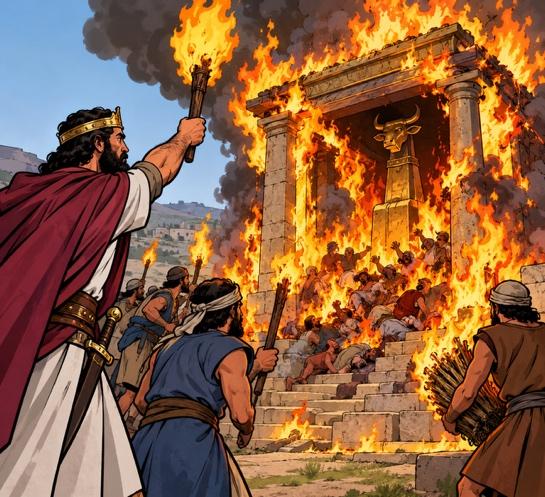
The slaughter itself is told with a dreadful matter-of-factness. So each of his men cut down some branches, following Abimelech’s example. They piled the branches against the walls of the temple and set them on fire, incinerating everyone inside. In the prophecy of the fate of the Shechemites, Jotham had spoken of trees and fire. Now, with awful accuracy, his words had been fulfilled. Fire had come out from that thornbush, Abimelech (9:14-15), the one they had chosen as king, and devoured them all (9:20a). Unwittingly, this fulfilled Jotham’s curse (see Bj – The Curse of Jotham). So all the people who had retreated to the tower of Shechem died – about a thousand men and women (9:49 NLT). The mention of them at the very end emphasizes the full horror of what happened; its immense, deep, tragedy.252
Dear heavenly Father, Praise You that You are not mean and wrathful, but full of steadfast love, righteousness, justice and mercy. You rule with both love and discerning righteous wisdom. Righteousness and justice are the foundation of Your throne. Lovingkindness and truth go before You (Psalms 89:14). The wicked may appear to prosper for a time; but then You, ADONAI, will break their strength, while upholding the righteous with an eternal inheritance. Better a little that the righteous have than the wealth of many wicked. For the arms of the wicked will be broken, while ADONAI upholds the righteous. ADONAI knows the days of the blameless—their inheritance endures forever (Psalms 37:16-18). So much greater than ruling a city, as Abimelech desired, is the joy and peace that comes from desiring to please and to live for You. You are my strength and my portion. Whom have I in heaven but You? On earth there is none I desire besides You. My flesh and my heart may fail, but God is the strength of my heart and my portion forever. (Psalms 73:25-26). It is comforting to know that while the wicked prosper, You are my refuge. I desire to please You in every way possible. To the One who sits at Your right hand. Amen
Leave A Comment