




The Destruction of the Altar of Ba’al
6: 25-32
The destruction of the Altar of Ba’al DIG: What problem did Gideon’s alter unwittingly cause? Why couldn’t two gods coexist? What was the significance of sacrificing the prize bull over where the altar of Ba’al had been? Have you ever had to confront a family member about their lack of a relationship with God? Why was Joash’s decision surprising? What was Gideon’s new name? What did it mean?
REFLECT: Gideon wasn’t sure that YHVH was going to be there for him. Why are you so afraid? “Do you? Do you still have no faith” (Mark 4:40)? “Surely God is my salvation, I will trust in Him and not be afraid” (Isaiah 12:2a). After all the encouragement God had given him, Gideon’s faith should have been strong, but before we judge him, we’d better look at ourselves and see how much we trust the Lord!
We can’t have allegiance to both God and the world; He has left us no middle ground.
When Gideon replaced his make-shift stone altar with a more permanent one in gratitude for his call (to see link click Ba – The Call of Gideon), he unwittingly created a situation that couldn’t remain unresolved. Now there were two altars in Ophrah, two rival gods; his own God, ADONAI, who had just appeared to him, and his father’s god, Ba’al. The state of things in Ophrah was symptomatic of Isra’el’s situation in general. The real problem was not the relationship between Isra’el and Midian, but the relationship between Isra’el and ADONAI, which had been compromised by the worship of other gods. Things had to change, and Gideon had to start where it was the hardest . . . at home.152
Restoration (6:25-32): Gideon was not allowed to enjoy his shalom (6:23) for very long. Now on the very night that the Angel of ADONAI had called Gideon, the LORD told him, “Take the prize bull from your father’s herd, the one that’s seven years old.” The phrase the prize bull comes from the Hebrew root shanah, which means to be of high rank or the finest. The fact that it was supposed to be seven years old (the same number of years as the retribution) means it had to be of highest quality, the prize bull, the most expensive of all the possible sacrifices. God’s command was to pull down his father’s altar to Ba’al, and cut down the Asherah pole standing beside it (6:25a NLT). Gideon had every right to destroy Ba’al worship because this was what Ha’Shem had commanded in His Torah (Ex 34:12-13 and Deut 7:5). Ironically, when the people were crying out and appealing to God to be rescued from Midian, there was an altar to Ba’al in Ophrah.153
The altar to be demolished was typically Canaanite: a raised stone platform for sacrificial rites (which was to be pulled down), with a wooden Asherah pole beside it (which was to be cut down). Asherah was supposed to be the female counterpart of Ba’al, and was represented by a carved wooden image with female features. But the most disturbing thing for Gideon was the fact that this was his father’s idol on his father’s property. His father’s name, Joash (6:11), is thoroughly Israelite, and probably involves some kind of play on words with the name YHVH. His altar, however, represented the kind of Canaanization that had become so very common during the time of the judges: the worship of YHVH in Canaanite fashion, effectively an Israelite Ba’al! But this was clearly unacceptable to ADONAI, who had appeared to Gideon.154
Then build a proper altar to ADONAI your God on the top of this demonic stronghold. By commanding Gideon to build the altar on that pagan site, YHVH was ordering him to reclaim that Canaanized land for Himself. Then he was to commit the ultimate indignity against the pagan cult by offering to God the bull that was used to destroy Ba’al’s altar, and then he was to use the wood from the Asherah image as fuel.155 Then take the prize bull and offer it as a burnt offering (see the commentary on Leviticus Ai – The Burnt Offering: Accepted by God), using the wood from the Asherah pole you cut down (6:26 CJB). If YHVH was to be Isra’el’s Savior, Ba’al needed to go. Ba’al might have been tolerant, but God is zealous for His people. Since ADONAI was going to use Gideon to deliver Isra’el; Gideon needed to remove from his own house the very element that brought on the divine judgment in the first place, which was spiritual adultery.
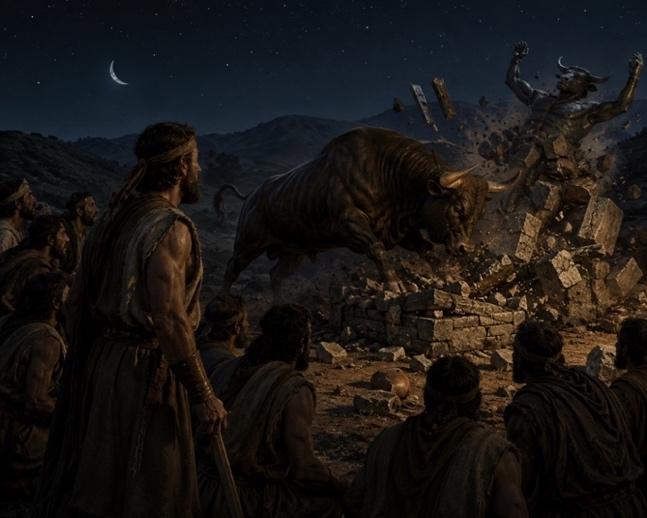
Fearing the repercussions of the destruction of the Ba’al altar and Asherah pole, Gideon took ten of his servants and did what ADONAI told him to do. Since altars to Ba’al were built on high places, it would have been difficult to obey God’s orders without drawing attention. Therefore, because he was afraid of his family and the townspeople to do it during the day, he did it under cover of darkness (6:27 NIV). On the one hand, Gideon was still not the mighty warrior that the Angel of ADONAI had called him to be (6:12); but on the other hand, evidently obedience was essential and heroism optional. For us, those times come when our commitment to Messiah can no longer remain hidden, when we must declare ourselves, when we must burn our bridges, and, if need be, stand alone against the religious, social, and cultural expectations of the world.156 As Yeshua has said: Whoever acknowledges Me before others, I will also acknowledge before My father in heaven (Matthew 10:32).
And they offered sacrifices to ADONAI (2:5b NLT). The fact that they sacrificed to ADONAI at Bochim does not mean that the Tabernacle was located there at that time. Normally, it would have been the place for sacrifices. However, since the Angel of ADONAI was a theophany (the preincarnate Yeshua Messiah) the Shechinah Glory, the visible manifestation of God’s presence, it was permissible to sacrifice there. This action will be repeated in Judges 6:20, 6:26, 6:28, 13:16-20, and also in Second Samuel 24:25. Any place where a theophany appeared, it was possible to sacrifice at that place. This further shows that the Angel of ADONAI is indeed God Himself. But Isra’el’s revival was very short-lived.157 When the men of the city got up the next morning, the altar of Ba’al was destroyed, and the Asherah pole cut down. In their place a new altar had been built, and on it were the remains of the bull that had been sacrificed (6:28 NLT).
They asked each other, “Who could have done this?” Significantly, there was no reflection on why their idol lay shattered on the ground. But after investigating, they concluded that Gideon the son of Joash had done it (6:29 CJB). Because Gideon was still living at home, and because in the patricentric society the head of the household was held responsible for the conduct of all its members, the men of the city came to Joash and demanded that he send out his son so they could kill him for destroying the altar of Ba’al and cutting down the Asherah pole (6:30 Hebrew). This reflected the true spiritual condition of the nation. The death penalty should have been imposed on the idolaters and instead was pronounced upon the one who destroyed the idol! The fact that it was the Jews who wanted to execute Gideon for pulling down the altar of Ba’al showed how far the Canaanization of the people had progressed.158
Joash found himself having to choose between the men of the city and his son. At a more fundamental level, however, he had to choose between Ba’al and YHVH, between syncretism and covenantal obedience, between polytheism and monotheism: he could not have both, Gideon’s courageous act left him no middle ground. It is a breath-taking moment and a critical turning point in the story.159 Joash had every reason to be angry with his son. Gideon had smashed his altar to Ba’al and replaced it with an altar to YHVH. His son had sacrificed his prize bull and used his sacred Asherah pole for fuel (Isaiah 44:13-20). But ADONAI so worked in Joash’s heart that he defended Gideon before the gathered mob and even insulted Ba’al for good measure.160 As soon as Joash spoke, it was clear to everyone where his loyalties lay. The crisis was over. Joash, the former patron of a heretical cult, then morphed before our very eyes into a foreshadowing of Elijah, declared to all those crowding around him, “Does Ba’al need a defense attorney? Do you need to rescue (Hebrew: yasha) him? Anyone who defends the false god Ba’al will be put to death by tomorrow morning. If Ba’al is really a god, no one needs to defend him, let him defend himself and destroy the one who broke down his altar (6:31 Hebrew).
Therefore, on that day Gideon was given the name Jerub-Ba’al, which means, “the one who contends with Ba’al,” since Gideon broke down his altar (6:32 NIV). It is in the aftermath of this pivotal episode that Gideon takes on the new name of Jerub-Ba’al, for his mission will be not only to relieve Isra’el’s political plight, but to address her spiritual decline as well. How astounding indeed was it that the citizens of Ophrah, Israelites all, had become champions of Ba’al and his protectors, while the God of Isra’el was either brazenly ignored by them or else admitted only grudgingly to their idolatrous pantheon! The showdown at Ophrah is the first time in the TaNaKh that the people of Isra’el pronounced their willingness to kill opponents of idolatry, and this new development will not bode well for them in the future.161
Dear heavenly Father, praise You for being so wonderful always! Your Presence abides in those who place their trust in You so that You are always there to help and to guide (John 14:23). You who sees into the heart and discern the desires of all men. You know who really loves You and will trust in You. But Adonai said to Samuel, “Do not look at [David’s brother] or his stature, because I have already refused him. For God does not see a man as man sees, for man looks at the outward appearance, but ADONAI looks into the heart” (First Samuel 16:6-7). Thank You for being gracious to even take as special warriors for Yourself, men and women whose family do not worship you, but whose hearts will obey and trust You. Living a life of faith brings an eternity of joy in heaven with You. But whoever did receive Him, those trusting in His name, to these He gave the right to become children of God (John 1:12). In Messiah Yeshua’s holy Name and power of His resurrection. Amen
Leave A Comment